AI glossary
AGI (Artificial General Intelligence)
AGI, or artificial general intelligence, is AI that can match people across most thinking tasks rather than excelling at just one, such as chess or translation. There is no single agreed definition: OpenAI defines it as “highly autonomous systems that outperform humans at most economically valuable work”, while Google DeepMind grades it in five levels from “Emerging” to “Superhuman”.
The short answer as of October 2026: nobody has shown a system that meets every definition, but the gap is closing faster than most experts expected. The best models now score 93% to 95% on ARC-AGI-2, a puzzle test the official human panel solves completely, yet the same models stumble on harder interactive tests and have no lasting memory. Forecasters on Metaculus put the median date for the first general AI system at October 2030, down from about 2064 in 2020, and AI researchers surveyed by AI Impacts give a 50% chance of human-level machine intelligence by 2042. This guide covers what AGI means, how it differs from narrow AI and superintelligence, what the benchmarks show, when experts expect it, the risks, and the money behind the race. We also gave an open model 220 ARC-AGI puzzles to see how far a mid-sized model is from the frontier.
What does AGI mean?
The term artificial general intelligence has a specific history, but its meaning has shifted as the technology has evolved. The original use of the term dates back to a 1997 article by Mark Gubrud. However, computer scientists did not widely adopt it until Legg and Goertzel popularized the term AGI among researchers in 2001, according to a DeepMind paper. Since then, various labs and researchers have proposed their own frameworks to operationalize the concept.
| DeepMind level | Performance (general tasks) | Examples given in the paper |
|---|---|---|
| 0. No AI | Simple software with no learning | |
| 1. Emerging | Equal to or somewhat better than an unskilled human | ChatGPT, Bard, Llama 2, Gemini |
| 2. Competent | At least 50th percentile of skilled adults | Not yet achieved |
| 3. Expert | At least 90th percentile of skilled adults | Not yet achieved |
| 4. Exceptional | At least 99th percentile of skilled adults | Not yet achieved |
| 5. Superhuman (ASI) | Outperforms 100% of humans | Not yet achieved |
OpenAI’s Charter, published in April 2018, offers one of the most cited definitions. It defines AGI as “highly autonomous systems that outperform humans at most economically valuable work.” This definition ties the concept directly to economic utility rather than just raw cognitive ability. DeepMind has taken a more structured approach with its “Levels of AGI” paper, which outlines a path from no AI to superhuman performance. Their scale includes Level 1 “Emerging AGI,” which is equal to or somewhat better than an unskilled human, up to Level 5 “Superhuman,” where a system outperforms 100% of humans. According to the DeepMind paper, current models like ChatGPT, Bard, Llama 2, and Gemini sit at Level 1. Levels 2 through 5, which represent competent, expert, and exceptional human-level performance, have not yet been achieved.
The debate over what counts as AGI is further complicated by differing academic perspectives. A 2025 paper by Hendrycks et al. defines AGI as an AI that can match or exceed the cognitive versatility and proficiency of a well-educated adult. Using the Cattell-Horn-Carroll (CHC) theory, they measured models across ten cognitive domains. Their results showed GPT-4 scoring 27% and GPT-5 scoring 57%. The paper highlights that models exhibit a “jagged” profile, with long-term memory storage identified as a critical deficit.
Not everyone is sold on the term itself. Dario Amodei, co-founder of Anthropic, has publicly stated, “I dislike the term AGI.” He describes it as “an imprecise term that has gathered a lot of sci-fi baggage and hype” and prefers the phrase “powerful AI.” He describes powerful AI as a “country of geniuses in a datacenter.”
The definition also has real-world financial implications. In October 2025, Microsoft and OpenAI announced a partnership update that includes an independent expert panel to verify when AGI is achieved. This declaration will trigger changes in their revenue share agreement, which runs until either the panel verifies AGI or 2030, whichever comes first. Microsoft’s stake in OpenAI is roughly 27% on a diluted basis, valued at about $135 billion. Additionally, according to reporting by The Information, a 2023 agreement treats AGI as reached when OpenAI builds a system able to generate at least $100 billion in profits, though the contract text has not been published. This financial stake underscores that AGI is not just an academic concept but a pivotal business milestone.
AGI vs narrow AI vs superintelligence
To understand where AGI fits, it helps to distinguish it from narrow AI and superintelligence. Narrow AI refers to systems that excel at a specific task. AlphaFold, for instance, is superhuman at protein folding but cannot play chess or write a poem. In the DeepMind framework, a narrow system like AlphaFold can already be Level 5, superhuman, in its own narrow column. AGI sits in the middle, representing a system that is broadly competent across many domains. Superintelligence, or ASI (artificial superintelligence), is Level 5 on the general scale: a system that outperforms 100% of humans across a wide range of tasks.
The concept of superintelligence has gained traction at major labs. According to reports, Meta established Superintelligence Labs in June 2025, led by Alexandr Wang and Nat Friedman, following a $14.3 billion investment in Scale AI. Mark Zuckerberg stated in a July 2025 letter that “Developing superintelligence is now in sight” and that Meta’s vision is to bring personal superintelligence to everyone. Similarly, Microsoft AI set up an “MAI Superintelligence Team” under Mustafa Suleyman in November 2025, aiming for what it calls “humanist superintelligence”.
Sam Altman has also shifted his focus. In early 2025, he wrote, “We are now confident we know how to build AGI as we have traditionally understood it.” He noted that AI agents might join the workforce that year and that the industry is beginning to turn its aim toward superintelligence in the true sense of the word. Demis Hassabis of Google DeepMind has been more cautious; as reported by CNBC, he said in March 2025 that “over the next five to ten years, a lot of those capabilities will start coming to the fore” but that “We’re not quite there yet.” He defines AGI as a system that can exhibit all the complicated capabilities that humans can.
The gap between narrow and general AI is significant. While narrow AI can solve specific problems better than humans, AGI requires the flexibility to learn new tasks without extensive retraining. Superintelligence goes a step further, potentially outperforming humans in every field, including scientific discovery and strategic planning. This progression from narrow to general to super highlights the complexity of the goal and why defining AGI remains a moving target.
How close are we? What the benchmarks show
ARC-AGI: puzzles built to test generalization
The ARC (Abstraction and Reasoning Corpus) benchmark was created by François Chollet in 2019 to test AI generalization. It consists of puzzles that require understanding visual patterns and rules, similar to an IQ test. On the original ARC-AGI-1, the ARC Prize human panel scores 98%, while AI models long struggled. The harder ARC-AGI-2 was tested in early 2025 on more than 400 members of the public: every task was solved by at least two people in two attempts or fewer, and the official human panel score is 100%.
In December 2024, OpenAI’s o3-preview model scored 75.7% on the semi-private ARC-AGI-1 set at about $26 per task ($2,680 in total). With far more computing power it reached 87.5%, at about $4,560 per task, or roughly $456,000. The ARC Prize 2025 results, announced in December 2025, showed that the best Kaggle entry, NVARC, scored only 24.03% on the ARC-AGI-2 private set. The best verified commercial model, Claude Opus 4.5, scored 37.6%. By October 2026, the official leaderboard shows a dramatic shift. GPT-6 Astra scored 95.0% on ARC-AGI-2, followed by GPT-6.1 Sol at 94.2% and Claude Opus 5.5 at 93.3%. Frontier models are now near the 100% human panel score, just ten months after the best Kaggle entry scored 24%.
The newest version, ARC-AGI-3, uses interactive game-like tasks. The scores depend heavily on the harness used. GPT-6 Astra scored 99.9% with a Provider Adapter but only 54.8% in Standard mode. The Provider Adapter keeps the model’s reasoning between steps, so the same model can look very different depending on how it is run. The ARC Prize 2026 offers a $700,000 grand prize for the first eligible open-source, compute-limited agent to score 100% on ARC-AGI-3.
Humanity’s Last Exam
Humanity’s Last Exam (HLE), from the Center for AI Safety and Scale AI, is another rigorous benchmark of expert-level questions, consisting of 2,500 questions finalized in March 2025. Published in Nature in January 2026, the official table shows that Gemini 3 Pro scored 38.3%, while GPT-5 scored 25.3% and GPT-4o scored just 2.7%. The official site has not been updated for the newest 2026 models, leaving a gap in our understanding of how current systems perform on this comprehensive test.
Longer and longer tasks
The International AI Safety Report 2026 notes that leading systems can now reliably complete ~30-minute coding tasks, up from under 10 minutes a year earlier. This increase in task length is a key indicator of progress. The research group METR measures the length of software tasks, in the time they take skilled humans, that a model can complete with a 50% success rate. The 50% time horizon has doubled approximately every seven months since 2019. Since 2023, the doubling time has accelerated to about 4.2 months. By April 2026, an early version of Claude Mythos Preview reached about 17.4 hours, with a wide uncertainty range of 8.5 to 55 hours, up from about 4 minutes for GPT-4 in 2023. This ability to sustain focus over longer periods is a critical step toward general intelligence.
‘Jagged’ intelligence
Despite these advances, performance remains “jagged.” The International AI Safety Report 2026 and the earlier “Sparks of AGI” paper (2023) highlight that models excel in some areas but struggle in others. GPT-4 was described as an “early (yet still incomplete) version” of AGI. Hendrycks et al. found that models show a “jagged” profile, with significant deficits in long-term memory and other cognitive domains. This unevenness suggests that while AI is powerful, it is not yet as versatile or reliable as a well-educated adult. The path to AGI involves smoothing out these jagged edges, ensuring that models can perform consistently across a wide range of tasks, not just the ones they were trained on.
Our test: an open model on 220 ARC-AGI puzzles
Leaderboards show what the most expensive frontier systems can do. We wanted to see where a capable but mid-sized open model stands. On 27 October 2026 we gave Qwen3.6-35B-A3B, an open-weight model from Alibaba’s Qwen team running on our own server, 100 randomly chosen tasks from the public ARC-AGI-1 evaluation set and all 120 tasks from the public ARC-AGI-2 evaluation set. Each task shows a few example grids of colored cells (written as numbers) and asks for the output grid for a new input. We gave one attempt per task and counted only exact matches, first with the model’s step-by-step “thinking” mode switched off, then with it on and a budget of 16,000 tokens per answer.
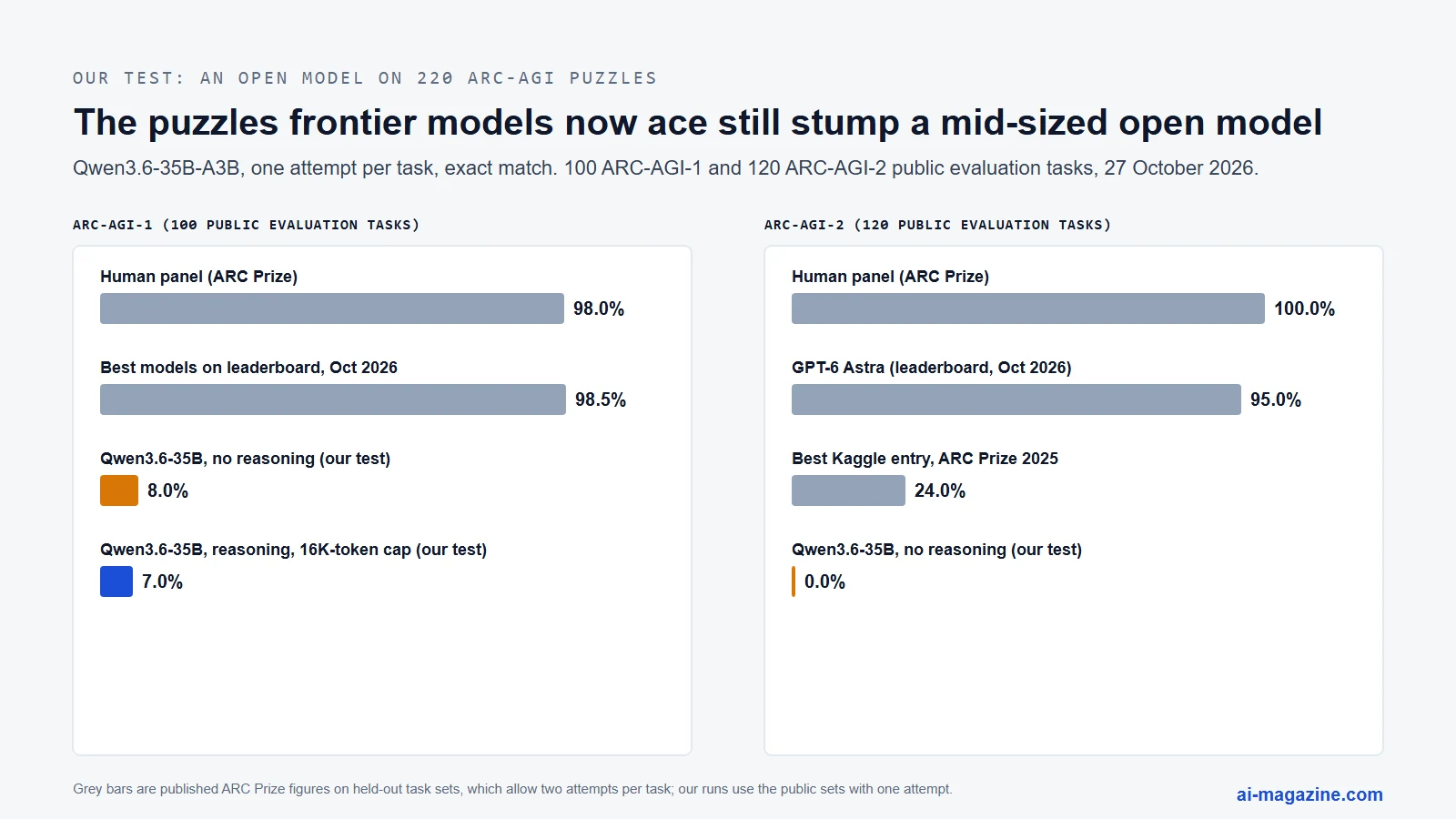
| Test | Tasks | Solved without reasoning | Solved with reasoning (16K-token cap) |
|---|---|---|---|
| ARC-AGI-1, public evaluation | 100 | 8 | 7 (92 ran out of budget) |
| ARC-AGI-2, public evaluation | 120 | 0 | not run |
The puzzles that frontier models now ace still stump this model. It solved 8 of 100 ARC-AGI-1 puzzles and none of the 120 ARC-AGI-2 puzzles, while the best models on the official leaderboard score 98.5% and 95.0%. The same model passed a US medical licensing exam set with 91% accuracy in another of our tests, which is exactly the “jagged” profile researchers describe: strong on knowledge, weak on spotting a new rule from a few examples.
More thinking did not help within a fixed budget. With reasoning switched on, the model filled its 16,000-token allowance on 92 of the 100 tasks without reaching an answer, and solved 7, a different set from the first run: only 3 puzzles were solved both ways, 12 in total. ARC-AGI-2 tasks are larger still, so we did not run them with reasoning: with most ARC-AGI-1 answers cut off by the budget, a fair test would need a much bigger one. Frontier systems reach their scores with far larger reasoning budgets, two attempts per task and, often, purpose-built harnesses.
What this means: the jump from 24% to 95% on ARC-AGI-2 within a year came from a handful of the largest systems, not from AI in general. A mid-sized open model you can run yourself is still far from that level on tests of fresh reasoning, even when it knows a great deal.
Limits: one model, one attempt, a text format for the grids, and a 16,000-token reasoning cap. Our tasks come from the public evaluation sets, while leaderboard scores use held-out sets, so the numbers are indicative rather than directly comparable.
When will AGI arrive? What forecasters and experts say
Two kinds of evidence exist: aggregated forecasts and surveys, and the stated views of the people building the systems. Both have moved sharply toward earlier dates.
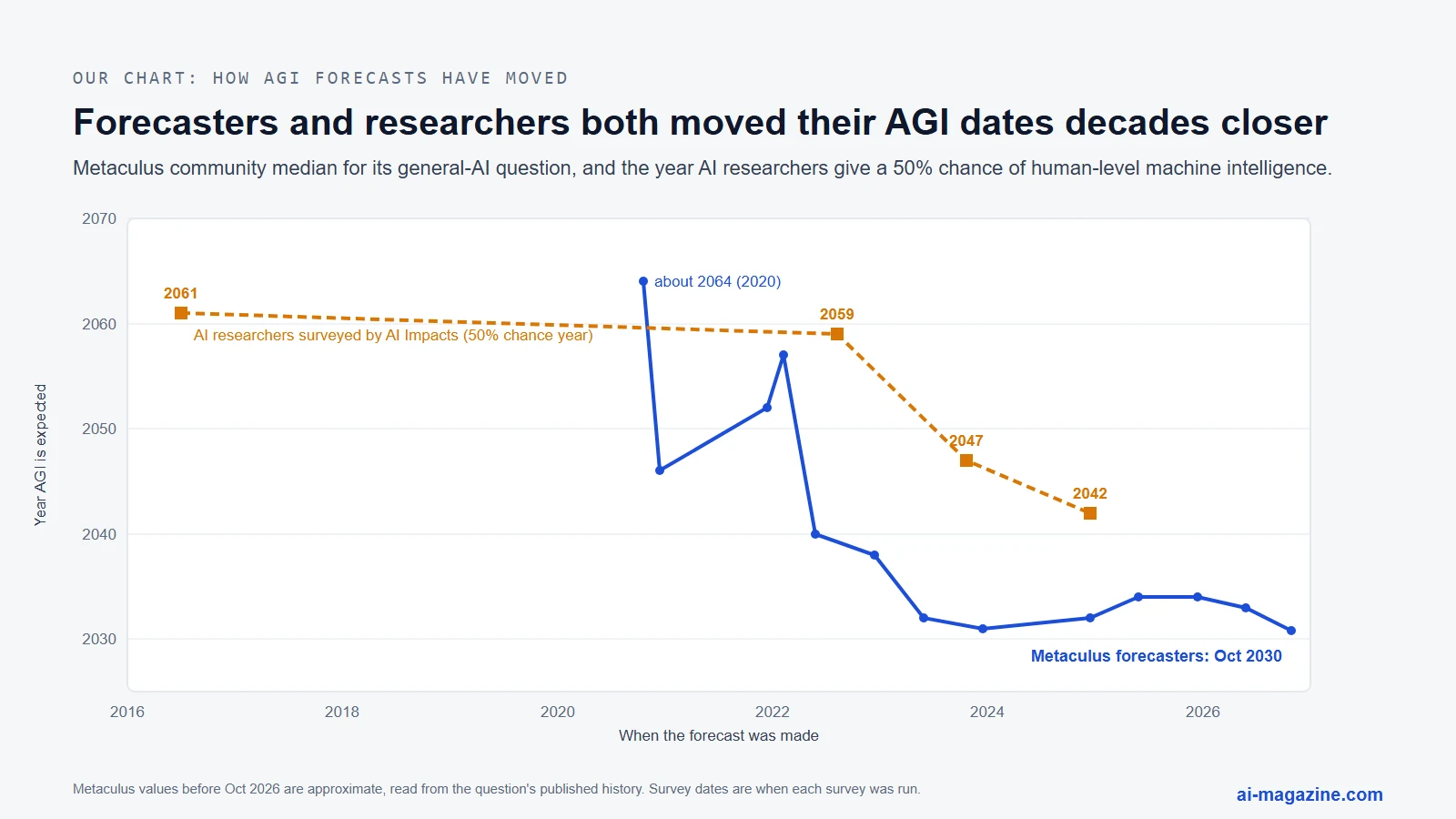
Metaculus, a forecasting platform, has asked since August 2020 “When will the first general AI system be devised, tested, and publicly announced?” The question sets strict tests a system must pass. On 27 October 2026 the community median was 21 October 2030, from 1,899 forecasters. Reading the question’s published history, the median was about 2064 when it opened in 2020, jumped around 2046 to 2057 until early 2022, fell to about 2040 in mid-2022 and about 2032 in 2023, drifted back to about 2034 in 2025, and reached 2030 this month.
Researchers have moved too. AI Impacts surveys thousands of authors of papers at top AI conferences about “high-level machine intelligence” (HLMI): unaided machines doing every task better and more cheaply than human workers. In the 2023 survey of 2,778 researchers, the 50% chance year was 2047, 13 years earlier than in 2022. The 2024 survey of 1,580 researchers, run in December 2024 and published in September 2026, moved it to 2042, with a 10% chance by 2027. The authors note the date has been getting “about 3.4 years closer for each year that passed”. Researchers are far more cautious about full automation of labor (FAOL), every occupation automated: they give it a 50% chance by 2098, down from 2115 a year earlier.
Industry leaders are even more aggressive with their own timelines. Sam Altman stated in his “Reflections” blog post in early 2025 that “We are now confident we know how to build AGI as we have traditionally understood it,” adding that “in 2025, we may see the first AI agents ‘join the workforce’.” Dario Amodei, speaking in October 2024, said, “I think it could come as early as 2026, though there are also ways it could take much longer.” Anthropic’s submission to the White House in March 2025 explicitly stated they “expect powerful AI systems will emerge in late 2026 or early 2027.”
Other leaders are more cautious. As reported by CNBC, Demis Hassabis said in March 2025 that while capabilities will come to the fore “over the next five to 10 years,” he added, “We’re not quite there yet.” Yann LeCun said in October 2024, as reported by TechCrunch, that “it’s going to take years before we can get everything here to work, if not a decade,” adding that “current AI systems are not capable of any of this.” Geoffrey Hinton has offered a wide range of estimates: according to media reports, he said in 2024 there is a “50% chance” of smarter-than-human AI in 5 to 20 years, and later in April 2025 saying there is a good chance it will be here in 10 years or less. Ray Kurzweil has, according to interviews and reviews of his 2024 book, consistently predicted human-level AI by 2029, reaffirming this in 2024, though he still dates the broader Singularity to 2045. Shane Legg, one of the original popularizers of the term, gave a log-normal distribution in 2011 with a mean of 2028 and a mode of 2025, assuming no catastrophic disruptions.
Why AGI is so hard to pin down
The definitions above already disagree, and three more things make AGI hard to pin down.
The problem is that models show “jagged” abilities. They excel in some areas and fail in others, and results often depend heavily on the test harness. For example, on the ARC-AGI-3 benchmark, GPT-6 Astra scores 99.9% using a “Provider Adapter” that preserves reasoning state, but only 54.8% on the “Standard” track. So the same model can look very different depending on how it is tested. Benchmarks also saturate quickly: ARC-AGI-2 went from a best Kaggle score of 24% in December 2025 to 95% for the top model in October 2026, while the Hendrycks study still found long-term memory a critical gap.
Contracts are now tied to the word, which distorts the definition. The Microsoft–OpenAI agreement, updated in October 2025, states that once AGI is declared by OpenAI, the declaration will be verified by an independent expert panel. Revenue sharing runs until either the panel verifies AGI or 2030, whichever comes first. This financial incentive means that “AGI” is becoming a corporate milestone rather than just a scientific one.
Risks and safety
The race to AGI is not just about capability; it is about safety. The CAIS Statement on AI Risk, published in May 2023, declares that “Mitigating the risk of extinction from AI should be a global priority alongside other societal-scale risks such as pandemics and nuclear war.” The first signatories include Geoffrey Hinton, Yoshua Bengio, Demis Hassabis, Sam Altman, Dario Amodei, Dawn Song, Ted Lieu, Bill Gates, Ya-Qin Zhang, and Ilya Sutskever.
The 2024 AI Impacts survey provides a quantitative look at these risks. The mean probability of extinction or permanent severe disempowerment is about 18%, with a median of 10%. This is the first time the median has reached 10%, and 51% of respondents assign at least a 10% chance of such an outcome. Furthermore, 72% of respondents favor more priority on AI-risk research, and 83% say deepfakes and misinformation deserve substantial or extreme concern. The International AI Safety Report, led by Yoshua Bengio, published its second edition in February 2026, written by over 100 experts with an advisory panel from 29 countries plus the EU, OECD and UN. It found that leading systems reached gold-medal performance on International Mathematical Olympiad questions, but that performance remains “jagged”.
Public opinion is shifting toward caution. According to Pew Research Center surveys as reported, a February 2026 survey found that 63% of US adults say AI is advancing too quickly. Another Pew survey from June 2026 showed that 52% of people are more concerned than excited about AI, up from 37% in 2021. While there is no specific Pew question on AGI, the broader anxiety about AI’s speed and impact is clear. The leading labs have published their own safety frameworks, such as Anthropic’s Responsible Scaling Policy, OpenAI’s Preparedness Framework and Google DeepMind’s Frontier Safety Framework, which set capability thresholds that trigger extra safeguards. They are voluntary and not standardized.
The risk is not just about superintelligence taking control, but about immediate societal disruption. The International AI Safety Report notes that at least 700 million people now use leading AI systems weekly, meaning any flaws or biases are amplified at scale. The “jagged” nature of current models means they can be highly competent in narrow tasks but fail unpredictably in others, which is dangerous in high-stakes environments like healthcare or finance.
The money behind the race to AGI
The financial commitment to AGI is unprecedented. The Stargate Project, announced in January 2025, is a new company that intends to invest $500 billion over four years to build new AI infrastructure in the United States for OpenAI. Of this, $100 billion is being deployed immediately. The project’s stated goal is “continuing to build and develop AI—and in particular AGI—for the benefit of all of humanity.” This massive capital expenditure is driving the compute arms race, allowing labs to train larger, more capable models faster than ever before.
Microsoft is deeply involved in this race. In October 2025, Microsoft announced a new chapter in its partnership with OpenAI. Microsoft holds a roughly 27% stake in OpenAI, valued at about $135 billion. OpenAI has committed to an incremental $250 billion in Azure services. The deal extends Microsoft’s IP rights for both models and products through 2032 and allows Microsoft to independently pursue AGI alone or with third parties. A verified AGI declaration would end the revenue-sharing terms early, which is why the definition matters so much to both companies.
Meta is also making significant moves. According to reports, Meta established Superintelligence Labs in June 2025, led by Chief AI Officer Alexandr Wang and Nat Friedman, following a $14.3 billion investment in Scale AI. Mark Zuckerberg’s “Personal Superintelligence” letter, published in July 2025, stated, “Developing superintelligence is now in sight.” The letter says Meta’s vision is “to bring personal superintelligence to everyone.”
Microsoft has also formed the “MAI Superintelligence Team,” led by Mustafa Suleyman. In a November 2025 post titled “Towards Humanist Superintelligence,” Suleyman described “Humanist superintelligence” as “incredibly advanced AI capabilities that always work for, in service of, people and humanity more generally.”
Frequently asked questions
What is AGI in simple terms? AGI stands for Artificial General Intelligence. It is a type of AI that can understand, learn, and apply knowledge across a wide variety of tasks at a level equal to or exceeding that of a human. Unlike narrow AI, which is designed for a single task like playing chess or recognizing faces, AGI would be capable of reasoning, problem-solving, and adapting to new situations without being explicitly programmed for each one.
What is the difference between AI and AGI? AI is a broad term for machines designed to perform specific tasks, such as recommending movies or driving a car. AGI is a subset of AI that possesses general cognitive abilities. While current AI systems are “narrow” and excel in their specific domain, AGI would have the flexibility to transfer knowledge from one domain to another, much like a human can learn a new skill by applying principles from a different field.
Does AGI exist yet? By most definitions, not yet, though it depends on the definition. DeepMind’s 2023 paper placed ChatGPT and Gemini at Level 1, “Emerging AGI”, and the Hendrycks study scored GPT-5 at 57% of a well-educated adult’s range. Frontier models now nearly match humans on ARC-AGI-2 but still fall short on the standard ARC-AGI-3 test and lack lasting memory.
When will AGI be achieved? Predictions vary widely. Prediction markets like Metaculus currently estimate an AGI arrival around 2030. Dario Amodei has said powerful AI could come as early as 2026, and Anthropic expects it in late 2026 or early 2027. Others, like Yann LeCun, have suggested it may take about a decade. AI researchers give a 50% chance of human-level machine intelligence by 2042, but the trend is accelerating, with timelines getting about 3.4 years closer each year.
Is ChatGPT AGI? No, ChatGPT is not AGI. It is a large language model that excels at generating text and answering questions but lacks general reasoning, consistent memory, and the ability to perform a wide range of physical or abstract tasks independently. Google DeepMind’s 2023 framework classed it as “Emerging AGI” because it shows general abilities but is far from matching the cognitive proficiency of a well-educated adult across all domains.
What is the difference between AGI and ASI? AGI (Artificial General Intelligence) refers to AI that matches human-level cognitive abilities across all domains. ASI (Artificial Superintelligence) refers to AI that vastly outperforms humans in virtually every field, including scientific creativity, general wisdom, and social skills. In the Google DeepMind framework, Levels 1 to 4 describe increasingly capable AGI, while Level 5 (Superhuman) is ASI: a system that outperforms 100% of humans.
Is AGI dangerous? AGI poses significant risks, including economic disruption, loss of human control, and potentially existential threats if the AI’s goals are not aligned with human values. Geoffrey Hinton, Yoshua Bengio and the heads of OpenAI, Google DeepMind and Anthropic signed a 2023 statement saying the risk of extinction from AI should be a global priority, and surveyed AI researchers put the median chance of an extremely bad outcome at 10%. The CAIS statement highlights that mitigating this risk should be a global priority alongside nuclear war and pandemics. However, others argue that AGI could also solve major global challenges like disease and climate change.
Who is closest to building AGI? No company has shown a system that meets every definition. On the ARC-AGI-2 leaderboard in October 2026, OpenAI’s GPT-6 Astra (95.0%), Anthropic’s Claude Opus 5.5 (93.3%) and Google’s Gemini 4 Argon (91.3%) led, and open-weight models such as DeepSeek V4.1 Flash (78.1%) were not far behind. Meta and Microsoft have also set up dedicated superintelligence teams.
Related terms
- Artificial Intelligence - AGI is a specific, aspirational category within the broader field of artificial intelligence.
- ASI (Artificial Super Intelligence) - AGI is distinct from ASI, which refers to intelligence that surpasses human capabilities, whereas AGI matches them.
- Machine Learning - AGI relies on advanced machine learning techniques but aims to go beyond them to achieve general reasoning.
- Neural Network - Neural networks are a common architectural approach used to build the cognitive systems that may lead to AGI.
- Reasoning - AGI is defined by its ability to reason and solve problems, a core component of general intelligence.