AI glossary
Artificial Intelligence (AI)
Artificial intelligence is the field of computer science focused on building systems capable of performing tasks that typically require human intelligence. These tasks include understanding language, recognizing images and speech, reasoning, planning, learning from data, and making decisions. While the term often conjures images of robots or futuristic sci-fi scenarios, the reality is far more grounded: AI is software that processes information in ways that mimic certain human cognitive functions. This guide explains how AI works, how it relates to machine learning and deep learning, the main types of AI, where it came from, where it stands in 2026 and what the best-sourced forecasts say about its future.
How AI works
To understand how artificial intelligence works, it helps to look at the two main approaches behind it: rule-based systems and machine learning. Older AI, often called symbolic or rule-based AI, relied on humans explicitly writing down logic rules. For example, a program might be told, “If the email contains the word ‘lottery’ and the sender is unknown, mark as spam.” This approach works well for simple, defined problems but struggles when the rules become too complex or numerous to manage manually.
Modern AI is dominated by machine learning, a subset of AI where systems learn patterns from data rather than following hand-written rules. The process begins with data collection. You gather a large dataset, such as thousands of labeled images of cats and dogs. This data is then fed into a model, a mathematical function with adjustable internal parameters. During training, the model adjusts those parameters to minimize errors. If it misidentifies a dog as a cat, the algorithm calculates the error and adjusts its weights slightly to reduce that mistake in the future. This cycle repeats millions of times until the model achieves a high level of accuracy.
Once training is complete, the model moves to inference. Inference is when the trained model is applied to new, unseen data to make a prediction or decision. For example, you take a new photo of a pet, run it through the trained model, and the system outputs “cat” or “dog” based on the patterns it learned during training.
Deep learning is a specialized form of machine learning that uses neural networks with many layers (hence “deep”). These layers allow the model to extract increasingly abstract features from the data. The first layers might detect edges in an image, while deeper layers recognize complex shapes like eyes or ears. This hierarchical feature extraction is what makes deep learning so powerful for tasks like image and speech recognition.
Consider a spam filter as a concrete example of how this works generically. Initially, the filter might use simple rules, like blocking emails from certain domains. However, as machine learning comes into play, the system is trained on a massive dataset of emails labeled as “spam” or “not spam.” The model analyzes features such as the sender’s address, the words used, the links and the formatting. Over time, it learns combinations of signals that no one wrote down as a rule. When a new email arrives, the model calculates the probability that it is spam based on these learned patterns. If the probability exceeds a certain threshold, the email is moved to the spam folder. The system continues to learn from user feedback, such as when a user marks a spam email as “not spam,” allowing the model to refine its parameters and improve accuracy over time.
AI vs machine learning vs deep learning vs generative AI
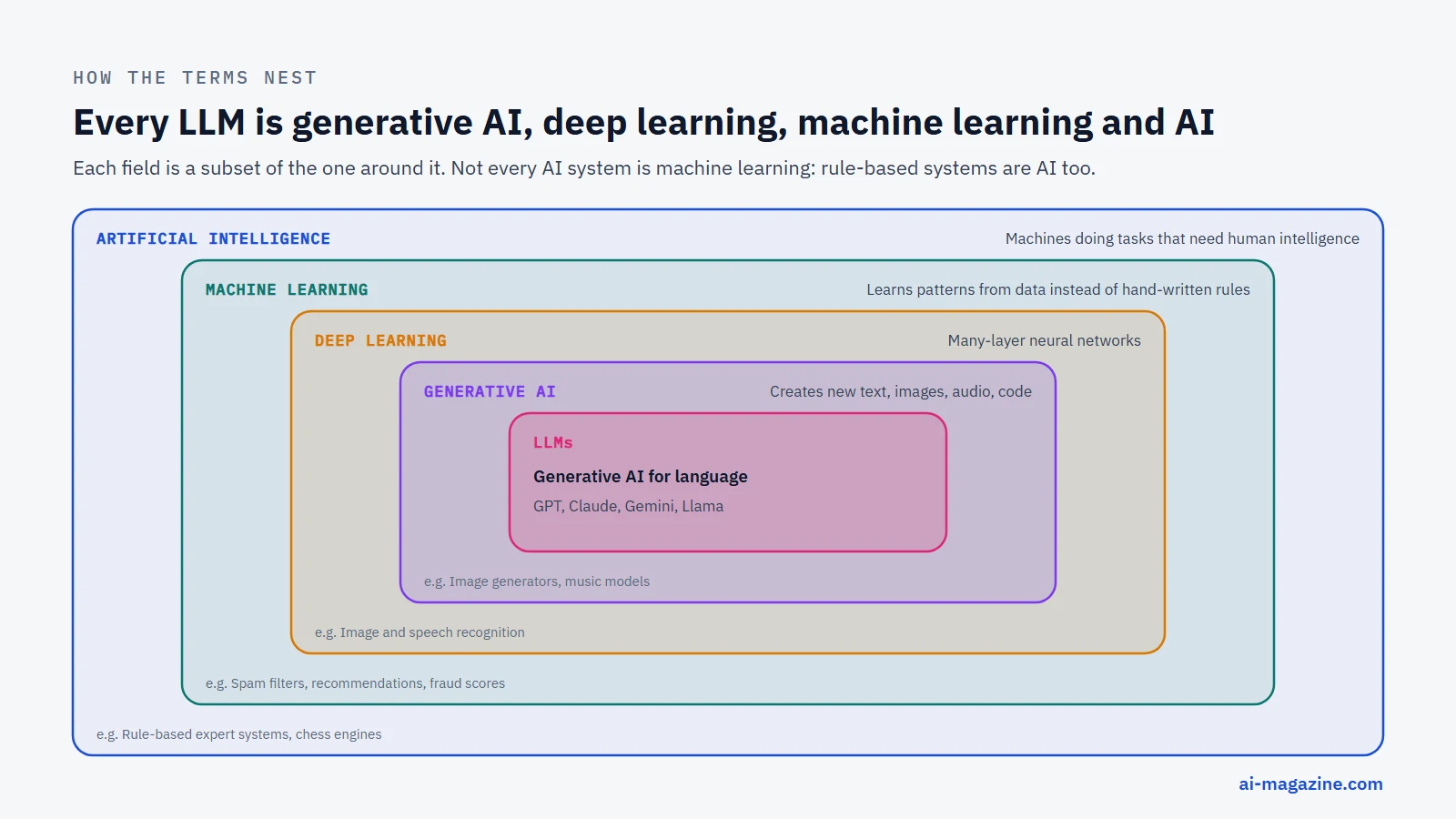
These terms are often used interchangeably, but they represent a specific hierarchy. Artificial intelligence is the broadest field, encompassing any technique that enables computers to simulate human intelligence. Machine learning is a subset of AI. It refers specifically to systems that learn from data rather than following explicit instructions. Deep learning is a subset of machine learning that uses neural networks with many layers. Generative AI is a subset of deep learning focused on creating new content, such as text, images, or code. Large language models (LLMs) are a specific type of generative AI trained primarily on text.
| Term | What it is | Example |
|---|---|---|
| Artificial Intelligence (AI) | The broad field of creating systems that perform tasks requiring human intelligence. | A chess program that plays at a grandmaster level. |
| Machine Learning (ML) | A subset of AI where systems learn patterns from data instead of following hand-written rules. | A recommendation engine that suggests movies based on your viewing history. |
| Deep Learning | A subset of ML that uses multi-layer neural networks to extract complex features from data. | A facial recognition system that identifies people in photos. |
| Generative AI | A subset of deep learning that creates new content, such as text, images, or audio. | A tool that generates a summary of a long article or creates an image from a text prompt. |
| Large Language Model (LLM) | The text branch of generative AI, trained on vast amounts of text data to understand and generate language. | A chatbot that answers questions and writes code based on natural language prompts. |
This nesting means that all deep learning is machine learning, and all machine learning is artificial intelligence, but not all artificial intelligence is deep learning. Understanding this hierarchy helps clarify why some AI systems are better at specific tasks than others. For instance, a rule-based expert system is AI but not machine learning, while a neural network is both AI and machine learning. Generative AI represents a shift from merely classifying or predicting data to creating entirely new data instances, which has driven much of the recent public interest in the technology.
Types of AI
AI can be classified in several ways, depending on whether you are looking at its capabilities, its functionality, or its underlying techniques. Each framework offers a different lens through which to view the technology.
Narrow, general and super AI (by capability)
The most common way to categorize AI is by its scope of competence. This framework distinguishes between systems that are good at one thing and systems that could potentially be good at many things.
| Type | Also called | What it can do | Exists today? |
|---|---|---|---|
| Narrow AI | Weak AI | Performs specific tasks, such as playing chess, recognizing faces, or translating languages. | Yes |
| Artificial General Intelligence (AGI) | Strong AI | Would have the ability to understand, learn, and apply knowledge across a wide variety of tasks, matching human-level versatility. | No (hypothetical) |
| Artificial Superintelligence (ASI) | Super AI | Would exceed human intelligence in all aspects, including creativity, general wisdom, and social skills. | No (hypothetical) |
Narrow AI is the only kind that currently exists. Every AI system you interact with today, from your phone’s voice assistant to hospital diagnostic tools, is a narrow AI. It excels in its designated domain but cannot easily transfer its skills to unrelated tasks. For example, a chess-playing AI cannot drive a car. AGI remains a theoretical goal. If achieved, an AGI system would possess a level of adaptability and understanding comparable to a human, able to learn a new skill with the same ease a person does. ASI would go further, surpassing human capabilities in every measurable domain. This three-way split is a consensus framing used by IBM, Coursera and TechTarget, among others; there is no single official standard for defining the exact thresholds of AGI or ASI.
The “four types of AI” (by functionality)
Another framework, popularized by Arend Hintze of Michigan State University in a November 2016 article in The Conversation, classifies AI by how it perceives and remembers its environment. It is important to note that this is an informal framework from an article, not a scientific standard, but it remains a useful way to visualize the evolution of AI capabilities.
- Type I: Reactive Machines. These AI systems have no memory and do not rely on past experiences to make decisions. They process the current input and generate an output based on predefined rules. A classic example is IBM’s Deep Blue, which played chess by evaluating board positions in real-time without remembering previous games.
- Type II: Limited Memory. These systems can use past experiences to inform future decisions. Most modern AI, including self-driving cars and recommendation algorithms, falls into this category. They retain data from recent interactions to improve their performance over time.
- Type III: Theory of Mind. This hypothetical type would understand the emotions, beliefs, and intentions of other beings. It would be capable of social intelligence, recognizing that others have perspectives different from its own. This level of AI does not exist yet.
- Type IV: Self-Awareness. The most advanced hypothetical form, where AI would possess a consciousness and sense of self. It would be aware of its own existence and state. This level is purely theoretical and currently does not exist.
Other ways to classify AI
Beyond capability and functionality, AI is often classified by its underlying technique, output type, or level of autonomy. By technique, AI is divided into symbolic AI, which uses logic and rules, and machine learning, which uses data-driven patterns. By output, AI can be predictive, forecasting future events based on data, or generative, creating new content. By autonomy, AI ranges from assistive systems, which require human oversight for every step, to agents, which can operate independently to achieve a defined goal. These classifications help developers choose the right approach for specific problems, balancing control, accuracy, and efficiency.
Examples of AI in everyday life

AI is no longer a futuristic concept; it is embedded in many aspects of daily life, often working invisibly in the background. One of the most common examples is search engines. When you type a query, AI algorithms analyze the context, your location, and your past behavior to rank and display the most relevant results. This goes beyond simple keyword matching; modern search AI understands the intent behind your question.
Recommendation systems are another ubiquitous example. Streaming services, e-commerce sites, and social media platforms use AI to analyze your past interactions and suggest content or products you might like. These systems rely on machine learning to identify patterns in your behavior and predict your preferences with increasing accuracy over time.
Spam filtering is a critical AI application in email services. As described earlier, these systems learn from labeled data to identify unwanted messages. They adapt to new spam tactics by continuously updating their models based on user feedback. Navigation apps use AI to predict traffic patterns and suggest the fastest routes. By analyzing live traffic data, the AI can anticipate congestion and reroute you before you get stuck in traffic.
Voice assistants like Siri, Alexa, and Google Assistant use natural language processing, a branch of AI, to understand and respond to spoken commands. They convert speech to text, interpret the meaning, and execute actions or provide information. Translation services have also been revolutionized by AI, particularly deep learning models that can translate text and speech between languages with high accuracy.
Chatbots and virtual assistants are increasingly used in customer service. They handle routine inquiries, freeing up human agents for more complex issues. Some advanced chatbots use generative AI to provide more natural, conversational responses. Fraud detection in banking is another vital application. AI models analyze transaction patterns to identify unusual activity that might indicate fraud, such as a large purchase in a different country.
Medical imaging is a growing field where computer vision assists radiologists in detecting diseases. AI algorithms can analyze X-rays, MRIs, and CT scans to identify anomalies that might be missed by the human eye, improving early diagnosis. These examples demonstrate how AI is already integrated into our routines, making tasks faster, more accurate, and more personalized.
A short history of AI
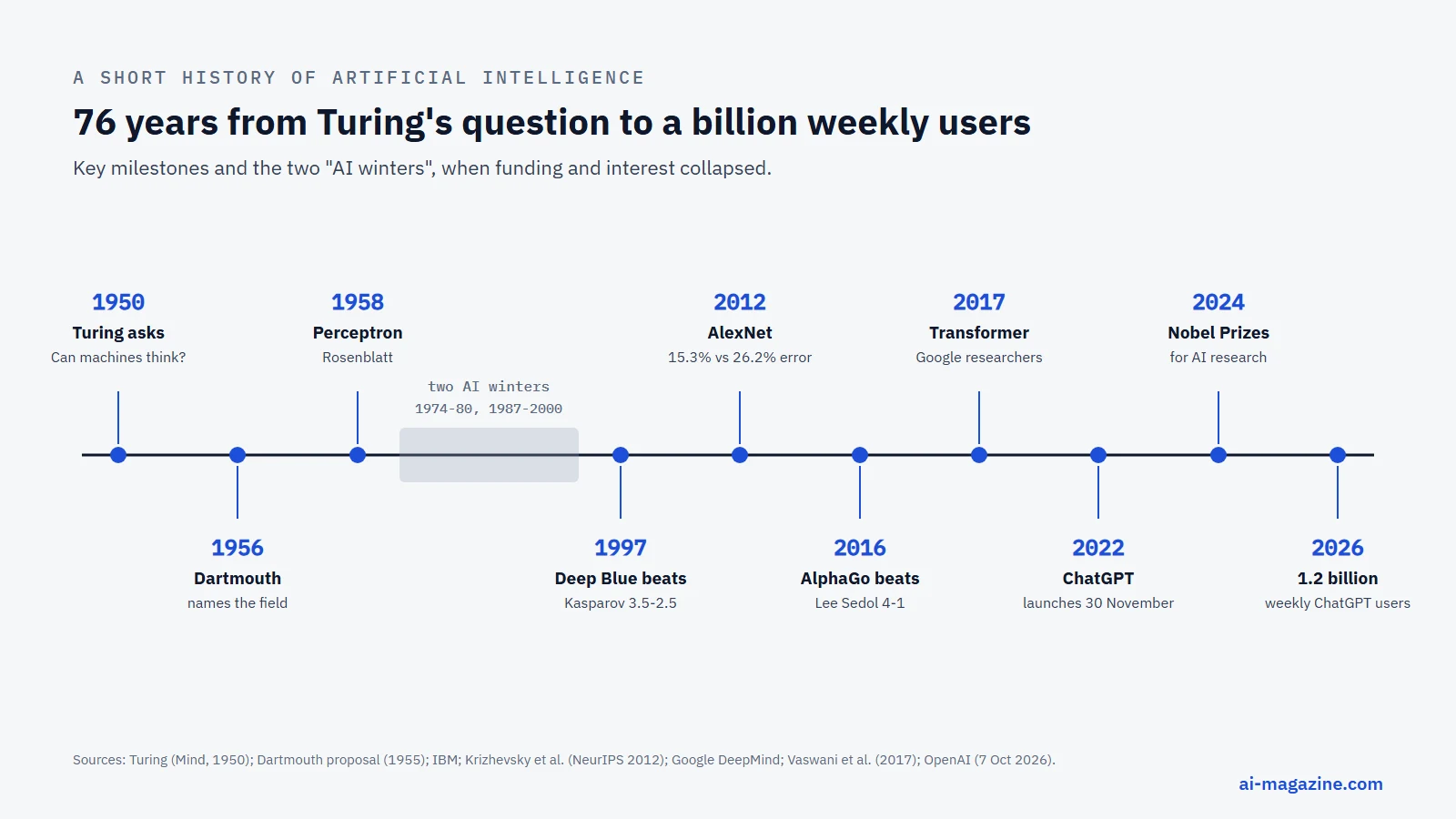
The history of artificial intelligence is not a straight line of progress. It is a series of bursts of optimism followed by periods of reduced funding and skepticism, known as AI winters. The field has evolved from symbolic logic to statistical learning, and now to generative systems that create new content. Understanding this arc helps explain why AI capabilities advance quickly in some areas while remaining brittle in others.
The idea and the name (1950–1956)
The conceptual foundation for AI was laid in 1950 when Alan Turing published “Computing Machinery and Intelligence” in Mind. In that paper, Turing opened with: “I propose to consider the question, ‘Can machines think?’” and proposed the imitation game, now known as the Turing test, to determine if a machine could exhibit intelligent behavior indistinguishable from that of a human. This was a philosophical and computational starting point, not an engineering blueprint.
The term “artificial intelligence” itself was coined in 1955. John McCarthy, Marvin Minsky, Nathaniel Rochester, and Claude Shannon wrote a proposal for a summer workshop at Dartmouth College. The document stated: “We propose that a 2 month, 10 man study of artificial intelligence be carried out during the summer of 1956 at Dartmouth College.” The workshop itself ran in summer 1956. This moment is widely considered the birth of AI as a distinct field.
In the early years, researchers focused on symbolic AI. They built systems that used logic and hand-written rules to solve problems. In 1958, Frank Rosenblatt published the perceptron, an early neural network, in Psychological Review. This was an attempt to model the human brain’s structure, but early neural networks had limited capabilities compared to the symbolic approaches that dominated the field at the time.
Early optimism and the first AI winter (1956–1980)
The 1960s and early 1970s saw significant funding and excitement. Researchers built programs that proved theorems, solved algebra word problems and played checkers, and the optimism was high: these systems showed computers doing tasks previously thought to require human insight.
However, limitations became apparent. Early AI struggled with context, ambiguity, and the sheer complexity of the real world. The UK’s Lighthill report, written in 1972 and published in 1973, concluded that the field had failed to deliver on its grand promises. This report is widely blamed for ending most UK university AI funding. This period, roughly 1974–1980, is known as the first AI winter.
Expert systems and the second winter (1980–2000)
The field revived in the 1980s with the rise of expert systems. These programs encoded the knowledge of human experts into rule-based systems, allowing them to diagnose diseases, interpret geological surveys, and manage inventory. Companies built and sold Lisp machines, specialized computers designed to run AI software.
But expert systems had significant drawbacks. They were brittle; if a situation fell outside their narrow rules, they failed. They were also expensive to maintain because rules had to be hand-written and updated by experts. In 1987, the Lisp-machine market collapsed. Japan’s Fifth Generation computer project, started in 1981 to build AI-oriented computers, ended in 1992 without meeting its goals. This period, roughly 1987–2000, is known as the second AI winter. Funding dried up, and interest shifted toward more data-driven approaches.
Machine learning and the deep-learning breakthrough (1997–2016)

While the winters lasted, research into machine learning continued. Instead of hand-writing rules, researchers began building systems that could learn patterns from data. In May 1997, IBM’s Deep Blue beat world chess champion Garry Kasparov 3.5–2.5 in New York. Deep Blue evaluated 200 million positions per second, demonstrating that brute-force calculation combined with specialized algorithms could defeat human expertise in specific domains.
The real breakthrough came in 2012. An entry called AlexNet won the ImageNet competition with a top-5 error rate of 15.3%, significantly better than the second-best entry’s 26.2%. AlexNet had 60 million parameters and used deep neural networks. This victory marked the start of the deep-learning boom. Researchers realized that deep neural networks, trained on large datasets with GPUs, could beat hand-engineered methods in image recognition, speech processing and other tasks. Our history of image recognition covers that turn in detail.
In March 2016, DeepMind’s AlphaGo beat Lee Sedol 4–1 in Seoul, a match watched by over 200 million people. AlphaGo used deep learning and reinforcement learning to master the complex game of Go, demonstrating that AI could handle tasks requiring intuition and strategy.
Transformers, ChatGPT and generative AI (2017–2026)
In June 2017, Google researchers published “Attention Is All You Need”, introducing the transformer architecture. It relied on attention, “dispensing with recurrence and convolutions entirely”. The transformer became the foundation for every major large language model (LLM) that followed.
On 30 November 2022, OpenAI released ChatGPT as a free research preview. It demonstrated that LLMs could generate coherent, human-like text, answer questions, and write code. This sparked a wave of public interest and commercial investment. In October 2024, the Nobel Prize in Physics was awarded to John Hopfield and Geoffrey Hinton “for foundational discoveries and inventions that enable machine learning with artificial neural networks”. Half of the Chemistry prize went to David Baker for computational protein design, and the other half to Demis Hassabis and John Jumper of Google DeepMind for protein structure prediction using AlphaFold.
As of 7 October 2026, OpenAI says more than 1.2 billion people use ChatGPT each week. The history of AI shows a clear shift from symbolic reasoning to statistical learning, and now to generative models that create new content.
AI history timeline
| Year | Milestone |
|---|---|
| 1950 | Alan Turing publishes “Computing Machinery and Intelligence,” proposing the Turing test. |
| 1955 | John McCarthy, Marvin Minsky, Nathaniel Rochester, and Claude Shannon write the Dartmouth proposal, coining the term “artificial intelligence.” |
| 1956 | The Dartmouth Workshop takes place, marking the birth of AI as a field. |
| 1958 | Frank Rosenblatt publishes the perceptron, an early neural network, in Psychological Review. |
| 1973 | The Lighthill report is published, leading to reduced AI funding in the UK and marking the start of the first AI winter. |
| 1980s | Expert systems become popular, but market collapse and brittleness lead to the second AI winter (1987–2000). |
| 1987 | The Lisp-machine market collapses, accelerating the decline of symbolic AI. |
| 1992 | Japan’s Fifth Generation computer project ends without meeting its goals. |
| 1997 | IBM’s Deep Blue beats chess champion Garry Kasparov 3.5–2.5. |
| 2012 | AlexNet wins the ImageNet competition, sparking the deep-learning boom. |
| 2016 | DeepMind’s AlphaGo beats Lee Sedol 4–1 in a widely watched match. |
| 2017 | Google researchers publish “Attention Is All You Need,” introducing the transformer architecture. |
| 2022 | OpenAI releases ChatGPT as a free research preview. |
| 2024 | Nobel Prizes in Physics and Chemistry awarded for foundational AI and protein design breakthroughs. |
| 2026 | OpenAI reports over 1.2 billion weekly ChatGPT users; the EU AI Act becomes generally applicable. |
AI today: trends in 2026
The landscape of artificial intelligence in 2026 is defined by rapid adoption, significant investment, and shifting dynamics between open and closed models. According to Stanford’s AI Index 2026, which covers data from 2025, the field has moved from experimental phases to widespread industrial integration.
Investment and adoption
Private AI investment in the US reached $285.9 billion in 2025, compared to $12.4 billion in China. The AI Index notes that Chinese government guidance funds are not fully captured, so the actual gap may be smaller, but US investment remains dominant. Overall, 88% of organizations report using AI. Generative AI has spread particularly fast, reaching 53% adoption among the population within three years.
According to McKinsey’s “The state of AI in 2026” report, published on 25 August 2026, 40% of companies with revenue over $1 billion are scaling AI agents, up from 27% previously. 80% of respondents report individual productivity gains, and 37% report an impact on EBIT. About 6% of companies are considered “high performers” in AI adoption.
Models: closed vs open, US vs China
The competition between US and Chinese models is intensifying. As of March 2026, the top US model led the top Chinese model by 2.7% on the Arena leaderboard. Closed-weight models led open-weight models by 3.3%, up from 0.5% in August 2024. Industry produced over 90% of notable AI models, indicating that major tech firms are driving innovation.
The cost of running a GPT-3.5-level model fell “over 280-fold” between November 2022 and October 2024, according to the AI Index 2025. This cost reduction has made AI more accessible for enterprises and developers.
From chatbots to agents
AI is moving from chatbots to agentic AI that carries out tasks. On the OSWorld computer-use benchmark, the best score rose from about 12% to 66.3% during 2025. The human baseline is 72.35%. Agents still fail roughly one attempt in three on structured benchmarks, but the trend is clear: AI is becoming more capable of executing multi-step tasks without constant human guidance.
Regulation: the EU AI Act timeline
Regulation is catching up to innovation. The EU AI Act entered into force on 1 August 2024. Bans on prohibited practices and AI-literacy duties applied from 2 February 2025. Obligations for general-purpose AI models started on 2 August 2025. The Act became generally applicable on 2 August 2026, with exceptions.
In 2026, the “AI Omnibus” amendment postponed high-risk obligations. Annex III high-risk systems are now delayed until 2 December 2027, and AI embedded in regulated products (Annex I) is delayed until 2 August 2028. This gives companies more time to comply but extends the regulatory uncertainty.
Documented AI incidents rose to 362 in 2025, up from 233 in 2024, highlighting ongoing risks as adoption scales.
The future of AI
Predicting the future of AI is difficult. Forecasts vary widely, and many are uncertain. Three trends, though, are measured rather than guessed: compute keeps growing, energy demand is rising, and researchers keep moving their own estimates of human-level AI closer.
Compute keeps scaling
Training compute for frontier language models has been growing at 5× per year since 2020, according to Epoch AI’s February 2026 report. Training costs grow about 3.5× per year, but AI chip performance per dollar improves about 49% per year. This efficiency gain helps offset some of the rising costs, but the absolute amount of compute required continues to increase.
Energy demand

Data centers used about 415 TWh of electricity in 2024, which is about 1.5% of global electricity, according to the IEA’s “Energy and AI” report from April 2025. This is set to more than double to around 945 TWh by 2030. Electricity use by AI-optimized data centers is projected to more than quadruple by 2030. Power supply is becoming a practical limit on how fast AI can grow; see AI’s energy consumption.
When will AI match humans?
An AI Impacts survey of 2,778 AI researchers, published in January 2024 (surveying 2023 data), estimated a 50% chance that unaided machines outperform humans at every possible task by 2047. This is 13 years earlier than the 2022 survey’s estimate. There is a 10% chance this happens by 2027. For full automation of all occupations, the median estimate is 2116. Between 38% and 51% of respondents gave at least a 10% chance to outcomes as bad as human extinction. These figures are expert estimates, not facts, and reflect uncertainty.
What to watch next
Four questions are worth watching. Can agents close the remaining gap to the human baseline on computer-use tasks, and fail less than one time in three? Do reasoning models keep improving with more test-time compute? How do the delayed EU high-risk rules land in December 2027 and August 2028? And can power grids supply the data-centre growth the IEA projects? Whether open-weight models catch up with closed ones, or the gap keeps widening, will decide how concentrated the industry stays.
Risks and limitations of AI
Despite rapid progress, AI has significant risks and limitations.
- Hallucination: AI systems can hallucinate, generating confident but false output, especially when they lack specific knowledge or encounter ambiguous inputs.
- Bias: AI models inherit biases from their training data, which can lead to unfair or discriminatory outcomes in hiring, lending, and law enforcement.
- Privacy and copyright: There are ongoing disputes over how training data is used, with concerns about unauthorized use of personal information and creative works.
- Deepfakes and misuse: AI can generate realistic audio, video, and text, making it easier to spread misinformation and create convincing fake content.
- Energy use: AI’s growing energy demand contributes to carbon emissions and strains power grids, raising sustainability concerns.
- Job disruption: While AI may create new jobs, it will also automate routine tasks, leading to displacement and the need for workforce reskilling.
- Concentration of power: A few large companies control most of the compute, data, and talent, which could limit competition and innovation.
FAQ
What is AI in simple words?
Artificial intelligence (AI) is the field of computer science that builds systems able to perform tasks that normally require human intelligence. This includes understanding language, recognizing images and speech, reasoning, planning, learning from data, and making decisions. AI is not a single technology but a hierarchy that includes machine learning, deep learning, and generative AI.
What are the 4 types of AI?
The “four types of AI” framework was popularized by Arend Hintze in The Conversation in November 2016. Type I consists of reactive machines (e.g., Deep Blue) that have no memory of past games. Type II includes limited memory systems (e.g., self-driving cars and today’s AI models) that use recent observations. Type III is theory of mind, where AI would understand others’ beliefs and intentions; this does not exist yet. Type IV is self-awareness, which also does not exist. This is an informal framework, not a scientific standard.
Who is the father of AI?
There is no single father of AI. John McCarthy coined the term “artificial intelligence” in the 1955 Dartmouth proposal. Alan Turing posed the founding question in 1950 with his paper “Computing Machinery and Intelligence.” McCarthy, Marvin Minsky, Nathaniel Rochester and Claude Shannon organized the 1956 Dartmouth workshop, which is considered the birth of the field.
When was AI invented?
AI as a field was born at the Dartmouth Workshop in the summer of 1956. However, the term “artificial intelligence” was coined in the proposal written on 31 August 1955 by John McCarthy, Marvin Minsky, Nathaniel Rochester, and Claude Shannon. Alan Turing’s 1950 paper laid the conceptual groundwork, but the formal discipline began in 1956.
What is the difference between AI and machine learning?
AI is the broad field of computer science focused on creating intelligent systems. Machine learning (ML) is a subset of AI. ML systems learn patterns from data instead of following hand-written rules. Deep learning is a further subset of ML that uses multi-layer neural networks. Generative AI is a branch of deep learning that creates new content like text, images, and audio.
Is ChatGPT AI?
Yes. ChatGPT is an AI application built on OpenAI’s GPT large language models, which belong to the generative AI branch of deep learning. Despite its range, it is still narrow AI: it is very capable with language but is not general intelligence.
Does AGI exist yet?
No, artificial general intelligence (AGI) does not exist yet. All deployed AI today is narrow AI, meaning it excels at specific tasks but lacks general human-like flexibility. According to the AI Impacts survey, experts estimate a 50% chance of unaided machines outperforming humans at every task by 2047. This is an expert estimate, not a fact, and reflects significant uncertainty.
Will AI replace jobs?
AI will not simply replace jobs; it will change the tasks within jobs. According to the AI Impacts survey, there is a 50% chance of full automation of all occupations by 2116. Most experts believe AI will first automate routine tasks, requiring workers to adapt to new roles. In McKinsey’s 2026 survey, 80% of respondents reported individual productivity gains, which points to AI changing how work is done before it removes whole jobs.