AI glossary
Generative AI (GenAI)
Generative AI is artificial intelligence that creates new content, such as text, images, audio, video or code, by learning the patterns in huge amounts of existing data and producing something new that follows them. The US National Institute of Standards and Technology (NIST) defines it as “the class of AI models that emulate the structure and characteristics of input data in order to generate derived synthetic content.” In plain terms: a model that has read billions of sentences can write a new one; a model that has seen millions of pictures can draw a new one.
You probably use it already. OpenAI said in February 2026 that ChatGPT had more than 900 million weekly users, and Google said in August 2026 that its Gemini app had passed one billion monthly users. This guide explains what generative AI is and how it differs from other AI, how it works under the hood for text and images, a short history, the main types with examples, who uses it, what studies show about productivity, the risks, and the rules that apply. We also ran our own tests: the same prompt sent 50 times to one model, and a count of what 3.2 million open models on Hugging Face are built to do.
Generative AI vs other AI
To understand generative AI, it helps to compare it with discriminative AI. The distinction dates back to a 2001 paper by Andrew Ng and Michael Jordan. Generative models learn the joint probability of inputs and labels, effectively modeling how data is generated. Discriminative models learn the boundary between classes, focusing on predicting the label given an input.
In practical terms, discriminative AI classifies. It tells you if an email is spam or if a tumor is malignant. Generative AI creates. It writes the email, drafts the report, or generates a synthetic X-ray. Ng and Jordan showed a trade-off: discriminative classifiers usually reach a lower error in the end, while generative ones get to their (higher) error faster, with fewer examples.
Generative AI is a subset of machine learning and, today, mostly of deep learning (see our guide to machine learning vs deep learning). It relies on neural networks with millions or billions of parameters. In the EU AI Act, these are often referred to as general-purpose AI models. The act defines these as models trained on large datasets using self-supervision that display significant generality. They can perform a wide range of distinct tasks and integrate into various downstream systems.
This broad capability is why the examples are so diverse. The same underlying architecture that writes code can be fine-tuned to summarize legal documents or generate medical images. However, the general-purpose nature also introduces risks, such as what NIST calls confabulation, better known as hallucination: confidently stated but false content.
How does generative AI work?
Generative models do not simply copy-paste data. They learn statistical relationships. When you ask a model to write a poem, it is not searching a database for existing poems. It is calculating the most probable sequence of words based on patterns it absorbed during training. The process varies by modality, from text to images.
Learning patterns from huge amounts of data
The foundation of any generative model is data. Models are trained on massive corpora: billions of web pages, books, source code, and images. During training, the model adjusts its internal weights to minimize the difference between its predictions and the actual data.
For text, this means predicting the next word in a sequence. For images, it involves learning the distribution of pixel values or latent features. The more data the model sees, the better it understands the underlying structure of the language or visual world. This process is computationally expensive, requiring thousands of specialized GPUs running for weeks or months.
Text: predicting the next token
Text models, known as large language models (LLMs), are autoregressive. This means they predict the next token (a word or piece of a word) based on all previous tokens. The Transformer architecture, introduced in 2017, revolutionized this field by using self-attention mechanisms. This allows the model to weigh the importance of different words in a sentence, regardless of their distance from each other.
GPT-3, released in 2020, demonstrated the power of scale. With 175 billion parameters, it was ten times larger than any previous non-sparse language model. It could perform tasks with minimal examples, a capability known as few-shot learning. Modern models continue this trajectory, using instruction tuning to become more helpful and conversational.
Images and video: diffusion models
Image generation relies heavily on diffusion models. These models start with random noise and gradually remove it to reveal an image. The process is inspired by thermodynamics. A forward process adds noise to an image until it becomes pure randomness. The model learns the reverse process: starting from noise and stepping back through time to reconstruct a coherent image.
Latent diffusion models, like Stable Diffusion, speed this up by working in a compressed “latent” space rather than raw pixels. This makes generation faster and more efficient. Video models, such as Sora, extend this concept to temporal data, generating sequences of frames that maintain consistency over time. Sora, announced in early 2024, uses a transformer architecture to handle video generation, though it was discontinued as a product in April 2026.
GANs and VAEs: the earlier approaches
Before diffusion models dominated, Generative adversarial networks (GANs) and variational autoencoders (VAEs) were the standard. GANs, introduced in 2014, pit two neural networks against each other. A generator creates fake data, while a discriminator tries to distinguish it from real data. This adversarial training leads to high-quality outputs.
VAEs, dating back to 2013, encode data into a compressed representation and then decode it back. They are excellent for creating smooth, continuous latent spaces, which is useful for interpolation and style transfer. While still used, diffusion models generally produce higher fidelity images and video, which is why they have become the standard approach for image and video generation.
From raw model to assistant: instruction tuning and RLHF
Raw models are powerful but unpredictable. They might answer a question with a random fact or ramble. To make them useful, developers first fine-tune them on examples of instructions and good answers (instruction tuning), then use reinforcement learning from human feedback (RLHF), which trains the model to prefer the answers people rate as more helpful and truthful.
InstructGPT, a precursor to ChatGPT, demonstrated this effectively. Its 1.3 billion parameter model, tuned with RLHF, produced outputs preferred by humans over the much larger 175 billion parameter GPT-3. This shift from pure prediction to instruction following is what turned models into assistants.
Temperature: why answers vary
You might notice that asking the same question twice yields different answers. This is controlled by a parameter called temperature. Temperature adjusts the randomness of the model’s output. A low temperature makes the model more deterministic and conservative, picking the most probable words. A high temperature increases randomness, leading to more creative but potentially less coherent text.
Developers tune temperature based on the use case. Code generation benefits from low temperature for accuracy, while creative writing benefits from higher temperature for variety. This simple knob allows users to balance precision with creativity, and our test below shows what it does in practice.
Our test: the same prompt, 50 times
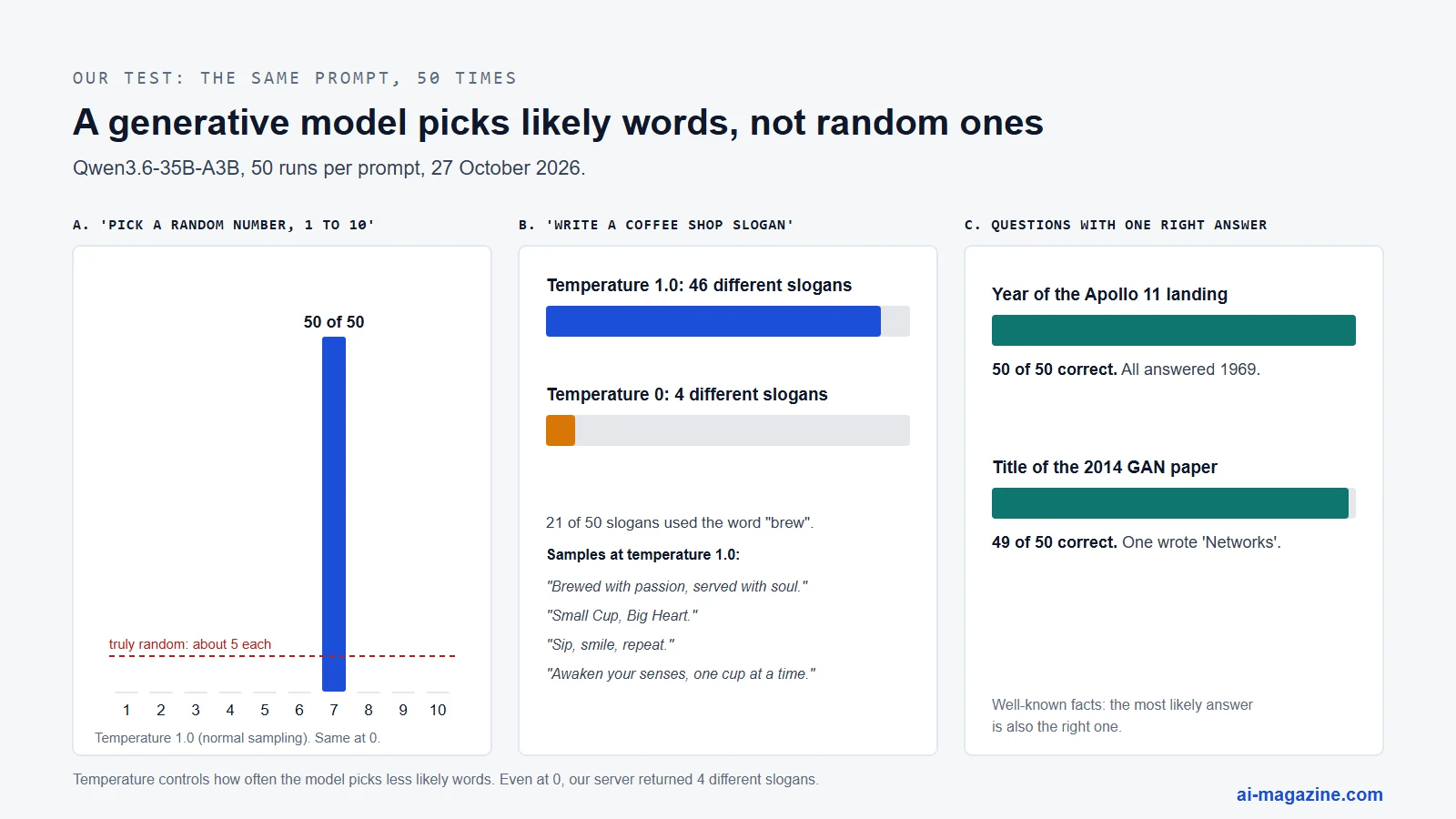
The best way to see what “generative” means is to ask a model the same thing over and over. On 27 October 2026 we sent four prompts 50 times each to Qwen3.6-35B-A3B, an open-weight language model running on our own server, at temperature 1.0, the setting that lets the model sample less likely words. We repeated two of them at temperature 0, which tells it to pick the most likely word every time.
| Prompt | Temperature 1.0 | Temperature 0 |
|---|---|---|
| “Pick a random whole number between 1 and 10” | 7 in 50 of 50 runs | 7 in 50 of 50 runs |
| “Write a one-sentence slogan for a small coffee shop” | 46 different slogans; 21 used “brew” | 4 different slogans; one appeared 34 times |
| “In what year did Apollo 11 land on the Moon?” | 1969 in 50 of 50 runs | not tested |
| Title and venue of the 2014 paper that introduced GANs | Correct title 49 of 50 (“Generative Adversarial Nets”, NIPS); once “Networks” | not tested |
“Random” is not random. Asked for a random number, the model said 7 every single time, even with sampling switched on. It is not drawing a number; it is predicting the most likely reply, and 7 is the answer it has learned to treat as the most typical one. A truly random generator would give each number about five times out of 50.
Creative prompts produce real variety, within a style. The slogan prompt gave 46 different answers in 50 tries, but most were variations on one template: 21 used the word “brew” and 14 the word “soul” (“Brewed with heart, served with soul.”). At temperature 0 the variety collapsed to four slogans, one of them repeated 34 times. That is the trade-off temperature controls: more surprise or more consistency.
Well-known facts come back stable. For questions with one well-documented answer, the most likely words are also the right ones: 1969 every time, and the correct title of Ian Goodfellow’s GAN paper in 49 of 50 runs. Errors creep in where the training data is thin, which is why the same model can be reliable on famous facts and invent details about obscure ones.
Limits: one model, four prompts, 50 runs each. Temperature 0 was not perfectly repeatable on our server, a known side effect of how requests are batched on GPUs.
A short history of generative AI
| Year | Milestone |
|---|---|
| 2013 | Variational autoencoders (Kingma and Welling) |
| 2014 | Generative adversarial networks (Goodfellow et al.) |
| 2015 | First diffusion models (Sohl-Dickstein et al.) |
| 2017 | The Transformer (“Attention Is All You Need”) |
| 2018 | GPT-1 |
| 2020 | GPT-3 (175 billion parameters); DDPM diffusion |
| 2021 | DALL-E |
| 2022 | Stable Diffusion released openly (August); InstructGPT; ChatGPT launches (30 November) |
| 2024 | Sora video model announced (product discontinued April 2026) |
| 2026 | ChatGPT passes 900 million weekly users (February); Gemini app passes 1 billion monthly users (August) |
The journey of generative AI spans over a decade. It began with foundational research in deep learning and evolved rapidly into the dominant technology of the 2020s.
The Variational Autoencoder (VAE) was published in December 2013, offering a new way to encode and decode data. Generative Adversarial Networks (GANs) arrived in June 2014, introducing the concept of adversarial training. By March 2015, diffusion models were proposed, laying the groundwork for future image generation.
The Transformer architecture was introduced in June 2017, making it far easier to model long-range relationships in text. This enabled the rise of large language models. GPT-1 was released in June 2018, followed by the massive GPT-3 in May 2020, which showcased the power of scale.
January 2021 saw the release of DALL-E, one of the first models to generate images from text. By August 2022, Stable Diffusion was publicly released, making high-quality image generation accessible to the masses. The true breakthrough came on November 30, 2022, with the launch of ChatGPT, which brought generative AI to the mainstream.
Sora was announced in February 2024, demonstrating the ability to generate minute-long videos. It used a transformer architecture and diffusion techniques. However, by April 2026, the Sora product was no longer available, marking a shift in how video models are commercialized. By 2026, hundreds of millions of people were using generative AI tools every week, and companies were building them into everyday software.
Types of generative AI, with examples
Generative AI is not a single technology but a collection of architectures, each optimized for different data types. The most familiar category is text and chat. These models, built on transformer architectures, predict the next word in a sequence to generate human-like prose, code, or dialogue. ChatGPT is the best-known example, leveraging reinforcement learning from human feedback to align its outputs with user intent. For code generation, GitHub Copilot acts as an autocomplete engine that suggests entire functions and blocks of logic, helping developers write software faster.
Image generation relies heavily on diffusion models. These systems start with random noise and gradually refine it into a coherent image based on a text prompt. DALL-E, developed by OpenAI, was one of the first mainstream examples, while Stable Diffusion gained massive popularity for its open-source accessibility. Stable Diffusion XL is still the most downloaded text-to-image model on Hugging Face, with about 4.3 million downloads in the 30 days to 27 October 2026, by our count.
Video generation is a more recent frontier, though it has already seen consolidation. Sora, introduced by OpenAI in early 2024, demonstrated the ability to generate minute-long videos with complex camera movements and physics. It used a transformer architecture to process visual data, but OpenAI discontinued the Sora product in April 2026. Google’s Veo 3, shown in 2025, generates video with native audio, including synced dialogue, sound effects, and music, addressing a major limitation of earlier text-to-video models that produced silent clips.
Audio and music generation have also advanced significantly. Google’s Lyria 2 is a music model, and open text-to-speech models such as Kokoro-82M, downloaded about 10.6 million times in 30 days, turn written text into natural-sounding speech. The same technology can clone voices, which is behind many deepfake scams.
Multimodal models represent the current state of the art. These systems do not limit themselves to one data type; they can process and generate text, images, audio, and video simultaneously. Gemini is a prominent example of a multimodal model that understands and creates across these formats. By combining formats, these models can answer questions about a photo, read a chart or summarize a video. The diversity of these tools means that “generative AI” is no longer just about writing emails; it is a versatile engine for creating digital assets in almost any format.
Our count: what open models are built for
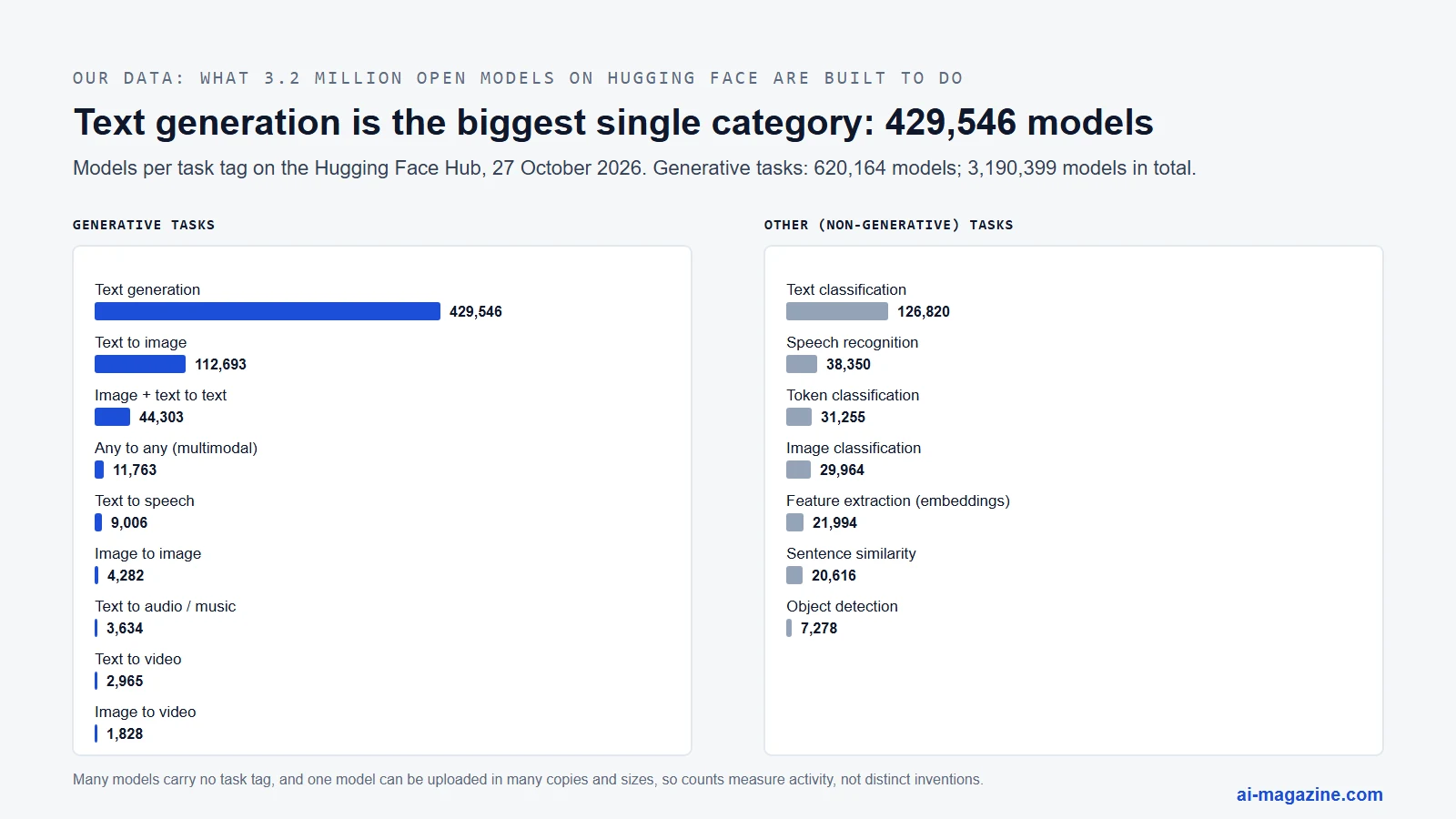
On 27 October 2026 we counted the models on the Hugging Face Hub, the largest public library of AI models, by the task their creators tag them with. Of 3,190,399 models, 620,164 (19%) carry a generative task tag, and text generation is the single biggest category with 429,546 models, followed by text-to-image with 112,693. The biggest non-generative category, text classification, has 126,820.
| Task | Models on the Hub | Downloads of the top 1,000, last 30 days | Most downloaded model |
|---|---|---|---|
| Text generation | 429,546 | 391 million | Qwen/Qwen3-0.6B |
| Image + text to text | 44,303 | 287 million | google/gemma-4-31B-it |
| Text to image | 112,693 | 39 million | stabilityai/stable-diffusion-xl-base-1.0 |
| Text to speech | 9,006 | 47 million | hexgrad/Kokoro-82M |
| Image to video | 1,828 | 22 million | Comfy-Org/Wan-2.2 |
| Sentence similarity (not generative) | 20,616 | 384 million | sentence-transformers/all-MiniLM-L6-v2 |
Two things stand out. Uploads are dominated by generative models, especially fine-tuned and compressed copies of popular open-source LLMs. But by downloads, the quiet workhorses are not generative at all: small “embedding” models that turn text into numbers for search, such as all-MiniLM-L6-v2 with about 191 million downloads in 30 days, power much of the retrieval behind chatbots. Video is still a niche among open models: fewer than 5,000 are tagged for text-to-video or image-to-video. Limits: many models have no task tag, one model may be uploaded in many copies, and download counts include automated systems.
Who uses generative AI?
Adoption of generative AI has moved from experimental pilot programs to widespread enterprise integration. According to the Stanford AI Index 2026, 70% of organizations now use generative AI in at least one business function. This represents a sharp increase from previous years and indicates that the technology has become a standard component of the corporate toolkit. Global corporate AI investment reached $581.69 billion in 2025, with private AI investment growing by 127.5%. Generative AI captured nearly half of all private AI funding, signaling that companies are prioritizing these models for their potential to automate knowledge work.
Consumer adoption is equally dramatic. Pew Research Center data from June 2025 shows that 34% of U.S. adults have used ChatGPT, a figure that has doubled since 2023. The usage is heavily skewed toward younger demographics: 58% of adults under 30 have tried the service. This suggests that the next generation of workers is already fluent in interacting with AI assistants. On the workplace side, 28% of employed adults have used ChatGPT for work, indicating that the technology is no longer confined to tech departments but is embedded in daily workflows across industries.
A broader survey by economists at the St. Louis Federal Reserve and Harvard, as reported in November 2025, found that 54.6% of US adults aged 18 to 64 used generative AI in August 2025. Use for work rose from 33% to 37% over the year, while use outside work grew faster, from 36% to 49%. This shift suggests that workers are moving from casual experimentation to relying on AI for tangible job functions.
Major platforms are seeing massive engagement numbers. OpenAI reported in February 2026 that ChatGPT has over 900 million weekly active users and more than 50 million consumer subscribers. This scale underscores the ubiquity of the technology. Google’s Gemini app also crossed a significant milestone in August 2026, reaching more than one billion monthly users. Notably, 63% of Gemini users interact via voice, highlighting a preference for natural, conversational interfaces over traditional text boxes. These numbers make generative AI a mainstream tool used by hundreds of millions of people every week.
Does generative AI make people more productive?
The impact of generative AI on productivity is significant but uneven. A landmark study by Noy and Zhang, published in Science in 2023, gave 453 college-educated professionals writing tasks: with ChatGPT, the time they took fell by 40% and the quality of their work rose by 18%. The gap between weaker and stronger writers also narrowed. This suggests that AI acts as a force multiplier, particularly for those who are still mastering the nuances of a task.
However, productivity gains are not universal. A 2025 study published in the Quarterly Journal of Economics by Brynjolfsson, Li, and Raymond examined 5,172 customer support agents. They found that AI assistance increased productivity by an average of 15%. The benefits were distributed unevenly: less experienced and lower-skilled workers saw improvements in both speed and quality, while the most experienced agents experienced small declines in quality. In other words, AI helped novices catch up with experts more than it made experts better.
A study of 758 Boston Consulting Group consultants using GPT-4, led by Harvard Business School researchers (Dell’Acqua et al.), coined the phrase “jagged technological frontier”. On tasks within the model’s capabilities, consultants completed 12.2% more work and finished 25.1% faster. However, on tasks outside the model’s frontier, they were 19% less likely to produce correct solutions. This indicates that users must understand the limits of the AI to avoid errors. If a worker trusts AI blindly on complex reasoning tasks, their output quality can actually suffer.
Developer productivity shows another dimension of this trend. A randomized controlled trial by Peng et al. on GitHub Copilot found that developers using the tool completed JavaScript tasks 55.8% faster. This substantial speed boost highlights the value of AI in automating repetitive coding patterns. Yet, a 2025 METR study using Cursor Pro and Claude models found a different result for experienced open-source developers: AI increased completion time by 19%. Developers had predicted a 24% speedup, but the reality was a slowdown. This discrepancy suggests that AI can introduce cognitive load or require more review time, especially when the tool makes subtle errors that are hard to spot.
Macro-level estimates remain cautious. Goldman Sachs projects that generative AI could increase global GDP by 7% and lift productivity growth by 1.5 percentage points over a decade. A 2023 McKinsey estimate put the potential value at $2.6 to $4.4 trillion a year. These figures are plausible but depend on widespread adoption and successful integration into workflows. The current evidence suggests that generative AI boosts productivity most when it augments human judgment rather than replacing it entirely.
Risks and limits
Hallucinations
Generative AI models are not databases; they are probabilistic engines that predict likely outputs. This means they can confidently state incorrect facts, a phenomenon known as hallucination. The NIST AI 600-1 profile defines this as “the production of confidently stated but erroneous or false content.” A practical way to gauge current hallucination rates is the Vectara HHEM Hallucination Leaderboard, which measures how well models summarize documents without adding false information. As of October 22, 2026, the best-performing model, antgroup/finix_s1_32b, had a hallucination rate of 1.8%. OpenAI’s gpt-5.4-nano followed at 3.1%, and Google’s gemini-2.5-flash-lite was at 3.3%. While these numbers seem low, they are not directly comparable to older datasets because the benchmark was refreshed in November 2025. It is crucial to note that this leaderboard measures summarization, not open-ended factual Q&A, where error rates can be higher. Users must always verify critical facts, especially in high-stakes domains like medicine or law; our guide to LLM hallucinations explains why they happen and how to reduce them.
Copyright fights
The legal landscape surrounding generative AI is complex and evolving. In the UK, Getty Images v. Stability AI was decided in November 2025 mostly in Stability’s favor. The court ruled that Stability AI did not commit secondary copyright infringement because it did not store or contain copies of Getty’s images in its model. However, Getty did win on trademark grounds for some outputs containing its historic watermarks. Leave to appeal was granted in December 2025, leaving the final precedent unsettled.
In the United States, according to the Authors Guild and other reports, the Bartz v. Anthropic case reached a $1.5 billion class action settlement in September 2025, with final approval in July 2026. This settlement covers past conduct up to August 2025 and addresses the use of pirated library copies but excludes claims about AI-generated outputs. Meanwhile, according to court reporting, the New York Times v. Microsoft and OpenAI case remains pending in the Southern District of New York. In June 2026, the NYT amended its complaint to drop contributory infringement claims against OpenAI, following a Supreme Court ruling in Cox v. Sony.
Another significant ruling, as reported by law firms, came from the Third Circuit in September 2026, affirming the decision in Thomson Reuters v. Ross Intelligence. The court ruled that training a non-generative legal research AI on Westlaw headnotes was not fair use, calling the use “minimally transformative.” It is the first federal appellate ruling on fair use in AI training, although the court noted that generative AI cases may be different. These cases highlight the uncertainty around who owns the outputs of AI models and whether the training data was used fairly.
Deepfakes and fraud
Generative AI is not just a creative tool; it is a potent weapon for fraud. In a notable case reported in 2024, according to Hong Kong police and Arup, an employee at Arup in Hong Kong joined a video conference where all participants appeared real but were actually AI-generated. The employee was tricked into transferring HK$200 million (approximately US$25.6 million) to five fraudulent accounts. This incident demonstrates that deepfakes can bypass traditional verification methods, such as voice recognition or visual confirmation, when they are sophisticated enough. As models like Veo 3 generate more realistic video and audio, the risk of such scams increasing is significant. Organizations must develop new protocols for verifying identity, such as out-of-band confirmation or biometric challenges, to protect against AI-driven fraud.
Model collapse
A theoretical risk to AI’s future is “model collapse,” a phenomenon where models degrade when trained on data generated by other AI models. Research by Shumailov et al., published in Nature in July 2024, demonstrated that indiscriminately using model-generated content for training causes irreversible defects. The tails of the original content distribution disappear, leading to models that are less diverse and less accurate. This effect was observed in large language models, variational autoencoders, and Gaussian mixture models. As the internet fills with AI-generated content, future models may train on this synthetic data, potentially reducing their quality over time. This creates a feedback loop that could limit the ceiling of AI performance unless data sources are carefully curated.
Energy
The computational cost of generating content is substantial. Data centers, which house the servers running these models, consumed 415 TWh of electricity in 2024, according to the International Energy Agency. This represents about 1.5% of global electricity use and is projected to more than double to 945 TWh by 2030. The United States accounted for 45% of this data center usage in 2024. As generative AI becomes more integrated into daily life, the environmental impact of its energy consumption will likely become a key consideration for both providers and users.
Rules and labels for AI-generated content
Regulatory frameworks are beginning to catch up with the technology. The European Union’s AI Act, which entered into force in August 2024, sets strict obligations for general-purpose AI models. From August 2, 2025, providers of general-purpose AI models must keep technical documentation, publish a summary of the content used to train them, and have a policy for complying with EU copyright law.
Transparency rules under Article 50 of the AI Act will come into effect in August 2026. They require AI-generated content to be marked in a machine-readable way and deepfakes to be disclosed, and people must be told when they are talking to an AI system. According to secondary sources, a voluntary code of practice on labeling AI-generated content was published around June 2026.
In the United States, there is no comparable federal law. The Executive Order 14110, issued in October 2023, provided a framework for AI development but was revoked in January 2025. Its definition of generative AI, however, survives through the NIST AI 600-1 profile. The U.S. approach remains fragmented, with sector-specific regulations and state-level laws addressing different aspects of AI use.
To address the need for provenance, the C2PA (Coalition for Content Provenance and Authenticity) has emerged as a leading standard. Often described as a “nutrition label for digital content,” C2PA allows creators to embed metadata into files that records the history of how the content was created and modified. The standard has evolved through several versions, with 2.5 being the latest. It does not stop fakes on its own, but it lets people check where an image or video came from when the credentials are present.
Frequently asked questions
What is generative AI in simple terms? Generative AI refers to a class of artificial intelligence models that can create new content rather than just analyzing existing data. In NIST’s wording, these models emulate the structure of input data to generate derived synthetic content, which can include text, images, video, audio, or code. Unlike traditional AI that classifies or predicts, generative AI produces original outputs based on patterns it has learned from vast datasets.
What is the difference between generative AI and AI? All generative AI is AI, but not all AI is generative. Traditional or “discriminative” AI focuses on classification and prediction, such as identifying whether an email is spam or predicting stock prices. Generative AI, by contrast, creates new data. For example, a discriminative model might identify a picture of a cat, while a generative model might create a new picture of a cat that never existed. The key distinction is that generative models learn the underlying distribution of data to produce novel outputs, whereas discriminative models learn the boundary between different categories of data.
Is ChatGPT generative AI? Yes, ChatGPT is a prime example of generative AI. It is a large language model trained using Reinforcement Learning from Human Feedback (RLHF) to generate human-like text. As of February 2026, it has over 900 million weekly active users. ChatGPT generates responses by predicting the next likely word in a sequence, allowing it to write essays, code, emails, and creative stories. Its ability to adapt to different tones and styles makes it one of the most accessible and widely used generative AI tools today.
What are examples of generative AI? Generative AI spans multiple formats. For text and chat, ChatGPT and Gemini are leading examples. For code, GitHub Copilot assists developers by suggesting code snippets. Image generation includes DALL-E and Stable Diffusion, which create visuals from text prompts. Video generation is represented by models like Sora (now discontinued) and Google’s Veo 3. Audio and music are handled by tools like Google’s Lyria 2. Multimodal models like Gemini can process and generate across all these formats simultaneously, making them versatile tools for diverse creative and professional tasks.
How does generative AI create images? Image generation typically uses diffusion models. These models start with a field of random noise and gradually refine it over many steps to remove the noise and reveal a coherent image. The process is guided by a text prompt that specifies what the image should look like. Models like Stable Diffusion use latent diffusion, which operates in a compressed representation of the image data to speed up the process. This method allows for high-resolution, detailed images that can be tailored to specific artistic styles or realistic scenarios.
Can generative AI be wrong? Yes, generative AI can be wrong, a phenomenon known as hallucination. The NIST AI 600-1 profile defines this as the production of confidently stated but erroneous content. Models predict the most likely next word or pixel, not necessarily the most accurate fact. For instance, on Vectara’s summarization leaderboard in October 2026, even the best models added false details in 1.8% to 3.3% of summaries. Users should always verify critical information, especially in high-stakes contexts like medicine or law, because AI can invent plausible-sounding but false details.
Is generative AI going to take jobs? Generative AI is more likely to complement jobs than replace them entirely. A 2023 Goldman Sachs report estimated that generative AI could expose the equivalent of 300 million full-time jobs to automation, but said most jobs are more likely to be complemented than replaced. Our article on generative AI’s impact on jobs looks at the data in detail. Studies show that AI boosts productivity, allowing workers to complete tasks faster. However, it can also change the nature of work, requiring employees to adapt to new tools and workflows. The Brynjolfsson study found that while less experienced workers benefited significantly, experienced workers saw small declines in quality, indicating a shift in the skills required for certain roles.
Is content made with generative AI copyrighted? The copyright status of AI-generated content is still being litigated. In the U.S., the Bartz v. Anthropic settlement covered past conduct but excluded claims about AI outputs, leaving the question open. In the UK, the Getty Images v. Stability AI ruling suggested that AI models do not store copies of copyrighted images, which complicates claims of infringement. In the US, copyright protects works with meaningful human authorship, so the human contributions to an AI-assisted work can be protected while purely machine-made output generally is not. Rules differ by country.
Related terms
- Large Language Model (LLM) - The model type behind ChatGPT and other text generators.
- Diffusion - The main technique behind today’s image and video generators.
- Generative Adversarial Network (GAN) - An earlier generative architecture of two competing networks.
- Autoencoders - Models that compress and rebuild data; variational autoencoders can generate new samples.
- Neural Network - The building block of all modern generative models.
- Hallucination - Confident but false output from a generative model.
- Deepfake - Synthetic video, images or audio that imitate real people.
- AI Ethics - Copyright, consent and authenticity questions raised by generated content.