Best AI Courses in 2026: Free and Paid, Compared (Independent Guide)
The landscape of AI education has shifted from a gold rush to a utility. A few years ago, anyone could slap “AI” on a course and charge premium prices. Now, thousands of options exist, many driven by affiliate fees rather than educational value. Worse, the landscape is volatile: major certifications retired in 2026, and foundational materials are becoming obsolete as generative models evolve.
This guide cuts through the noise. Every course listed below was checked on the provider’s own page on 12 October 2026. Prices and enrollment numbers reflect that date. We have no affiliate links and received no payment from any provider to include or exclude a course. We wrote this for beginners, career changers, developers, and managers who want to know what they are getting before they commit time or money.
Why does this matter now? Because AI skills are no longer a nice-to-have; they are a baseline requirement. According to the PwC 2026 Global AI Jobs Barometer, jobs requiring AI skills carry a 62% wage premium, up from 57% a year earlier. In Microsoft and LinkedIn’s 2024 Work Trend Index, 66% of leaders said they would not hire someone without AI skills. This guide helps you pick the course that fits your goal, and skip the ones that no longer do.
How to choose an AI course

Before you click “enroll,” define what you actually need to do with AI. The market offers courses for four distinct goals, and confusing them leads to wasted time.
First, Use AI at work. If you are a manager, marketer, or analyst, you need to learn prompt engineering, workflow integration, and ethical guardrails. You do not need to know how backpropagation works; you need to know how to get reliable outputs from existing tools. Courses like AI For Everyone or Google AI Essentials target this group; our guide to prompt engineering covers the core skill.
Second, Understand AI. This is for those who want to grasp the concepts—LLMs, neural networks, bias, and capabilities—without building anything. These courses are often short and conceptual. They are excellent for leaders who need to make budget or strategy decisions but won’t be writing code.
Third, Build with AI. This involves using APIs, building agents, or integrating models into applications. You need practical, code-heavy courses. Hugging Face or fast.ai are better fits here than a generic “AI for Business” course.
Fourth, ML Engineering. If you want to train models, optimize architectures, or work with data pipelines, you need deep technical knowledge. This requires prerequisites like Python, linear algebra, and calculus. Courses like the Machine Learning Specialization or Deep Learning Specialization are designed for this path.
When comparing free vs. paid, understand what the certificate actually costs. Many courses advertise as “free” but charge for the certificate. In 2026, a certificate is often just a PDF proving you clicked through the material. It has little value on its own unless it is a proctored certification exam from a recognized body like AWS, Google Cloud, or Microsoft. These exams verify your knowledge through supervised testing and are often required for cloud roles. A course completion certificate is useful for learning; a proctored exam is useful for hiring.
Consider your time commitment. A 90-minute video series is useless if you never apply the knowledge. Look for courses with projects. The CS50 AI course, for example, requires seven weeks of lectures and projects. That time investment is far more valuable than a weekend of watching videos.
Finally, check prerequisites. Many “beginner” AI courses assume you already know Python. If you don’t, you will struggle with the coding exercises. Conversely, some advanced courses assume you have a computer science degree. Read the “Who is this for” section carefully. Also, avoid outdated material. The field moves so fast that a course from 2023 might be teaching deprecated methods. Always check the last update date.
AI courses compared at a glance
Prices and lengths as shown on each provider’s own page on 12 October 2026.
| Course | Provider | Level | Length | Cost | Certificate |
|---|---|---|---|---|---|
| Elements of AI | University of Helsinki, MinnaLearn | Beginner, no code | Self-paced | Free | — |
| AI For Everyone | DeepLearning.AI (Coursera) | Beginner, no code | ~7 hours | Free to watch | Paid |
| Google AI Essentials | Google (Coursera) | Beginner, no code | Under 10 hours | 7-day trial, then subscription | Included in subscription |
| Google AI Professional Certificate | Google (Coursera) | Beginner, no code | 8 courses, ~8–13 hours | Subscription | Included in subscription |
| AI Fluency and other courses | Anthropic Academy | Beginner to developer | ~1–4 hours each | Free | Completion certificates |
| OpenAI Academy | OpenAI | Beginner to developer | Short modules | Free | AI Foundations certification (pilot) |
| CS50’s Introduction to AI with Python | Harvard | ~1 year of Python | 7 weeks | Free | Free CS50 certificate; paid edX option |
| Practical Deep Learning for Coders | fast.ai | ~1 year of coding | 9 × 90-minute lessons | Free | — |
| LLM Course / Agents Course | Hugging Face | Python | 12 chapters / units of ~3–4 h a week | Free | LLM: none; Agents: free |
| Short courses | DeepLearning.AI | Developers | 1–2 hours each | Free to watch | Paid Pro membership |
| Machine Learning Specialization | DeepLearning.AI, Stanford (Coursera) | Basic coding, algebra | ~2 months at 10 h/week | Subscription ($49/month on course page) | Included |
| Deep Learning Specialization | DeepLearning.AI (Coursera) | Intermediate | ~3 months at 10 h/week | Subscription | Included |
| IBM AI Engineering Professional Certificate | IBM (Coursera) | Intermediate | ~4 months at 10 h/week | Subscription | Included |
Best free AI courses for beginners
Elements of AI
Created by the University of Helsinki and MinnaLearn, Elements of AI is one of the most widely taken introductions to AI. It is completely free. The course is split into two parts: “Introduction to AI” and “Building AI.” The first part requires no complicated math or programming, making it accessible to absolute beginners. It covers the history, ethics, and basic concepts of AI in a clear, engaging format.
The second part, “Building AI,” goes further into how AI systems work; some basic Python is recommended. This course has attracted over 2 million sign-ups, a testament to its clarity and quality. It is self-paced. It is ideal for anyone who wants a solid foundational understanding without being overwhelmed by jargon.
AI For Everyone
Taught by Andrew Ng, co-founder of Coursera and founder of DeepLearning.AI, this course is designed for non-technical professionals. It runs for about seven hours across four modules. The focus is on how AI works in business contexts, not on the mathematics behind it. You will learn to identify where AI can add value to your organization and how to manage AI projects effectively.
Over 2.6 million learners have taken this course, and it remains a top recommendation for managers and entrepreneurs. The certificate is paid; the videos can be watched for free. It is particularly useful if you want to bridge the gap between technical teams and business strategy. You will learn to speak the same language as data scientists and make better decisions about AI adoption.
Google AI Essentials and the Google AI Professional Certificate
Google has updated its approach to AI education with two distinct offerings. Google AI Essentials is a 5-course specialization that covers the basics of AI, productivity, prompting, responsible AI, and staying ahead of trends. It requires zero prior experience and takes under 10 hours to complete. It has attracted over 2 million learners, making it one of the most popular introductory programs available.
The Google AI Professional Certificate is a more comprehensive, newer program. It includes eight courses, covering AI for data analysis and building and deploying apps with AI. It requires no prerequisites; Google lists about 8 hours, though the individual course lengths add up to about 13. Over 1.6 million people are enrolled. Both programs are available on Coursera with a free 7-day trial, after which you must pay a monthly subscription. They suit people who want a structured path from zero to confident everyday AI use.
Anthropic Academy and OpenAI Academy
The leading AI companies are now offering their own training. Anthropic Academy provides free courses from the company behind Claude. The “AI Fluency” course takes about four hours and covers the basics. Other modules include “Claude 101,” “Claude Code,” and “Building with the Claude API.” They also offer specialized versions for educators, students, nonprofits, and small businesses. Completion certificates are available on their platform.
OpenAI Academy is a free learning hub with tracks for using AI at work, building with AI, leading AI adoption, and teaching. In December 2025, OpenAI launched an “AI Foundations” certification inside ChatGPT, piloted with employers and aiming to certify 10 million Americans by 2030. These courses are directly from the source, giving you insights into the tools that are shaping the industry. They are ideal for those who want to master the specific ecosystems of Claude and ChatGPT.
Microsoft AI Skills Navigator
Microsoft offers a free, personalized AI learning hub called the AI Skills Navigator. It curates courses and practice assessments tailored to your role and skill level. It is a great starting point if you are unsure where to begin, as it guides you through a structured path based on your interests. It is ideal for professionals who want a customized learning journey without committing to a single provider’s curriculum.
Best free AI courses for coders

CS50’s Introduction to Artificial Intelligence with Python
Offered by Harvard University, this is a rigorous, academic course for those who want to understand the algorithms behind AI. It is free, but it is not easy. You need a prerequisite of CS50x or about a year of Python experience. The course spans seven weeks and includes lectures and projects. You must score at least 70% on each project to receive the free CS50 certificate. A paid edX certificate is available if you prefer that format.
This course is ideal for developers who want to move beyond using AI APIs and understand how to build AI systems from scratch. You will cover topics like search algorithms, machine learning, neural networks, and natural language processing. It is a deep dive into the fundamentals, providing a strong foundation for more advanced studies. If you can handle the workload, it is one of the best free AI courses for beginners who are also coders.
fast.ai Practical Deep Learning for Coders
This course is for people with about a year of coding experience, preferably in Python. It consists of nine lessons, each about 90 minutes long. The course is free and has no certificate. The current version dates from 2022, which is notable because the field has evolved significantly since then. However, the core principles of deep learning remain relevant, and the teaching style is highly practical and accessible.
It is ideal for developers who want to get hands-on with deep learning quickly. The course emphasizes building real models rather than getting bogged down in theory. It is a great way to start your journey into machine learning, especially if you prefer learning by doing. Keep in mind that some of the libraries or practices might be slightly outdated, but the concepts are solid.
Hugging Face LLM and Agents Courses
Hugging Face is a leading platform for open-source AI models, and their courses are free, ad-free, and highly technical. The LLM Course requires good Python skills and covers transformers, fine-tuning, and reasoning models. It has 12 chapters and is ideal for developers who want to work with large language models. The Agents Course includes free certificates and requires basic Python and LLM knowledge. It takes about 3–4 hours a week per unit.
These courses are perfect for developers who want to specialize in the open-source AI ecosystem. Hugging Face is at the forefront of the shift toward open models, and their courses reflect that. They are practical and directly applicable to building AI applications with open-weight models; see also our guide to building an AI agent.
DeepLearning.AI short courses
Andrew Ng’s DeepLearning.AI offers over 100 free short courses for developers. These courses are typically 1–2 hours long and cover topics like agents, coding workflows, RAG and more. Certificates and labs require a paid Pro membership, but the video content is free. This is a great resource for developers who want to quickly upskill in specific areas without committing to a full specialization.
It is ideal for developers who want to stay current with the latest AI trends. The courses are concise and focused, allowing you to learn new skills quickly. They are a valuable supplement to more comprehensive courses, helping you fill in gaps or explore new topics as they emerge. If you are a busy developer, these short courses are an efficient way to keep your skills sharp.
Best paid AI courses and specializations
If you are moving past the basics, you need structured, rigorous training. The paid landscape is dominated by Coursera, edX, and direct university offerings. Here is what actually delivers value versus what is just content repackaged.
Machine Learning Specialization
This is the standard starting point for technical AI. Created by DeepLearning.AI and Stanford Online, taught by Andrew Ng, it updates the classic curriculum for modern practices. It assumes basic coding ability and high-school algebra but does not require prior ML experience. The program spans three courses and takes about two months if you commit ten hours a week. Over 849,000 people have enrolled, and it holds a 4.9 rating. You cannot take this for free; financial aid is available if you cannot afford the subscription, but there is no standard audit option. It is the most reliable foundation for understanding how models learn, rather than just how to call an API.
Deep Learning Specialization
Once you understand the basics, this five-course sequence dives into neural networks, optimization, and structural machine learning. It is intermediate-level, meaning you need Python, linear algebra, and ML basics. It takes about three months at ten hours a week. With over 1 million enrollments, it is widely recognized in engineering teams. The curriculum covers convolutional networks, sequence models, and hyperparameter tuning. It is subscription-based on Coursera, so you pay for the duration you need to complete it. It is dense but thorough.
IBM AI Engineering and IBM AI Developer certificates
IBM offers two distinct paths depending on your experience level. The IBM AI Engineering Professional Certificate is intermediate, requiring Python and Jupyter experience. It takes about four months at ten hours a week. The IBM AI Developer Professional Certificate (formerly IBM Applied AI) is for beginners. It spans ten courses and takes about six months at four hours a week. Both are subscription-based on Coursera.
What Coursera and edX actually cost
Pricing structures vary, but clarity helps you budget. Coursera typically charges $49 per month for individual course subscriptions in the US and Canada, with a seven-day free trial. If you plan to take multiple courses, Coursera Plus costs $35 per month or $239 per year. Financial aid is available for many courses if you submit an application. edX offers a free audit option for most courses, giving you temporary access to materials. Verified certificates on edX start at around $50 per course. Prices change, so always check the current rate at checkout. We have no affiliate relationship with either platform.
AI certifications in 2026: what changed and what’s worth it
Certifications differ from course completions. Course certificates prove you watched videos. Proctored exams prove you can solve problems under pressure. In 2026, major cloud providers have retired older exams and introduced new ones to reflect generative and agentic AI. Many online lists still recommend retired exams, so verify the code before you pay.

These are proctored exams, not course completion certificates.
| Exam | Provider | Who it’s for | Price (US) | Status |
|---|---|---|---|---|
| AI Practitioner | AWS | People who use AI, non-builders | $100 | Current |
| AI Business Strategist | AWS | Business roles, no coding | $50 beta ($100 standard) | Beta |
| Machine Learning Engineer – Associate | AWS | ~1 year with SageMaker/Bedrock | MLA-C02 beta $75 | New version GA 14 Jan 2027 |
| Generative AI Developer – Professional | AWS | Experienced builders | $300 | Current |
| Machine Learning – Specialty | AWS | — | — | Retired 31 Mar 2026 |
| Generative AI Leader | Google Cloud | Any role, non-technical | $99 | Current |
| Professional Machine Learning Engineer | Google Cloud | 3+ years experience recommended | $200 | Current |
| AI-901 Azure AI Fundamentals | Microsoft | Fundamentals, now expects Python | ~$99 | Replaced AI-900 (retired 30 Jun 2026) |
| AI-103 Azure AI Apps and Agents Developer | Microsoft | Python app developers | ~$165 | Replaced AI-102 (retired) |
| Generative AI LLMs Associate (NCA-GENL) | NVIDIA | Basic GenAI/LLM knowledge | $125 | Current, valid 2 years |
AWS certifications
AWS has shifted its certification strategy. The AWS Certified AI Practitioner is foundational, designed for people who use AI rather than build it. It is a 90-minute exam with 65 questions, costing $100. For engineers, the AWS Certified Machine Learning Engineer – Associate covers SageMaker and Bedrock. Its new version, MLA-C02, adds generative and agentic AI; it is in beta at $75, with general availability on 14 January 2027. Note that the older AWS Machine Learning – Specialty exam was retired on 31 March 2026. For senior roles, the AWS Certified Generative AI Developer – Professional is a 180-minute exam costing $300. The AWS Certified AI Business Strategist is for non-technical roles, requiring no coding, and costs $50 in beta or $100 standard.
Google Cloud certifications
Google Cloud offers the Generative AI Leader certification, which requires no technical experience and is aimed at any job role. It is a 90-minute exam costing $99. For technical engineers, the Google Cloud Professional Machine Learning Engineer recommends three or more years of industry experience and is a two-hour exam costing $200.
Microsoft certifications
Microsoft has updated its Azure AI certifications. The Azure AI Fundamentals exam AI-900 was retired on 30 June 2026 and replaced by AI-901. The new exam expects knowledge of Python, unlike its predecessor. It costs about $99 in the US. The Azure AI Engineer Associate (AI-102) was also retired and replaced by AI-103, the “Azure AI Apps and Agents Developer Associate.” This exam requires Python app development experience and costs about $165. If you see AI-900 or AI-102 recommended, they are outdated.
NVIDIA
NVIDIA offers the Generative AI LLMs Associate (NCA-GENL) certification. It is a one-hour exam costing $125 and is valid for two years. It focuses on large language models and generative AI principles.
University programs
University programs are expensive and time-intensive. They make sense if you need a formal credential for career advancement or academic progression. Stanford’s AI Graduate Certificate requires a graduate application and costs about $1,622 per unit, totaling roughly $20,000 to $27,000. MIT’s Professional Education Certificate in Machine Learning & AI has a $325 application fee plus $2,500 to $4,900 per course. UC Berkeley’s Executive Education AI programs range from $1,400 to $28,000. These programs offer networking and brand recognition but lack the agility of online courses. They are best for senior professionals who need university credit or an employer-sponsored program.
A learning path: which course to take first
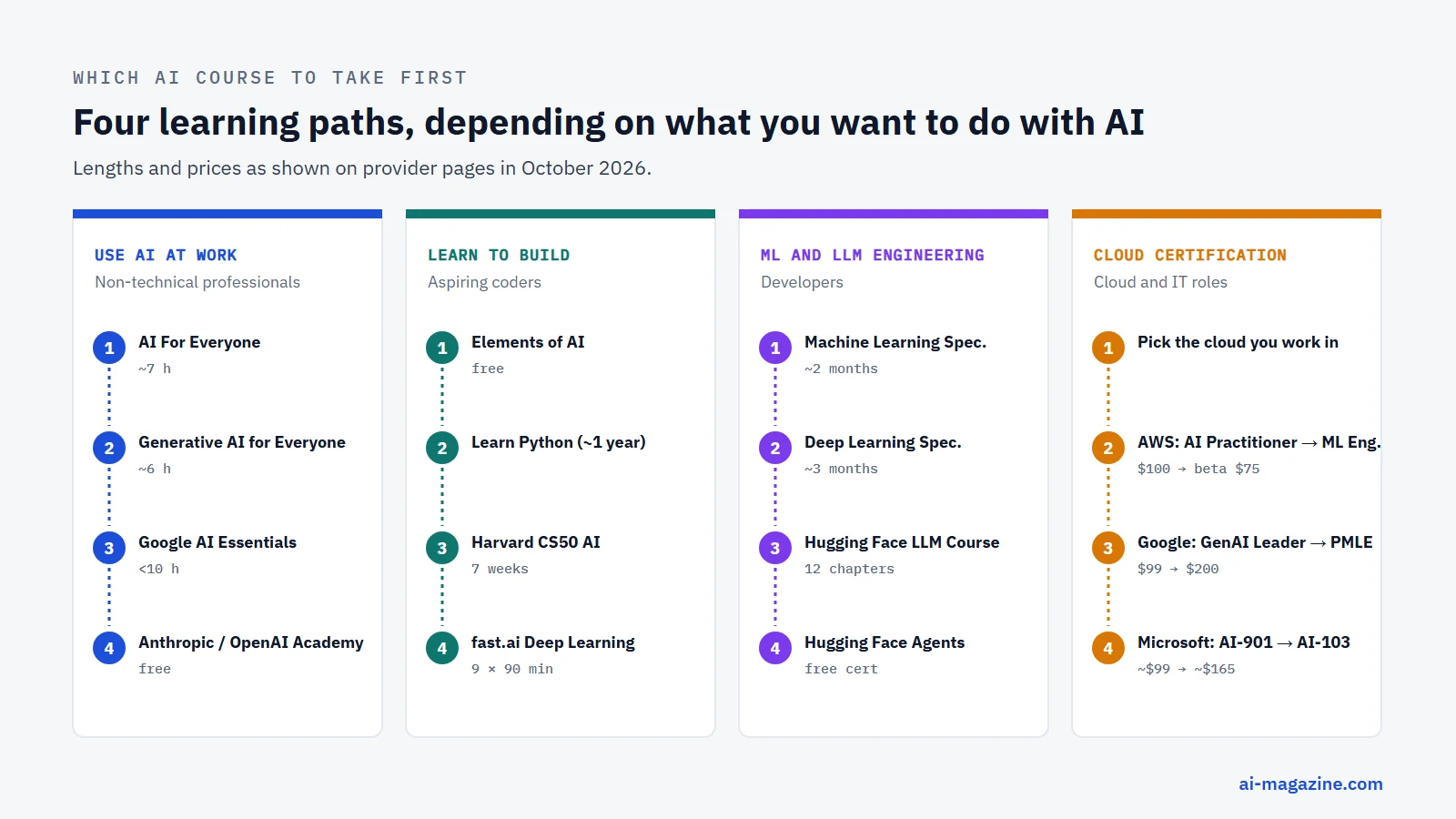
Your starting point depends on your current skills. Follow this numbered path to avoid overwhelm.
- Non-technical professionals: Start with AI For Everyone by Andrew Ng. It takes seven hours and covers business applications without code. Then move to Generative AI for Everyone, which takes six hours. These courses build context without technical debt.
- People who want to code: Begin with Elements of AI (part one needs no programming, part two recommends basic Python). Once you have about a year of Python, take Harvard’s CS50 AI (seven weeks, free certificate) and then fast.ai’s Practical Deep Learning for Coders (nine 90-minute lessons). If you prefer a structured paid path, take the Machine Learning Specialization instead.
- Developers moving into ML/LLM engineering: Start with the Machine Learning Specialization to solidify fundamentals. Then take the Deep Learning Specialization. For LLMs specifically, take the Hugging Face LLM Course, which covers transformers and fine-tuning. It requires good Python skills. The Hugging Face Agents Course is also valuable, taking about three to four hours per unit.
- Cloud and IT people: Choose a cloud provider and stick to it. For AWS, take the AI Practitioner exam first, then the Machine Learning Engineer – Associate. For Google Cloud, start with the Generative AI Leader exam, then the Professional Machine Learning Engineer. For Microsoft, take AI-901, then AI-103. These paths align with industry hiring standards.
Total hours vary by path but range from 20 hours for non-technical roles to 100+ hours for engineering tracks. Consistency matters more than speed.
Are AI courses worth it?
The data supports investing in AI education. PwC’s 2026 Global AI Jobs Barometer, analyzing over 1 billion job ads in 27 countries, found that jobs requiring AI skills carry a 62% wage premium, up from 57% a year earlier. Jobs requiring AI skills grew 69%, compared to just 9% for all jobs. LinkedIn’s 2026 Jobs on the Rise report lists AI engineer as the No. 1 fastest-growing job in the US.
However, certificates alone are not enough. Microsoft and LinkedIn’s Work Trend Index 2024 survey of 31,000 workers in 31 markets found that 66% of leaders would not hire someone without AI skills, and 71% would rather hire a less experienced candidate with AI skills. Yet only 39% of AI users had received AI training from their employer. This gap suggests self-directed learning is valuable.
Certificates help, but a portfolio of projects helps more. Employers want to see that you can build and deploy models, not just pass an exam. Use courses to learn, but build something tangible to prove it.
FAQ
What is the best AI course for beginners?
For non-technical beginners, AI For Everyone by Andrew Ng is the best starting point. It takes seven hours and covers business applications without code. For those who want to code, Elements of AI is free and requires no prior math or programming knowledge. It is self-paced and accessible to everyone.
Are there free AI courses with a certificate?
Yes. Harvard’s CS50 AI gives a free certificate if you score at least 70% on each project. Anthropic Academy offers free courses with completion certificates on its platform. Hugging Face also provides free certificates for its Agents Course. Most other free courses, like fast.ai, do not include certificates.
Which AI certification is most recognized?
There is no independent ranking of AI certifications. The proctored exams from the big cloud providers (AWS, Google Cloud, Microsoft) are the most common in job ads for cloud roles, and the right one is the one for the cloud your employer uses. For non-technical roles, AWS AI Practitioner and Google Cloud Generative AI Leader are the entry points.
How long does it take to learn AI?
It depends on your goal. Non-technical courses take 6–10 hours. Technical specializations like the Machine Learning Specialization take about two months at ten hours a week. Deep Learning Specialization takes three months. Full career transitions can take six to twelve months of consistent study.
Do I need to know programming to take an AI course?
No. Courses like AI For Everyone and Generative AI for Everyone require no coding. However, if you want to build models, you need Python. The Machine Learning Specialization assumes basic coding skills. Practical Deep Learning for Coders requires about a year of coding experience.
Is the Google AI Essentials course worth it?
Yes, if you want to use AI in your daily work. It takes under ten hours and covers productivity, prompting, and responsible AI. It is part of a five-course specialization on Coursera. It is free for seven days, then requires a subscription. It is practical and immediately applicable.
Can I learn AI on my own for free?
Yes. Platforms like Hugging Face, fast.ai, and Elements of AI offer high-quality free content. You can learn Python, transformers, and fine-tuning without paying. Some free courses even include certificates (CS50 AI, Hugging Face Agents Course), but you get less personal feedback. It requires self-discipline.