ChatGPT vs Claude vs Gemini: Which AI Chatbot Is Best in November 2026?

ChatGPT, Claude and Gemini all cost about $20 a month for their main paid plan, and all three can search the web, remember you, talk out loud and write code. The differences are in what sits underneath: which model you actually get on each plan, how much text one conversation can hold, whether the app makes images and video, and what happens to your chats.
We compared the three consumer apps on prices, models, independent leaderboards, features and privacy settings, using the companies’ own pages and two public leaderboards, all checked between November 20 and 23, 2026. Short version: Claude leads on coding and on the broadest independent test, Gemini leads crowd-voted chat and is the only one with video generation on cheap plans, and ChatGPT has the most users and the cheapest top-tier models through the API, but the smallest working memory in its app.
At a glance
| ChatGPT | Claude | Gemini | |
|---|---|---|---|
| Company | OpenAI | Anthropic | |
| Free plan model | GPT-6 Luna | Sonnet 5.5, Haiku 5.5 | Gemini 4 Hydrogen |
| Main paid plan | Plus, $20/mo | Pro, $20/mo ($17 billed yearly) | Google AI Pro, $19.99/mo |
| Model on the $20 plan | GPT-6.1 Sol, GPT-6 Sol, GPT-6 Astra | Opus 5.5, Sonnet 5.5, Haiku 5.5 | Gemini 4 Neon |
| Cheapest paid plan | Go, $8/mo | Pro, $20/mo | AI Plus, $4.99/mo |
| Top plan | Pro 500, $500/mo | Ultra, $200/mo | AI Ultra, $199.99/mo |
| Context in the app | 27K (Free) to 400K tokens | 1M tokens on paid plans | 1M tokens on AI Pro |
| Makes images | Yes | No | Yes |
| Makes video | No | No | Yes, from AI Plus |
| Trains on your chats | Yes by default (Free, Go, Plus, Pro) | Only with “Help improve” on; default not stated | Yes by default, unless you turn it off |
| Users | 1.2 billion weekly (OpenAI) | Not disclosed | More than 1 billion monthly (Google) |
User numbers are the companies’ own claims and are measured differently (weekly versus monthly), so they are not directly comparable.
Prices: the same $20, different edges
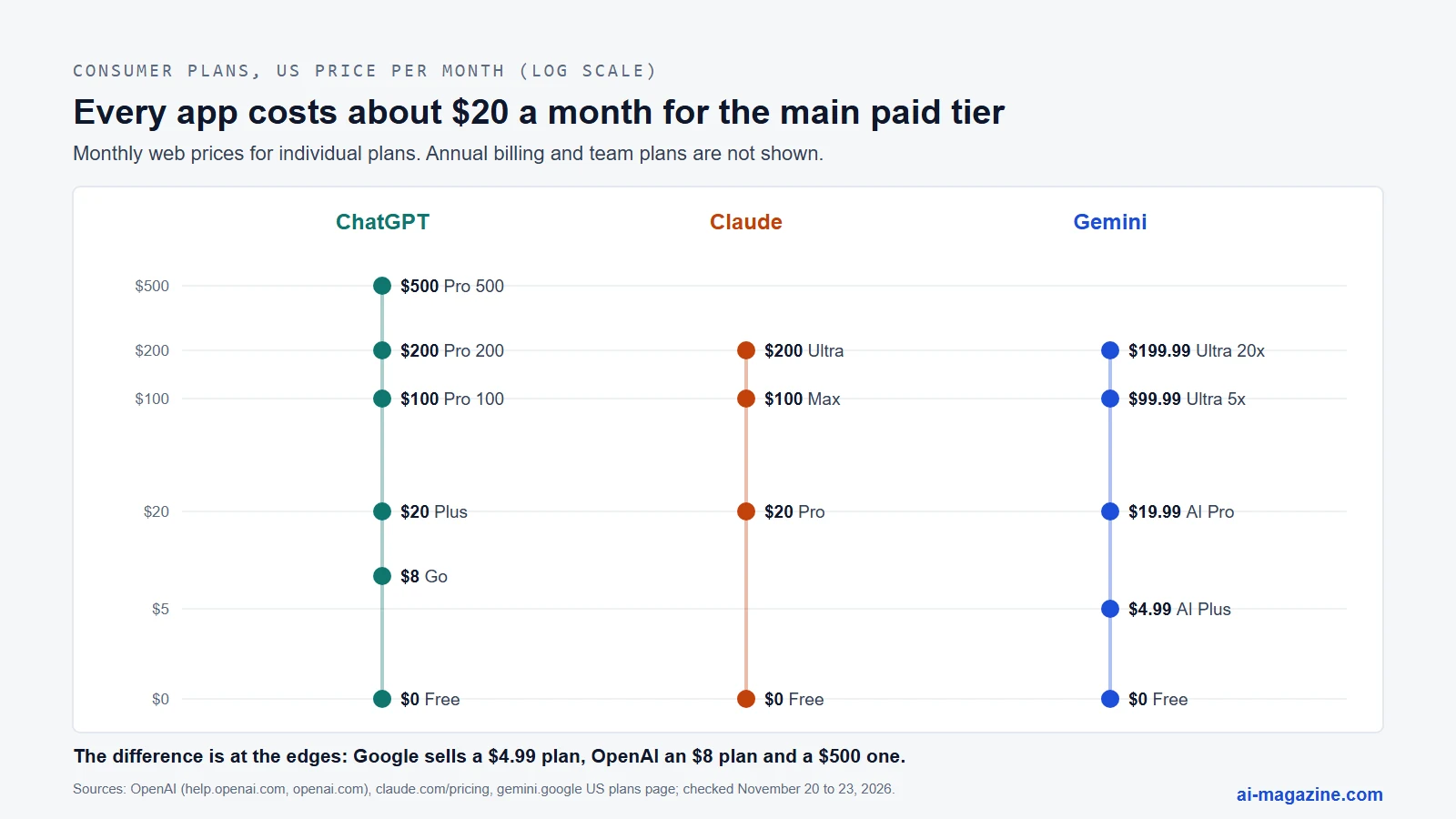
| Plan level | ChatGPT | Claude | Gemini |
|---|---|---|---|
| Free | $0 | $0 | $0 |
| Budget | Go, $8 (may show ads) | none | AI Plus, $4.99 |
| Standard | Plus, $20 | Pro, $20 or $17/mo yearly | AI Pro, $19.99 |
| Heavy use | Pro 100, $100 | Max, $100 | AI Ultra, $99.99 |
| Heaviest | Pro 200, $200; Pro 500, $500 | Ultra, $200 | AI Ultra 20x, $199.99 |
| Team seat | Business, $25 ($20 yearly) | Team, $25 ($20 yearly) | Through Google Workspace |
Sources: OpenAI’s Go launch post and Pro tiers help page, claude.com/pricing, Google AI plans. ChatGPT’s own pricing page did not show dollar amounts when we checked. Full plan-by-plan details are in our AI chatbot pricing tables.
Three things the headline prices hide:
- Usage limits are not published as numbers. All three describe limits as multiples (“5x Pro usage”, “4x the free limit”) that reset every five hours and every week, and that depend on how long your chats are and which model you use.
- Google’s plans bundle storage. AI Pro includes 5 TB of Google storage and YouTube Premium Lite. If you already pay for Google One, the effective price of the AI is lower.
- App Store prices can differ. On iPhone, Claude Max costs $124.99 a month and Ultra $249.99, versus $100 and $200 on the web, according to Anthropic’s App Store listing.
Which model you actually get
The chatbot name tells you little; the model behind it matters more, and it changes with the plan.
- ChatGPT. Free and Go run GPT-6 Luna, a small fast model, with GPT-5 Thinking Mini for harder questions. Plus adds GPT-6.1 Sol, GPT-6 Sol and GPT-6 Astra. OpenAI’s newest models, GPT-6.2 Astra and GPT-6.2 Sol, released November 17, are so far available only in ChatGPT Work and Codex for paying users, not in regular chat, according to OpenAI’s release notes.
- Claude. Free gets Sonnet 5.5 and Haiku 5.5. Pro adds Opus 5.5. Anthropic’s strongest model, Claude Fable 5.2 (November 9), is paid for with extra usage credits on Pro, and included for up to half the weekly limit on Max, Ultra and premium Team seats, per Anthropic’s help center. A launch week that gave Pro users Fable within their limits ended November 16.
- Gemini. Free and AI Plus run Gemini 4 Hydrogen. AI Pro gets Gemini 4 Neon since November 18, and AI Ultra gets Google’s top model, Gemini 4 Carbon.
So the fair $20 comparison is GPT-6.1 Sol and GPT-6 Astra versus Claude Opus 5.5 versus Gemini 4 Neon, not each company’s flagship.
Which is smartest: the leaderboards
We looked at two independent sources rather than the companies’ own benchmark tables.
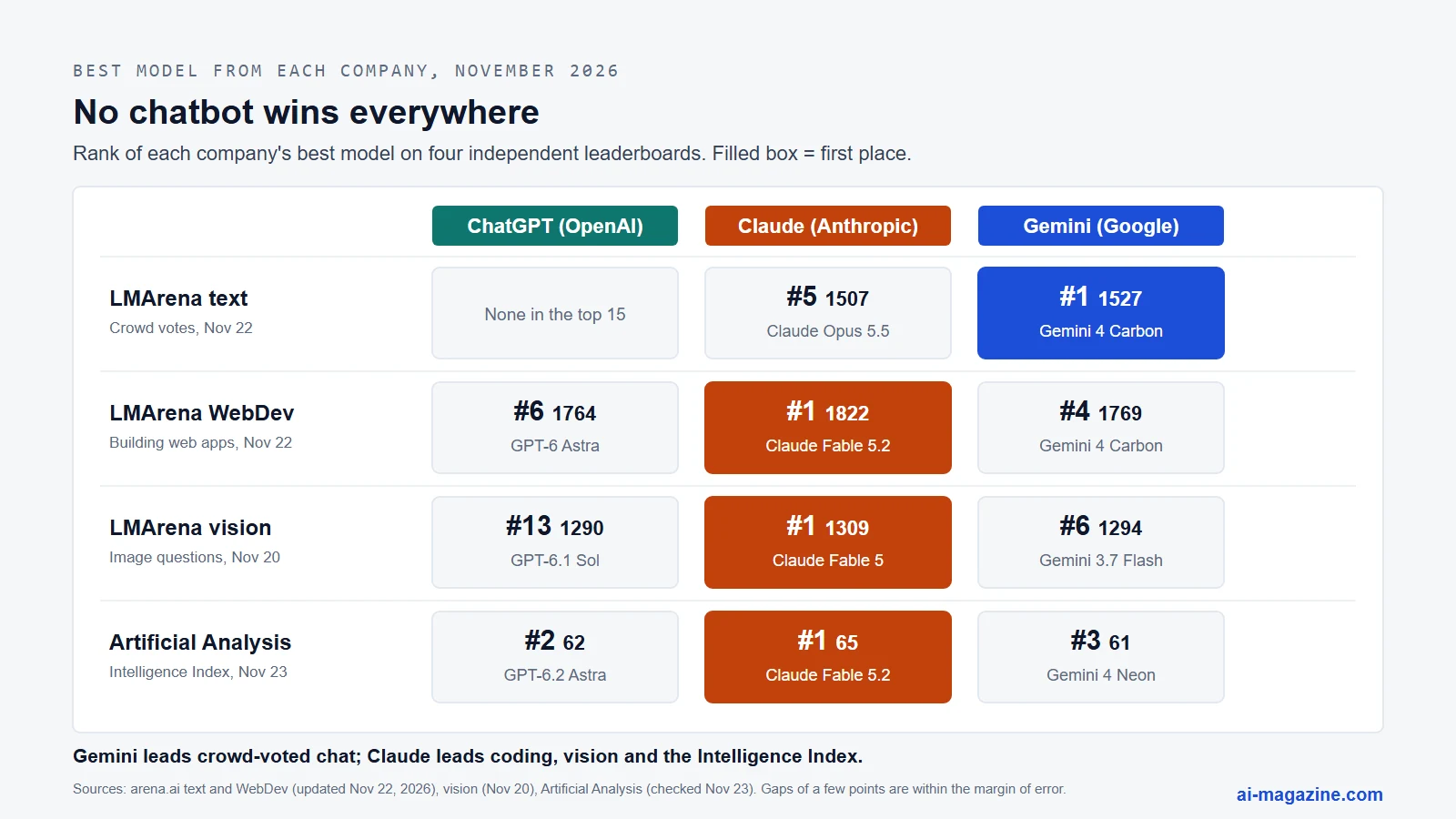
LMArena (arena.ai) ranks models by millions of blind votes: people see two anonymous answers and pick the better one. On the text leaderboard updated November 22, Google holds the top three places: Gemini 4 Carbon (1527), Gemini 4 Argon (1520) and Gemini 4 Neon (1512). Claude Opus 5.5 is fifth (1507) and Claude Fable 5.2 eighth (1502). No OpenAI model is in the top 15, the part of the table the page shows. On the WebDev leaderboard, where voters judge working web apps, the order flips: Claude Fable 5.2 (1822) and Claude Opus 5.5 (1820) lead, Gemini 4 Carbon is fourth and OpenAI’s GPT-6 Astra sixth. Claude models also lead the vision leaderboard.
Artificial Analysis (leaderboard) runs its own set of reasoning, knowledge, maths and coding tests. Its Intelligence Index puts Claude Fable 5.2 first (65), GPT-6.2 Astra second (62) and Gemini 4 Neon third (61).
How to read this: LMArena measures which answers people prefer in a quick side-by-side, which rewards clear, well-formatted replies; Artificial Analysis measures whether the model gets hard problems right. Differences of a few points on LMArena are inside the margin of error. Neither covers the full chatbot experience, such as search, memory or limits.
Price against performance
For developers using the API rather than the apps, the picture changes again.
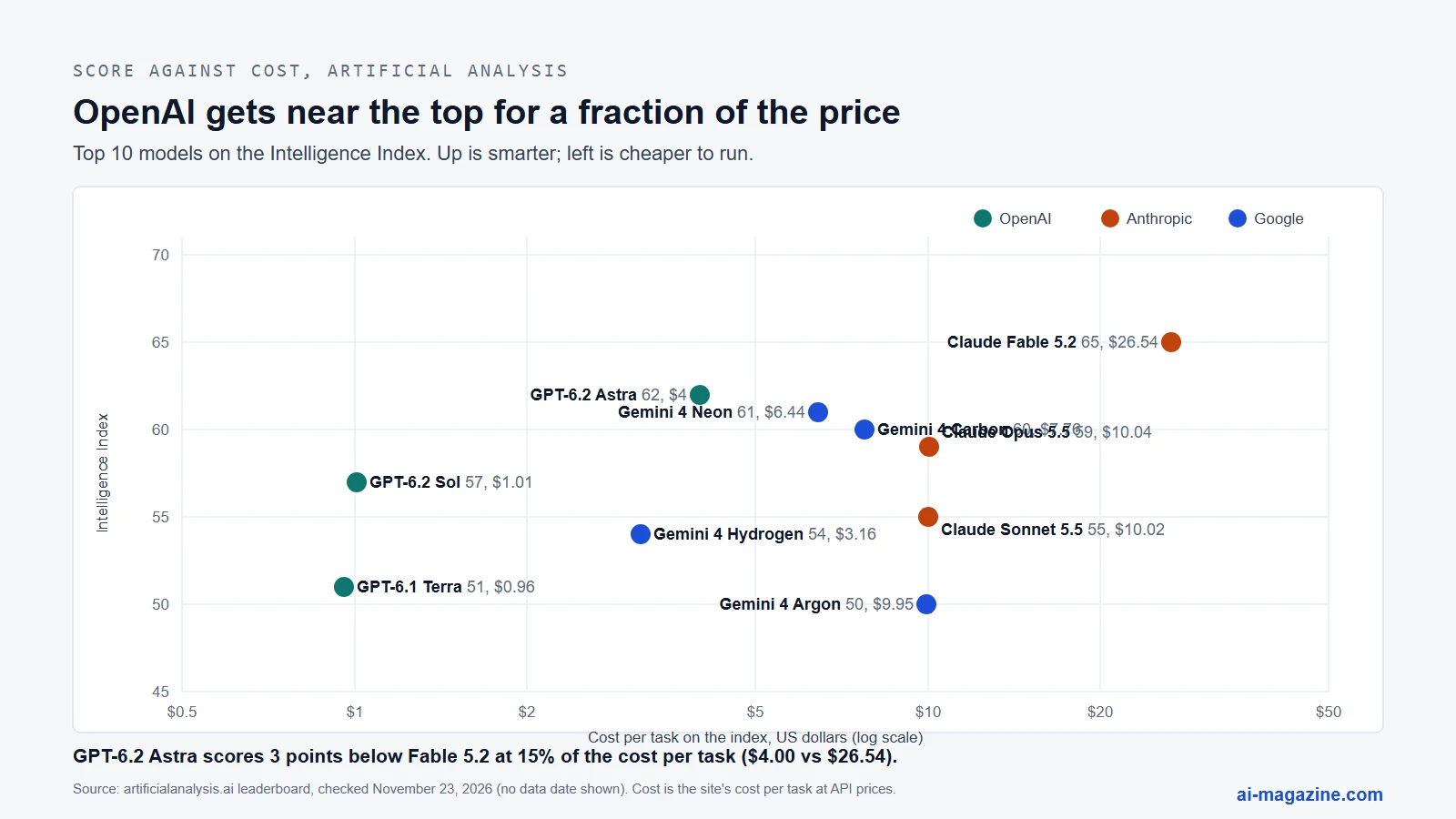
On Artificial Analysis’s cost per task, GPT-6.2 Astra scores three points below Claude Fable 5.2 for 15% of the cost ($4.00 versus $26.54), and GPT-6.2 Sol reaches 57 for $1.01. Claude’s models are the most expensive to run per task on this test. List prices per million tokens are close: Fable 5.2 and GPT-6.2 Astra both cost $8 input and $40 output, and Gemini 4 Neon $3 and $15. Compare them side by side: Fable 5.2 vs GPT-6.2 Astra, GPT-6.2 Astra vs Gemini 4 Carbon, Gemini 4 Carbon vs Opus 5.5, or see all API prices. Note that Gemini 4 Carbon’s API price doubles to $4 / $20 on December 1.
How much text it can hold
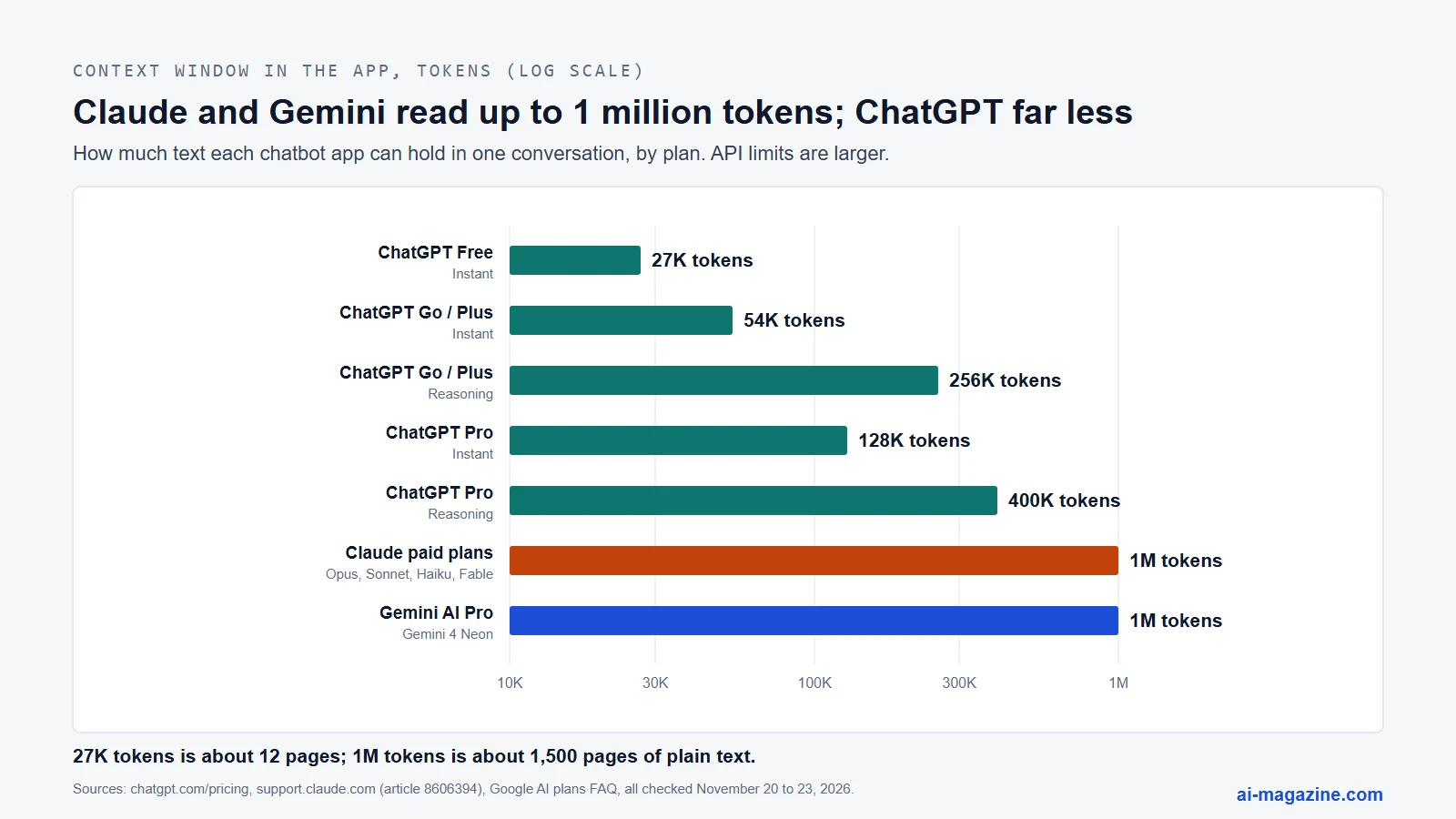
This is the biggest practical difference we found. The context window is how much text a conversation can hold at once: your messages, uploaded files and the replies. In the apps, Claude’s paid plans and Gemini’s AI Pro hold about 1 million tokens, roughly 1,500 pages. ChatGPT holds 27,000 tokens on Free (about 12 pages), 54,000 on Plus for quick answers and 256,000 when it reasons, and up to 400,000 on Pro, according to OpenAI’s pricing page. If you work with long contracts, books or large codebases in the chat window, this matters more than any benchmark. OpenAI’s models support about 1 million tokens through the API; the limit is in the app.
Features compared
| Feature | ChatGPT | Claude | Gemini |
|---|---|---|---|
| Image generation | Yes (Images 2.6) | No; makes charts and diagrams as code | Yes (Nano Banana), all plans |
| Video generation | No (Sora app closed April 2026) | No | Yes from AI Plus; Veo 3.1 on Ultra |
| Voice conversation | Yes, all plans | Yes, all plans (Free: Haiku only) | Yes (Gemini Live), free |
| Web search and deep research | Yes; deep research limited on Free | Yes; research from Pro | Yes; Deep Research on Free |
| Memory | Yes | Yes, including Free | Yes |
| Projects or notebooks | From Go | Up to 5 on Free, unlimited paid | Gemini Notebook |
| Coding agent | Codex | Claude Code (from Pro) | Antigravity (Gemini CLI ended for consumer plans June 2026) |
| Agents that do tasks | ChatGPT Work; dot on Pro | Cowork, scheduled tasks, Claude in Chrome | Tasks (free in six countries), Agent Mode on Ultra |
| Desktop computer use | Via Work and Codex desktop | Beta for Team and Enterprise (November 20) | Mac app, paid plans (November 19, press report) |
| Built into other apps | Connected apps | Microsoft 365, Slack, Gmail connectors | Gmail, Docs, Drive, Calendar, Android |
Sources: each company’s pricing page and release notes, checked November 20 to 23, 2026; items marked “press report” are not yet in the company’s own notes.
The pattern: Gemini is the most complete media package and the most tightly built into the products you may already use (Gmail, Android, Chrome). Claude is built around writing, analysis and coding, with no image or video generation. ChatGPT sits in between, with images and the broadest set of plugins, but no video since OpenAI closed Sora in April.
Privacy: who trains on your chats
| ChatGPT | Claude | Gemini | |
|---|---|---|---|
| Training on consumer chats | On by default (Free, Go, Plus, Pro) | Only with “Help improve” switched on; Anthropic does not state the default | On by default for most users (carried over from Keep Activity) |
| How to stop it | Settings, Data controls, “Improve the model for everyone” | Settings, Privacy | New separate training setting (rolling out since November 16) |
| Private or temporary chats | Temporary Chat, kept up to 30 days, not trained on | Incognito, never trained on | Temporary chats, kept about 2 months, not trained on |
| Business plans | Not trained on | Not trained on | Not trained on (Workspace) |
Sources: OpenAI’s Data Controls FAQ, Anthropic’s privacy center, Google’s Gemini Apps Privacy Hub.
Two recent changes are worth knowing. On November 16, Google split its single “Keep Activity” setting into History and a separate AI-training control; existing choices carry over, and with History off Google now keeps chats for about two months instead of 72 hours. OpenAI’s FAQ now says that sessions in Daybreak, its approval-only cybersecurity access programme, may be used for training even with the setting off; this affects only approved security users. Anthropic’s pages do not say whether its training switch starts on or off; press reports in 2025 said it was pre-selected when the choice was introduced. With it off, Anthropic keeps chats for 30 days; with it on, de-identified data for up to five years. Whichever app you use, check the setting yourself.
Who uses which
| ChatGPT | Gemini | Claude | |
|---|---|---|---|
| Official users | 1.2 billion weekly (OpenAI, September 2026) | More than 1 billion monthly (Alphabet, October 2026) | Not disclosed |
| Share of AI chatbot web visits, October 2026 | 55.7% | 24.2% | 11.5% |
| Change over a month | -0.7 points | -0.8 points | +1.9 points |
| US adults who use it (Pew, February 2026) | 44% | 24% | 6% |
Web share is from Similarweb and covers website visits only, not mobile apps. Claude is the smallest of the three but the fastest growing: claude.ai’s visits rose 24% in October, against 2% for chatgpt.com. Anthropic, which listed on Nasdaq on November 19, reports revenue rather than user numbers; most of its revenue comes from businesses using its API.
Known problems
- ChatGPT: the smallest context window in its app; ads on the Free plan in the US and in tests on Go; several outages this year, including a worldwide one in July; product churn (Sora closed in April, the Atlas browser in August); and lawsuits over its role in mental-health crises, which OpenAI disputes.
- Claude: frequent complaints about usage limits running out, especially at weekday peak hours, which Anthropic acknowledged in March; no image or video generation; its strongest model costs extra on the $20 plan; higher prices when bought through the iPhone app.
- Gemini: outages in June, July and October; longer retention of chats when history is off since November 16; the Gemini CLI coding tool was withdrawn from consumer plans in June; Google does not publish exact limits even for paid plans.
Claude vs ChatGPT
Pick Claude if you write, analyse long documents or code: it leads the coding and broad-intelligence leaderboards, holds about 1 million tokens in the app versus ChatGPT Plus’s 54,000 to 256,000. Pick ChatGPT if you want images, the widest choice of plugins and plans (including an $8 tier), or simply the tool most people around you use. On the API, OpenAI’s models are much cheaper per task.
ChatGPT vs Gemini
Pick Gemini if you live in Google’s apps, want video generation, or want a cheap plan: AI Plus at $4.99 includes video, and AI Pro gives a 1M-token context and 5 TB of storage for $19.99. Gemini also wins crowd votes on LMArena. Pick ChatGPT for its bigger plugin ecosystem, Codex for coding, and the stronger result on Artificial Analysis’s tests.
Gemini vs Claude
Both hold about 1 million tokens in the app and cost about $20. Gemini adds images, video, Google Workspace integration and a free Deep Research tool; it leads crowd-voted chat. Claude leads on coding, vision and the Intelligence Index, and its incognito chats are never used for training. If you mostly code or write, Claude; if you mostly search, plan and create media, Gemini.
Our verdict
There is no single best chatbot in November 2026, and the leaderboards agree on that: each company leads somewhere. For most people the $20 tier of any of the three is enough, and the free tiers are good enough to try all three before paying. Choose by what you do most:
- Coding and long documents: Claude.
- Google users, images and video, lowest price: Gemini.
- General use, images, the biggest ecosystem: ChatGPT.
- Privacy: none of the three is private by default on consumer plans; turn off training in the settings, or use a business plan.
If none of the three fits, our guide to ChatGPT alternatives covers Copilot, Perplexity, Grok, Mistral, DeepSeek and private options.
FAQ
Is Claude better than ChatGPT? On the November 2026 leaderboards, yes for coding and hard reasoning: Claude Fable 5.2 is first on LMArena WebDev and on the Artificial Analysis Intelligence Index, where OpenAI’s best model is second. ChatGPT has more features (image generation, more plugins) and a cheaper $8 plan.
Is Gemini better than ChatGPT? Gemini 4 Carbon is first on LMArena’s crowd-voted text leaderboard, where no OpenAI model is in the top 15. On Artificial Analysis, OpenAI’s GPT-6.2 Astra scores one point above Gemini 4 Neon. Gemini also has video generation and a 1M-token context window on AI Pro.
Which is cheapest? All three have free plans. The cheapest paid plan is Google AI Plus at $4.99 a month, then ChatGPT Go at $8. Claude’s cheapest paid plan is Pro at $20, or $17 a month billed yearly.
Can I use all three? Yes. Each has a free plan that needs only an account. Many people use one for coding or writing and another for search or images.
Which is best for coding? Claude, on the evidence available: Claude Fable 5.2 and Opus 5.5 hold the top two places on LMArena WebDev, and Claude Code is included from the $20 plan. OpenAI’s Codex and Google’s Antigravity are the alternatives; OpenAI’s models are cheaper per task through the API.
Which one doesn’t train on my chats? On consumer plans, ChatGPT and Gemini train on chats by default, and Claude does when its “Help improve” setting is on, which Anthropic does not say is off by default. All three let you turn training off, and their business and enterprise plans do not train on your data.
Do they get new models automatically? Yes, but not always on every plan. OpenAI’s GPT-6.2 models are not yet in regular ChatGPT chat, Claude Fable costs extra credits on the Pro plan, and Gemini’s top model, Carbon, is only on AI Ultra.
Related
- AI chatbot pricing: every plan compared
- The best ChatGPT alternatives
- LLM API pricing tables
- Gemini 4 Neon: price and benchmarks
- Anthropic IPO and the November market selloff
Prices are US monthly web prices. All figures checked November 20 to 23, 2026. Leaderboards change weekly; LMArena does not show confidence intervals or its style-control setting on the pages we read, and Artificial Analysis does not show a data date.