The Best ChatGPT Alternatives in 2026: Free and Paid AI Chatbots Compared
People look for ChatGPT alternatives for good reasons: a tighter budget, a privacy policy they don’t like, a need for sources and citations, or simply a different model that writes or codes better for them. ChatGPT is still the most used chatbot: in a February 2026 Pew Research Center survey, 44% of US adults said they use it, and OpenAI reported more than 900 million weekly users the same month. But rivals have caught up. On LMArena’s crowd-voted leaderboard of 22 October 2026, the top three text models came from Google, Anthropic and Meta, and OpenAI’s best listed model was 21st.
This guide compares the main alternatives as of October 2026: what each offers free, what it costs, which models it runs, and, often overlooked, whether it uses your chats to train its models by default. We read each provider’s own pricing and privacy pages, and we asked an AI model for recommendations 120 times to see how reliable that shortcut is. For full plan-by-plan prices, see our AI chatbot pricing pages.
ChatGPT alternatives compared
| Chatbot | Free version | Paid plans from (US, Oct 2026) | Uses your chats for training by default? | Best for |
|---|---|---|---|---|
| ChatGPT (baseline) | Yes; may show ads | Plus $20/mo (cheaper Go plan, about $8 per press reports) | Yes; turn off “Improve the model for everyone” | All-round use |
| Claude | Yes (Sonnet, Haiku) | Pro $20/mo ($17 billed yearly) | You choose at sign-up | Writing, analysis, coding |
| Google Gemini | Yes | Google AI Pro $19.99/mo | Yes, while Keep Activity is on | Google users, long documents |
| Microsoft Copilot | Yes | Microsoft 365 Personal $9.99/mo | Yes, with opt-out (older app) | Word, Excel and Outlook users |
| Perplexity | Yes | Pro $20/mo (press reports) | Yes, per press reports | Research with cited sources |
| Grok | Yes | SuperGrok about $30/mo (press reports) | Yes, unless you turn off “Improve the model” | Real-time X content |
| Meta AI | Yes, in WhatsApp, Instagram, Messenger | Not needed for chat | Chats used for ads outside EU, UK, South Korea (press reports) | Quick help inside Meta apps |
| DeepSeek | Yes, no paid plan | None | Yes, with an opt-out right; data stored in China | Strong free model |
| Mistral Vibe (Le Chat) | Yes | Pro $14.99/mo | Yes, with opt-out | A European option |
| Duck.ai | Yes, anonymous | Optional DuckDuckGo subscription | No: providers are barred from training on chats | Privacy |
| Local models (Ollama, LM Studio) | Free software | None | No: chats stay on your device | Full privacy, offline use |
Quick picks
- Best overall for writing and coding: Claude. Anthropic’s Opus 5.5 and Sonnet models consistently rank at the top of performance leaderboards, offering excellent reasoning and a clean interface.
- Best for Google users: Google Gemini. Deeply integrated into Workspace apps with a 1 million token context window, making it ideal for long document analysis.
- Best for Microsoft 365 users: Microsoft Copilot. Now bundled with M365 Premium, it offers advanced agentic research and deep integration with Word, Excel, and Outlook.
- Best for research with sources: Perplexity. According to press reports, it excels at providing cited, real-time answers rather than just generating text from memory.
- Best for privacy: Duck.ai. It strips your IP address before sending prompts to models, and its agreements bar the model providers from training on your chats.
- Best free open-weight option: DeepSeek. Offers its V4 models free, but data is stored in China and several governments have restricted the app on official devices.
- Best for many models in one app: Poe. Lets you switch between thousands of bots and models, from GPT-5 to Claude Sonnet 5, in one app.
The best ChatGPT alternatives, reviewed
Claude
Claude, from Anthropic, is the strongest all-round alternative on the rankings. Claude Opus 5.5 placed second on LMArena’s style-controlled leaderboard of 22 October 2026 with 1509 points, and Claude models filled most of places 4 to 8. The free tier is surprisingly robust, offering access to Sonnet and Haiku models along with web search, file creation, code execution, and memory features. You can create up to five projects and use Artifacts for real-time code previewing.
As of October 2026, paid plans start at $20/month for Pro, which unlocks Opus, Sonnet, and Haiku, plus advanced features like Claude Code and scheduled tasks. The Max tier starts at $100/month and adds priority access and $100 to $200 a month in API credits. On privacy, Anthropic asks every user to choose whether chats may be used to improve Claude; according to press reports, the toggle was pre-set to on when the choice was introduced in 2025. You can change it under Settings → Privacy → Model Improvement. If you do opt in, data may be retained in de-identified format for up to five years. Incognito chats are never used for training. Claude requires users to be 18 or older.
Google Gemini
Gemini has closed much of the gap with ChatGPT: Google reported more than 950 million monthly users in July 2026, and more than 1 billion was reported in August. Its flagship, Gemini 4 Argon, was first on LMArena’s leaderboard of 22 October 2026, with or without style control. The free tier is accessible via the app with a Google account, though specific model limits aren’t published. The paid tiers offer significant storage and access benefits: Google AI Pro is $19.99/month ($199.99 a year) and AI Ultra starts at $99.99/month; a cheaper AI Plus plan costs $7.99 according to press reports.
Gemini’s standout feature is its 1 million token context window, allowing it to ingest massive documents or codebases in one go. It integrates natively with Gmail, Docs, and Sheets, and offers features like Deep Research, Gemini Live, and Chrome Auto Browse. Privacy-wise, Gemini uses your activity to improve services by default if “Keep Activity” is on. You can change this to auto-delete after 18 months or turn off activity tracking entirely, though some data may still be retained for up to three years if reviewed by humans. Google says AI Ultra is available in more than 150 countries.
Microsoft Copilot
Microsoft Copilot has evolved from a simple chatbot into a full-fledged productivity suite. The free version offers limited usage. Copilot also comes with Microsoft 365 Personal ($9.99/month) and Family ($12.99), and Microsoft 365 Premium, at $19.99/month, replaces the discontinued Copilot Pro and includes advanced agentic research and analytics features. Copilot is deeply embedded in Word, Excel, PowerPoint, and Outlook, allowing you to generate drafts, analyze spreadsheets, and summarize meetings without leaving your workflow.
Privacy is a strong point for enterprise users: conversations in Microsoft 365 Copilot are not used for training. For the consumer app, you can opt out of training for conversation activity in the privacy settings. However, note that a new app version shipped in August 2026, and the default training settings for this newer version are still being verified.
Perplexity
Perplexity operates differently from standard chatbots; it is primarily a research tool. According to press reports, it provides real-time, cited answers by scouring the web, making it indispensable for students and professionals who need verifiable sources. The free tier offers basic queries, while, according to press reports, Pro ($20/month) and Max ($200/month) plans offer higher limits, faster speeds, and access to Perplexity Computer for complex tasks.
According to press reports, the default setting on Free, Pro and Max is to use your data for AI improvement (“AI data retention” is ON by default). You can turn this off in Settings, but logged-out users cannot opt out. Its chief executive said in 2025 that it handled 780 million queries in May 2025; no official 2026 figure is public. Enterprise plans ensure data is never used for training. Perplexity’s interface is clean and focused on delivering concise, sourced answers rather than long-form creative writing.
Grok
Grok, developed by xAI (now branded as SpaceXSI), offers a unique angle with real-time access to the X (formerly Twitter) platform. The free version is available on web and apps, with a paid SuperGrok tier offering higher limits and multi-agent reasoning. Recent updates include a weekly usage pool that covers Chat, Imagine (images), Voice, and Build modes. According to press reports, SuperGrok costs about $30/month and SuperGrok Heavy about $300/month.
Grok’s standout feature is its ability to analyze real-time sentiment and trends from X, combined with image generation and voice modes. Privacy-wise, you control whether your data is used for training. Private Chats are excluded from training and deleted within 30 days. However, if you don’t opt out, your data may be used to improve the model. Grok is for users aged 13 and over, with parental permission for ages 13 to 17.
Meta AI
Meta AI is accessible directly within WhatsApp, Instagram, Facebook, and Messenger, making it one of the most convenient alternatives for social media users. Since April 2026 the Meta AI app has run on Meta’s Muse Spark model, and Meta’s Muse Wonder ranked joint second on LMArena in October 2026. Chat is free; according to press reports, Meta also launched paid agent tiers at $20 and $100 a month in the US.
Meta AI’s primary differentiator is its deep integration into the Meta ecosystem. However, privacy is a concern: according to press reports, since December 2025 Meta uses Meta AI chats to personalize ads and content across its platforms, with no opt-out available except by stopping use of the AI entirely (except in the EU, UK, and South Korea). Meta said Meta AI reached 1 billion monthly users in May 2025. While convenient, the trade-off is that your conversations may influence the ads you see on Instagram and Facebook.
DeepSeek
DeepSeek offers a free chat application and web interface without subscription tiers, relying on open-weight models like V4 and V4.1. The app stores user data directly in China, which triggered immediate government scrutiny upon its rise. According to press reports, multiple nations including the US, Italy, South Korea, and Taiwan have restricted or banned DeepSeek on government devices due to privacy concerns. NASA blocked the app on staff devices in January 2025, and the US Navy advised against its use.
The privacy policy states that DeepSeek collects and processes personal data in the People’s Republic of China. The company uses this data to train and improve its machine learning models, though it lists a right to opt-out. Account and payment data is retained for as long as you maintain an account. Its terms say users under 18 should read them with a guardian. The app provides “Expert” (V4-Pro) and “Instant” (V4-Flash) modes, but storage in China remains the main consideration, especially for work data.
Mistral Vibe (Le Chat)
Mistral’s consumer product, now branded as Vibe (or Le Chat), provides a free tier with limited messages, basic image generation, and access to over 100 connectors. The Pro plan costs $14.99 per month, offering up to six times the free message limit, five times the web searches, and 15 GB of library storage. A Team plan is available at $24.99 per user. Mistral Medium is the recommended model for most tasks, and Mistral Large 4 ranked 111th on LMArena’s style-controlled leaderboard in October 2026.
By default, Mistral uses input and output data to train its artificial intelligence models on the consumer tier. You can opt out of this training in the settings, though feedback remains usable for training. Vibe integrates well with various third-party tools via its connector library, making it a versatile option for developers and power users who want to avoid vendor lock-in.
Qwen Chat and Kimi
Qwen Chat, developed by Alibaba, is a free service that powers one of the top-performing models on the LMArena leaderboard. The Qwen3.8-Max model ranks 23rd overall in style-controlled tests. The service is free to use, though official pricing for any potential premium tiers has not been publicly confirmed in primary sources. According to press reports, Qwen had more than 300 million monthly users across platforms in February 2026, and the mainland-China app 167 million in June 2026.
Kimi, built by Moonshot AI, operates on kimi.com and now promotes its K3.1 Pro model; Kimi K3 ranked 18th on LMArena in October 2026, the highest of any Chinese model. According to press reports, Kimi has a free tier and paid plans at $19, $39, $99 and $199 a month. Both are strong at coding and agent tasks; as with DeepSeek, check where your data is stored before using them for anything sensitive.
Duck.ai
Duck.ai provides anonymous access to AI chatbots through the DuckDuckGo ecosystem. It removes metadata like IP addresses before sending prompts to underlying model providers such as Anthropic, OpenAI, and Azure OpenAI. Provider agreements prohibit these partners from using prompts and outputs to develop or improve their own models. Data is deleted at most within 30 days, and some models offer zero data retention. Synced chats are auto-deleted after 18 months.
The service is free, though higher limits and access to additional models are available through a DuckDuckGo subscription, the price of which is not verified. Duck.ai is intended for users aged 18 or older, though minors may use it with parental supervision. Because the metadata is stripped and retention is short, it stands out as a strong privacy-focused option. It effectively decouples your chat history from the model providers, reducing the risk of your data being used for long-term model training.
Poe
Poe, owned by Quora, aggregates thousands of models including GPT-5, Claude-Sonnet-5, and DeepSeek-R1. Users receive daily points that reset every 24 hours. According to press reports, extra points cost $30 per million, and subscriptions range from $4.99 (Starter) to $249.99 a month (Pro Max). The Premium allowance reportedly decreased from one million to 660,000 points per month in July 2026.
Poe is ideal for users who want to test multiple models in one interface without managing separate accounts. The platform supports a wide variety of bots, from standard chatbots to specialized agents. While the point system can be complex, it allows free users to sample premium models daily. For heavy users, the paid tiers offer predictable access to high-volume usage. Poe remains a versatile hub for exploring the AI landscape, especially for users who want to compare different models side-by-side.
Run a model on your own computer
For maximum privacy, you can run open-weight models locally on your own hardware using tools like Ollama or LM Studio. Ollama is a free, open-source runtime that downloads and runs models such as Llama, Qwen, Gemma, DeepSeek, and Mistral directly on your Mac, Windows, or Linux machine. It provides a command-line interface and a local API. LM Studio offers a graphical desktop app that helps you find, download, and chat with these models, complete with an OpenAI-compatible local server.
Running models locally means your chats never leave your computer. Our guide on how to run an LLM locally with Ollama walks through the setup, and our list of the best open-source LLMs helps you pick a model. The trade-off is hardware dependency; you need sufficient RAM and GPU power to run larger models efficiently. This approach is ideal for users who prioritize data sovereignty and want to avoid subscription fees or internet connectivity requirements. It also allows for complete customization of the model’s behavior and parameters. Local models are perfect for sensitive documents or repetitive tasks where you don’t want any data transmitted to a third party.
Which chatbot is the best? What the rankings say
The LMArena text leaderboard, based on the October 22, 2026 dataset, shows Gemini 4 Argon (High) at the top with a score of 1517, followed closely by Claude Opus 5.5 (High) at 1509. Meta’s Muse Wonder (Max) also scored 1509, while Claude Fable 5 and 5.1 tied at 1503. The raw rankings place Gemini 4 Argon first at 1526, with Claude Opus 5.5 second at 1516. OpenAI’s GPT-5.6 Sol (xHigh) ranks 21st in style control with a score of 1485, and its newer GPT-6 models do not appear in the dataset yet, likely because they are too new.
These rankings are based on crowd-sourced votes and style-controlled comparisons, which can skew towards specific writing styles. The score gaps of a few points often sit within confidence intervals of roughly ±6–8, meaning many models are statistically tied. The leaderboard also includes 418 models, reflecting a highly fragmented market. While Gemini and Claude dominate the top spots, the closeness of the scores suggests that performance differences are often marginal and dependent on the specific task or prompt style. Users should view these rankings as a snapshot of current capabilities rather than a definitive hierarchy.
Which chatbots people actually use
Usage data reveals a stark contrast between leaderboard scores and real-world adoption. According to Similarweb data reported in the press for September 2026, ChatGPT holds 56.4% of the generative AI website visit share, down from 71.8% in October 2025. Gemini follows with 25.0%, and Claude has grown significantly to 9.6%, up from just 2.3% a year earlier. This shift indicates that users are diversifying their AI tools, with Gemini and Claude gaining substantial ground.
Pew Research’s February 2026 survey of US adults shows ChatGPT at 44%, Gemini at 24%, and Copilot at 17%. Meta AI sits at 14%, while Grok and Claude trail at 8% and 6% respectively. Overall chatbot use among US adults rose to 49% in 2026, up from 33% in 2024. Official user numbers show OpenAI with 900 million weekly active users, while Google reports over 950 million monthly active users for Gemini. Meta AI also claims 1 billion monthly active users. These figures highlight the massive scale of AI adoption, with ChatGPT remaining the most widely used, but competitors rapidly closing the gap.
Our test: we asked an AI for ChatGPT alternatives 120 times
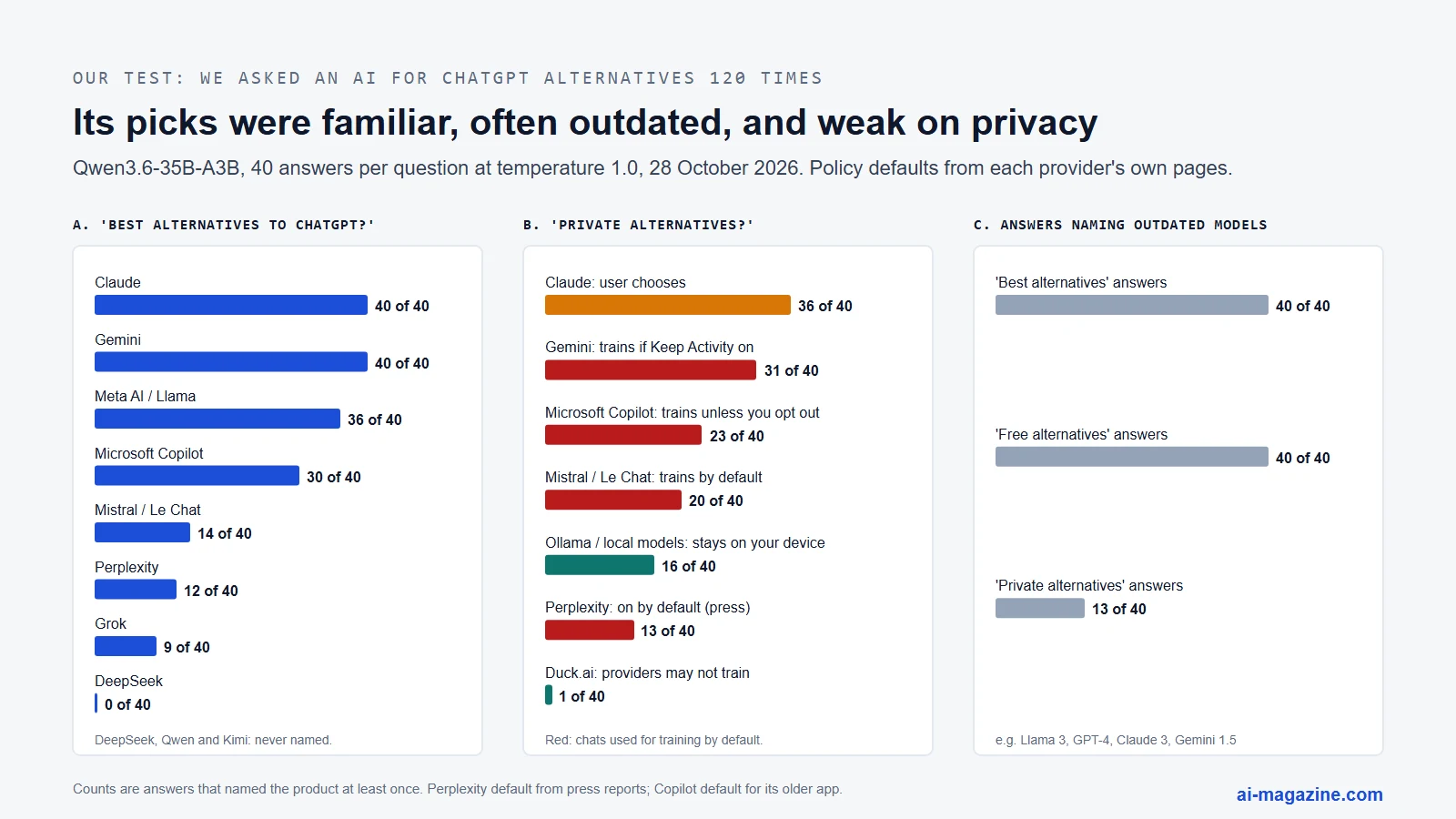
More people now ask a chatbot, not a search engine, which chatbot to use. So on 28 October 2026 we asked Qwen3.6-35B-A3B, a capable open-weight model running on our own server, three questions 40 times each: the best alternatives to ChatGPT, the best free ones, and the best ones for someone who does not want their chats used for training. Then we checked its answers against the providers’ own policies above.
| What we found | Result |
|---|---|
| Answers to “best alternatives” naming Claude / Gemini | 40 of 40 / 40 of 40 |
| Answers naming DeepSeek, Qwen or Kimi (best + free questions) | 0 of 80 |
| “Best” and “free” answers naming an outdated model (Llama 3, GPT-4, Claude 3, Gemini 1.5…) | 80 of 80 |
| “Privacy” answers naming Gemini, Copilot, Mistral or Perplexity, whose consumer versions use chats for training by default | 39 of 40 |
| “Privacy” answers mentioning Duck.ai | 1 of 40 |
| “Privacy” answers describing a “privacy mode” or “private mode” | 8 of 40 |
The picks were sensible but frozen in time. Every answer to the general and free questions named Claude and Gemini, which matches the leaderboards. But all 80 of those answers also described products by model names that are one to three generations old, such as Claude 3.5 Sonnet, Gemini 1.5 Pro, Llama 3 and GPT-4. An AI model only knows the market as it was when its training data was collected.
It never mentioned the Chinese options. DeepSeek, Qwen and Kimi, three of the most widely used chatbots in the world and all ranked in LMArena’s top 40, did not appear once in 80 answers to the general and free questions, even though the model we asked is itself made by the Qwen team.
Its privacy advice was the weakest part. For the privacy question, 39 of 40 answers named at least one service whose consumer version uses chats for training by default unless you change a setting (some pointed to business tiers, which don’t): Gemini (31 answers), Copilot (23), Mistral (20) or Perplexity (13). Several described features that do not exist under those names, such as a Gemini “Privacy Mode”, or claimed Mistral keeps “no data retention for training”, the opposite of its policy. Duck.ai, whose agreements forbid providers to train on chats, came up once. Local models were the one solid suggestion, in 16 answers.
What this means: use AI answers as a starting list, not a buying guide. Check current plans and privacy defaults on the provider’s own pages, as we did for the comparison table at the top.
Limits: one model, three prompts, 40 runs each. Larger commercial assistants with web search would likely give more current answers. We counted a product as recommended if the answer named it at least once.
Privacy: which chatbots train on your chats
Privacy settings vary significantly across platforms. ChatGPT enables data sharing by default on personal workspaces, meaning your chats are used to train the model. You can opt out in Settings → Data Controls or via privacy.openai.com. Temporary chats are not used for training but may be retained for up to 30 days. Claude asks users to choose at sign-up; according to press reports, the toggle was pre-set to on when the choice was introduced in 2025. If you allow training, data may be retained for up to five years in de-identified format. Deleted conversations are removed from backend storage within 30 days. Incognito chats are never used for training.
Google Gemini uses activity data to improve services, including training generative models, if “Keep Activity” is on. Auto-delete defaults to 18 months. If you turn off activity keeping, chats are retained for 72 hours and not used for training unless you send feedback. Human-reviewed chats can be kept for up to three years. Microsoft Copilot stores conversation activity for 18 months by default, but you can opt out of training in the Privacy settings. According to press reports, Meta AI uses chats to personalize ads and content by default, with no opt-out except by not using the service, except in the EU, UK, and South Korea.
Duck.ai and local models offer stronger privacy guarantees. Duck.ai strips metadata and deletes data within 30 days, with some models offering zero retention. Local models via Ollama or LM Studio keep all data on your device. DeepSeek stores data in China and uses it for training, with a right to opt-out. Mistral Vibe uses data for training by default but allows an easy opt-out. According to press reports, Perplexity’s AI data retention is on by default for Free, Pro, and Max tiers, but can be turned off in Settings. Logged-out users cannot opt out. Enterprise data is never used for training. Always review the specific privacy policy of your chosen chatbot, as defaults can change and retention periods vary.
Safety for teens
A November 2025 assessment by Common Sense Media, in partnership with the Stanford Brainstorm Lab, found that ChatGPT, Claude, Gemini, and Meta AI are fundamentally unsafe for teen mental health support. The study noted that three in four teens use AI for companionship. Earlier per-product ratings, reported by TechCrunch in September 2025, put that Gemini’s kids and teen tiers are “High Risk,” while Meta AI and Character.AI are “Unacceptable.” ChatGPT is rated “Moderate,” and Claude is “Minimal,” though it is an 18+ product. These ratings highlight the need for parental supervision and careful selection of AI tools for younger users, especially those relying on them for emotional support.
How to choose a ChatGPT alternative
Choosing the right chatbot depends on your specific needs. Follow this checklist to make an informed decision:
- Identify your primary use case: Do you need coding assistance, creative writing, data analysis, or general chat? Some models excel in specific domains like coding or reasoning.
- Set your budget: Many services offer free tiers with limitations. Paid plans unlock higher usage limits, priority access, and advanced features. Compare the cost against the value of the time saved.
- Check ecosystem integration: If you use Microsoft 365, Copilot might be the most seamless choice. Google users may prefer Gemini. Consider how the chatbot integrates with your existing tools.
- Review privacy settings: Determine if data training is acceptable for you. Opt-out options vary in ease and effectiveness. If privacy is paramount, consider local models or services with strict data retention policies.
- Evaluate sources and citations: If you need reliable information, prioritize chatbots that provide clear citations and access to real-time web data.
- Consider age limits: Ensure the service meets the age requirements for you or your children. Some services require users to be 18 or older.
- Test the free tier: Most services offer a free version. Use it to assess speed, accuracy, and user interface before committing to a paid plan.
Frequently asked questions
What is the best free alternative to ChatGPT? There is no single “best” free alternative, as it depends on your needs. Claude, Gemini, and Mistral Vibe all offer robust free tiers with competitive performance. For privacy, Duck.ai and local models like those run via Ollama provide strong options without data training. Evaluate which model aligns with your specific tasks and privacy preferences.
Is there anything better than ChatGPT? On LMArena’s October 2026 leaderboard, Gemini 4 Argon and Claude Opus 5.5 scored higher than OpenAI’s best listed model, GPT-5.6 Sol; OpenAI’s newer GPT-6 models were not yet listed. However, “better” is subjective. ChatGPT remains the most widely used and integrated service. For specific tasks like coding or creative writing, specialized models may outperform ChatGPT. Test different options to see which fits your workflow best.
Which ChatGPT alternative is best for privacy? Duck.ai and local models are top choices for privacy. Duck.ai removes metadata and deletes data within 30 days, while local models keep all data on your device. Claude offers incognito chats that are never used for training. Meta AI uses data for ads by default, making it less private unless you are in the EU or UK. Always review the default data retention and training settings of your chosen service.
Is Claude better than ChatGPT? Claude often scores higher on leaderboards for reasoning and coding tasks. It offers a generous free tier and strong privacy controls, including incognito mode. ChatGPT, however, has a much larger user base and features such as its ChatGPT Work agent and Codex. The choice depends on whether you prioritize raw performance or ecosystem breadth.
Is DeepSeek safe to use? It depends on what you share. Data is stored in China, and the app has faced government bans in several countries due to data residency concerns. The privacy policy allows data use for training, with an opt-out option. It is a capable free option for non-sensitive tasks, but avoid it for confidential or work data.
Is Gemini free? Yes, the Gemini app is free with a Google account, offering limited usage. Paid plans like Google AI Pro and Ultra provide higher limits, more storage, and access to advanced models like Gemini 4 Argon. The free tier is sufficient for casual users, while power users may benefit from the paid tiers for increased usage and features.
Can I run a ChatGPT alternative offline? Yes, you can run open-weight models offline using tools like Ollama or LM Studio. These platforms allow you to download and run models like Llama, Qwen, and Mistral directly on your computer. This ensures complete privacy and works without an internet connection, provided your hardware meets the requirements. It is an excellent option for users who want full control over their data and computing resources.