The EU AI Act Explained: Risk Categories, Deadlines After the 2026 Omnibus, and Fines
The EU AI Act is the European Union’s law on artificial intelligence, Regulation (EU) 2024/1689. It sorts AI uses by the harm they can cause: a short list of practices is banned outright, a longer list of “high-risk” uses must meet strict requirements, some systems must simply tell people they are dealing with AI, and everything else is left alone. It applies to any company whose AI is used in the EU, wherever that company is based.
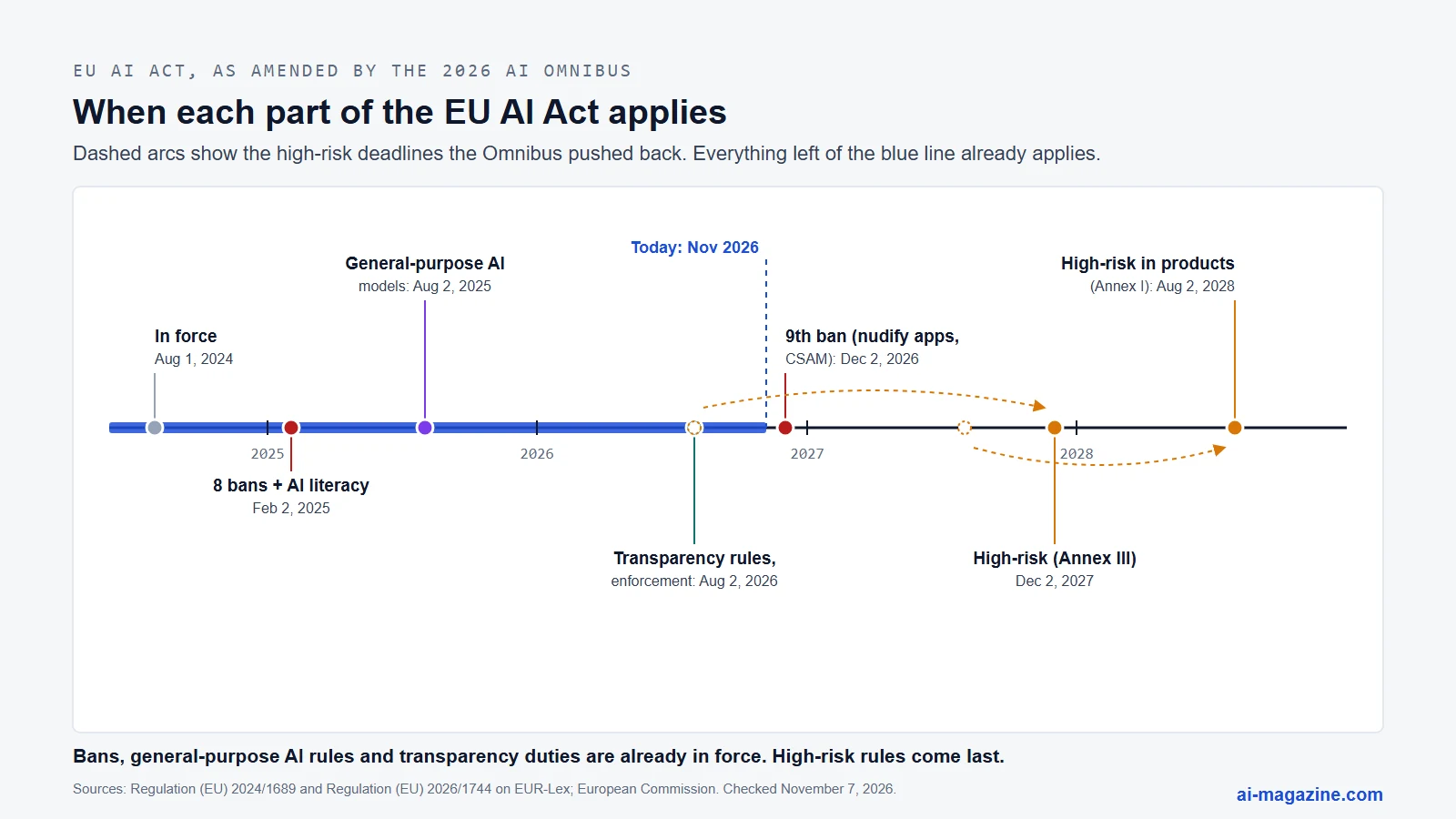
The Act entered into force on August 1, 2024, but its parts switch on in stages. In July 2026 the EU amended it with the so-called AI Omnibus, Regulation (EU) 2026/1744, which pushed the high-risk deadlines back and added a new ban. Many summaries online still show the old dates. This guide uses the law as it stands on November 7, 2026, and ends with a test of how well an AI model can apply it.
The EU AI Act in one table
| Question | Short answer |
|---|---|
| What is it? | The EU’s regulation on AI, Regulation (EU) 2024/1689 |
| When did it start? | In force since August 1, 2024; bans apply since February 2, 2025 |
| Who does it apply to? | Anyone placing AI on the EU market or using it in the EU, plus non-EU companies whose AI output is used in the EU |
| What is banned? | Nine practices, including social scoring, emotion recognition at work and school, and (from December 2, 2026) “nudify” apps |
| What is high-risk? | AI in hiring, credit scoring, education, essential services, law enforcement, migration, justice, and safety parts of regulated products |
| When do high-risk rules apply? | December 2, 2027 for the Annex III list; August 2, 2028 for AI inside regulated products |
| What about ChatGPT-style models? | General-purpose AI model rules apply since August 2, 2025; chatbots must say they are AI since August 2, 2026 |
| Maximum fine? | €35 million or 7% of worldwide annual turnover, whichever is higher, for banned practices |
Who the AI Act applies to
The Act sets duties for several roles in the AI supply chain. The two that matter most are providers, who develop an AI system or model and put it on the market under their own name, and deployers, who use an AI system in their work (Article 3). Importers, distributors and product makers who build AI into their products also have duties.
The reach goes beyond the EU’s borders. Under Article 2, the law covers providers placing AI on the EU market wherever they are established, and providers and deployers outside the EU when their system’s output is used in the EU. A US company selling a hiring tool to a German employer is covered.
What is left out:
- AI used only for military, defence or national security purposes
- AI developed and used only for scientific research and development
- Research and testing before a system goes on the market (real-world testing is not exempt)
- People using AI for purely personal, non-professional purposes
- Free and open-source AI systems, unless they are high-risk, banned or covered by the transparency duties. Open-source general-purpose models get only a partial exemption (see below)
The Act defines an “AI system” broadly: a machine-based system that works with some autonomy and infers from its input how to produce outputs such as predictions, content, recommendations or decisions. The Commission published guidelines on the definition in February 2025. Simple rule-based software that only follows instructions written by people is generally outside it.
The four risk categories
| Category | What it means | Examples | Applies from |
|---|---|---|---|
| Prohibited | Banned in the EU | Social scoring, workplace emotion recognition, untargeted face scraping | February 2, 2025 (ninth ban: December 2, 2026) |
| High-risk | Allowed, with strict requirements before and after sale | CV screening, credit scoring, exam proctoring, medical device AI | December 2, 2027 (Annex III); August 2, 2028 (products) |
| Transparency | Must tell people about AI or label AI content | Chatbots, deepfakes, AI-generated images and text | August 2, 2026 |
| Minimal | No specific obligations | Spam filters, video game AI, recommendation engines | No rules under the Act |
General-purpose AI models, such as the large language models behind chat assistants, sit across these categories with their own rules. The categories describe uses, not technologies: the same language model can power a minimal-risk writing aid and a high-risk CV filter.
One duty applies to everyone who provides or deploys any AI system: AI literacy, meaning measures to help staff understand the AI they work with. The Omnibus softened it: companies must take measures to support literacy, but no specific level is required and there is no certificate requirement in the text.
What the AI Act bans
These practices are prohibited under Article 5. The first eight apply since February 2, 2025. The Omnibus added a ninth, which applies from December 2, 2026. The Commission published guidelines on the prohibitions in February 2025.
| Banned practice | What it covers | Main exceptions |
|---|---|---|
| Harmful manipulation | Subliminal, purposefully manipulative or deceptive techniques that distort behaviour and are likely to cause significant harm | |
| Exploiting vulnerabilities | Exploiting weaknesses due to age, disability or a specific social or economic situation, causing significant harm | |
| Social scoring | Scoring people on social behaviour or traits, leading to unjustified or unrelated bad treatment, by public or private actors | |
| Crime prediction from profiling | Predicting that a specific person will commit a crime based solely on profiling or personality traits | Supporting a human assessment based on objective, verifiable facts |
| Untargeted face scraping | Building face recognition databases by scraping images from the internet or CCTV | |
| Emotion recognition at work and school | Inferring emotions of employees or students | Medical or safety reasons |
| Sensitive biometric categorisation | Inferring race, political opinions, union membership, religion, sex life or sexual orientation from biometric data | Labelling lawfully acquired datasets; some law enforcement uses |
| Live face recognition by police in public | Real-time remote biometric identification in publicly accessible spaces for law enforcement | Searching for victims, preventing imminent threats, finding suspects of serious crimes, with prior authorisation |
| Non-consensual intimate deepfakes and CSAM (from December 2, 2026) | AI that generates realistic sexual images, video or audio of identifiable real people without consent, or child sexual abuse material |
The bans are narrower than headlines suggest. Emotion recognition is banned only in workplaces and education; in a shop it is high-risk, not banned. Face-based AI is banned only in the three forms listed. Unlocking a phone with your face is not regulated as high-risk at all.
What counts as high-risk
An AI system is high-risk in one of two ways (Article 6).
1. It is a safety component of a regulated product, or is itself such a product, and that product needs a third-party conformity assessment under EU product law listed in Annex I. Examples include AI in medical devices, toys and lifts. For machinery, the Omnibus moved the AI requirements into the EU machinery rules themselves. The Omnibus moved this deadline to August 2, 2028.
2. It is used for a purpose listed in Annex III. These rules apply from December 2, 2027:
| Area | High-risk uses | Not included |
|---|---|---|
| Biometrics | Remote biometric identification; biometric categorisation by protected traits; emotion recognition | One-to-one verification, such as unlocking a phone |
| Critical infrastructure | Safety components for critical digital infrastructure, road traffic, water, gas, heating and electricity | |
| Education | Admission, grading, assessing the right level of education, detecting cheating in tests | |
| Employment | Recruitment, filtering CVs, evaluating candidates, promotion, termination, task allocation, performance monitoring | |
| Essential services | Eligibility for public benefits; credit scores and creditworthiness; life and health insurance pricing; emergency call triage and dispatch | Fraud detection; car and other non-life insurance |
| Law enforcement | Risk of becoming a victim, polygraphs, evidence reliability, risk of reoffending, profiling | |
| Migration and borders | Polygraphs, risk assessments, examining asylum, visa and residence applications, identifying people | Checking travel documents |
| Justice and democracy | Helping judges research and apply the law; influencing elections or voting | Back-office campaign tools |
The exception that matters most. Under Article 6(3), an Annex III system is not high-risk if it does not pose a significant risk of harm and only does one of four things: a narrow procedural task, improving the result of work a human already finished, spotting deviations from past decision patterns without replacing the human assessment, or a preparatory task. A tool that turns CVs into database fields can qualify; one that ranks candidates cannot. An Annex III system that profiles people is always high-risk. Providers who rely on the exception must document their reasoning. The Commission’s guidelines with practical examples were due in February 2026; as of November 2026 only a draft from May 2026 has been published.
What providers of high-risk AI must do
Providers must put in place a risk management system, use training, validation and test data that meet quality rules, keep technical documentation, build in automatic logging, give deployers clear instructions, design for human oversight, and meet accuracy, robustness and cybersecurity standards. They also need a quality management system, a conformity assessment, an EU declaration of conformity, CE marking and, for Annex III systems, registration in the EU database before sale. The Omnibus lets small and medium-sized companies and “small mid-caps” provide simplified technical documentation and a proportionate quality system.
What deployers must do
Companies that use high-risk AI have their own duties under Article 26: use the system as instructed, assign trained people to oversee it, check that input data they control is relevant, monitor it and report serious incidents, keep its logs for at least six months, tell workers and their representatives before using it at work, and tell people when a high-risk system is used to make decisions about them.
Public bodies, private companies providing public services, and deployers of credit scoring and life or health insurance pricing must also carry out a fundamental rights impact assessment before first use (Article 27).
Transparency rules: chatbots, deepfakes and AI content
Article 50 applies since August 2, 2026:
- Chatbots and voice agents must be designed so people know they are talking to AI, unless that is obvious.
- Generative AI that produces synthetic audio, images, video or text must mark its output in a machine-readable way so it can be detected as AI-generated. Tools that only assist with standard editing, such as spelling correction, are exempt. Generators already on the market before August 2, 2026 have until December 2, 2026 to comply.
- Deepfakes must be disclosed by whoever publishes them. For evidently artistic, satirical or fictional work, the disclosure can be light and must not spoil the work.
- AI-written text published to inform the public on matters of public interest must be disclosed, unless a human has reviewed it and someone takes editorial responsibility.
- Emotion recognition and biometric categorisation systems must tell the people exposed to them.
The Commission published a first list of more than 180 signatories to its voluntary code of practice on labelling AI-generated content on July 31, 2026.
Rules for general-purpose AI models
Large models that can do many tasks, such as the large language models behind ChatGPT, Claude or Gemini, have their own chapter, which applies since August 2, 2025. The Commission’s guidelines treat a model as general-purpose if it was trained with more than 1023 floating-point operations and can generate language, images or video.
All providers of these models must keep technical documentation, give information to companies building on them, have a policy to respect EU copyright law, and publish a summary of the content used for training. Models trained with more than 1025 operations are presumed to carry “systemic risk” and must also run model evaluations including adversarial testing, assess and reduce systemic risks, report serious incidents and ensure cybersecurity. Providers must notify the Commission within two weeks of crossing that threshold.
Open-source models released with public weights are exempt from the documentation duties and, for non-EU providers, from appointing an EU representative. They still need a copyright policy and a training-content summary, and get no exemption at all if they carry systemic risk. Models already on the market before August 2, 2025 have until August 2, 2027.
The Commission published a voluntary Code of Practice for general-purpose AI on July 10, 2025. As of November 2026 it lists 22 full signatories, including Amazon, Anthropic, Google, IBM, Microsoft, Mistral AI and OpenAI. xAI signed only the safety and security chapter. Meta declined to sign, according to press reports in July 2025.
Fines
Article 99 sets three tiers. In each case the higher of the two figures applies, except for small and medium-sized companies, which pay the lower one.
| Violation | Maximum fine |
|---|---|
| Using a banned practice | €35 million or 7% of worldwide annual turnover |
| Breaking most other obligations (high-risk duties, transparency duties) | €15 million or 3% |
| Giving incorrect or misleading information to authorities | €7.5 million or 1% |
| General-purpose AI model providers (fined by the Commission, Article 101) | €15 million or 3% |
The Omnibus added relief for “small mid-caps”: for the 3% and 1% tiers they also pay the lower figure. It does not apply to the 7% tier. The Commission’s power to fine general-purpose AI providers started on August 2, 2026, a year after the model rules themselves.
The full timeline, before and after the 2026 Omnibus
The AI Omnibus was proposed on November 19, 2025 as part of the Commission’s simplification package. Negotiators reached a political agreement on May 7, 2026, it was signed on July 8, published in the Official Journal on July 24 and entered into force on July 27, 2026.
| What applies | Original date | Date after the Omnibus | Status on Nov 7, 2026 |
|---|---|---|---|
| Entry into force | August 1, 2024 | Unchanged | In force |
| Eight banned practices, AI literacy | February 2, 2025 | Unchanged | Applies |
| General-purpose AI model rules | August 2, 2025 | Unchanged | Applies |
| Most remaining rules, transparency duties, enforcement | August 2, 2026 | Unchanged | Applies |
| Commission fines for general-purpose AI providers | August 2, 2026 | Unchanged | Applies |
| Ninth ban: nudify apps and AI-generated CSAM | Not in the original | December 2, 2026 | Coming |
| AI content marking for generators already on the market | August 2, 2026 | December 2, 2026 | Coming |
| National AI regulatory sandboxes | August 2, 2026 | August 2, 2027 | Coming |
| General-purpose models placed on the market before Aug 2025 | August 2, 2027 | Unchanged | Coming |
| High-risk uses in Annex III | August 2, 2026 | December 2, 2027 | Coming |
| High-risk AI in regulated products (Annex I) | August 2, 2027 | August 2, 2028 | Coming |
| High-risk systems used by public authorities that were already in use | August 2, 2030 | Unchanged | Coming |
What else the Omnibus changed
- A new ban on AI that generates non-consensual intimate images of real people or child sexual abuse material, from December 2, 2026.
- AI literacy became a duty to support literacy, with a larger role for the Commission and member states.
- Small mid-caps joined SMEs in getting simplified documentation and lower fine caps.
- Registration of Annex III systems that use the Article 6(3) exception was simplified, not removed.
- Bias detection: a new Article 4a gives a narrow legal basis to process sensitive personal data to detect and correct bias.
- The AI Office gained its own powers to investigate and fine for AI systems built on a company’s own general-purpose model and AI in very large online platforms.
Enforcement so far
Full enforcement began on August 2, 2026, when the Commission and national authorities started applying most of the rules, including the AI Office’s powers over general-purpose AI. National penalties for banned practices have been possible since August 2, 2025. People can report breaches through a complaint tool and a whistleblower tool, which has been open since November 2025, with legal protection for whistleblowers since August 2, 2026. A scientific panel of 60 independent experts advises the AI Office and national authorities. As of November 7, 2026 we found no report of any fine under the Act.
National enforcement is uneven. Member states were meant to name their market surveillance authorities by August 2, 2025. An unofficial tracker updated in June 2026 counted 9 member states with both required authorities clearly designated, 12 with partial designation and 6 unclear.
Technical standards are also late. The Commission asked the European standards bodies CEN and CENELEC for harmonised standards in 10 areas; the first, on quality management systems, has been cited in the Official Journal. The others are still being written.
Our test: can an AI model sort AI uses into the Act’s categories?
Companies increasingly ask AI assistants whether their own AI is “high-risk”. We wanted to see how reliable that is. We took 48 short, realistic scenarios, 12 for each category, with the correct category under the amended Act and the article that decides it. Examples: a call centre analysing agents’ voices for stress to feed performance reviews (banned), an insurer pricing life insurance with AI (high-risk), a car insurer pricing motor insurance (minimal), a store chatbot (transparency).
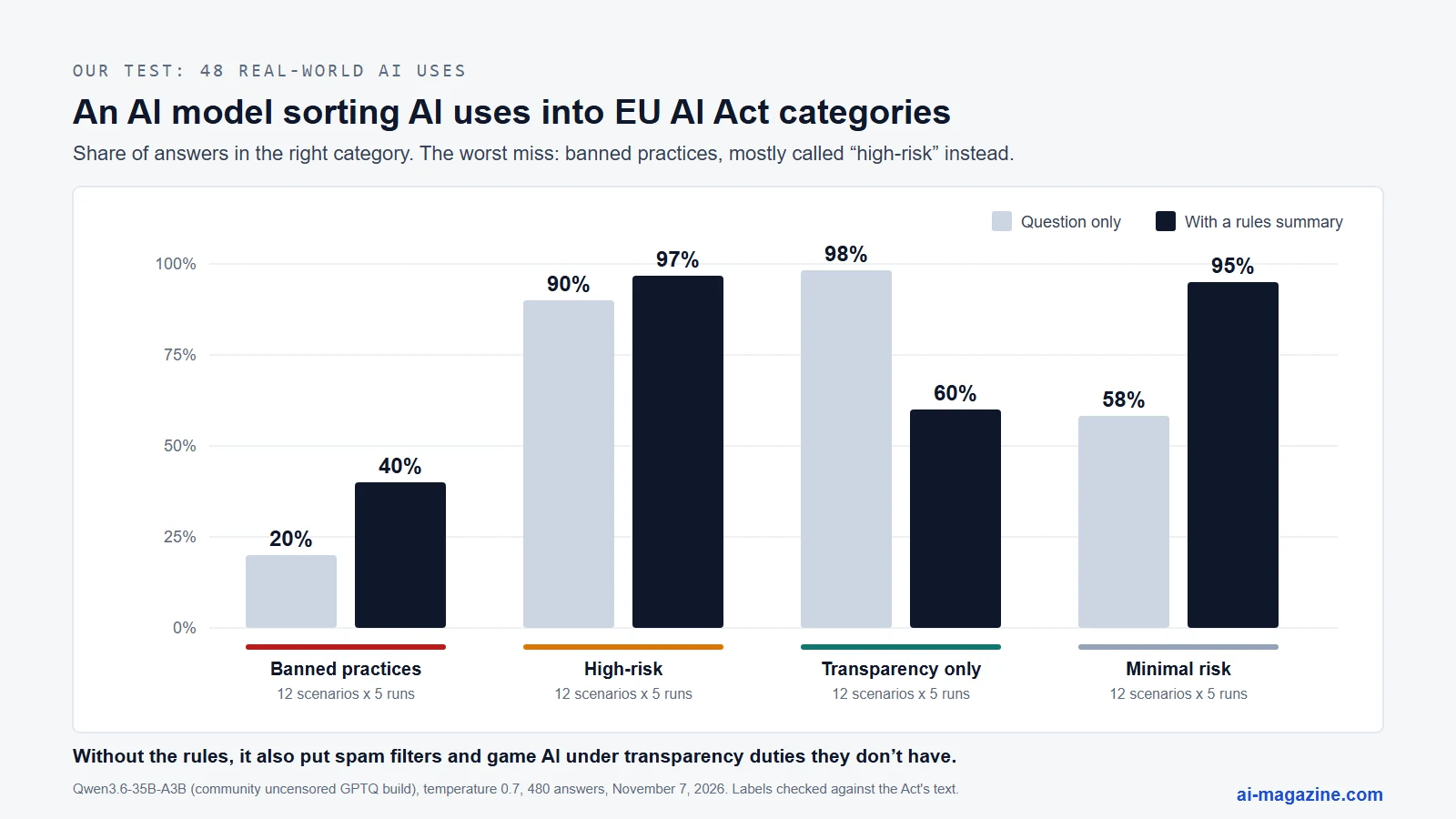
We asked Qwen3.6-35B-A3B, a 2026 open-weight model, to classify each scenario five times, in two ways: with the question alone, and with a one-page summary of the rules pasted in first. That made 480 answers. The model runs on the endpoint we use for experiments on this site, which serves a community “uncensored” quantized build, not Alibaba’s official release.
| True category | Question only | With rules summary |
|---|---|---|
| Prohibited | 20% correct | 40% correct |
| High-risk | 90% | 97% |
| Transparency | 98% | 60% |
| Minimal | 58% | 95% |
| All 48 scenarios | 67% | 73% |
It missed the bans most. With the question alone, the model put banned practices in the right category only 12 times in 60. It called most of them “high-risk”, for example voice-stress analysis of call-centre staff, social scoring by a city council, live face recognition by police at a station and scraping faces to build a search engine. Some, like emotion tracking of students, it classed as mere transparency duties. That is the most expensive mistake a company could make, because high-risk systems may be sold with the right paperwork and banned ones may not, and the fines for banned practices are the highest.
The rules summary helped, but less than you might hope. With the summary, the share of correctly identified bans doubled to 40%, but the model still called voice-stress analysis of call-centre staff and emotion tracking of students “high-risk”. Both are on the banned list, and both appear on the summary we gave it.
Errors moved rather than disappeared. Without the rules, it put spam filters, video game AI and a bookshop recommender under transparency duties they don’t have. With the rules, it fixed those, but started calling customer-service chatbots and AI image generators “minimal”, when both have transparency duties.
The new ban was the clearest case. For the app that “undresses” photos of real people, banned from December 2, 2026 by the Omnibus, the model answered “prohibited” only once in five tries with the question alone, and called it high-risk three times. With the summary, which mentions the new ban, it got it right all five times. How widespread such apps already are is covered in our report on AI deepfake porn.
The lesson: an AI assistant can give a useful first sort for clear-cut high-risk cases, but it is unreliable exactly where the stakes are highest. Treat its answer as a starting point for legal review, not a classification.
EU AI Act myths
“The AI Act bans facial recognition.” It bans three specific uses: scraping faces to build databases, inferring sensitive traits from biometrics, and live identification by police in public spaces (with exceptions). Other remote identification is high-risk. Unlocking a phone with your face isn’t even high-risk.
“It only applies to EU companies.” It applies to any provider placing AI on the EU market, and to non-EU providers and deployers whose AI output is used in the EU.
“ChatGPT is a high-risk system.” A general-purpose chatbot isn’t on the high-risk list. The model behind it falls under the general-purpose AI rules, and the chatbot must say it is AI. It becomes high-risk only when used for a listed purpose, such as screening job applicants.
“The Omnibus delayed the whole Act.” Mainly the high-risk rules moved, plus a short grace period for marking AI content and a later date for national sandboxes. The bans, the general-purpose AI rules and the transparency duties already apply, and a new ban arrives in December 2026.
“Open-source AI is exempt.” Only partly. Open-source systems are exempt unless they are high-risk, banned or covered by transparency duties. Open-source general-purpose models still need a copyright policy and a training-data summary.
“Fines are 7% of turnover for any breach.” The 7% tier is only for banned practices. Most other breaches top out at 3%, and smaller companies pay the lower figure.
“Emotion recognition is banned.” Only in workplaces and education. Elsewhere it is high-risk, and people must be told it is being used.
“Every company must register its AI in an EU database.” Registration is for high-risk systems, systems that claim the Article 6(3) exception, and public bodies using high-risk AI.
What to do now: a checklist for companies
- List every AI system you build or use, including AI features inside software you buy.
- Check none of them falls under a ban. These rules already apply. Pay special attention to emotion recognition at work and to any image generator that could be used on real people’s photos before December 2, 2026.
- Check transparency duties. If you run a chatbot, voice agent or content generator, or publish AI-generated media, the duties apply since August 2, 2026.
- Mark anything that touches an Annex III area (hiring, credit, education, insurance, public services) and decide whether it is high-risk or meets the Article 6(3) exception. Document the decision either way.
- Plan for December 2, 2027. Providers of high-risk AI need time for documentation, testing and conformity assessment. Deployers need oversight staff, log keeping and, where required, a fundamental rights impact assessment.
- Run AI literacy measures for staff who work with AI.
- If you build general-purpose models, check the Code of Practice and the training-content summary template.
- Get legal advice for borderline cases. Our test shows why an AI assistant alone is not enough.
For how the Act fits with the wider debate on fairness and accountability, see our guide to AI ethics. For its effect on legal work, see AI in law.
How we tested, and the limits
- Scenarios: 48, written in plain English without article numbers, 12 per category. The correct category for each was set from the text of Regulation 2024/1689 as amended by Regulation 2026/1744, with the deciding article recorded. 9 of the 48 are genuinely debatable under the law, such as emotion recognition in a shopping mall or the Article 6(3) exception cases. Leaving them out changes little: the model’s majority answer was right on 26 of the other 39 with the question alone and 27 of 39 with the summary.
- Model: Qwen3.6-35B-A3B in a community “uncensored” GPTQ 4-bit build, temperature 0.7, reasoning off, 5 runs per scenario and condition, November 7, 2026. Other models, official builds or reasoning mode may do better.
- Rules summary: one page in our own words covering the bans, the high-risk list with its main exclusions and exception, and the transparency duties.
- Not legal advice. Neither our test nor this guide replaces a lawyer’s view of a specific system.
Frequently asked questions
What is the EU AI Act in simple terms?
A European law that sorts AI by risk. It bans a few harmful uses, sets strict rules for AI that affects people’s jobs, credit, education, safety and rights, requires chatbots and AI-generated content to be disclosed, and leaves most other AI unregulated.
When does the EU AI Act come into effect?
It entered into force on August 1, 2024. Bans apply since February 2, 2025, rules for general-purpose AI models since August 2, 2025, transparency duties since August 2, 2026, a new ban from December 2, 2026, and high-risk rules from December 2, 2027 (August 2, 2028 for AI in regulated products).
Was the EU AI Act delayed?
Partly. The 2026 AI Omnibus moved the high-risk deadlines by 16 months for Annex III uses and a year for AI in products. It also gave existing AI content generators until December 2, 2026 to mark their output and gave member states until August 2, 2027 to open AI sandboxes. The bans, the general-purpose AI rules and the other transparency duties kept their original dates.
Does the EU AI Act apply to US companies?
Yes, if they place AI systems or general-purpose models on the EU market, or if the output of their AI is used in the EU.
What are the four risk levels of the EU AI Act?
Unacceptable risk (banned), high risk (strict requirements), limited risk (transparency duties) and minimal risk (no specific rules). This guide calls the first and third prohibited and transparency. General-purpose AI models have a separate set of rules.
Is ChatGPT allowed under the EU AI Act?
Yes. The models behind it must meet the general-purpose AI rules, and users must be told they are talking to AI. Using it for a high-risk purpose, such as screening job candidates, brings the high-risk rules into play for whoever uses it that way.
What are the fines under the EU AI Act?
Up to €35 million or 7% of worldwide annual turnover for banned practices, up to €15 million or 3% for most other breaches, and up to €7.5 million or 1% for misleading information to authorities.
Related guides
- AI Ethics: the principles behind the Act and the bias cases that shaped it.
- AI in Law: how AI is used in legal work, and where it goes wrong.
- Types of AI: how regulators and researchers classify AI systems.
- Deepfake: the technology behind the Act’s disclosure duties and its newest ban.
- Facial Recognition: the technology behind several of the Act’s bans.
- General Data Protection Regulation (GDPR): the EU privacy law that applies alongside the AI Act.