The History of Artificial Intelligence: From Turing to the LLM Boom
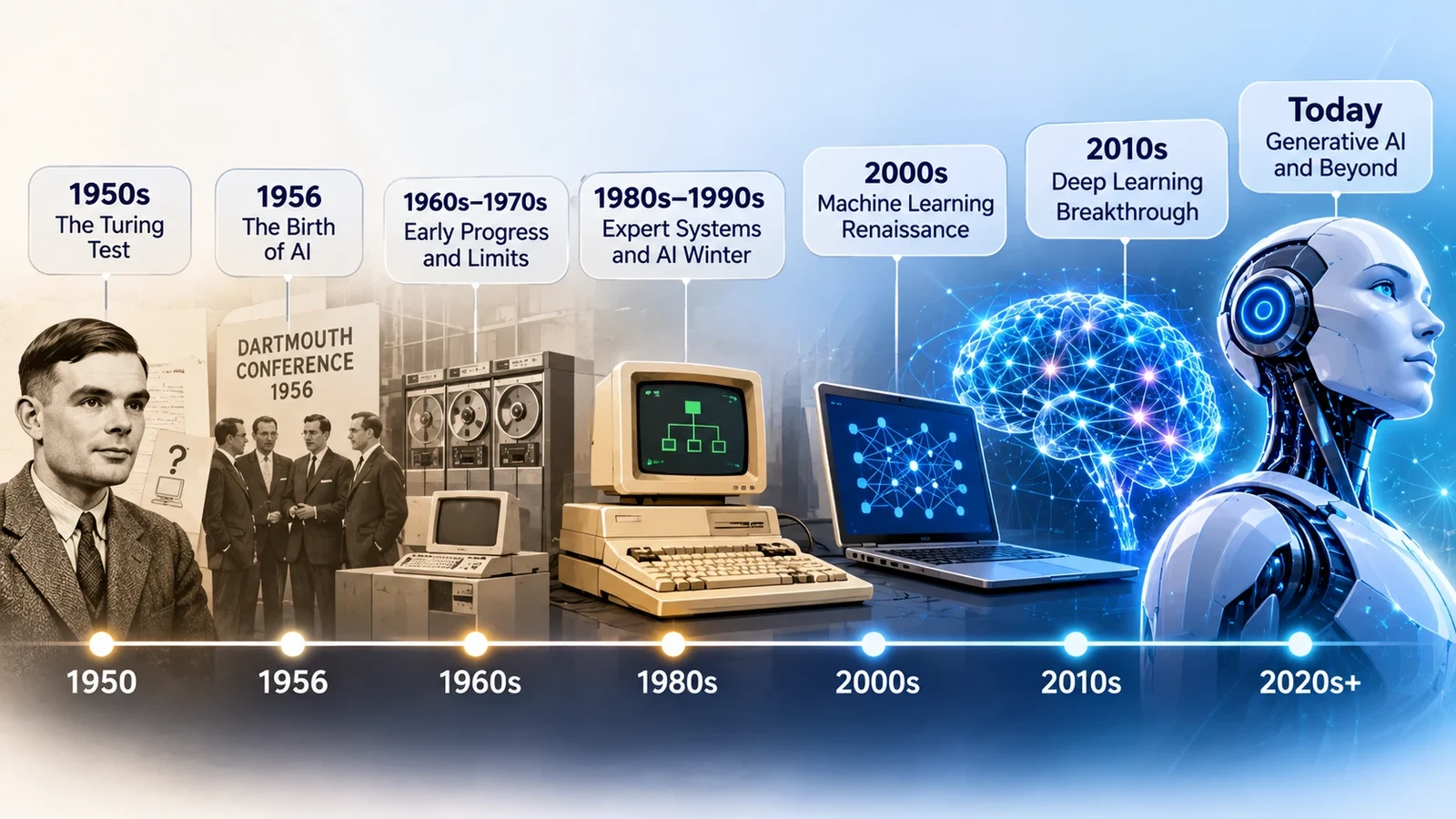
No single person invented artificial intelligence. The name comes from a proposal dated August 31, 1955, written by John McCarthy, Marvin Minsky, Nathaniel Rochester and Claude Shannon. Their workshop at Dartmouth College in the summer of 1956 is usually treated as the field’s birth. The ideas are older, though: an artificial neuron model appeared in 1943, and Alan Turing asked whether machines can think in 1950.
Since then, AI has gone through a repeating cycle of big promises, disappointment, funding cuts and comeback. This guide follows that story through to 2026 and checks the popular version against the original documents, which often say something different. It also includes our own count of AI paper titles in OpenAlex, an open index of scholarly works, year by year since 1960. The count shows one “AI winter” clearly and barely shows the other.
A short answer: who invented AI, and when?
| Question | Short answer |
|---|---|
| Who invented AI? | No one person. It grew from work by many researchers |
| Who is the “father of AI”? | Most often John McCarthy, who chose the name. Turing, Minsky, Herbert Simon and Allen Newell are also often given the title |
| When was AI invented? | It’s usually dated to the 1956 Dartmouth workshop. The term appeared in writing in August 1955 |
| What was the first AI program? | Disputed. The Logic Theorist (1956) is the usual answer, but checkers programs came earlier |
| What were the AI winters? | Periods when funding and interest fell, commonly dated about 1974 to 1980 and from 1987 into the 1990s |
| When did the current boom start? | Deep learning took off after 2012. ChatGPT brought it to the public on November 30, 2022 |
The AI timeline: key dates
| Date | Event | Why it mattered |
|---|---|---|
| 1843 | Ada Lovelace’s notes on the Analytical Engine | Said a machine could compose music, but had no power to originate anything |
| 1943 | McCulloch and Pitts neuron model | Simple threshold units could perform logic |
| 1950 | Turing’s “Computing Machinery and Intelligence” | Introduced the imitation game, now called the Turing test |
| 1955 | Dartmouth proposal | The term “artificial intelligence” appears in writing |
| 1956 | Dartmouth workshop | A summer workshop of about eight weeks, with people coming and going |
| 1958 | Perceptron | A machine that learned from examples, and an early hype cycle |
| 1966 | ELIZA | A simple chatbot that users took seriously |
| 1966 | ALPAC report | Found no near-term prospect of useful machine translation |
| 1969 | Perceptrons by Minsky and Papert | Showed limits of simple neural networks |
| 1973 | Lighthill report published | A harsh review that hurt UK funding |
| 1979 | MYCIN evaluated | A medical expert system outscored Stanford faculty in a small test |
| 1982 | Japan’s Fifth Generation project | A national bet on AI hardware and logic |
| 1986 | Backpropagation paper | Popularized training multilayer neural networks |
| 1987 | Lisp machine market collapses | Start of the second winter |
| 1997 | Deep Blue beats Kasparov | 3.5 to 2.5, and a chess forecast finally came true |
| 2009 | ImageNet | A labelled image set that gave deep learning its test bed |
| 2011 | Watson wins Jeopardy! | $77,147 against $24,000 and $21,600 |
| 2012 | AlexNet | 15.3% top-5 error against 26.2% for the runner-up |
| 2016 | AlphaGo beats Lee Sedol | 4 to 1, in a game long seen as out of reach for brute force |
| 2017 | Transformer | The architecture behind today’s LLMs |
| 2020 | AlphaFold at CASP14 | Median score of 92.4 in predicting protein structures |
| 2022 | ChatGPT | Brought LLMs to the general public |
| 2024 | Nobel Prizes in physics and chemistry | Recognized neural networks and protein structure prediction |
| 2025 | DeepSeek-R1 | A cheap-looking open model set off a record one-day Nvidia loss |
| 2026 | GPT-6, Gemini 4 and Claude 5.5 | The current frontier, tracked in our model catalog |
Before the name: 1843 to 1955
The idea that machines might do mental work is older than electronic computers. In 1843, Ada Lovelace wrote that Charles Babbage’s Analytical Engine might compose elaborate music if musical relationships could be expressed for it. She also wrote that the engine had “no pretensions whatever to originate anything”, a claim Turing later answered directly in his 1950 paper. She is often called the first programmer, though that is disputed: Babbage’s earlier notes contain programs too, and the engine was never built.
Three later papers set up the field:
- 1943: Warren McCulloch and Walter Pitts described neurons as simple logic units, the root of every neural network since.
- 1950: Claude Shannon showed why brute force alone couldn’t play chess, with roughly 10^120 possible games.
- 1950: Turing proposed the imitation game. His actual forecast was modest: that in about 50 years, an average interrogator would have no more than a 70% chance of spotting the machine after five minutes.
Practical work followed quickly. Minsky and Dean Edmonds built SNARC, a tube-based learning machine simulating a rat in a maze, in the early 1950s. Arthur Samuel’s checkers program improved through self-play on an IBM 701, and IBM credits Samuel with coining “machine learning”.
Dartmouth and the first boom: 1956 to 1973
The Dartmouth proposal asked the Rockefeller Foundation for $13,500 to fund a two-month, ten-man study. Its authors thought a carefully chosen group could make a significant advance in one summer. The foundation reportedly gave about $7,500, though that sum rests on secondary accounts.
The event itself was less grand than the legend. Grace Solomonoff, working from Ray Solomonoff’s notes, puts it at about eight weeks from June 18 to August 17, 1956, not the six weeks usually quoted. Only three people stayed throughout, and daily attendance ran from about three to about eight.
Newell, Simon and Cliff Shaw brought the Logic Theorist, which proved theorems from Principia Mathematica. Its famous score of 38 out of 52 theorems may come from 1957 runs, not the 1956 version.
The forecasts that aged badly
Optimism ran high, and leading researchers put dates on it. These claims later became the case against the field.
| Who and when | What they forecast | What happened |
|---|---|---|
| Simon and Newell, 1958 | A computer would be world chess champion within ten years | Deep Blue won in 1997, about 29 years late |
| Simon and Newell, 1958 | A computer would find and prove an important new theorem within ten years | Approximately true about 40 years later, according to Russell and Norvig |
| Simon and Newell, 1958 | Most psychological theories would take the form of computer programs within ten years | Not within that limit |
| Simon, 1965 | Within 20 years, machines could do any work a person can do | Didn’t happen |
| Minsky, 1967 | Within a generation, creating AI would be substantially solved | Didn’t happen on that schedule |
| Minsky, as quoted in Life, 1970 | Human-level general intelligence in three to eight years | Didn’t happen |
Simon himself said in 1998 that he regarded the 1958 predictions as highly successful and would make them again. We read the dates as the main error, not the direction, at least for chess and theorem proving. You can decide how that applies to the forecasts being made today.
Learning machines and the perceptron
Frank Rosenblatt’s perceptron was unveiled in July 1958. Fed punch cards, it learned to tell left-marked from right-marked cards after 50 trials. A press report, carried in the New York Times, relayed the Navy’s expectation of a machine that would one day walk, talk, see, write, reproduce and be conscious of its existence.
In 1969, Minsky and Seymour Papert’s book Perceptrons proved limits on simple networks. Popular accounts say it killed neural network research with its XOR result. That version has problems. It was already known that networks of these units could compute any logical function, and work on neural networks kept going, including in Kyiv and Tokyo, as we describe below.
Other landmarks included ELIZA, SHRDLU, which followed English commands in a tiny simulated world of blocks, and Shakey, the SRI robot project that gave us the A* search algorithm.
The first AI winter: did it really happen?
The usual story has funding collapsing in the mid-1970s after two blows.
The Lighthill report, written in July 1972 for the UK’s Science Research Council, not Parliament as often claimed, said AI had fallen short of its promises and singled out the combinatorial explosion as a general cause of the disappointments. It formed the basis for ending support for AI at most UK universities. In the US, the 1969 Mansfield Amendment pushed the defense agency DARPA towards mission-focused research, and it cut back in 1974.
Those cuts were real, but the historian Thomas Haigh argued in Communications of the ACM in 2023 that there was no first AI winter at all, pointing to growth in conferences, enrolment and publications through the 1970s. Membership of the ACM’s AI group rose from 1,241 in 1973 to 3,500 by mid-1978, by Haigh’s count.
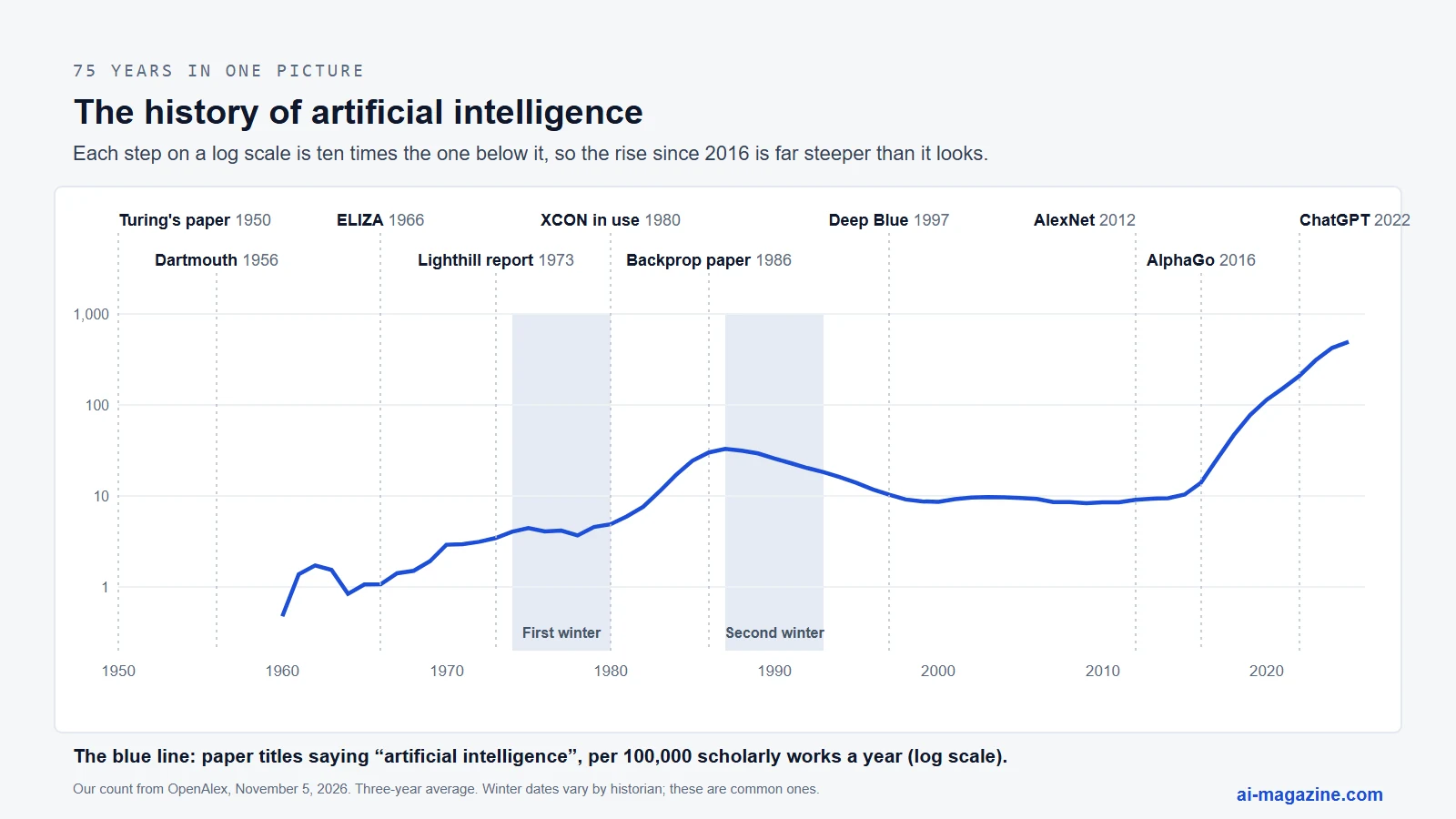
Our count of paper titles points the same way. Titles containing “artificial intelligence” numbered 34 in 1973, then stayed between 39 and 50 a year from 1974 to 1979, reaching 81 in 1980. Output stayed small and showed no clear fall. That fits a field where the money and the mood turned, in some countries, while research carried on.
Expert systems and the second winter: 1980 to the 1990s
AI’s first commercial success came from expert systems, which encode specialists’ knowledge as if-then rules.
The medical system MYCIN is the classic example. In a blinded test on 10 meningitis cases, published in 1979, outside specialists rated 65% of its treatment recommendations acceptable, against 42.5% to 62.5% for Stanford faculty. The authors named the small sample as the main limitation, and MYCIN never entered routine use. XCON, which configured DEC computers from 1980, was a real business success, saving tens of millions of dollars a year by most accounts, though figures vary and we found no DEC source for them.
Money poured in. Companies were spending over $1 billion on AI by 1985. Japan launched its Fifth Generation project in 1982 and spent about ¥54 billion over 11 years. The $850 million often quoted was a 1981 allocation, not the amount spent. The UK and US answered with programs of their own.
It then fell apart. Expert systems were costly to maintain and brittle outside their narrow field. The specialized Lisp machine market collapsed in 1987 as cheaper workstations and desktops caught up. Researchers had seen it coming: “AI winter” appeared in 1984 as the topic of a panel at the AAAI meeting, published as “The Dark Ages of AI”, with the analogy being nuclear winter. Who coined it remains unclear.
What 65 years of paper titles show
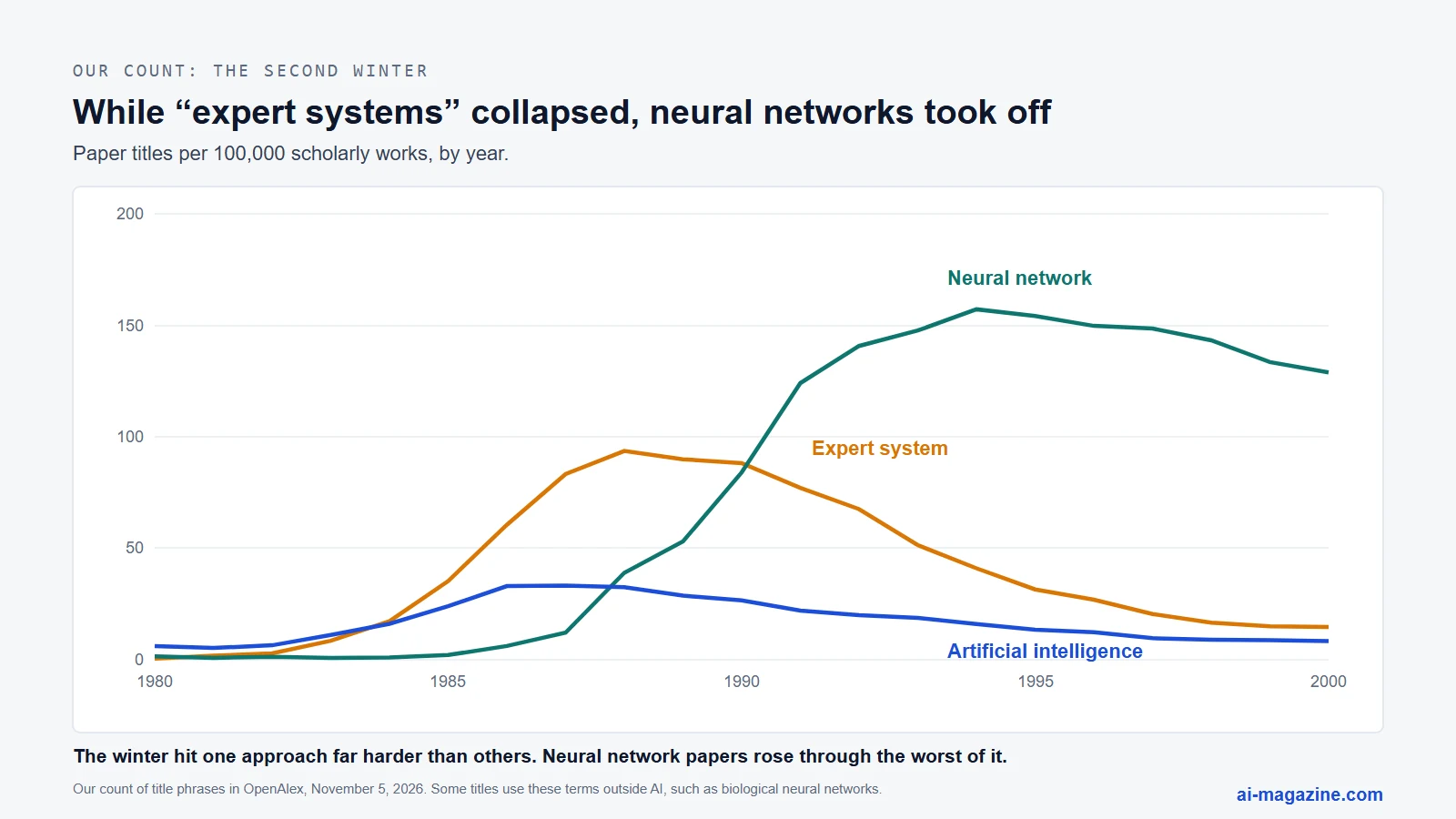
To check the story against data, we counted how many scholarly works per year had certain phrases in their titles, using OpenAlex, and divided by all works that year. This second winter is obvious in the data, but it wasn’t the same for every approach.
| Title phrase | Early | High point of that era | Later |
|---|---|---|---|
| “Expert system”, per 100,000 works | 0.5 in 1980 | 93.6 in 1988 | 14.7 in 2000 |
| “Artificial intelligence”, per 100,000 works | 6.1 in 1980 | 33.2 in 1987 | 8.4 in 2000 |
| “Neural network”, per 100,000 works | 2.1 in 1985 | 157.2 in 1994 | 128.9 in 2000 |
Three things stand out:
- The bust was real, and fast. “Expert system” fell by about two-thirds in the seven years after 1988, and about 85% by 2000.
- The label itself went out of fashion. “Artificial intelligence” in titles fell by about three-quarters by 2000 and stayed near that level until about 2016. We read that as a change in branding as well as interest, with researchers choosing narrower terms, though title counts alone can’t prove why.
- Neural networks rose through the worst of the winter. Titles went from 32 in 1985 to 3,789 in 1995, with their share peaking in 1994. The field’s comeback idea was growing while “AI” as a brand was shrinking.
The comeback: backpropagation to AlexNet
The 1986 paper by David Rumelhart, Geoffrey Hinton and Ronald Williams is often credited with inventing backpropagation, the method used to train neural networks. Its history is longer. Seppo Linnainmaa described the underlying math in 1970, and Paul Werbos applied it to multilayer networks in 1982. What the 1986 paper did was show that such networks learn useful internal representations, and make the method widely known.
Progress then came in steps that drew little public notice:
- 1989: Yann LeCun’s team at Bell Labs read ZIP codes with a neural network. Later versions read a notable share of US checks.
- 1992: TD-Gammon taught itself backgammon through self-play and nearly matched top players, using reinforcement learning.
- 1997: Sepp Hochreiter and Jürgen Schmidhuber published the LSTM, a recurrent design that overcame the vanishing-gradient problem, so networks could keep information across long sequences.
The headline wins came from elsewhere. Deep Blue beat Garry Kasparov in May 1997, searching 200 million positions a second. That’s brute force and chess knowledge rather than learning. Kasparov had won their 1996 match 4 to 2, which is often forgotten.
The turning point came in 2012. Fei-Fei Li’s team had built ImageNet, labelled by online workers. AlexNet, a neural network with 60 million parameters trained on two Nvidia GTX 580 graphics cards. A seven-network variant won the 2012 contest with a top-5 error of 15.3%, against 26.2% for the second-best entry. Data, cheap compute and an old idea had finally met.
Compute trends show the change. Before 2010, the computing power used to train leading systems doubled about every 20 months. After that, it doubled about every 6 months. Rich Sutton’s 2019 essay “The Bitter Lesson” draws the conclusion that general methods using more computation have beaten hand-built human knowledge over 70 years, which is a neat summary of the whole field and also a contested one.
Myth check: which of these popular claims hold up?
“AI was coined at the 1956 Dartmouth conference.” False. It’s in the proposal from August 1955.
“The Dartmouth workshop ran six weeks.” Probably false. Notes from attendees point to about eight.
“Hinton invented backpropagation.” False. The 1986 paper he co-wrote popularized it, but the method is older.
“Perceptrons killed neural networks.” Exaggerated. It hurt their prestige and funding, but the work continued.
“DeepSeek trained R1 for $5.6 million.” False. That figure is for the earlier V3 model and excludes prior research. Press coverage says DeepSeek later reported $294,000 for R1, on top of about $6 million for its base model.
“ChatGPT reached 100 million users in two months, OpenAI said.” Misattributed. The figure was a UBS estimate of monthly active users, based on Similarweb data.
“AlphaFold solved biology.” False. DeepMind’s own post lists open problems, such as protein complexes and interactions with DNA.
Who the usual story leaves out
Popular histories of AI tend to center on a few Western labs. A wider view includes:
- Oleksiy Ivakhnenko (Kyiv). From the mid-1960s at Kyiv’s Institute of Cybernetics, he and Valentin Lapa trained networks layer by layer, and in 1971 he reported an eight-layer network. Schmidhuber dates working deep learning to their 1965 work, though he is an active party in these priority debates and exact dates vary by source.
- Seppo Linnainmaa (Finland). His 1970 master’s thesis described reverse-mode differentiation, the math at the core of backpropagation.
- Shun’ichi Amari (Japan). He described training multilayer networks by gradient descent in 1967, and a learning recurrent network in 1972, a decade before John Hopfield’s better-known work.
- Kunihiko Fukushima (Japan). His Neocognitron of 1979 to 1980 had the layered layout of today’s convolutional image networks.
- Karen Spärck Jones (Cambridge). Her 1972 paper on inverse document frequency shaped search engines for decades. We tested that idea against an LLM in our guide to natural language processing.
Honors tell a narrower story. The 2024 physics Nobel went to Hopfield and Hinton, the 2018 Turing Award to Yoshua Bengio, Hinton and LeCun, and the 2024 Turing Award to Andrew Barto and Richard Sutton. These awards were deserved, but they don’t amount to a full list of who built the field.
The deep learning and LLM era: 2012 to 2026
Games provided the public moments. DeepMind’s DQN learned Atari games from pixels in 2013. In March 2016, AlphaGo beat Lee Sedol 4 to 1, including a Move 37 that DeepMind says had a 1 in 10,000 chance of being used. Modern image generators took off after GANs in 2014 and reached the public with DALL-E and Stable Diffusion, the latter built on academic research that’s often overlooked.
Language then took over, starting with the Transformer in 2017.
| Model | Date | What changed |
|---|---|---|
| GPT-1 | June 2018 | 117 million parameters |
| BERT | October 2018 | Transformers proved themselves across language tasks |
| GPT-2 | 2019 | 1.5 billion parameters, released in stages |
| GPT-3 | May 2020 | 175 billion parameters |
| ChatGPT | November 30, 2022 | A simple chat interface opened LLMs to everyone |
| GPT-4 | March 2023 | OpenAI declined to disclose its size, so any parameter count isn’t from OpenAI |
| DeepSeek-R1 | January 2025 | Open reasoning model; Nvidia lost about $589 billion in a day |
| GPT-5 | August 2025 | Followed by updates every few months |
| GPT-6 Astra | September 2026 | OpenAI’s flagship. GPT-6.1 Terra followed in October |
| Claude Opus 5.5 | September 2026 | With Sonnet 5.5 and Haiku 5.5 by October |
| Gemini 4 Argon | October 2026 | Google’s newest generation reached general availability |
The trend in that table has also ended a kind of openness. According to the 2026 AI Index, OpenAI, Anthropic and Google no longer disclose code, parameter counts, dataset sizes or training duration for several top systems. The GPT-3 paper disclosed its size; GPT-4’s report didn’t.
AI also moved into science. AlphaFold 2’s result at CASP14 was far ahead of every other group. Demis Hassabis and John Jumper shared half of the 2024 chemistry Nobel for it, and David Baker received the other half for protein design.
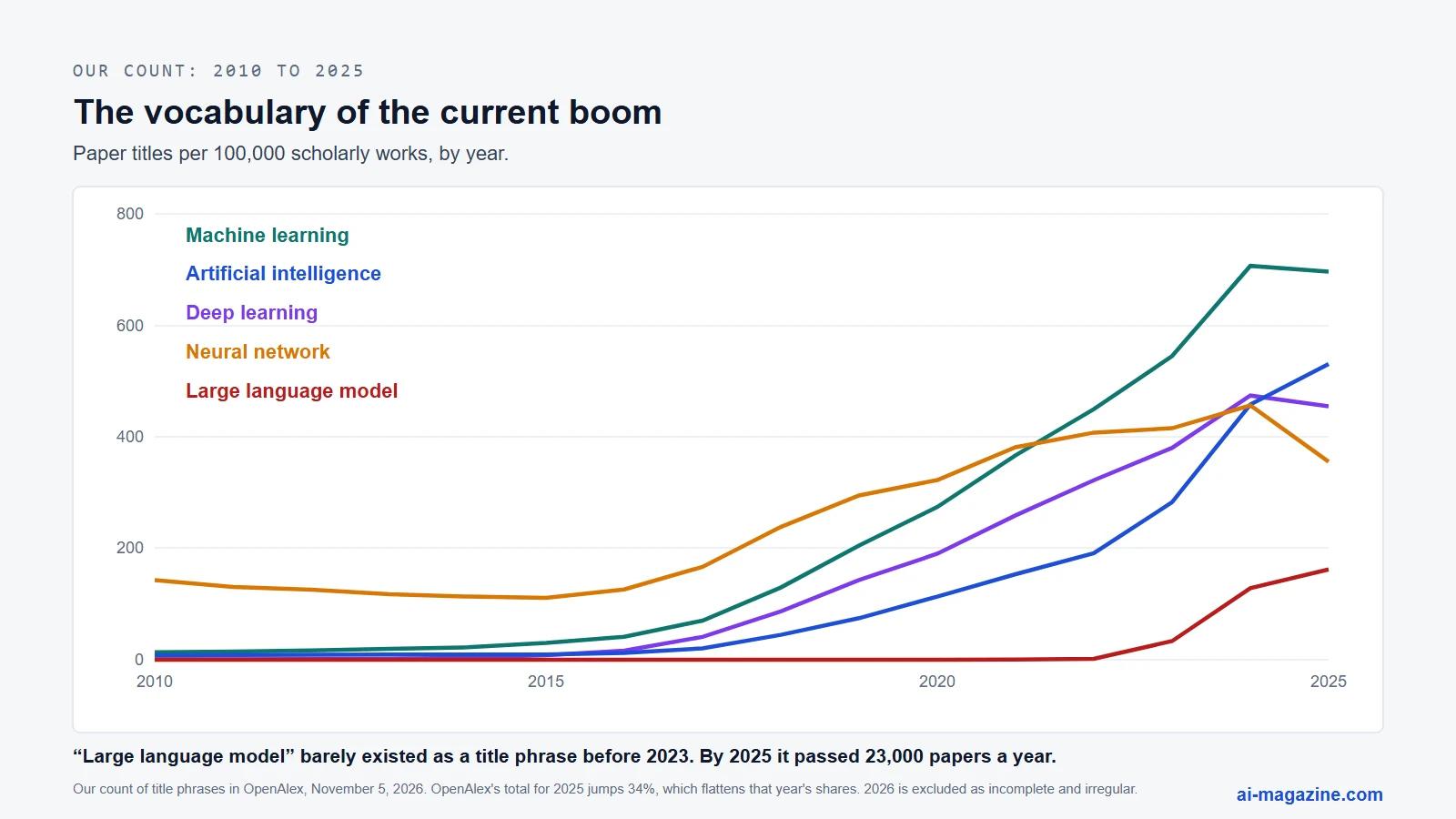
The current boom dwarfs anything before it in our data. “Artificial intelligence” appeared in 912 titles in 2015 and 76,151 in 2025. As a share of all works, that’s 9.4 per 100,000 becoming 530.6, or 16 times the 1987 peak. “Large language model” went from 175 titles in 2022 to 23,258 in 2025.
The scale of the current boom
| Measure | Figure | Source |
|---|---|---|
| Global private AI investment, 2025 | $344.66 billion, up 127.5% | AI Index 2026 |
| Of which, United States | $285.88 billion (China $12.41 billion, excluding much state funding) | AI Index 2026 |
| Organizations using AI | 88% in 2025, up from 55% in 2023 | AI Index 2026 |
| Notable models, 2025 | US 59, China 35 | AI Index 2026 |
| Estimated compute cost to train | GPT-4 about $78 million, Gemini Ultra about $191 million | AI Index 2024 |
| Training compute of frontier language models | Doubling about every 5.2 months since 2020 | Epoch AI |
| Price of GPT-3.5-level performance | $20 per million tokens in 2022, $0.07 in 2024 | AI Index 2025 |
Governments have followed. The EU AI Act entered into force on August 1, 2024, and a 2026 amendment moved its high-risk deadlines to December 2027 and August 2028. In the US, a 2023 executive order on AI safety was revoked in January 2025, and a December 2025 order targets state AI laws.
Five patterns that keep repeating
Looking across the whole history, the same things keep happening.
- Forecasts get the direction right and the date wrong. Chess fell, 29 years late. Be cautious with any AI forecast that has a date on it, in either direction.
- Hard things turn out easy, and easy things hard. That’s Moravec’s paradox. Chess and logic fell long before reliable robots that can clear a table.
- Success stops counting as AI. Once a task is solved, people stop calling it intelligence.
- Old ideas wait for hardware. Backpropagation and neural networks were decades old when AlexNet won. Much of the field’s progress came when compute and data caught up.
- Winters hit brands and budgets more than ideas. Our title counts show this most clearly: “expert system” collapsed, but research moved to neural networks, which were still growing.
Could there be another winter? Investment at today’s scale makes a correction possible, and history says it wouldn’t be unusual. History also suggests it wouldn’t end the research. This is our reading and not a forecast with a date on it, for reasons explained in point 1.
How we counted, and the limits
We queried the OpenAlex works API on November 5, 2026, using exact title phrase searches grouped by publication year, and divided by all OpenAlex works for that year. Treat the results as a rough trend, for these reasons:
- Titles only. Plenty of AI papers don’t use these phrases in their titles, especially when the label is out of fashion.
- Words aren’t always AI. “Neural network” can mean biological networks, and “expert system” is also used outside AI.
- Coverage changes. OpenAlex’s records vary by era and field, and older and non-English work is likely undercounted. Our shares adjust only for total volume.
- Odd years in the data. Records appear to pile up on certain years, so we left out 1970 and 2026, and our second-winter chart stops at 2000, before a spike in several terms in 2002. OpenAlex’s total for 2025 also jumps 34%, which pushes that year’s shares down.
- Low counts in early decades. Before 1980 there are often only dozens of titles a year, so small changes mean little.
- Winter dates are conventions. Sources disagree. Wikipedia runs the second winter to 2000, other accounts end it earlier, and our timeline chart shades 1987 to 1993.
For early history, we also relied on secondary sources in places, including Wikipedia, where the original documents were unavailable. We’ve linked each source so you can check it.
Frequently asked questions
Who invented artificial intelligence?
No single person. John McCarthy named the field in the 1955 Dartmouth proposal he wrote with Minsky, Rochester and Shannon. Turing, McCulloch, Pitts, Newell, Simon and many others contributed the ideas.
Who is the father of AI?
John McCarthy is the usual answer because he chose the name and organized the Dartmouth workshop. Alan Turing is often named too, for his 1950 paper and earlier work on computation.
When was AI first created?
The field is usually dated to the summer 1956 Dartmouth workshop. Early programs that could be called AI, including checkers players, existed by the early 1950s.
What is the origin of the term “artificial intelligence”?
It appears in the proposal dated August 31, 1955. McCarthy reportedly chose it partly for neutrality, to avoid focusing on automata theory or cybernetics.
What caused the AI winters?
Promises outran results, and funders reacted. The first followed reports such as ALPAC and Lighthill plus DARPA’s change of direction, though some historians dispute that it was a real winter. The second followed the collapse of the expert system and Lisp machine markets in the late 1980s.
Why did AI suddenly get so good after 2012?
Three things arrived together: large labelled datasets such as ImageNet, graphics chips that made training affordable, and neural network methods refined over decades. The Transformer in 2017 then opened the way to today’s large language models.
Related guides
- Artificial Intelligence (AI): what AI is and how the main types differ.
- Turing Test: the 1950 idea, and how modern chatbots do when tested.
- Expert Systems: the rule-based approach behind the 1980s boom.
- Symbolic Artificial Intelligence: the logic-first tradition that dominated early AI.
- Natural Language Processing: how language became the center of AI, with our own test.
- AI Model Catalog: prices and specs for today’s frontier models.