Types of AI: The 3, 4 and 7 Types Explained, and Which Ones Actually Matter
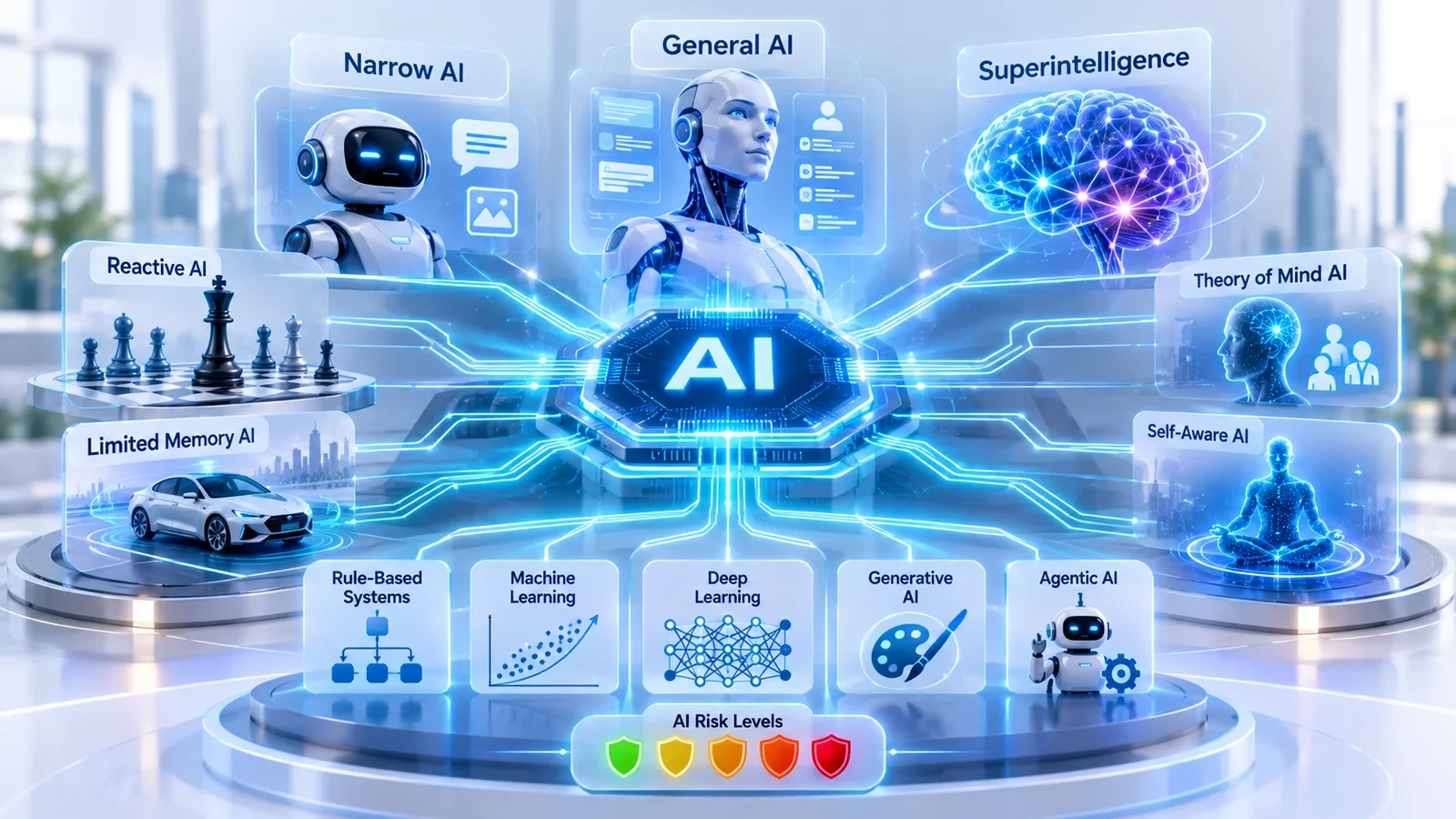
There is no single official list of the types of AI. Popular pages give you three, four, seven or even fifteen because they sort artificial intelligence along different axes: what a system can do (capability), how it behaves while running (functionality), and how it is built (technique). Standards bodies and regulators use other schemes again, based on model design or on risk.
So the useful question is not “how many types are there?” but “which question am I trying to answer?” Below we trace each list to its source, including a few details most summaries leave out, and show what we found when we ran the popular schemes on 100 real AI systems: two of them put nearly everything into one box, and the famous four-type list was also the least consistent from one run to the next.
The different types of AI at a glance
| Scheme | Question it answers | Types | Where it comes from | Best used for |
|---|---|---|---|---|
| Capability | How broad is it? | 3: narrow, general, superintelligence | ISO/IEC 22989 defines narrow and general; Bostrom defined superintelligence | Talking about the future of AI |
| Functionality | How does it behave at run time? | 4: reactive, limited memory, theory of mind, self-aware | A 2016 article by Arend Hintze | History and popular explanation |
| “7 types” | None of its own | 3 + 4 added together | A web convention with no authoritative source | Little, beyond recognizing the term |
| Technique | How is it built? | Rule-based, machine learning, deep learning, generative, agentic and others (they overlap) | Textbooks, ISO, Google, NIST | Choosing and comparing real tools |
| Risk | What duties apply to it? | 4 levels, plus separate rules for general-purpose models | EU AI Act | Compliance |
The 3 types of AI by capability
This scheme sorts AI by how wide a range of tasks a system can handle.
Narrow AI
The ISO/IEC 22989 standard defines narrow AI as a system “focused on defined tasks” to address a specific problem. Search rankings, recommendation engines, face unlock and chatbots are all usually placed here. A chess engine that beats every human still can’t tell you whether a loan is risky, because what it does well stays inside its task.
The label is older than the standard. Ben Goertzel’s 2007 essay on Ray Kurzweil’s The Singularity Is Near says Kurzweil called mainstream AI “narrow AI” to set it apart from “strong AI”, a choice of wording Goertzel found confusing. Many pages still use “weak AI” as a synonym for narrow AI, which, as we explain below, is not what the phrase first meant.
General AI (AGI)
ISO describes general AI as addressing a broad range of tasks “with a satisfactory level of performance”, and notes the term is often used in a stronger sense: all the tasks a human can perform. That gap between the two meanings explains much of today’s argument about it.
The term has a tangled history. By Goertzel’s own account, Shane Legg proposed “artificial general intelligence” around 2002, when Goertzel and Cassio Pennachin needed a book title, and Mark Gubrud had already used it in a 1997 article. Their edited book came out in 2007.
Whether AGI has arrived is disputed. At the launch of GPT-6 Astra on 3 September 2026, OpenAI president Greg Brockman said it was “not unreasonable to feel that we are now in the AGI era”, and Nvidia’s Jensen Huang wrote that AGI had arrived, according to the Australian Computer Society’s news site. ARC Prize measured Astra on ARC-AGI-3 at 62.7% with its Standard harness against 99.9% with a provider-specific one, and wrote “we are not claiming that it is AGI”. The AGI Society said the published evidence does not yet support that conclusion. We found no formal verification of the claim, and there is no agreed test for it.
Superintelligence
Philosopher Nick Bostrom defined superintelligence in 1998 as an intellect “much smarter than the best human brains in practically every field”. He left open how it would be built, and excluded firms and the scientific community because they are not single intellects. The definition says nothing either way about consciousness: it is a claim about performance, not about inner experience. No system is generally accepted to meet it.
Strong AI vs weak AI: not the same as general vs narrow
The two pairs are often used interchangeably, but they began as different ideas. Philosopher John Searle introduced strong and weak AI in his 1980 paper “Minds, brains, and programs”, the source of the Chinese Room argument. For Searle, strong AI is the claim that “the appropriately programmed computer really is a mind”. Weak AI is the claim that a computer is a powerful tool for studying the mind. His question was whether a program literally understands, not how many tasks it can do.
Modern pages use “strong AI” as another word for AGI, which is a claim about capability. In our reading, a system could therefore be general without being strong in Searle’s sense. ISO seems to recognize the shift: a clause of its standard is titled “From strong and weak AI to general and narrow AI”.
The 4 types of AI by functionality
This is the list most people mean by “the 4 types of AI”. It comes from one source: “Understanding the four types of AI, from reactive robots to self-aware beings”, by Arend Hintze, then an assistant professor at Michigan State University, published in The Conversation on 14 November 2016. It is a short popular article, not a standard, and it does not set testable criteria for each type.
| Type | What it means | Hintze’s example | Status today |
|---|---|---|---|
| I. Reactive machines | Acts on the present situation without storing experience | Deep Blue and AlphaGo | Exists |
| II. Limited memory | Uses recent observations, which are not kept | Self-driving cars | Exists |
| III. Theory of mind | Would model the beliefs and intentions of others | None; framed as future | Contested: models pass many tests |
| IV. Self-aware | Would have a sense of self | None; framed as far off | None established |
Type I: Reactive machines
Reactive machines respond to what is in front of them and don’t build up experience as they go. Hintze’s first example is Deep Blue, the IBM computer that won its May 1997 rematch against Garry Kasparov 3.5 to 2.5 while evaluating about 200 million positions per second. Its knowledge was engineered ahead of the match: IBM improved its endgame databases and evaluation, and hired grandmasters to help.

His second example usually gets dropped from summaries: AlphaGo, which beat Lee Sedol 4-1 in March 2016. AlphaGo learned from expert games and self-play, so many readers would expect it to count as “limited memory”. In our reading, the reason it doesn’t is that the scheme is about what a system does while running, not how it was trained.
Type II: Limited memory
Hintze’s limited memory is narrower than many summaries suggest. His example is a self-driving car tracking the speed and direction of nearby vehicles. That information is, in his words, “only transient”, and is not saved to the car’s library of experience.
Self-driving systems are now a large real-world case. Waymo reports 271.3 million rider-only miles through June 2026. It also reports 95% fewer crashes with serious injury or worse than human drivers in the same areas, by its own published comparison.
Type III: Theory of mind
Theory of mind is the ability to work out what others believe and intend. Hintze described it as a future type, and many pages still say flatly that it doesn’t exist. Since then, research has made that harder to say:
- Michal Kosinski tested 11 language models on 40 false-belief tasks, published in PNAS in 2024. ChatGPT-4 solved 75%, which he described as matching six-year-old children.
- Strachan and colleagues, in Nature Human Behaviour in 2024, found GPT-4 at or above human level on irony, hints and false beliefs, but below humans on faux pas. They put that down to a “hyperconservative approach” to answering.
- Tomer Ullman showed in 2023 that small changes which preserve the logic of a task can flip the result.
- A February 2026 paper titled “GPT-4o Lacks Core Features of Theory of Mind” found a model passing one task and failing a logically equivalent one.
The honest status is that language models pass many theory-of-mind tests, and it is contested whether that amounts to having one.
Type IV: Self-aware AI
No AI system has been established as self-aware or conscious. A 2023 analysis by Patrick Butlin and 18 co-authors suggested that no current system is conscious, while finding no obvious technical barrier to building one that meets its indicators.
The debate has moved on since then. In July 2026, Anthropic researchers reported that language models show workspace-like functional properties, but the paper addresses only access consciousness (information available for reasoning and report) and “takes no position” on subjective experience. A commentary from Eleos AI called it the most significant interpretability evidence so far, while its authors stayed “highly uncertain”. Microsoft AI chief Mustafa Suleyman, by contrast, wrote in 2025 that there is “zero evidence” of AI consciousness.
Where the “7 types of AI” come from
The seven types are the three capability types and the four functional types added together. No standard, textbook or paper we could find defines them. IBM’s widely read page uses both lenses and maps them onto each other, but never says “seven”, gives no date and cites no origin for either list. The earliest explicit “7 types” article we could trace is by Naveen Joshi, republished by Cognitive World, though we can’t say it was the first.
Other counts are just as loose. Lenovo publishes five types, WalkMe 10 and Dorik 15. If you need a single answer for an exam or a slide, the sum is seven, but the two lists answer different questions and adding them doesn’t produce a classification.
Types of AI by technique
For anyone choosing or comparing tools, this is usually the most useful axis. The categories overlap: a large language model is machine learning, deep learning and generative, is often multimodal, and becomes agentic when given tools. Treat them as attributes rather than exclusive boxes.
Rule-based (symbolic) AI
Symbolic AI manipulates symbols according to explicitly defined rules, which the OECD describes simply as “human-generated rules”. The best-known examples are expert systems. In a 1979 JAMA evaluation, experts rated the therapy advice of Stanford’s MYCIN acceptable 65% of the time, while five faculty specialists scored 42.5% to 62.5%. XCON, a rule system for configuring DEC computers, reportedly saved the company tens of millions of dollars, though the reported figures vary.
Machine learning
Machine learning learns patterns from data instead of following hand-written rules. Its main branches are:
- Supervised learning: learns from examples with labeled answers.
- Unsupervised learning: finds patterns in unlabeled data.
- Reinforcement learning: learns from rewards and penalties.
- Self-supervised learning: gets its training signals from the data itself.
Deep learning
Deep learning uses models with multiple processing layers that learn representations at several levels of abstraction, as described in a 2015 Nature review by LeCun, Bengio and Hinton. We compare it with other machine learning in machine learning vs deep learning.
Generative AI
Generative AI creates new text, images, audio, video or code. Its usual counterpart is predictive AI, which scores, ranks or forecasts. This split has real institutional use: NIST’s 2025 taxonomy of attacks on machine learning is organized into predictive AI and generative AI.
Agentic AI
Agentic AI carries out multi-step tasks using tools. Anthropic draws a useful line: workflows follow predefined code paths, while agents “dynamically direct their own processes and tool usage”. Agents are still far from flawless. The Stanford AI Index 2026 puts their success rate on the OSWorld benchmark at about 66%, against a human baseline of 72.35%. For more, see our guide to AI agents.
Neuro-symbolic and multimodal AI
Neuro-symbolic AI combines neural learning with symbolic knowledge and logical reasoning; Garcez and Lamb call it AI’s “third wave”. Multimodal AI processes and relates several kinds of information, such as text, audio and images, in one model.
How standards bodies and regulators classify AI
The reactive-to-self-aware ladder is rare in formal documents. We did not find it in the OECD framework or in the headings and defined terms of ISO’s public preview. Official schemes ask more practical questions.
OECD. Its 2022 Framework for the Classification of AI Systems describes a specific system rather than assigning it a type, across five dimensions: People & Planet, Economic Context, Data & Input, AI Model, and Task & Output. Under AI Model it asks whether a model is symbolic, statistical or hybrid, and whether it is generative, discriminative or both.
ISO/IEC 22989. This 2022 terminology standard defines narrow and general AI, and symbolic and subsymbolic AI. It also lists supervised, unsupervised, semi-supervised and reinforcement learning.
NIST. Its AI Risk Management Framework is built around managing risk rather than sorting types, while the taxonomy mentioned above uses the predictive and generative split.
Textbooks. Russell and Norvig’s Artificial Intelligence: A Modern Approach (4th edition, section 2.4) classifies agents as simple reflex, model-based reflex, goal-based, utility-based and learning agents.
EU AI Act. The law sorts AI by risk, which determines the legal duties:
| Risk level (Commission wording) | What applies | When |
|---|---|---|
| Unacceptable risk | Banned practices (Article 5), now nine | First eight from 2 February 2025; the ninth, on nudification and child sexual abuse material, from December 2026 |
| High risk | Strict duties for providers (Articles 6 and 8-21) | Annex III uses from 2 December 2027; AI in Annex I products from 2 August 2028 |
| Transparency risk (shown as “limited risk” in the Commission’s graphic) | Disclosure duties (Article 50) | 2 August 2026, with a grace period reported until 2 December 2026 for marking AI output from systems already on the market |
| Minimal or no risk | No specific duties under the risk tiers | Not applicable |
General-purpose AI models have separate rules, which have applied since 2 August 2025. A model is presumed to pose systemic risk once its cumulative training compute exceeds 10^25 floating point operations. The later high-risk dates come from the AI Omnibus, which entered into force on 27 July 2026.
Our test: we ran the types of AI on 100 real systems
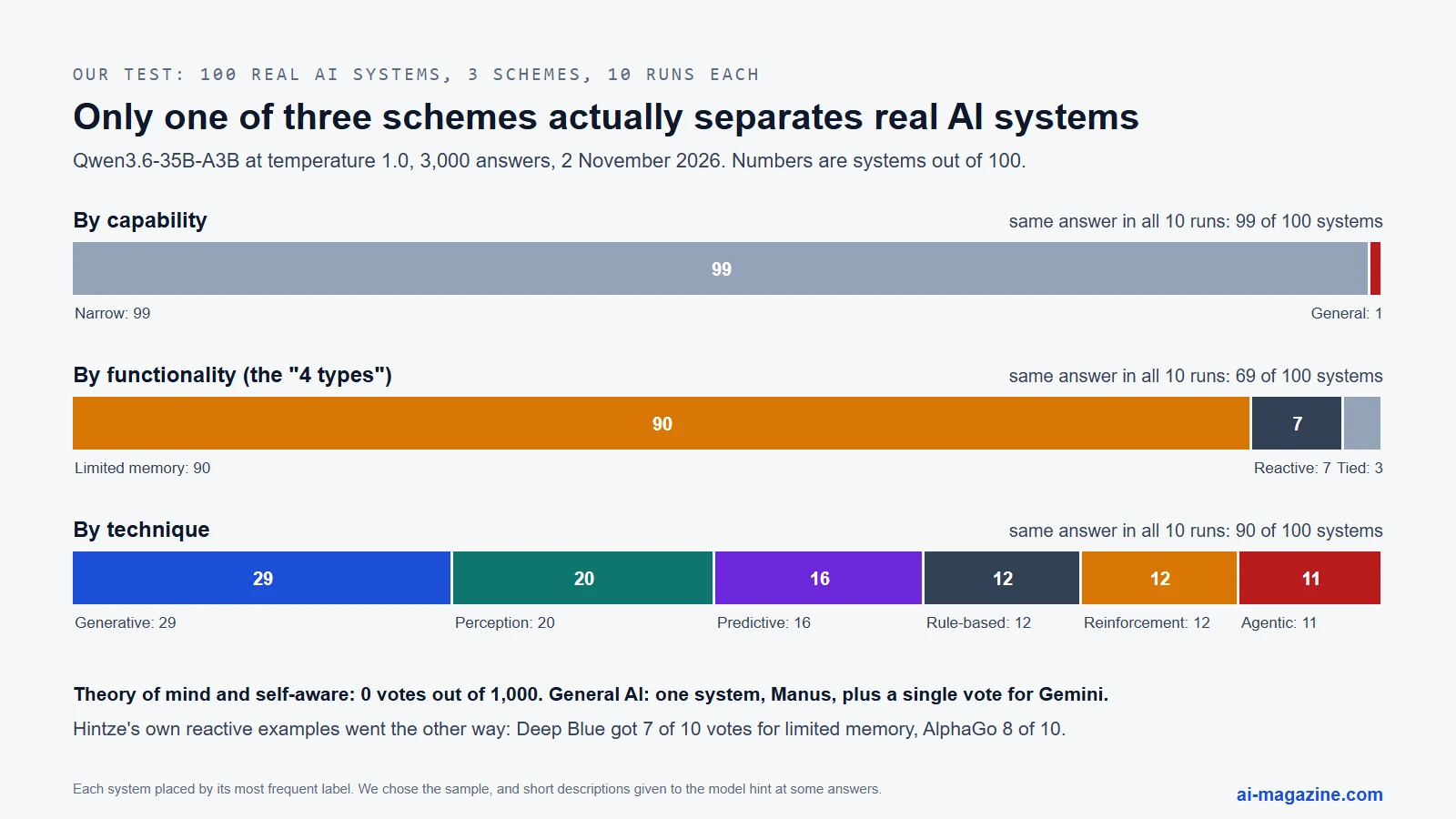
A classification is only useful if it separates things and gives the same answer twice. So on 2 November 2026 we listed 100 real AI systems, from 1956’s Logic Theorist to today’s coding agents, and asked Qwen3.6-35B-A3B, an open-weight model on our own server, to place each one in each of three schemes, 10 times over. That made 3,000 answers. Each prompt included a short definition of every type and a one-line description of the system.
| What we measured | Capability | Functionality (4 types) | Technique |
|---|---|---|---|
| Largest group, out of 100 systems | Narrow: 99 | Limited memory: 90 | Generative: 29 |
| Groups actually used | 2 of 3 | 2 of 4 | 6 of 6 |
| Systems with the same answer in all 10 runs | 99 | 69 | 90 |
The four types barely separate anything. Theory of mind and self-aware received 0 of 1,000 votes, as you would expect for types with no agreed examples. That leaves two working categories, and 90 systems landed in limited memory. Half of the rule-based systems (6 of 12) did too, even though they don’t learn from data. The model was also least consistent here: it changed its answer between runs on 31 systems.
The labels clash with their own source and with each other. Hintze names Deep Blue and AlphaGo as reactive machines, but the model chose limited memory for Deep Blue in 7 of 10 runs and for AlphaGo in 8 of 10. Netflix’s recommendations went to limited memory in all 10 runs, yet IBM’s page calls them reactive. The definition we used was the broad one common on the web (uses past data or recent observations), and that breadth is the problem: nearly every modern system fits it.
Capability is stable but tells you little. 99 of 100 systems came out as narrow, including every chatbot. The exception shows how a word can sway the label: Manus went to general AI in all 10 runs, and our description of it said “general-purpose task agent”. That is a result about wording, not evidence of AGI.
Technique is the one that tells systems apart. The 100 systems spread across all six groups, and the model’s most frequent label matched ours on 99. The one difference was Perplexity, which we called generative and the model called agentic in 9 of 10 runs, a fair argument in itself.
What this means: use capability when you talk about the future of AI, technique when you choose or compare tools, risk when you deal with regulation, and the four types mainly as a piece of AI history.
Limits: this is one model, and its choices are not ground truth. We picked the sample and its groups ourselves, aiming for variety, so the spread across technique partly reflects that choice, and our one-line descriptions hint at some answers. What the test shows is the contrast: the same 100 systems spread out under one scheme and collapse under the others.
Which types of AI organizations actually use
The Stanford AI Index 2026 reports that 88% of surveyed organizations used AI in 2025, up from 55% in 2023, and 70% used generative AI in at least one function. Agent deployment was still in the single digits across nearly all business functions.
McKinsey’s 2026 survey of 1,719 participants found about two in ten organizations scaling agents, rising to 40% among those with more than $1 billion in revenue, up from 27%. We found no source that splits current use into predictive, generative and agentic on one common base, so be wary of any single chart claiming to.
Common misconceptions about AI types
“Limited memory means it remembers you.” Hintze’s limited memory is transient and isn’t saved. ChatGPT’s memory feature, by contrast, can reference past conversations, according to reports of its April 2025 rollout. IBM still lists chatbots under limited memory, so in our reading the label is a convention rather than an exact fit.
“Generative AI is a fifth type.” It depends on the axis. It has no slot of its own in the four types. Google lists it alongside the main branches of machine learning, the OECD treats it as a property of a model, and NIST contrasts it with predictive AI.
“Being trained on past data means limited memory.” Hintze files AlphaGo as reactive despite its training. Other sources disagree on similar cases: IBM, Built In and TechTarget call recommendation engines reactive, while Simplilearn lists them under limited memory.
“The types are a ladder.” The numbering suggests AI climbs from Type I to Type IV. In our reading, language models don’t fit that sequence: they already pass many theory-of-mind tests, while persistent memory remains a product feature added around the model.
Frequently asked questions
How many types of AI are there?
There is no agreed number. Lists of 3, 4, 5, 7, 10 and 15 are all in circulation, because they sort AI along different axes. The most common are 3 by capability and 4 by functionality.
What are the 3 types of AI?
Narrow AI, general AI (AGI) and superintelligence. They are sorted by capability, meaning how broad a range of tasks a system can handle. Almost every AI product in use today is classed as narrow, and claims that AGI has arrived remain disputed.
What are the 4 types of AI?
Reactive machines, limited memory, theory of mind and self-aware AI. The list comes from a 2016 article by Arend Hintze in The Conversation. Only the first two have clear real-world examples.
What are the 7 types of AI?
The 3 capability types plus the 4 functional types: narrow, general, super, reactive, limited memory, theory of mind and self-aware. It is a web convention rather than a formal classification, and we found no standard or textbook that defines it.
What are the 5 main types of AI?
There is no standard list of five. Lenovo publishes one such list, and others differ. If you want a practical short list, the technique axis works best: rule-based AI, machine learning, deep learning, generative AI and agentic AI.
What type of AI is ChatGPT?
By capability, it is usually classed as narrow AI, though some executives dispute that for the newest models. By technique, it is generative AI built with deep learning, and it can be agentic when it uses tools. IBM files chatbots under limited memory in the four-type scheme.
Does self-aware AI exist?
No AI system has been established as self-aware or conscious, and there is no scientific consensus that any is. Researchers are studying functional features of language models, but the leading papers don’t claim subjective experience.
What is the difference between AI and machine learning?
AI is the broad field of building systems that do tasks associated with intelligence, including rule-based systems that never learn. Machine learning is the part of AI in which systems learn from data rather than following hand-written rules.