Self-Driving Cars in 2026: How They Work, Who Leads, and How Safe They Are
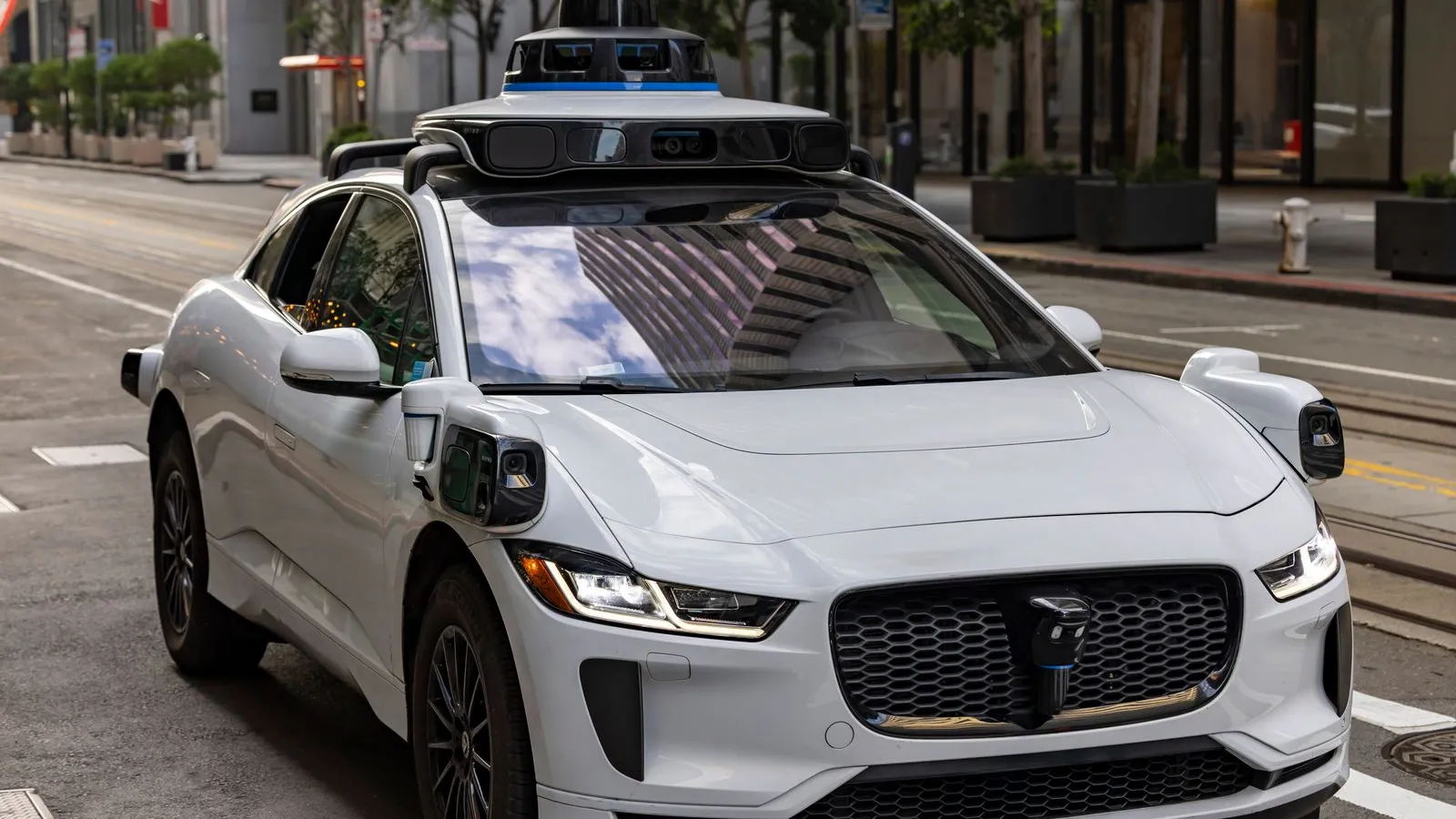
Self-driving cars are vehicles in which software, not a person, does the driving: it watches the road through cameras, radar and lidar, predicts what everyone else will do, and steers, brakes and accelerates on its own. As of October 2026, cars that drive with nobody behind the wheel exist only as robotaxi and trucking services in limited areas, known as Level 4. Every car you can buy still needs a human supervising it (Level 2), apart from Mercedes-Benz’s Drive Pilot, which can take over completely in a few narrow situations (Level 3).
The robotaxi business is real, though. Waymo serves riders in 15 US metro areas and had logged 271 million miles with no one in the driver’s seat by June 2026. Baidu, Pony.ai and WeRide run large fleets in China and the Middle East, Zoox carries riders in a vehicle with no steering wheel, and Tesla runs a smaller robotaxi service in Texas and Florida. This guide explains how the technology works, who is driving where, what the safety evidence shows, and which rules apply. We also analyzed all 1,550 crashes involving self-driving systems that companies reported to the US regulator NHTSA between April 2025 and August 2026.
The levels of driving automation, explained
| Level | Name | Who drives | Example in 2026 |
|---|---|---|---|
| 0-1 | Driver assistance | You drive; the car warns or helps with one task | Lane-keeping alert, adaptive cruise control |
| 2 | Partial automation | You must watch the road at all times | Tesla FSD (Supervised), GM Super Cruise |
| 3 | Conditional automation | The car drives in set conditions; you take over on request | Mercedes-Benz Drive Pilot |
| 4 | High automation | The car drives itself, only in its service area | Waymo, Baidu Apollo Go, Zoox robotaxis |
| 5 | Full automation | The car drives anywhere, in any conditions | None exists |
The Society of Automotive Engineers (SAE) defines six levels of driving automation, labeled 0 through 5. The standard is SAE J3016, with the current version being J3016_202104 (April 2021). It was developed jointly with ISO (ISO/SAE PAS 22736). This revision added definitions for “remote assistance” and “remote driving” and renamed L1–L2 “driver support”. No 2025 or 2026 revision has been found.
Level 0 (“Momentary Driver Assistance”), Level 1 (“Driver Assistance”), and Level 2 (“Additional Assistance”) all fall under the same operational principle: “You Drive, You Monitor.” In Level 2, the vehicle provides continuous assistance with both acceleration/braking and steering. However, the driver remains fully engaged and attentive. The National Highway Traffic Safety Administration (NHTSA) states that Level 2 advanced driver-assistance systems (ADAS) “require the human driver to remain fully engaged in the driving task at all times.” Tesla’s Full Self-Driving (FSD) is classified as Level 2. A 2025 NHTSA resume notes that Tesla characterizes FSD as an SAE Level 2 partial automation system requiring a fully attentive driver. The driver remains fully responsible at all times. The product name is officially “FSD (Supervised).”
Level 3 (“Conditional Automation”) shifts responsibility to the system, but with a catch. The system drives, but you must be available to take over upon request. Mercedes DRIVE PILOT is a Level 3 system. In California, a deployment permit issued on 8 June 2023 limits it to designated highways, daylight, and speeds not exceeding 40 miles per hour. It excludes city streets, construction zones, heavy rain, fog, and flooded roads. The driver must stay behind the wheel and be ready to take over. In Germany, the KBA granted extended type approval on 19 December 2024 for speeds up to 95 km/h on freeways, provided the car stays in the right-hand lane behind a lead vehicle. If the driver does not respond to a takeover request, the car makes a safe emergency stop. According to news reports, China’s industry ministry issued its first Level 3 market-access approvals on 15 December 2025. These include the Changan Deepal SL03 for congested highway traffic in Chongqing (up to 50 km/h) and the BAIC Arcfox Alpha S for designated Beijing expressways (up to 80 km/h).
Level 4 (“High Automation”) means the system drives and you ride, but only in limited service areas, not universally. This is the level where robotaxis operate. Level 5 (“Full Automation”) would drive universally under all conditions and on all roadways, which does not yet exist commercially. NHTSA confirms there is no vehicle currently available for sale that is fully automated or “self-driving.” It also states that Levels 4 and 5 are not available on today’s vehicles for consumer purchase.
How do self-driving cars work?
Autonomous vehicles rely on a combination of hardware sensors, software perception, and AI planning to navigate the world. The architecture varies significantly between companies, but the core challenge remains the same: understanding the environment and predicting what other road users will do.
Sensors: cameras, radar and lidar
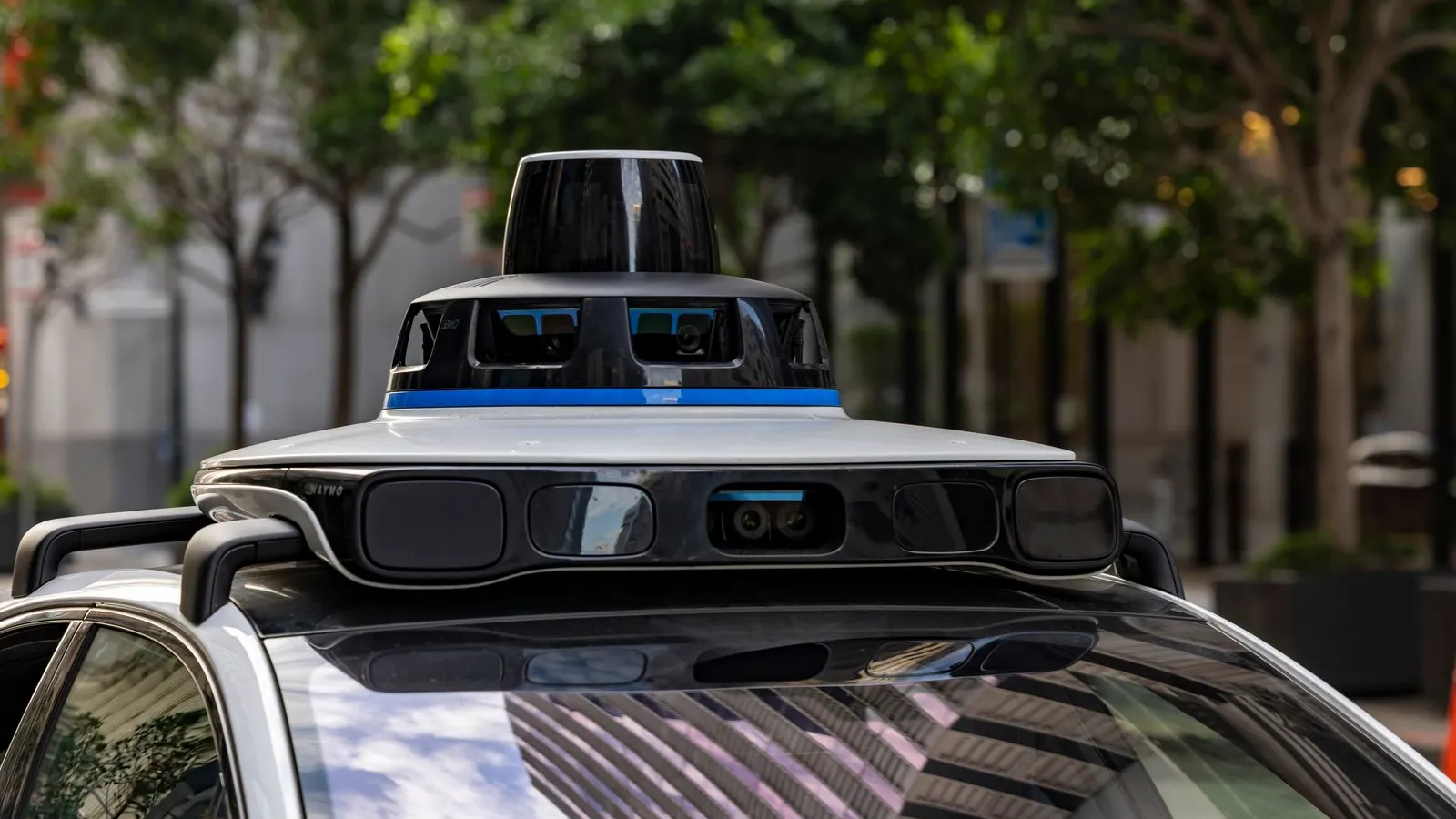
Sensors are the eyes and ears of the autonomous vehicle. Waymo’s 6th-generation Driver uses a suite of 13 cameras, 4 lidar units, 6 radar sensors, and external audio receivers. This setup sees up to 500 meters away. The first vehicle to carry this 6th-gen Driver is the Ojai, which began rider trips on 28 May 2026 in San Francisco, Phoenix, and Los Angeles. Waymo also runs the Hyundai IONIQ 5 and the Jaguar I-PACE. Interestingly, the 6th-gen uses less than half the number of cameras of the 5th gen, relying on a higher-resolution 17-MP imager. Waymo treats lidar, a laser sensor that measures distance, as essential: in its words, “cameras are incredible, but they aren’t enough.”
Tesla takes a different approach. It is camera-only. This relies heavily on advanced software to compensate for the lack of dedicated depth-sensing hardware like lidar.
Perception, prediction and planning
Once data is collected, the car must interpret it. Perception involves identifying objects such as cars, pedestrians and traffic lights, a job for computer vision and object detection. Prediction involves guessing what those objects will do next. Planning is deciding the vehicle’s own path.
Waymo describes its current design as neither purely modular nor purely end-to-end. A single foundation model, which it calls a “world model”, powers the Driver, its simulator and an automated critic. Its Sensor Fusion Encoder fuses camera, lidar, and radar data in a “Think Fast” layer. A Gemini-trained “Driving VLM” handles rare scenarios in a “Think Slow” layer. A World Decoder predicts other road users, produces HD maps, and generates trajectories. Crucially, a separate and rigorous onboard validation layer checks the generative model’s trajectories before they are executed. Waymo calls this layer “non-negotiable for safely scaling at L4.” It warns that pure end-to-end systems are black boxes, making it harder to understand why a car made a specific decision.
Modular stacks vs end-to-end AI
The industry is split between modular stacks (separate components for perception, prediction, planning) and end-to-end AI (one neural network handles everything).
According to release notes quoted in the press, Tesla’s FSD Beta v12 replaced over 300,000 lines of explicit C++ code with a single end-to-end neural network trained on millions of video clips. This approach mimics human learning more closely but lacks the explicit transparency of modular systems. Wayve, in partnership with Nissan, is developing an L2 supervised system with next-generation lidar that will enter production in fiscal year 2027. Waymo has also published EMMA, a research model built on Google’s Gemini that maps raw camera images directly to driving trajectories and detected objects. It processes only a few frames and uses no lidar or radar, and Waymo stresses that it is research, not the production driver.
Simulation and maps
Before hitting the road, these systems log billions of miles in simulation. Waymo has run tens of billions of simulation miles. This allows them to test rare edge cases—like a child running out from behind a parked car—without risking physical vehicles. HD maps provide a high-precision blueprint of the road, including lane markings, traffic light positions, and curbs. This helps the vehicle know exactly where it is and what the road ahead should look like. Simulated driving is also a source of synthetic data for training.
Remote assistance is not remote driving
When a car gets stuck or confused, it doesn’t always mean a human is driving it from afar. Remote assistance is different from remote driving. Waymo has about 70 remote assistance (RA) agents on duty worldwide at any time, supporting a fleet of 3,000 vehicles. These agents do not continuously monitor a vehicle. They respond to specific requests for information initiated by the Waymo Driver and provide advice which the system can decide to use or reject. The median one-way latency is about 150 ms for US centers. A TÜV SÜD audit confirmed that the Driver is in control of the vehicle at all times.
Zoox uses a similar concept called TeleGuidance. Remote “tacticians” give guidance such as a suggested path or a request to pull over. The ADS then determines when and how it is appropriate to execute that guidance. Manual remote driving is possible only at low speeds within line of sight using a handheld controller.
Who runs self-driving cars in 2026
| Company | Where it runs (as of 2026) | Scale (latest public figure) | Driverless? |
|---|---|---|---|
| Waymo | 15 US metros incl. Phoenix, SF Bay Area, LA, Austin, Atlanta, Miami, Dallas, Houston | 400,000+ rides a week (Feb 2026); 271.3M rider-only miles (June 2026) | Yes |
| Baidu Apollo Go | 28 cities, mostly in China, plus Dubai | 3.2M driverless rides in Q1 2026 | Yes |
| Pony.ai | China, Singapore, Luxembourg; Europe with Uber planned | 1,975 robotaxis (June 2026) | Varies by city |
| WeRide | China, Middle East; Europe with Uber planned | About 1,800 robotaxis (July 2026, company figure as reported) | Varies by city |
| Zoox (Amazon) | Las Vegas, San Francisco and other US cities | Exemption for up to 2,500 vehicles a year (July 2026) | Yes, no steering wheel |
| Tesla Robotaxi | Austin, Dallas, Houston, Miami, Orlando, Tampa (news reports) | 3.1M miles (Tesla’s own figure, Oct 2026) | Partly, per news reports |
| Aurora (trucks) | Highway routes in Texas and to Phoenix | 500,000+ driverless miles (Sep 2026) | Yes |
A handful of companies run most driverless services, each with a different strategy.
Waymo
Waymo, owned by Alphabet, is the largest robotaxi operator outside China. As of 26 October 2026, Waymo serves riders in 15 US metros: Atlanta, Austin, Dallas, Denver, Houston, Las Vegas, Los Angeles, Miami, Nashville, Orlando, Phoenix, San Antonio, San Diego, San Francisco Bay Area, and Tampa. Houston opened to everyone on 20 August 2026. San Antonio, San Diego, and Tampa opened on 14 October 2026. International groundwork is underway, with Toronto targeting first riders in 2028 and Madrid starting in 2027.
In February 2026 Waymo said it provided more than 400,000 rides every week across six major US metropolitan areas; according to TechCrunch, a Waymo post in March put the figure at 500,000 paid rides a week across 10 cities. It completed 15 million rides in 2025 and has served over 20 million trips lifetime. The company raised $16 billion in February 2026 at a $126 billion post-money valuation. It has a target of 1 million rides per week by the end of 2026.
The fleet consists of 3,000 vehicles (17 February 2026), though recall populations suggest closer to 3,800–3,900. Waymo has driven 271.3 million rider-only miles through June 2026. Since November 2025 it has taken public riders on freeways in the Bay Area, Phoenix and Los Angeles, and it serves airports including Phoenix Sky Harbor, San Francisco (SFO), San Jose, Las Vegas Harry Reid and San Antonio.
Its safety record and recalls are covered in the safety sections below.
Tesla Robotaxi
Tesla’s approach is different. It uses a camera-only, end-to-end AI system. According to news reports, Tesla launched its robotaxi service in Austin on 22 June 2025 with safety monitors in the passenger seat of Model Y cars. Rides without a monitor reportedly began in Austin in January 2026, followed by Dallas and Houston on 18 April 2026, Miami on 3 July 2026, and Orlando and Tampa on 21 July 2026. As of 23 October 2026, the service operates in six cities: Austin, Dallas, Houston, Miami, Orlando, and Tampa. The Bay Area service still requires a safety driver.
On its own safety page, Tesla reports 3.1 million autonomous miles across six cities through 18 October 2026, with 0 injuries, 0 airbag deployments, and 0 pedestrians or cyclists hit. However, this is self-published data with no independent audit. News reports say Cybercab production started in April 2026 and paid Cybercab rides began in Austin in early September 2026. Tesla says Dallas comes “next month” and that unsupervised FSD for customer cars could join the network around Q2 2027.
According to news reports, NHTSA opened a compliance audit of the Cybercab in September 2026 and a review of alleged school-zone speeding in October 2026. Its investigations of Tesla’s FSD driver-assistance software are covered below.
Zoox
Zoox, owned by Amazon, operates purpose-built robotaxis without steering wheels or pedals. It received a Part 555 commercial exemption on 31 July 2026, exempting up to 2,500 vehicles from certain FMVSS standards until 31 July 2028. The exemption includes enhanced oversight conditions. Riders under 8 are not permitted. Zoox will not sell the vehicles.
Free public rides began in Las Vegas in September 2025. Paid rides reportedly started around 10 August 2026, though this is unconfirmed. Its website lists Las Vegas, San Francisco, Austin, Miami, Atlanta and Los Angeles as places to ride, without saying where paid service is live. San Francisco paid service still needs CPUC/DMV deployment permits.
China and beyond: Baidu Apollo Go, Pony.ai, WeRide
China is a major player in autonomous driving. Baidu’s Apollo Go completed 3.2 million fully driverless rides in Q1 2026, with a weekly peak above 350,000. Cumulative public rides exceeded 22 million as of April 2026. The global footprint reached 28 cities by Q2 2026, with over 350 million autonomous kilometers driven. Baidu also operates fully driverless commercial services in Dubai, bookable on Uber. Our earlier profile of Baidu’s Apollo program covers its history.
Pony.ai has a robotaxi fleet of 1,975 vehicles as of 30 June 2026, targeting more than 3,500 by year-end. It has an Uber contract to deploy more than 2,000 robotaxis in Europe. It also operates in Singapore via ComfortDelGro’s Zig app and in Luxembourg with Bolt and Stellantis.
According to company figures reported in the press, WeRide has about 3,400 Level 4 vehicles, including more than 1,800 robotaxis, as of 31 July 2026. About 400 robotaxis are in the Middle East. China utilization is above 21 rides per vehicle per day. Uber launches are planned in Madrid and Zurich later in 2026.
Driverless trucks: Aurora and Kodiak
Autonomous trucking is another frontier. Aurora began commercial driverless trucking on the Dallas–Houston lane on 1 May 2025, with launch customers Uber Freight and Hirschbach. In July 2026 Aurora said it was on track to end the year with 200 driverless trucks in operation. It has driven over 500,000 driverless miles since commercial launch, with zero Aurora Driver-attributed collisions (company claim). Aurora targets more than 30,000 driverless trucks by 2030.
According to company figures reported in the press, Kodiak operates 35 customer-owned driverless trucks in the Atlas and Permian Basin regions as of 30 June 2026, with over 40,000 paid driverless hours.
What happened to Cruise
Cruise, GM’s robotaxi subsidiary, faced significant setbacks. In October 2023, a driverless Cruise vehicle in San Francisco ran over a pedestrian who had been thrown into its path by another car. It dragged the woman over 20 feet before stopping. Cruise’s initial report to NHTSA omitted the dragging. This led to a deferred prosecution agreement with the DOJ on 14 November 2024, including a $500,000 criminal fine. According to reports, it also paid a $1.5 million civil penalty to NHTSA and $112,500 to California’s utilities regulator. On 10 December 2024, GM announced it would stop funding Cruise robotaxi development and refocus on personal-vehicle autonomy (Super Cruise).
How safe are self-driving cars?
The question of whether self driving cars are safer than human drivers has moved from speculative marketing to hard data, though the numbers tell a nuanced story. Waymo, the leader in robotaxi deployment, reports 271.3 million rider-only miles through June 2026. When compared against human benchmarks, their system shows a 95% reduction in serious injury or worse crashes, an 82% reduction in airbag-deployment crashes, and an 82% reduction in injury-causing crashes. Pedestrian injury crashes dropped by 93%. These figures are impressive, but they require context. The data comes from Waymo’s own safety hub, and while the company has published peer-reviewed research, the benchmarks rely on police-reported data, which often under-reports minor incidents. Waymo adjusts for this, but the comparison is not perfect.
A peer-reviewed study by Kusano et al. (2025), analyzing 56.7 million miles, confirmed statistically significant reductions in any-injury, airbag, and serious-injury outcomes. Notably, vehicle-to-vehicle intersection crashes saw a 96% reduction in any-injury crashes. However, the study noted that confidence intervals remain wide for serious injuries because such events are rare. A separate Swiss Re study, also based on Waymo data, found 88% fewer property-damage claims and 92% fewer bodily-injury claims than the overall human baseline. Even when compared to newer human-driven cars equipped with advanced driver-assistance systems (ADAS), the reductions remained high at 86% and 90%, respectively.
Despite these positive metrics, significant limitations exist. RAND Corporation research established that proving an autonomous vehicle matches the human fatality rate of 1.09 per 100 million miles requires 275 million failure-free miles. Waymo’s 271 million rider-only miles are close to that scale, although RAND’s figure assumes no fatal crashes at all, and proving smaller differences in safety performance would require hundreds of billions of miles. Furthermore, NHTSA has warned that Standing General Order (SGO) crash data is not normalized, may be incomplete, and can contain multiple reports for the same incident. The operating areas, times of day, and road types for robotaxis often differ from the average human driving mix, making direct apples-to-apples comparisons difficult.
The fairest summary: in the cities and conditions where it operates, Waymo’s record is clearly better than the average human driver’s, and the evidence for other companies is much thinner.
Our analysis: 1,550 self-driving crashes reported to NHTSA
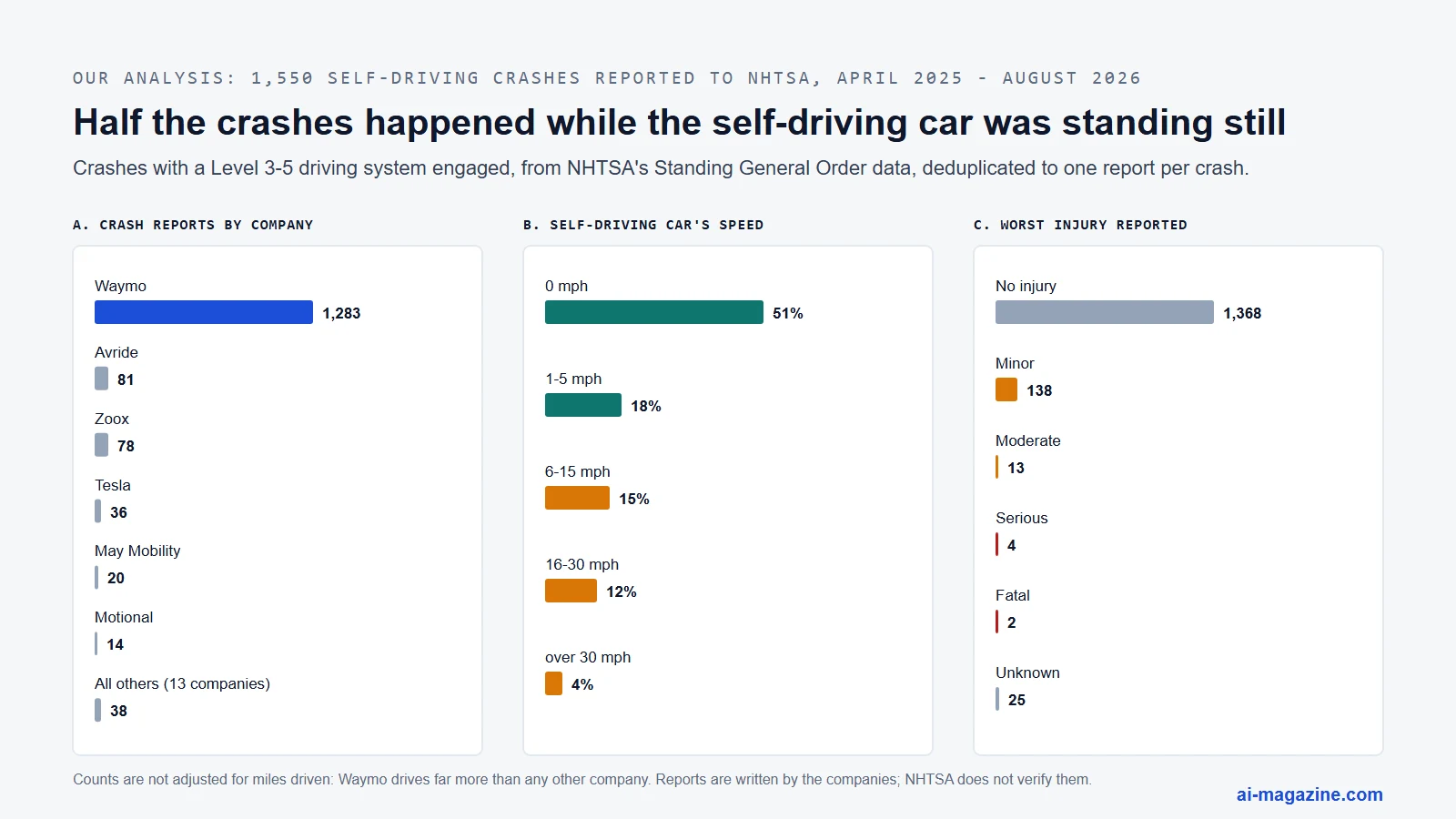
Companies testing or running automated driving systems in the US must report crashes to NHTSA under its Standing General Order. We downloaded the public file for the current version of the order, which covers crashes from April 2025 to August 2026, and kept one record per crash (the latest version of each report, and one report where two companies filed on the same crash). That left 1,550 crashes in which a Level 3 to 5 driving system was in use. Here is what they look like.
| What we measured | Result |
|---|---|
| Crashes, April 2025 to August 2026 | 1,550, reported by 19 companies |
| Share reported by Waymo | 83% (1,283) |
| Self-driving car stopped or parked at the time | 50% (778) |
| Self-driving car at 5 mph or less | 69% (1,065) |
| Self-driving car above 30 mph | 4% (64) |
| No injury reported | 88% (1,368) |
| Moderate, serious or fatal injury | 19 crashes (1.2%) |
| Crash partner was a pedestrian, cyclist or scooter rider | 26 crashes |
| Self-driving car’s airbag deployed | 29 crashes |
Most of these crashes are minor and slow. Half happened while the self-driving car was stopped or parked, so the contact came from someone else’s movement, and 69% at 5 mph or less. Only 4% happened above 30 mph, and 88% involved no reported injury.
Waymo dominates the count because it drives the most. Its 1,283 reports do not mean it is the least safe; it had about 3,000 to 3,800 driverless vehicles in this period and logged about 271 million rider-only miles by mid-2026, far more than any rival. NHTSA itself warns that these reports are not adjusted for miles. 55% of Waymo’s reported crashes happened while its car was stopped or parked.
The most serious cases. All 19 moderate, serious or fatal crashes in this period were reported by Waymo. Both fatal crashes, in Tempe (September 2025) and Dallas (August 2026), are described in Waymo’s reports as involving other road users: a motorcycle hitting the back of a Waymo that was slowing to turn, and a pedestrian struck by an SUV and thrown into a Waymo. Those accounts are the company’s own; NHTSA and the police may reach their own conclusions.
Tesla’s robotaxi reports show remote help at work. Tesla filed 36 reports in this period, 35 of them for Model Ys and one for a Cybercab, 26 of them in Austin. In three, the narrative says a remote operator was moving or recovering the car at the time of a low-speed contact, a reminder that “driverless” services still lean on people behind the scenes.
Limits: crash reports are written by the companies and NHTSA does not verify them; we did not adjust for miles, cities or time of day; the latest months may still be incomplete because reports arrive late. For safety rates per mile, the studies in the previous section are the better guide.
Crashes, recalls and investigations
Autonomous vehicles are not immune to incidents. The history of the industry is marked by high-profile crashes that exposed gaps in perception, decision-making, and human oversight. The 2018 Uber ATG fatality in Tempe, Arizona, remains a pivotal case. An NTSB investigation found that the SUV was in autonomous mode at 45 mph when it struck a pedestrian. The system detected her 5.6 seconds before impact but failed to classify her as a pedestrian or predict her path. It decided a collision was imminent only 1.2 seconds before impact, and the design precluded emergency braking. The probable cause was the operator’s visual distraction, but contributing factors included inadequate safety risk assessment and automation complacency. Uber had also deactivated the Volvo’s factory forward collision warning.
More recent incidents highlight different failure modes. In January 2026, NHTSA opened an investigation (PE26001) into a crash in Santa Monica where a driverless vehicle struck a child who ran from behind a parked SUV near a school. Waymo has said the car braked from about 17 mph to under 6 mph before contact. This incident, along with others, prompted scrutiny of school-zone behavior. Waymo also issued recall 25E084 for 3,067 vehicles because their software would sometimes proceed after stopping for a school bus with flashing lights, although no collisions occurred. Another recall, 26E026, addressed 3,791 vehicles that might drive into standing water on higher-speed roadways. According to news reports, Waymo also paused freeway driving in May 2026 after 13 incidents of entering closed construction zones, and resumed it in July.
Tesla faces its own set of investigations and recalls. Recall 23V838, covering over 2 million vehicles, addressed insufficient prominence of Autosteer controls, leading to potential driver misuse. NHTSA opened investigation RQ24009 to review if the recall remedy worked, citing 20 crashes after the update. Two major investigations, PE24031 and PE25012, focus on FSD performance in reduced visibility (sun glare, fog) and traffic-law violations, respectively. PE25012, opened in October 2025, initially documented 58 incidents, including 14 crashes and 23 injuries, involving nearly 2.9 million vehicles. We could not confirm the status of these investigations as of October 2026.
Cruise’s 2023 crash, described above, ended GM’s robotaxi business. These incidents demonstrate that while the overall crash rate may be lower, the nature of errors in autonomous systems can be complex and sometimes severe. The industry is learning that safety is not just about avoiding collisions but about predictable behavior in edge cases like school zones, construction, and adverse weather.
The rules: who allows driverless cars?
Regulation is evolving quickly, but it remains fragmented. In the United States, the NHTSA released an Automated Vehicle (AV) Framework in April 2025, emphasizing safety, innovation, and commercial deployment. This framework streamlined the Standing General Order for crash reporting and expanded the Automated Vehicle Exemption Program (AVEP) to domestically built vehicles. The first domestic exemption went to Zoox in August 2025. Zoox also received the first Part 555 commercial exemption in July 2026, allowing up to 2,500 vehicles exempt from certain federal motor vehicle safety standards, provided they meet enhanced oversight conditions.
States play a crucial role. According to law firms tracking the rules, California adopted new AV regulations in April 2026, effective July 1, 2026. These rules allow staged deployment for heavy-duty AVs and give the DMV power to issue notices of noncompliance. The California Public Utilities Commission (CPUC) issues deployment permits for paid rides, which Waymo holds. In Texas, Senate Bill 2807 took effect in September 2025, with rules effective February 2026. From May 28, 2026, every commercial AV operator needs Texas DMV authorization, which can be revoked or restricted. This creates a clear regulatory pathway in a state friendly to autonomous testing.
Internationally, the UK’s Automated Vehicles Act 2024 is set to take full effect in the second half of 2027. Pilots are fast-tracked to spring 2026, potentially including taxi services without safety drivers. The UK government projects £42 billion in economic benefit and 38,000 jobs by 2035. Permits are granted by the DVSA, but London requires TfL consent. As of September 2026, according to news reports, no such permit had been granted, though supervised testing with safety drivers was under way.
Germany and the EU have established frameworks for Level 4 systems. The Autonomous Driving Act and AFGBV ordinance allow L4 in approved areas under a technical supervisor. The EU provides type approval for small-series ADS. Mercedes-Benz received extended type approval in Germany in December 2024 for its Level 3 DRIVE PILOT system, allowing speeds up to 95 km/h on freeways. Japan’s revised Road Traffic Act, effective April 2023, created a permit for Level 4 operations, with the first service starting in Eiheiji in May 2023. According to news reports, China’s Ministry of Industry and Information Technology (MIIT) granted the first Level 3 market-access approvals in December 2025, allowing Changan Deepal and BAIC Arcfox vehicles to operate in congested highway traffic under specific conditions. This patchwork of regulations means that a car legal in one jurisdiction may face restrictions in another, complicating national rollouts.
Public trust and jobs
Public opinion remains cautious. A AAA survey from January 2025 found that about 6 in 10 U.S. drivers are afraid to ride in a self-driving vehicle. Only 13% would trust one, up slightly from 9% in 2024. While 74% of drivers know about robotaxis, 53% would not ride in one. Only 13% want self-driving development prioritized, down from 18% in 2022. Fear persists despite the statistical safety benefits. This hesitation is understandable given the high-profile crashes and the visible limitations of current systems. Trust is built through consistent, uneventful experiences, which robotaxis are providing in limited zones, but scaling that trust globally is a slow process.
The impact on jobs is another critical factor. The UK government projects 38,000 new jobs by 2035 from autonomous vehicle adoption. In the trucking sector, Aurora plans to have 200 driverless trucks in operation by the end of 2026, with a target of more than 30,000 by 2030. Aurora says it has had zero collisions attributed to its driving system since its commercial launch in May 2025. Kodiak reports 35 customer-owned driverless trucks in the Permian Basin as of June 2026. However, there is no official U.S. government estimate of truck-driver jobs at risk. The transition will likely create new roles in remote assistance, fleet management, and maintenance, but the displacement of long-haul drivers is a real economic shift.
The technology is also reaching ordinary cars through suppliers. Nissan plans to use the Wayve AI Driver for its next-generation ProPILOT system starting in fiscal year 2027. This integration of AI into legacy manufacturing suggests that the future of driving is not just about robotaxis but about assisted driving becoming standard in all new cars. The economic potential is vast, with a 2023 McKinsey estimate suggesting that ADAS and AD could generate $300–400 billion in the passenger car market by 2035. But this growth depends on overcoming public skepticism and regulatory hurdles.
Frequently asked questions
Are self-driving cars legal? Yes, but the rules vary by location. In the U.S., the NHTSA oversees federal safety standards, while states like California and Texas have their own deployment permits and regulations. The UK’s Automated Vehicles Act is set to take full effect in 2027, and China has approved Level 3 systems for highway use. Level 4 robotaxis are legal in specific zones where permits are granted.
Can I buy a self-driving car? Not fully autonomous ones yet. NHTSA states that no vehicle currently available for sale is fully automated (Level 5). You can buy cars with Level 2 systems such as Tesla FSD (Supervised), which need constant driver supervision, and in a few places the Level 3 Mercedes-Benz Drive Pilot, which works only in narrow conditions. Level 4 vehicles like Waymo’s Ojai are available for ride-hailing, not purchase.
How do self-driving cars work? They use a combination of sensors, including cameras, lidar, and radar, to perceive the environment. Software processes this data to map the world, predict the behavior of other road users, and plan a path. Waymo uses a foundation model with a validation layer, while Tesla uses an end-to-end neural network. Both are updated continuously over the air.
Are self-driving cars safer than human drivers? For Waymo, in the cities where it operates, the evidence says yes: its data shows 95% fewer serious-injury crashes than human benchmarks over 271 million miles, and peer-reviewed and insurance studies point the same way. Those figures come from Waymo’s own service areas and are mostly Waymo-authored, and there is far less evidence for other companies.
Which companies have driverless robotaxis? Waymo serves riders in 15 US metro areas and plans Madrid (2027) and Toronto (2028). Zoox carries riders in Las Vegas and San Francisco, Baidu Apollo Go runs in 28 cities, mostly in China, plus Dubai, and Pony.ai and WeRide run fleets in China and the Middle East. Tesla runs a robotaxi service in several Texas and Florida cities. Cruise was a major player but ceased funding its robotaxi division in late 2024.
Is Tesla FSD fully self-driving? No. Tesla’s Full Self-Driving (FSD) is a Level 2 system, meaning it requires a fully attentive driver who is ready to take over at any time. NHTSA investigations have highlighted issues with driver misuse and traffic-law violations. Tesla calls its latest version “FSD (Supervised)” to reflect this requirement.
What are the levels of autonomous driving? SAE Levels 0–2 are driver-assisted, meaning the human is responsible for monitoring. Level 3 (Conditional Automation) allows the system to drive but requires the driver to be available to take over. Level 4 (High Automation) drives the vehicle in limited areas without driver input. Level 5 (Full Automation) can drive everywhere under all conditions.
What happens when a robotaxi gets stuck? If a vehicle cannot resolve a situation autonomously, it may pull over or request remote assistance. Waymo uses remote agents who provide advice to the system, which then decides whether to act. The vehicle remains in control. Zoox can also have a person drive the vehicle slowly with a handheld controller, within line of sight.