AI Search: How AI Is Changing Search Results, Website Traffic and Marketing
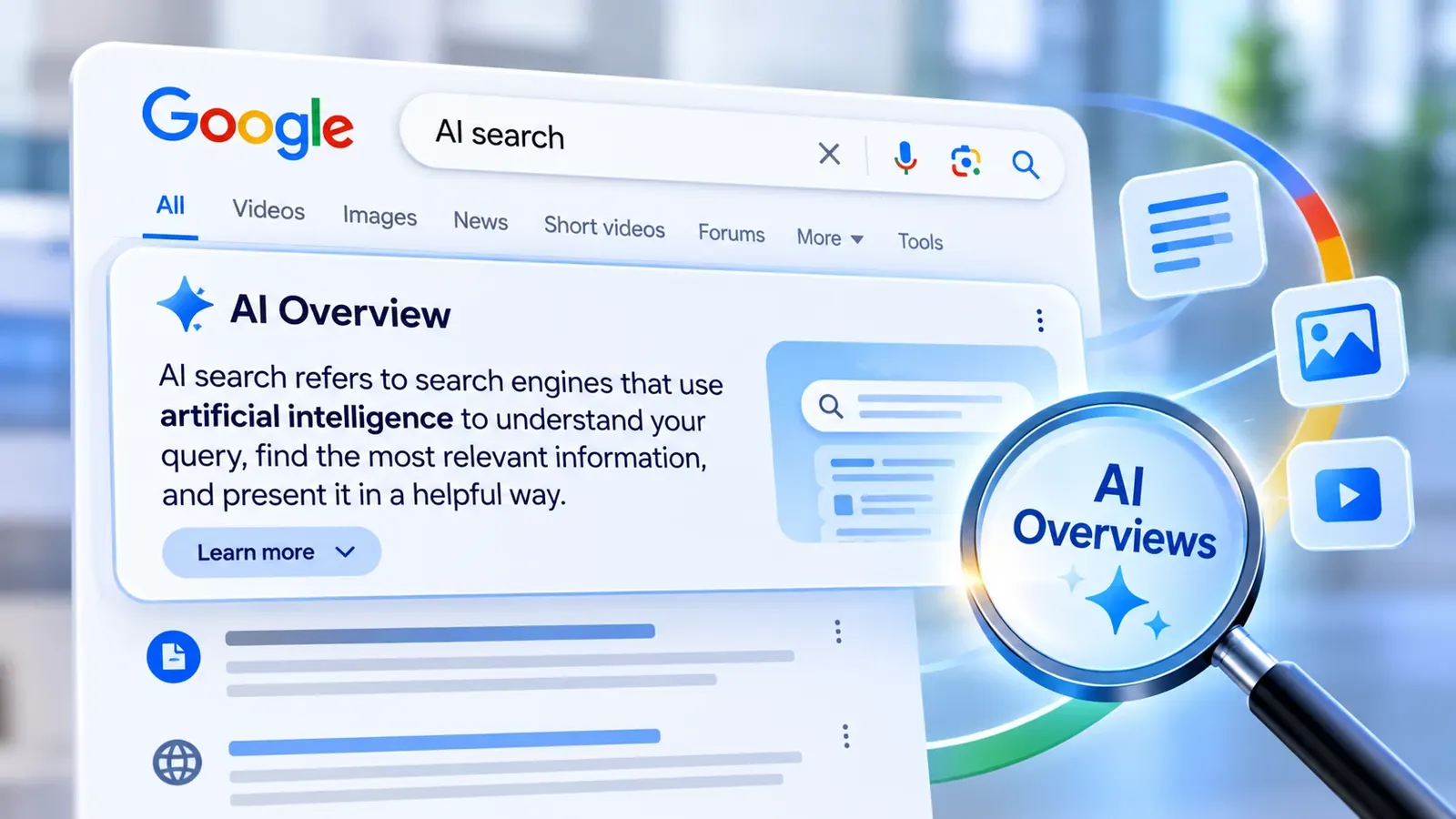
AI search means getting an answer written by an AI model instead of, or on top of, a list of links. It now comes in two forms. Search engines add AI answers to their own results pages, as Google does with AI Overviews and AI Mode. And AI assistants such as ChatGPT, Gemini, Perplexity and Claude search the web themselves and answer with a few cited sources.
Both change what happens after someone types a question. Fewer people click through to websites from a results page that already answers them. At the same time, a new stream of visitors arrives from the assistants. We saw this on a site our own team launched in October 2026: in its first three weeks, ChatGPT sent it 3.7 times more visitors than Google did, and over ten days in November OpenAI’s search crawler made 28 times more page requests than Googlebot.
This guide explains how search results have changed since 2024, what independent and industry studies say about clicks and traffic, which crawlers feed which AI products, and what all this means for SEO and online marketing. Our own data from that new site is in the middle of the article.
AI search at a glance
| Question | Short answer |
|---|---|
| What is AI search? | Search where an AI model writes the answer from web pages and shows a few sources, either inside a search engine (Google AI Overviews, AI Mode) or in an assistant (ChatGPT, Gemini, Perplexity, Claude) |
| How many people use it? | Google says AI Overviews have over 2.5 billion monthly users and AI Mode over 1 billion (May 2026). OpenAI says ChatGPT has more than a billion weekly users |
| Does it reduce clicks to websites? | In most studies, yes. Pew Research found people clicked a result in 8% of visits to results pages with an AI summary and 15% without. Google says total clicks are “relatively stable” |
| Do people still leave the search page? | Less and less. In SparkToro’s 2026 study, 68% of Google searches in the US ended without a click, against about 45% ten years earlier. In Google’s AI Mode, Semrush measured 92 to 94% zero-click searches (both vendor estimates) |
| Which sites lose most? | Sites that answer questions. Monthly new questions on Stack Overflow have fallen 99% since ChatGPT launched, by our count, and Wikipedia’s human page views in mid-2025 were about 8% lower than a year earlier |
| How much traffic do AI assistants send? | Still little in total: about 1% of visits to 1,215 large US websites in a 2025 study by Conductor, a vendor, most of it from ChatGPT. But it is growing fast |
| Can a new site get AI traffic before Google traffic? | It happened to us: ChatGPT started sending visitors four days after our new site launched, while Google sent no more than four visits a day in its first week and a half |
| What should marketers do? | Make sure AI crawlers can read the site, publish specific facts and data that AI answers can cite, track AI referrals separately, and do not give up on Google, which still has about 90% of the search engine market |
What counts as AI search today
There are now several ways to search with AI, and they work differently:
| Product | Owner | How it works | Started |
|---|---|---|---|
| AI Overviews | An AI summary at the top of normal Google results, with links to sources | US in May 2024; over 200 countries and 40 languages by May 2025 | |
| AI Mode | A separate chat-style search tab that runs many related searches at once and writes a longer answer | Test in March 2025; open in the US in May 2025; over 200 countries by October 2025 | |
| ChatGPT search | OpenAI | ChatGPT searches the web when a question needs fresh information and shows sources | October 2024; open to everyone without sign-up from February 2025 |
| Gemini app | Google’s assistant, which can search with Google | Gemini app has 1 billion users, Google said in October 2026 | |
| Perplexity | Perplexity AI | An “answer engine” that always searches and cites sources | 2022 |
| Claude web search | Anthropic | Claude searches the web when needed and cites sources | March 2025; all plans worldwide from May 2025 |
Google’s figures are its own. In its third-quarter 2026 results, it said queries in AI Mode are on average three times longer than traditional searches and one in five uses voice, images or documents. It also said its overall query growth was “the highest it’s been in the last five years”. So far AI has not shrunk Google: it still had about 91% of the world’s search engine market in October 2026, according to StatCounter. What has changed is what happens on the results page.
How the Google results page has changed
For 25 years a Google results page was mainly ten blue links. Since 2024 the answer often comes first:
- May 2024: AI Overviews launch for everyone in the US.
- October 2024: they reach more than 100 countries. Google expects over a billion monthly users.
- March 2025: AI Mode starts as a test. AI Overviews open to signed-out users and teenagers.
- May 2025: AI Overviews reach more than 200 countries and 40 languages; AI Mode opens to everyone in the US. Google says that in its biggest markets, such as the US and India, AI Overviews drive an “over 10% increase in usage” of Google for the queries that show them.
- October 2025: AI Mode reaches more than 200 countries and territories, including much of Europe.
- May 2026: Google says AI Overviews have over 2.5 billion monthly users and AI Mode over a billion. Users can ask a follow-up from an AI Overview and continue in AI Mode.
- August 2026: a new Search Console setting lets any site opt out of Google’s AI features worldwide, after a test in the UK (more on this below).
How often an AI Overview appears depends on how you count. Pew Research Center, which tracked the real browsing of 900 US adults in March 2025, found an AI summary on 18% of their searches. The longer the query, the more likely it was: 8% of one- or two-word searches, 53% of searches of ten words or more and 60% of questions starting with who, what, when or why (Pew Research). Studies by SEO software companies, which sample keywords rather than real users, give figures from about 6% to 48% depending on the keyword set and month. Semrush, a vendor, measured a peak of 24.6% of its 10 million keywords in July 2025 and 15.7% in November 2025.
AI Overviews are moving from questions to shopping. In Semrush’s data, informational queries made up 91% of the keywords that triggered an AI Overview in January 2025 but 57% by October 2025, as commercial and transactional searches grew. In a separate vendor study of 400 “best X”, “alternatives”, “pricing” and “reviews” keywords, AI Overviews appeared on 46% in September 2025 and 88% in August 2026. These are exactly the searches that used to send buyers to review sites and shops.
What happens to clicks
This is the central question for anyone who publishes on the web, and the answers range from “a little” to “almost all”.
| Study | Who | What it measured | Result |
|---|---|---|---|
| Pew Research Center (July 2025) | Independent | Real browsing of 900 US adults, March 2025 | A result was clicked in 8% of visits with an AI summary and 15% without. A link inside the summary was clicked in 1% |
| Ahrefs (February 2026) | SEO vendor | 300,000 keywords, Search Console data | An AI Overview is linked to a 58% lower click rate for the top result |
| Seer Interactive (November 2025) | Agency | 3,119 informational queries from 42 clients, June 2024 to September 2025 | Organic click rate on queries with an AI Overview down 61% since June 2024, by Seer’s count; paid click rate on those queries down about 68% |
| Amsive (April 2025) | Agency | 700,000 keywords on 10 sites | Click rate 15.5% lower on keywords with an AI Overview; on the few branded keywords with one, click rate rose 18.7% |
| Authoritas for DMG Media (submission to the UK regulator) | Publisher’s evidence | Daily Mail keywords, June to July 2025 | Desktop click rate down 89% in the UK when an AI Overview appears |
Pew also found that people ended their browsing session after 26% of searches with an AI summary, against 16% without. Google told reporters the study used a flawed method and a set of queries that was not representative of Search traffic.
Google’s own position is that clicks have held up. In August 2025 its head of Search, Liz Reid, wrote that “total organic click volume from Google Search to websites has been relatively stable year-over-year” and that Google is sending “slightly more quality clicks”, meaning visits where the user does not bounce straight back. She said traffic is shifting towards forums, videos and podcasts. In July 2026 Google said it was sending “billions of clicks to websites every week through AI features in Search”. Google does not publish the total, so these statements cannot be checked independently.
The two views can both be partly true. Google searches keep growing, so a lower click rate per search does not have to mean fewer clicks in total. But the losses are not spread evenly. Sites that answer simple questions, such as dictionaries, homework help, recipes and how-to guides, are exposed most. A site that people look for by name is exposed least. Amsive found that branded keywords which showed an AI Overview had a higher click rate, not a lower one.
Most answers now stay on the search page
For questions with a short factual answer, the search page or the chat window has become the destination rather than the signpost. The user reads the answer where it was asked and stops there. A “zero-click” search is one that ends without a click to any website, and several measurements suggest this is now the most common outcome on Google:
| Measurement | Source | Result |
|---|---|---|
| Google searches in the US ending without a click, 2024 | SparkToro and Datos (vendor panel) | 58.5%. Every 1,000 searches produced only 360 clicks to websites that are neither owned by Google nor Google ads |
| The same, January to April 2026 | SparkToro, with Similarweb data (vendor panel) | 68.01%, against about 45% ten years earlier |
| Searches in Google’s AI Mode ending without a click | Semrush, May to July 2025 (vendor) | 92 to 94% |
| Google news searches ending without a click | Similarweb, as reported by Press Gazette (vendor) | 56% in May 2024, almost 69% in May 2025 |
| Website visits that followed an AI or search session | Shi, Gu and Zhu, Comscore US desktop panel, October 2024 to July 2025 (preprint, not peer reviewed) | A referral to a website followed 5.4% of ChatGPT sessions and 31.1% of Google queries |
| Ending the browsing session after the results page | Pew Research Center, March 2025 | 26% with an AI summary, 16% without |
These studies use different panels and definitions, so their numbers should not be lined up as one trend. SparkToro’s 2024 and 2026 figures, for example, come from different data providers. Not every study agrees, either: Semrush found that on keywords which began showing AI Overviews between May and October 2025, the zero-click rate barely changed, from 33.8% to 31.5%. And Google says the clicks it does send are of higher quality.
The overall direction is still visible. More and more information that used to send people to a website stays inside the interface of Google or an AI assistant, where the user reads a summary of other people’s work. Across the whole web, SparkToro estimated with Similarweb data that visits to open-web sites fell 12.2% from their peak in early 2022 to the third quarter of 2026, while visits per internet user fell 29% (SparkToro, vendor estimate). That decline began before ChatGPT and has more than one cause, including social video. But where the answer is shown on the page, the search engines and AI companies keep the reader. The sites that wrote the answers lose the visit, and with it the ad view, the sale or the new subscriber.
Who has lost traffic
Among the sites with the clearest documented losses are those whose business was answering questions: Q&A forums, encyclopedias, dictionaries and homework help. Two of the biggest show the change most clearly.
Stack Overflow: from 200,000 questions a month to under 1,000
Stack Overflow, the question-and-answer site for programmers, was for 15 years the place developers landed from Google when code broke. We counted new questions on the site through the official Stack Exchange API. In March 2014 developers asked 207,169 questions. In November 2022, the month ChatGPT launched, they asked 109,119. In October 2026 they asked 880, a fall of 99%.
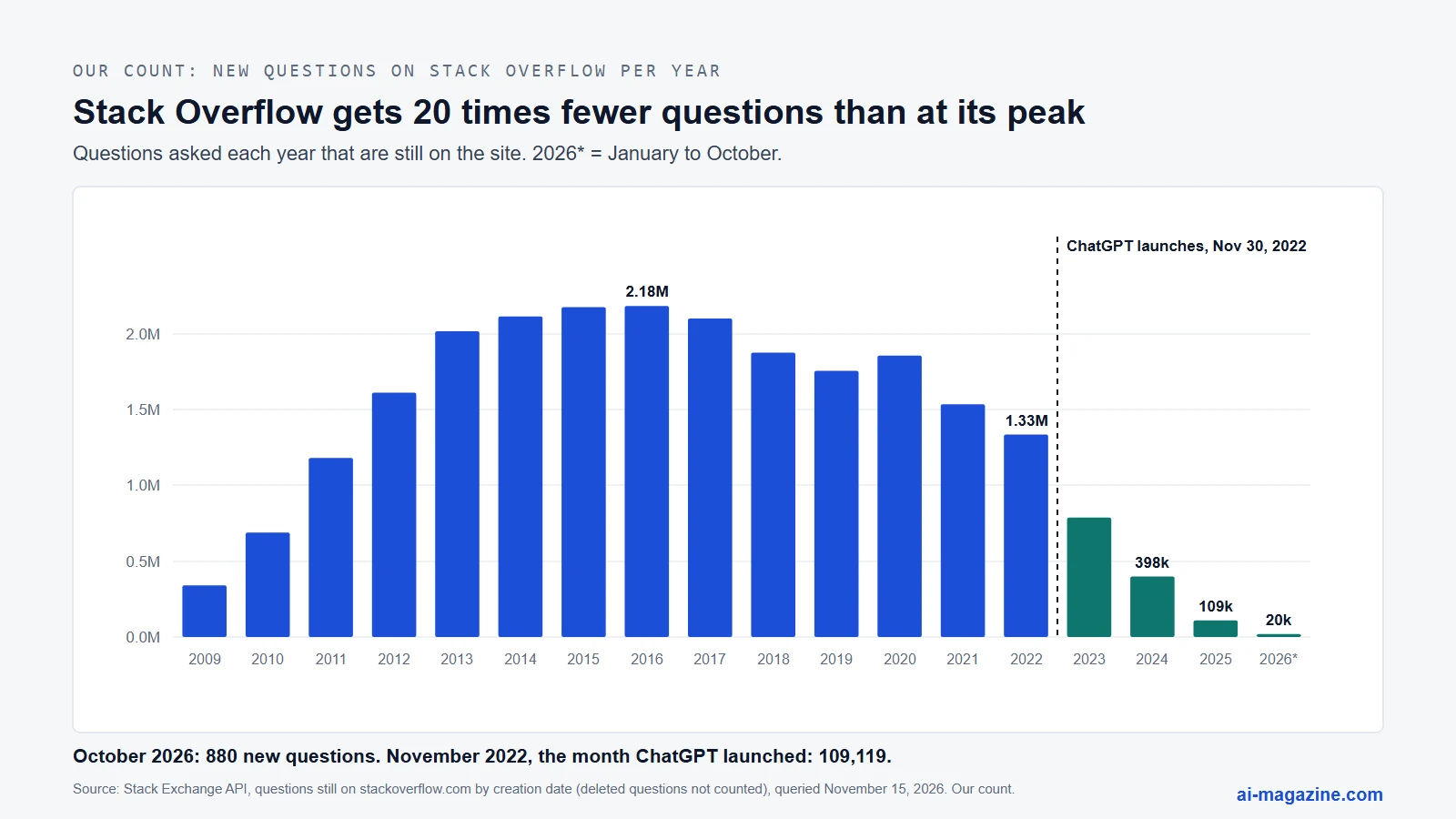
The decline began before ChatGPT. Yearly questions peaked in 2016 at 2.18 million and had already fallen 39% by 2022. What changed after November 2022 is the speed: down 41% in 2023, 49% in 2024 and 73% in 2025. Our count includes only questions that are still on the site, because deleted ones are not available through the API, so every year is somewhat understated.
Fewer questions does not mean nobody visits. Millions of old answers are still read, and they are among the material AI models learned to code from. In August 2023 the company said its traffic that year was about 5% lower than in 2022 and said a 14% drop in April 2023 could “likely” be attributed to developers “trying GPT-4” (Stack Overflow). In October 2023 it cut about 28% of its staff, citing profitability rather than AI (TechCrunch).
Its owner has since been more direct. In its results for the year to March 2026, Prosus, which bought Stack Overflow for $1.8 billion in 2021, wrote down $482 million of goodwill and other assets, “primarily related to Stack Overflow and GoodHabitz”. It said these businesses were not performing as expected “following the disruption caused by generative AI” (Prosus). In the same year Stack Overflow’s revenue grew 12% to $129 million. Part of the business now sells access to the site’s content through an API: Google and OpenAI both signed deals in 2024 to use it in their AI products. The archive of human answers now earns money by feeding the AI tools that developers ask instead.
Wikipedia: fewer human readers, more bots
In October 2025 the Wikimedia Foundation reported that human page views on Wikipedia were down roughly 8% compared with the same months of 2024. It found the decline after updating its bot detection, which showed that much of the unusually high traffic in May and June 2025 came from bots “built to evade detection”. The foundation linked the fall to search engines that use generative AI “to provide answers directly to searchers” and to younger people looking for information on social video platforms. It warned that fewer visits could mean fewer volunteers and fewer donors (Wikimedia Foundation).
The bots, meanwhile, keep coming. In April 2025 the foundation said bandwidth for downloading media files had grown 50% since January 2024, and that bots generated at least 65% of its most expensive traffic while accounting for only about 35% of page views (Wikimedia Foundation). Its answer has been to charge for bulk access: by January 2026 Amazon, Meta, Microsoft, Mistral AI and Perplexity had joined Google as partners of Wikimedia Enterprise, its commercial service for large reusers (Wikimedia Enterprise).
Encyclopedias, dictionaries, homework help and publishers
Other publishers have put numbers on their losses, in their own results or in court:
- Encyclopaedia Britannica and Merriam-Webster sued Perplexity in September 2025. Their complaint says Perplexity “free rides” on their work “by cannibalizing traffic” to their sites, which had more than 2.4 billion sessions between them in 2024. The complaint gives no figure for lost traffic, and these are allegations, not findings (complaint).
- Chegg, the homework help company, said its non-subscriber traffic was down 49% in January 2025 and sued Google in February 2025, arguing that AI Overviews had turned Google “from a ‘search engine’ into an ‘answer engine’” (Chegg).
- People Inc (formerly Dotdash Meredith, owned by IAC) said Google’s share of its core sites’ visits fell from 52% in the second quarter of 2023 to 28% in the second quarter of 2025, as reported by AdExchanger. By the second quarter of 2026 Google search was 21% of its total traffic, and Google search traffic was down 40% year on year, according to figures reported by Digiday.
- Business Insider cut about a fifth of its staff in May 2025. Its chief executive wrote that 70% of the business had “some degree of traffic sensitivity”, according to press reports.
- Penske Media, which owns Rolling Stone, Billboard and Variety, sued Google in September 2025, saying its affiliate revenue had fallen by more than a third from its peak (Axios). Google called the claims meritless.
Similarweb estimates that organic search traffic to news sites has fallen 26% since AI Overviews launched (Similarweb, vendor estimate).
AI assistants as a new source of visitors
While Google sends fewer clicks per search, the assistants have started sending visitors of their own:
- Size of the channel. In the largest study we found, Conductor, a vendor, counted 3.3 billion visits to 1,215 large US websites from May to September 2025. AI assistants sent 1.08% of them, rising to 2.8% for IT companies. ChatGPT sent 87% of all AI referrals.
- Growth. Similarweb estimates that AI platforms sent about 770 million visits a month to websites worldwide between June 2025 and May 2026, more than double a year earlier (Similarweb, vendor estimate). Adobe measured a 693% rise in visits from AI tools to US retail sites over the 2025 holiday season, while noting that “the base of users remains modest” (Adobe).
- Quality. Adobe reports that visitors from AI tools converted 90% better than other visitors to US retail sites in September 2026. Other studies disagree: Amsive compared 54 sites in 2025 and found no statistically significant difference in conversion rate between visitors from AI assistants and from organic search (4.87% against 4.60%). Both are vendor studies.
All these numbers probably undercount AI traffic. Many visits from apps arrive with no referrer and are recorded as “direct”. ChatGPT now adds a tag, utm_source=chatgpt.com, to many links, which helps analytics tools spot it.
Our data: a new site where ChatGPT beat Google
Industry studies look at big, established websites. We wanted to see what happens to a brand-new one. Our team launched footymath.com, a site with football match predictions from a statistical model, and opened it to search engines on October 22, 2026. It had no backlinks, no advertising and no history. We installed Google Analytics on October 25 and also kept the server logs.
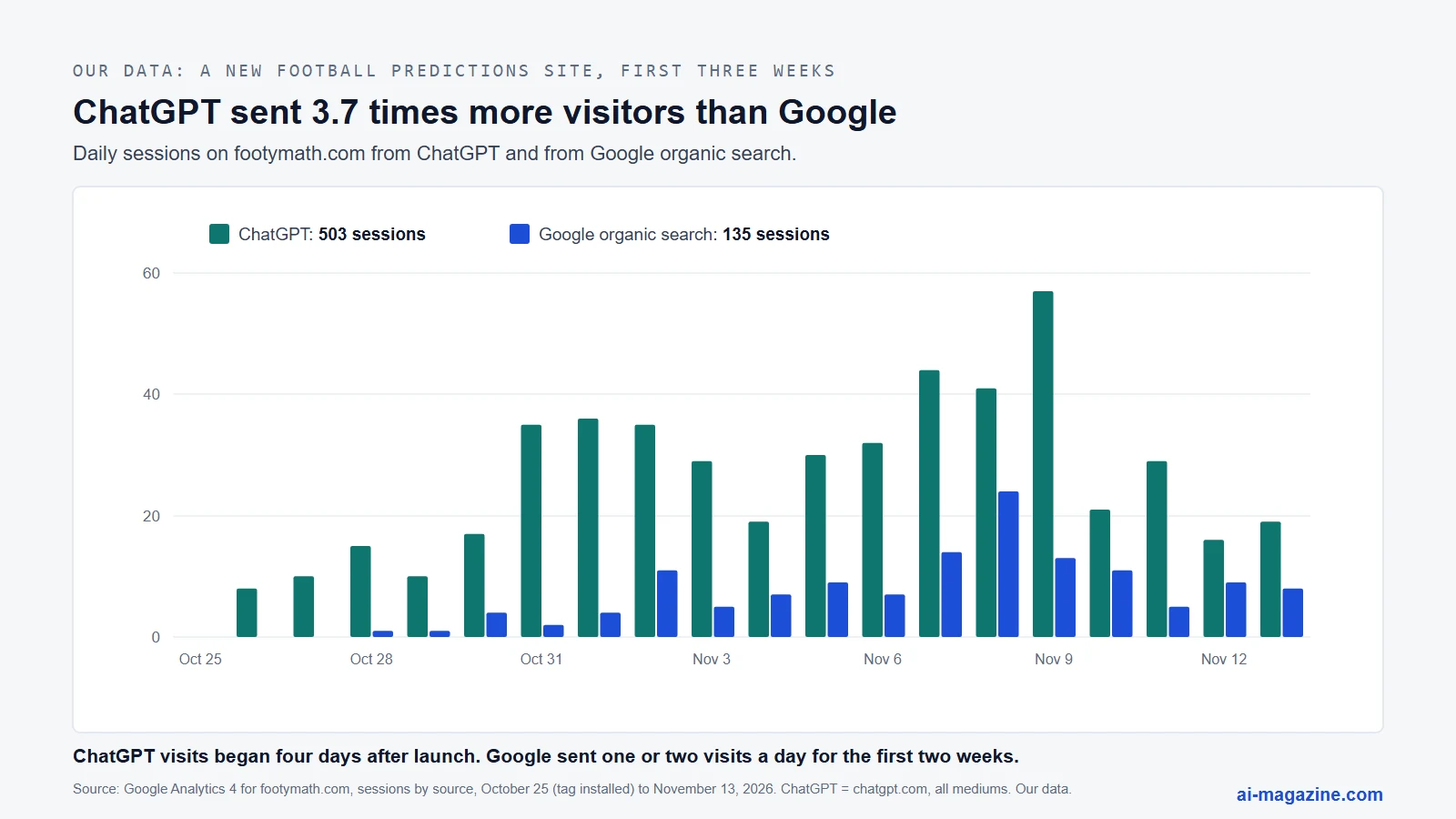
The chart shows the result. From October 25 to November 13:
- ChatGPT sent 503 sessions and Google organic search 135, 3.7 times fewer. ChatGPT was ahead of Google on every day from October 26.
- The first recorded ChatGPT visits came on October 26, four days after launch and a day after we started measuring. By the end of the first week ChatGPT was sending 35 visits a day.
- Google found the site quickly but sent few visitors. Search Console shows impressions from the first day and a first click on October 23. But until November 1, Google never sent more than four visits a day. By then ChatGPT had sent 131.
- Other assistants barely registered: two visits from Perplexity, none from Gemini, Copilot or Claude.
| Week | ChatGPT sessions | Google organic sessions | Ratio |
|---|---|---|---|
| October 26 to November 1 | 131 | 12 | 10.9 to 1 |
| November 2 to 8 | 230 | 77 | 3.0 to 1 |
| November 9 to 13 (5 days) | 142 | 46 | 3.1 to 1 |
The gap is narrowing as Google catches up. Google’s traffic grew six-fold from the first week to the second, which is the normal pattern as a new site gets indexed and starts to rank. Many of Google’s clicks so far came from people searching for the site by name: “footymath” was the top query in Search Console, at an average position of 1.8.
The visitors were similarly engaged. Visitors from ChatGPT and Google were equally engaged: about 72% of sessions from each counted as engaged in Google Analytics. ChatGPT visitors viewed 5.5 pages per visit and Google visitors 7.8. Both were mostly on phones: 84% of ChatGPT sessions and 95% of Google sessions. ChatGPT visitors landed most often on the home page, the page showing the model’s accuracy record and a betting simulator. These are the pages that answer a question like “is there a reliable football prediction site?”
What the crawlers did
The server logs suggest part of the explanation, although they start only on November 4, after ChatGPT had already pulled ahead. From November 4 to 14 we counted the pages each crawler fetched. We kept only requests from the IP addresses that OpenAI and Google publish for their bots, so programs pretending to be Googlebot are excluded.
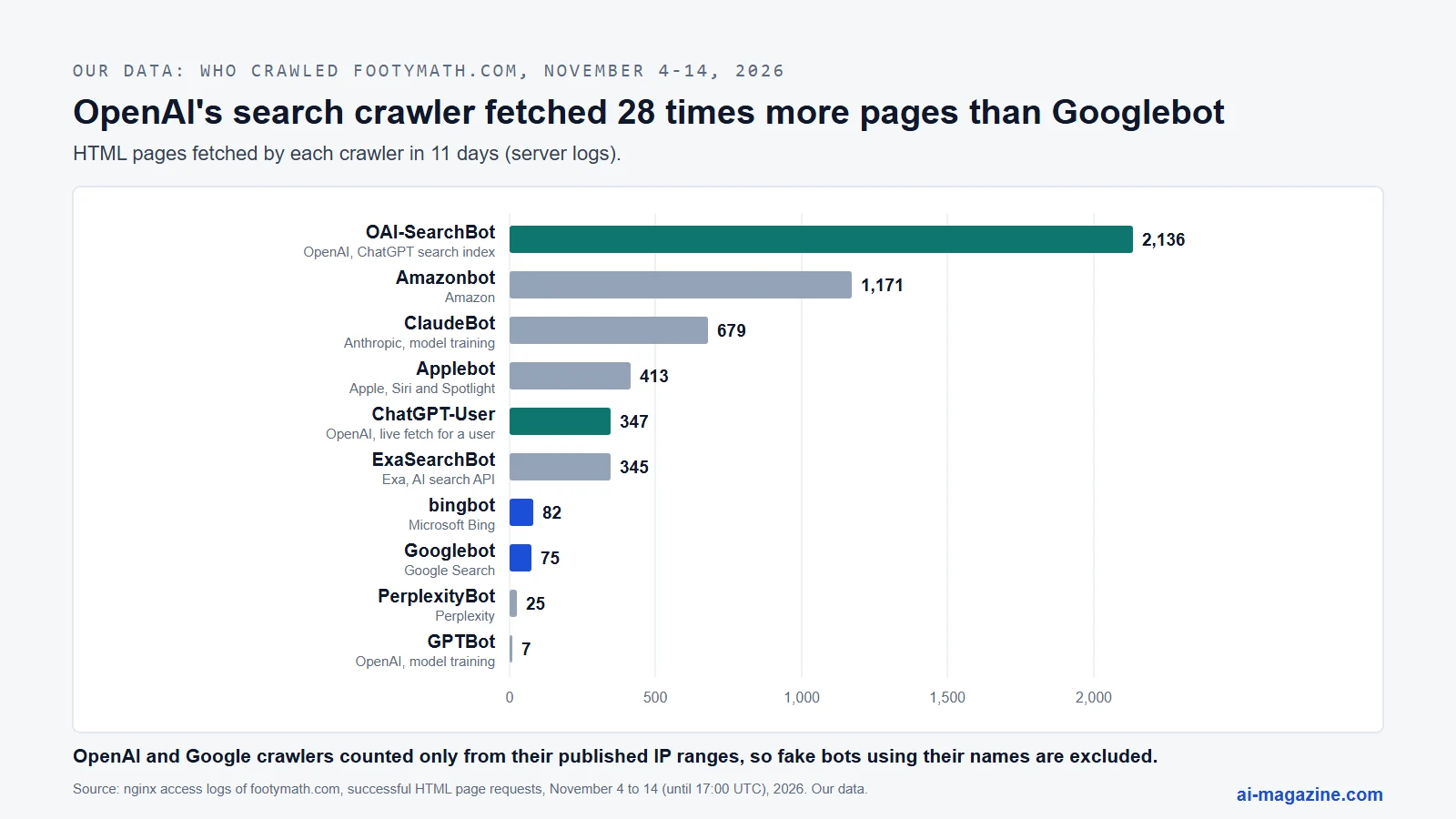
- OAI-SearchBot, the crawler that builds ChatGPT’s search index, made 2,136 page requests, covering 810 different pages. Googlebot made 75 requests, covering 32 different pages: 28 times fewer requests and 25 times fewer pages.
- ChatGPT-User, which fetches a page when a ChatGPT user’s question needs it, made 347 requests. Each one was triggered by a ChatGPT user’s conversation that led ChatGPT to open our page, whether or not the user then clicked; one question can trigger several fetches.
- GPTBot, OpenAI’s training crawler, fetched only 7 pages. Search and training are separate crawlers, and on our site search was far more active.
- ClaudeBot, Anthropic’s training crawler, fetched 679 pages, almost all in one day. Claude’s search and user crawlers made only a handful of requests, which matches the near absence of Claude visitors.
Google decides how much to crawl a new site based on signals such as links and popularity, and footymath had none yet. OpenAI’s crawler was much less cautious. ChatGPT also gets results from third-party search providers, which OpenAI’s help pages say include Bing. So a page can reach ChatGPT’s answers without first ranking in Google.
Limits of our data. This is one new site in one niche. People ask chatbots for football predictions every day, and the subject is time-sensitive, so assistants have to look for fresh pages. The site publishes a clean, hourly-updated summary for AI tools (an llms.txt file) and fast static pages, which may have helped. Google Analytics was installed three days after launch, so we have no visit data for October 22 to 24. An established site will usually see the opposite balance: for most sites Google is still by far the largest source of traffic. Our point is narrower. For a new site, AI assistants can be the first meaningful source of visitors, and they can arrive before Google sends any volume.
AI crawlers: which bot does what
Every AI company now runs several crawlers with different jobs. Blocking the wrong one can remove a site from AI answers, or fail to stop what the owner wanted to stop.
| Crawler | Company | Purpose | Blocking it means |
|---|---|---|---|
| OAI-SearchBot | OpenAI | Builds the ChatGPT search index | Site not shown in ChatGPT search answers |
| GPTBot | OpenAI | Collects data to train models | Content not used for training; search unaffected |
| ChatGPT-User | OpenAI | Fetches a page when a user’s request needs it | Not a crawler; OpenAI says robots.txt “may not apply” |
| Googlebot | Google Search, including AI Overviews and AI Mode | Site leaves Google Search entirely | |
| Google-Extended | A robots.txt switch for Gemini training and grounding | Does not remove a site from AI Overviews or AI Mode | |
| PerplexityBot | Perplexity | Builds Perplexity’s search index | Not shown in Perplexity answers |
| ClaudeBot | Anthropic | Collects data to train models | Content not used for training |
| Claude-SearchBot | Anthropic | Indexes pages for Claude’s search | Fewer appearances in Claude’s search answers |
| Applebot-Extended | Apple | A switch for training Apple’s models (no crawler of its own) | Content not used for training; Siri and Spotlight unaffected |
Sources: OpenAI, Google, Perplexity, Anthropic, Apple. OpenAI and Perplexity say robots.txt changes take up to about 24 hours to apply.
The deal between sites and search engines has changed. Search engines used to crawl pages and send visitors back in return. Cloudflare, which runs a large share of the web’s traffic through its network, measured how many pages each company crawled for every visitor it referred:
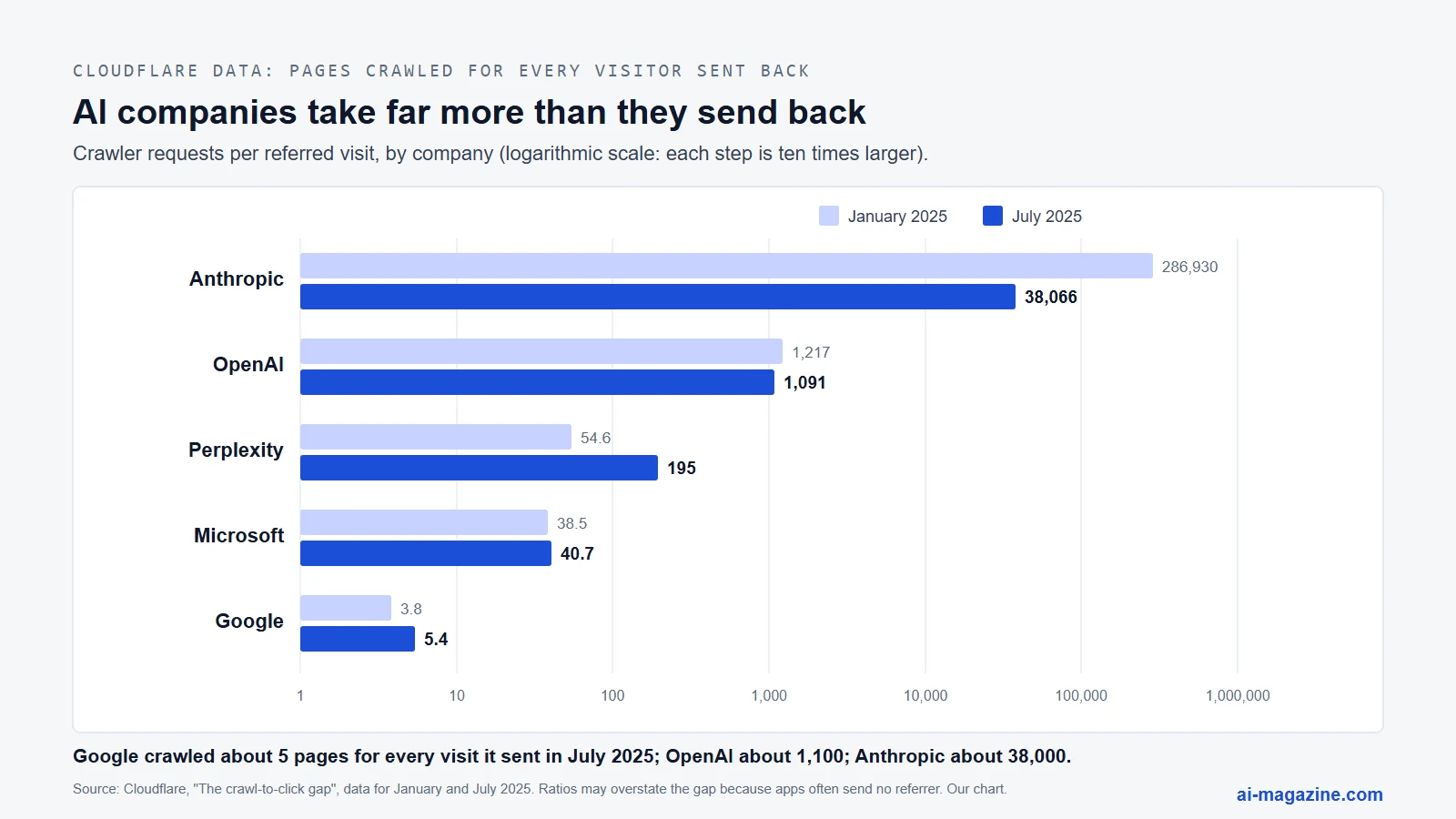
In July 2025 Google crawled about 5 pages for each visit it sent, OpenAI about 1,100 and Anthropic about 38,000 (Cloudflare). Cloudflare notes that the ratios may overstate the gap, because apps often send visitors without a referrer. Cloudflare also found that 80% of AI crawling was for model training, 18% for search and 2% for user requests. From July 1, 2025 it blocked AI crawlers by default on newly added domains. In 2026 it announced new defaults from September 15, 2026 for new sites and for free accounts that had not changed their settings: search crawlers allowed, but training and agent crawlers blocked on pages with ads. It has also launched “pay per crawl”, which lets sites charge AI companies for access (Cloudflare).
On our own site the balance looked much better. From November 4 to 13, OpenAI’s search crawler took about 2,000 pages and ChatGPT sent about 300 visits: roughly seven search-crawler fetches per visitor. Cloudflare’s figure for OpenAI counts all its crawlers, including the training crawler, so the two are not directly comparable, but the gap is still large. The ratio varies enormously from site to site, and a site that answers questions people put to ChatGPT gets far more back.
What AI search means for marketing and SEO
SEO does not go away, but the target moves
Google says there are “no additional requirements to appear in AI Overviews or AI Mode, nor other special optimizations necessary”. Pages are chosen from its normal index, and AI Mode runs many related searches at once (“query fan-out”) to build an answer. So the basics of SEO still decide whether a page can be cited at all: crawlable pages, clear content and a site Google trusts.
What changes is the goal. A page can now be useful without being clicked, by being the source an AI answer cites. The term for optimising for that is generative engine optimization (GEO), sometimes called answer engine optimization (AEO). It comes from a 2023 research paper by researchers at Princeton and IIT Delhi, presented at the KDD 2024 conference. They tested how changes to a web page affected how often AI answers used it. Adding quotations, citations of sources and statistics raised a page’s visibility by 30% to 40%. Stuffing keywords did not help. In other words, the pages AI likes to cite are the ones with specific, checkable facts.
Brands also need to show up when AI recommends products. BrightEdge, a vendor, found that ChatGPT’s answers now cite more sources but recommend fewer brands: in e-commerce, about four instead of six. Our own test of AI marketing recommendations found that the brands a model names change completely when the buyer adds a detail such as a small budget.
Advertising follows the answers
The search ads business is moving into AI answers too:
- Google shows ads inside AI Overviews and has been rolling out ads in AI Mode, including to ten more countries from October 2026. On its third-quarter 2026 earnings call, its chief business officer Philipp Schindler said the strong growth in AI Mode had weighed on search revenue “because of the lower monetization we were seeing in AI Mode”, and that Google is now scaling ads in both AI Overviews and AI Mode to more users and queries.
- OpenAI began testing ads in ChatGPT in the US in February 2026, for users of the free and Go plans. Ads appear below answers and are labelled; OpenAI says they do not influence the answers.
- Perplexity began testing sponsored follow-up questions in November 2024.
For advertisers this means fewer clicks on classic search ads when an AI answer sits above them. Seer Interactive found paid click rates on searches with an AI Overview fell about 68% between June 2024 and September 2025. In return there is new ad space inside the answers.
Measuring AI visibility
Traffic from AI is hard to see in standard reports. Google counts clicks from AI Overviews and AI Mode in Search Console’s normal “Web” report, without a separate line. In 2026 it added reporting of impressions in AI features. ChatGPT traffic shows up in Google Analytics 4 as source chatgpt.com (on our site under the medium “ai-assistant”), but app visits without a referrer land in “direct”. Server logs are the most complete record: they show which AI crawlers read which pages, and how often ChatGPT fetched a page for a user.
Regulators and the courts
- UK. In October 2025 the Competition and Markets Authority gave Google “strategic market status” in search, with AI Overviews and AI Mode in scope; Gemini is not covered. In June 2026 it ordered Google to give publishers effective control over how their content is used in its AI features, and to attribute it clearly (CMA).
- Google’s response. Also in June 2026 Google added a Search Console setting that lets sites opt out of appearing in and grounding AI Overviews and AI Mode. It started in the UK and has been available worldwide since August 31, 2026. The cost is clear: Google says sites that opt out “will not receive traffic or impressions” from its AI features. It is not a ranking factor for normal results.
- EU. Independent publishers complained to the European Commission in June 2025. In December 2025 the Commission opened a formal antitrust investigation into how Google uses publishers’ content in AI Overviews and AI Mode. Opening a case is not a finding that Google broke the law.
- US. Chegg and Penske Media are suing Google over AI Overviews. Both cases are at an early stage.
What to do now: a checklist for site owners
- Check your robots.txt and firewall. Make sure the search crawlers you want, such as Googlebot, OAI-SearchBot, PerplexityBot and Claude-SearchBot, are allowed. You can block training crawlers such as GPTBot or ClaudeBot separately without leaving AI search. If you use Cloudflare, check its AI crawler settings, because blocking can be on by default.
- Get indexed by Bing as well as Google. ChatGPT search uses third-party providers including Bing, so a site missing from Bing may be harder for ChatGPT to find. Bing Webmaster Tools and IndexNow make this quick.
- Publish what AI answers cite. Original data, specific numbers, named sources, dates and clear definitions. Pages that only rephrase what is already everywhere are the easiest to replace with an AI summary.
- Build a brand people search for. Searches by name are the least affected by AI Overviews, and on our site the brand name was the top query behind Google’s early clicks.
- Measure AI separately. Set up a channel for AI assistants in your analytics, watch “direct” traffic, and read your server logs for OAI-SearchBot and ChatGPT-User.
- Do not abandon Google. It still has about 90% of the search engine market worldwide. On our new site Google traffic grew six-fold in its second week, and for an established site it will usually remain the largest source.
- Decide on the AI Overviews opt-out carefully. Opting out protects content but removes the site from AI answers on Google, which now reach billions of users.
Frequently asked questions
What is AI search?
AI search is search where an AI model reads web pages and writes an answer, usually with links to its sources. It includes AI features inside search engines, such as Google’s AI Overviews and AI Mode, and AI assistants that search the web, such as ChatGPT, Gemini, Perplexity and Claude.
What is the best AI search engine?
It depends on the task. Google’s AI Mode is built on Google’s own search index and has over a billion monthly users by Google’s count. ChatGPT search is part of the most used assistant and sent by far the most AI referrals to websites in the studies we found. Perplexity always searches and always cites its sources. Claude and Gemini search when a question needs current information.
Is AI replacing Google search?
Not so far. Google still had about 91% of the global search engine market in October 2026, and it says its query growth is the fastest in five years. AI is changing Google from the inside: more searches end with an AI answer and fewer with a click.
How does AI search affect website traffic?
Most studies find fewer clicks from Google when an AI Overview appears, from about 15% fewer to almost 90% fewer depending on the study and the type of query. Google says total clicks are stable. At the same time AI assistants send a small but fast-growing stream of visitors, about 1% of visits to large US websites in a 2025 vendor study, mostly from ChatGPT.
What is a zero-click search?
A zero-click search is one that ends without the user clicking through to any website, because the answer is already on the results page or in the chat. SparkToro estimated that 68% of US Google searches ended this way in early 2026, and Semrush measured 92 to 94% in Google’s AI Mode. Both are vendor estimates.
Why has Stack Overflow lost so many questions?
The most likely reason is that developers now ask ChatGPT, Claude or a coding assistant in their editor instead of posting a question and waiting for an answer, and Stack Overflow’s owner has blamed generative AI for the business falling short of expectations. By our count through the Stack Exchange API, new questions fell from 109,119 in November 2022, when ChatGPT launched, to 880 in October 2026. The decline started earlier, after a peak in 2016, but became much faster after 2022.
Can a new website get traffic from ChatGPT before Google?
It can. Our new football predictions site recorded its first ChatGPT visits four days after launch, and over its first three weeks ChatGPT sent 3.7 times more visitors than Google. Over ten days in November, OpenAI’s search crawler made 28 times more page requests than Googlebot. One site does not prove a rule, but it shows that AI assistants do not wait for a site to build authority in Google.
What is generative engine optimization (GEO)?
GEO means making content more likely to be used and cited in AI-written answers. Research presented at KDD 2024 found that adding quotations, citations and statistics raised a page’s visibility in AI answers by 30% to 40%, while keyword stuffing did not help.
Should I block AI crawlers?
Block training crawlers if you do not want your content used to train models, but think twice before blocking search crawlers such as OAI-SearchBot, PerplexityBot or Claude-SearchBot, because that removes your site from those AI answers. Blocking Google-Extended does not remove a site from AI Overviews; that needs Google’s separate Search Console setting.
Related guides
- AI data centers: where the computing power behind AI search is being built.
- AI in marketing: how marketers use AI, with our test of AI tool recommendations.
- ChatGPT alternatives: the main AI assistants compared.
- Retrieval-augmented generation (RAG): the technique that lets AI answers quote fresh web pages.
- Semantic search: how search engines match meaning rather than exact words.