Is AI a Bubble? What the Spending, the Cash and the Markets Say

Is AI a bubble? Parts of it behave like one, and the rest is a very large bet that is still mostly paid for out of profits, though less so every quarter. As of November 11, 2026, the question is not settled. AI revenue is growing fast, the biggest spenders are highly profitable, and stock valuations on expected earnings are well below the dot-com peak. But spending is growing much faster than the cash that pays for it, more of it is borrowed, and markets have had several sharp AI sell-offs this year, including a 4.4% fall in the S&P 500 on November 5.
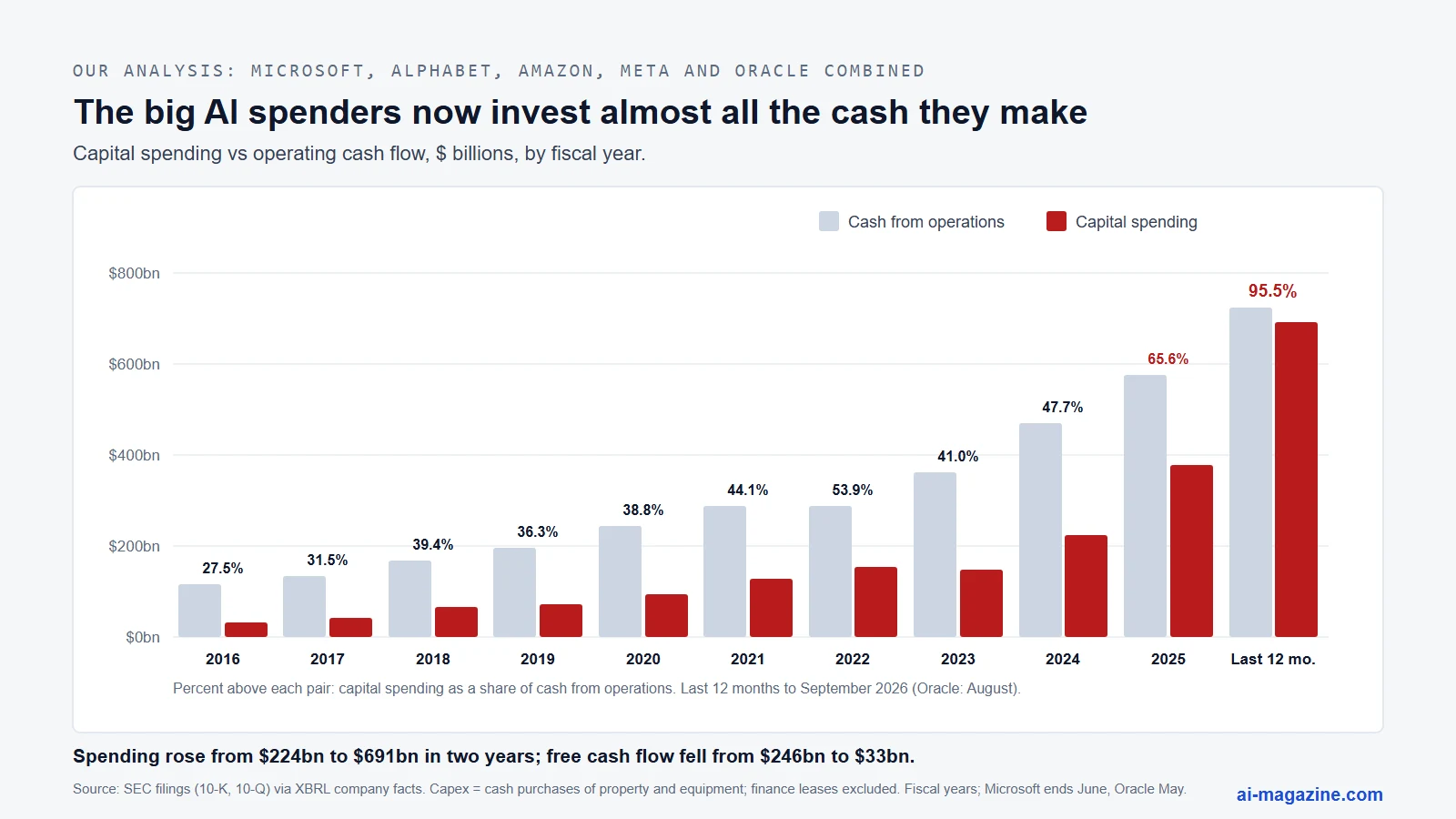
This guide explains what economists mean by a bubble and then tests the AI boom against the numbers. Our own analysis of SEC filings shows that Microsoft, Alphabet, Amazon, Meta and Oracle together spent $691 billion on property and equipment in the 12 months to September 2026. That equals 95.5% of the cash their businesses generated. In 2016 the figure was 27.5%. We also compare the boom with the 1990s telecom build-out, collect what central banks have warned, and list the signals that will show which way this goes.
This is an analysis of public data, not investment advice.
Is AI a bubble? The short answer
| Question | Short answer |
|---|---|
| Is AI a bubble? | There is no consensus. The IMF, the Bank of England and the BIS warn of a possible correction but do not call it a bubble outright. Several tech leaders said in 2025 that parts of it are |
| How much is being spent? | Microsoft, Alphabet, Amazon and Meta plan roughly $715-745 billion of capital spending for 2026 (our sum of company guidance; Microsoft’s figure from press reports) |
| Who pays for it? | Mostly operating cash flow. But for the five biggest spenders, capital spending now eats 95.5% of that cash, and borrowing is rising fast |
| Is there real revenue? | Yes, and it is growing: Google Cloud +103%, Azure +48%, AWS +39% in the third quarter of 2026. Still far short of what the spending needs to pay back on a common rule of thumb |
| Are stocks as expensive as in 2000? | On expected earnings, no: the S&P 500 trades at 17.7 times, against 24.4 at the dot-com peak. On the long-run Shiller CAPE, close: 39.7 against a record 44.2 |
| What could make it burst? | Demand not keeping up with new capacity, lenders pulling back from weaker borrowers, or chips wearing out faster than the accounts assume |
| Has it burst? | Not as of November 11, 2026. There were sharp drops in July and November and some data-centre projects were cancelled, but no major AI company has failed |
What counts as a bubble
There is no single test. Robert Shiller describes a bubble as a social process: rising prices make news, the news draws in more buyers, and stories that justify the rise spread from person to person, pulling in people who doubt the real value but do not want to miss out. Charles Kindleberger, building on Hyman Minsky, described a typical sequence: a new technology or shock opens up profits, credit fuels a boom, euphoria sets in, insiders start selling, and then comes the panic. In both accounts the price runs far ahead of what the underlying asset can ever earn.
AI has a real technology at its centre, which does not rule out a bubble. Railways, electricity and the internet were all real, and all had manias. Jeff Bezos made this distinction in October 2025 when he called AI “a kind of industrial bubble”: investors overbuild something useful, many lose money, and the infrastructure stays behind.
There is a further twist. The Richmond Fed economists who studied the telecom crash of 2000-2002 did not call it a bubble at all. In their reading, companies built on beliefs about future demand that turned out wrong, rather than on pure speculation (Couper, Hejkal and Wolman, 2003). The effect on investors was the same. So the more useful questions are: will the money being spent earn a return, who has borrowed to spend it, and who gets hurt if it does not?
Our analysis: the spending is catching up with the cash
The five companies that spend most on AI infrastructure and report it in US filings are Microsoft, Alphabet, Amazon, Meta and Oracle. We pulled their cash flow statements from SEC company filings (XBRL company facts, fetched November 11, 2026) and compared two lines: cash spent on property and equipment (capex) and net cash from operating activities. We added them up by fiscal year and for the latest 12 months available, to September 30, 2026 for four of them and to August 31, 2026 for Oracle.
| Fiscal year | Capex | Cash from operations | Capex as % of operating cash | Cash left after capex | Capex as % of revenue |
|---|---|---|---|---|---|
| 2016 | $32.0bn | $116.4bn | 27.5% | $84.3bn | 8.4% |
| 2020 | $94.6bn | $243.7bn | 38.8% | $149.2bn | 11.3% |
| 2022 | $154.7bn | $287.3bn | 53.9% | $132.6bn | 13.4% |
| 2023 | $148.8bn | $362.6bn | 41.0% | $213.7bn | 11.6% |
| 2024 | $224.1bn | $469.7bn | 47.7% | $245.6bn | 15.5% |
| 2025 | $378.7bn | $577.0bn | 65.6% | $198.3bn | 22.8% |
| Last 12 months | $691.0bn | $723.8bn | 95.5% | $32.7bn | 38.4% |
What the numbers show:
- Spending tripled in under two years. Capex rose from $224.1 billion in fiscal 2024 to $691.0 billion in the latest 12 months.
- Cash grew, but much more slowly. Operating cash flow rose 54% over the same stretch, from $469.7 billion to $723.8 billion.
- The cushion is almost gone. Cash left after capex fell from $245.6 billion to $32.7 billion. Every further increase now has to come from new revenue, borrowing or share sales.
- Capex is now 38.4 cents of every revenue dollar, against 8.4 cents in 2016.
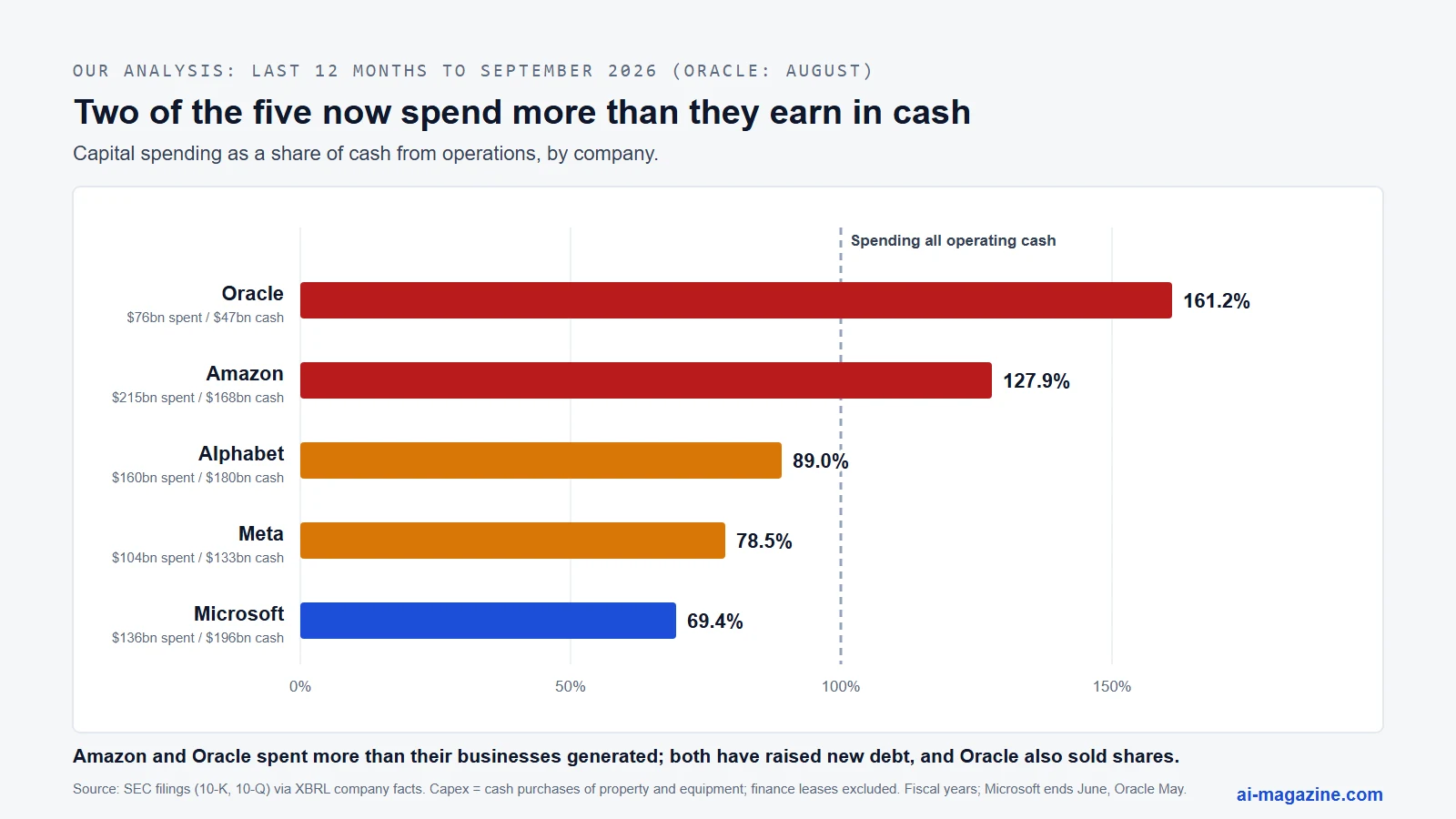
Company by company, the picture is uneven:
| Company | Capex, last 12 months | Cash from operations | Capex as % of operating cash |
|---|---|---|---|
| Oracle (to Aug 31, 2026) | $75.7bn | $46.9bn | 161.2% |
| Amazon | $215.2bn | $168.3bn | 127.9% |
| Alphabet | $159.8bn | $179.6bn | 89.0% |
| Meta | $104.4bn | $133.1bn | 78.5% |
| Microsoft | $135.9bn | $195.9bn | 69.4% |
Oracle and Amazon already spend more than their businesses bring in. Amazon’s own figure for free cash flow over the same period was an outflow of $42.4 billion (Amazon Q3 2026 results). Oracle reported negative free cash flow of $5 billion for its latest quarter alone (Oracle Q1 FY2027 release). Meta reported negative free cash flow of $2.12 billion for the third quarter of 2026 on its own definition, which includes finance lease payments (Meta Q3 2026 results).
Limits of this analysis
- It understates spending. We count cash purchases only. Equipment and buildings taken on finance leases are left out, and they are large: press reports put Microsoft’s finance leases at $7.4 billion in its latest quarter alone. Microsoft also reclassified future data-centre leases in 2026, which lowers the capex figure it reports including finance leases (press reports).
- Not all of it is AI. Amazon’s figure includes warehouses and logistics. None of the five breaks out AI capex exactly, though all five describe AI infrastructure as the main driver of the increase.
- Fiscal years differ. Microsoft’s year ends in June and Oracle’s in May, so “2025” mixes slightly different periods. The trend is far larger than that mismatch.
- Operating cash can be flattered. Customer prepayments raise operating cash flow, and Oracle in particular relies on them.
A high ratio is not a bubble by itself. It is the main reason the AI boom differs from 2000 that it is paid for out of profits, and that is now changing. The cloud companies plan to keep raising spending in 2027: Alphabet expects capex to “increase significantly”, Amazon’s chief executive said it will rise meaningfully, Meta said it will “continue investing aggressively”, and Microsoft’s finance chief pointed to about $170 billion for the fiscal year to June 2027, according to press reports. With almost no cash left over, that next step depends on outside money.
Where the extra money comes from
The gap is being filled by borrowing, much of it new for these companies:
- Bonds. Microsoft sold $25 billion of bonds on October 29, 2026, its first large dollar bond sale since 2017, as reported by the press. Amazon raised about $54 billion in dollar and euro bonds in March 2026, according to press reports. Meta’s long-term debt rose from $58.74 billion at the end of 2025 to $80.92 billion on September 30, 2026 (company filing). The five largest cloud and AI companies sold about $159 billion of bonds in the first five months of 2026, according to press tallies, close to Bank of America’s full-year forecast of $175 billion. Alphabet and Microsoft have each sold another $25 billion since.
- Oracle. Oracle’s borrowings stood at about $125 billion on August 31, 2026, and in its latest quarter it also sold $20 billion of new shares (company release). S&P Global cut its credit rating to BBB-, one notch above junk, on July 9, 2026, according to press reports. The cost of insuring Oracle debt against default reached its highest level since the data began in 2008 later that month, Bloomberg reported.
- Off the balance sheet. Meta’s Hyperion data centre in Louisiana is financed through a joint venture majority-owned by Blue Owl. The joint venture sold about $27.3 billion of bonds in October 2025. The debt does not sit on Meta’s balance sheet, though Meta leases the site and guarantees part of its value.
- Private credit. The Bank for International Settlements (BIS) warned in June 2026 that AI funding is increasingly routed through private credit funds and other non-banks, where deal terms are poorly disclosed and the same asset risks being pledged more than once, as reported by Fortune.
The totals are large. The Bank of England’s Financial Policy Committee, citing Morgan Stanley, noted global AI-related debt issuance of around $450 billion as of early September 2026, and cited a JPMorgan estimate that about $4.1 trillion of AI capex could be financed with debt between 2026 and 2030 (Bank of England FPC record, September 2026).
Is the revenue there?
Revenue is real and accelerating, which is the strongest argument against a bubble. In the third quarter of 2026:
- Google Cloud revenue was $30.7 billion, up 103% on a year earlier (as reported).
- Microsoft’s Azure grew 48% (Microsoft FY2027 Q1 release).
- AWS revenue was $46.0 billion, up 39%.
- Oracle’s cloud infrastructure revenue was $7.4 billion, up 121%.
Nvidia, which sells most of the chips, reported data-centre revenue of $89.0 billion in the quarter to July 26, 2026, up 117% on a year earlier (Nvidia Q2 FY2027 results). From its SEC filings, Nvidia’s total revenue over the 12 months to that date was $265.4 billion.
Cloud revenue is what the spenders earn from renting out capacity. The harder question is what the end customers earn. The AI labs that rent much of this capacity are growing quickly and losing money:
- OpenAI is private and its figures are leaked or reported, not audited. Reports from late September 2026 disagree on its annualised revenue: one put it near $70 billion, another near $50 billion. Its first-quarter 2026 revenue was reported at $5.7 billion, with $3.7 billion of cash burned.
- Anthropic filed publicly for an IPO in October 2026. According to press reports of the filing, revenue rose from $4.6 billion in all of 2025 to about $17 billion in the third quarter of 2026 alone, with an operating loss of $567 million in that quarter.
- Microsoft said its AI business had reached an annual revenue run rate of $37 billion as of March 2026 (company claim).
The “$600 billion question”, updated
In June 2024 David Cahn of Sequoia Capital proposed a rough test (AI’s $600B question). Take Nvidia’s revenue run rate, most of it from data centres, double it because chips are about half the cost of a data centre, and double it again so the end users earn a 50% gross margin. The result is the revenue AI products need to bring in each year to justify the hardware. In 2024 that came to about $600 billion.
Applied to Nvidia’s data-centre revenue in its latest quarter, the same rule gives about $1.4 trillion a year ($89.0 billion times four, times two, times two). That is our choice of input and our arithmetic, not Sequoia’s. Against it, the largest AI revenue figures disclosed in filings for any single AI company are in the tens of billions a year. The rule is crude: it ignores revenue that AI adds to existing products such as search ads, and capacity built today will earn for several years. But the gap it shows has widened, not narrowed.
Adoption by businesses
Use is spreading but slowly in the official data. The US Census Bureau’s business survey found that 24.6% of firms used AI in the two weeks to mid-October 2026, up from 19.8% in early May (Census Bureau, May 2026; the October figure via press reports). Both figures use the question wording introduced in November 2025. From late October 2026 the survey asks about “Super Intelligence” instead, which breaks the series again. In McKinsey’s 2026 survey, nearly nine in ten respondents use AI somewhere in their organisation, but only 37% attribute any profit impact to it, and about 6% get 5% or more of their operating profit from AI (McKinsey, The state of AI).
Circular deals
Several of the largest AI deals move money around a small group of companies, which can make demand look bigger than it is:
- Nvidia and OpenAI. In September 2025 Nvidia signed a letter of intent to invest up to $100 billion in OpenAI, released as OpenAI deployed Nvidia systems. It was non-binding and was reportedly replaced in early 2026 by a direct equity investment of up to $30 billion.
- AMD and OpenAI. In October 2025 AMD agreed to supply 6 gigawatts of chips and gave OpenAI warrants for up to 160 million AMD shares at one cent each, vesting as the chips are deployed (company announcement).
- Microsoft and OpenAI. OpenAI committed to buy more than $250 billion of Azure services (company claim, reported).
- Oracle. Oracle’s contracted backlog reached $664 billion in August 2026 (company release). Press reports in July 2026 said about half of the backlog at the time came from OpenAI, and S&P flagged that concentration as a credit risk.
OpenAI said in late 2025 that it had about $1.4 trillion of compute commitments, against annual revenue in the tens of billions. When a chip maker invests in a customer that then buys its chips, the same dollar can show up as investment, revenue and backlog. Both the IMF and the Bank of England named “circular” financing as a risk in 2026.
Valuations: expensive, but not 2000
Stock prices tell a mixed story:
- On expected earnings, valuations are moderate. The S&P 500 traded at 17.7 times forward 12-month earnings on November 5, 2026, below its 10-year average of 19.1. At the dot-com peak on March 23, 2000, the figure was 24.4. Earnings, not just falling prices, explain much of the drop: S&P 500 earnings were on track to grow 31.4% in the third quarter of 2026, on FactSet’s blended rate (FactSet Earnings Insight, November 6, 2026).
- On long-run earnings, valuations are near records. The Shiller CAPE, which divides prices by ten years of inflation-adjusted earnings, was 39.7 on November 10, 2026. Its record was 44.2 in December 1999 (multpl, Shiller data).
- The market is concentrated. The ten largest stocks made up a record of about 41% of the S&P 500 in late 2025, according to press reports. JPMorgan’s Michael Cembalest estimated in late 2025 that AI-related stocks accounted for 75% of S&P 500 returns since ChatGPT launched in November 2022.
The forward P/E depends on analysts’ earnings forecasts staying right. If AI spending slows, the chip makers’ earnings forecasts would fall with it, and the ratio would rise without prices moving.
AI boom vs the dot-com and telecom bubble
The closest historical parallel is not the dot-com stock mania in general but the telecom build-out that ran beside it: companies laid huge networks of fibre in expectation of internet traffic that arrived years later than planned.
| Test | Telecom and dot-com, 1996-2002 | AI, 2023-2026 |
|---|---|---|
| Who built | Many new entrants, funded by debt and share sales | A few very profitable incumbents, mostly from cash, with debt rising fast |
| Scale | US investment in communications equipment rose from about $62 billion a year in 1996 to over $135 billion in 2000 (in 1996 dollars) | Big-five capex rose from $32 billion in 2016 to $691 billion in the last 12 months; US data-centre construction ran at a $96.5 billion annual rate in September 2026, up 90% in a year (Census Bureau) |
| Was capacity used? | By 2002, US business internet traffic used under 5% of the capacity of lit metro fibre (TeleGeography) | The cloud companies say demand exceeds supply (company claims). Some projects are now being cancelled |
| How long the asset lasts | Fibre lasts decades | AI chips are depreciated over 5-6 years; critics say their useful economic life is closer to 3 |
| Valuation | S&P 500 forward P/E 24.4; CAPE 44.2 | Forward P/E 17.7; CAPE 39.7 |
| What happened | Nasdaq fell about 78% from March 2000 to October 2002; WorldCom and Global Crossing went bankrupt | So far: chip stocks fell 21% in July 2026; on November 5 the Nasdaq was 11.9% below its October record; no major failures |
Two differences cut in opposite directions. The builders today are far stronger than the telecom upstarts, which makes a 2002-style wave of bankruptcies less likely among them. But the assets wear out much faster than fibre, so if demand arrives late, the hardware may be obsolete before it pays for itself.
What happened in 2026
- February 20. CoreWeave, which rents out Nvidia GPUs, fell up to 12% in a day on a report that its lender Blue Owl had failed to fully fund a $4 billion data centre in Pennsylvania.
- March. OpenAI and Oracle dropped a planned expansion of the Stargate site in Abilene, Texas, to about 2 gigawatts, according to press reports. Fluidstack pulled out of a planned 1-gigawatt project in France.
- June 5. The Nasdaq Composite fell 4.2%, then its worst day in more than a year.
- July. The Philadelphia Semiconductor Index fell 21% in the month, its worst month since October 2008. The Bank of England later noted that “equity valuations for AI companies fell sharply in July.”
- July 9. S&P cut Oracle’s credit rating to one notch above junk.
- October. Shares of the South Korean GPU cloud provider Elice fell more than 30% after their market debut, and the Nvidia-backed Firmus cancelled its IPO.
- November 5. The S&P 500 fell 4.4% and the Nasdaq 5.5%. Nvidia dropped 9.3%, AMD 17.3% and CoreWeave 9.8%. The Associated Press cited worries that data-centre construction could slow as borrowing costs rose, and the chance of local pauses on data-centre building after the midterm elections.
- November 5-6. Bloomberg, the Financial Times and CNBC reported that Microsoft had stepped back from several leases with smaller GPU cloud providers, including Nscale in Texas. Microsoft had not confirmed the reports. Shares of Nebius and IREN fell about 20% in a day.
We found no bankruptcy of a GPU cloud provider or a major AI start-up in 2026.
What central banks and insiders say
The official warnings in 2026 are specific, and none of them uses the word bubble as a verdict:
- The IMF, in its October 2026 Global Financial Stability Report, warned that weaker or less durable AI investment and profits “could trigger a correction in AI-related asset prices”, made worse by rising leverage and circular financing. It also noted that core firms in the AI ecosystem “have been profitable so far” (IMF GFSR executive summary).
- The Bank of England said on September 30, 2026 that “the risk of a sharper correction persists”, and flagged the rising debt of AI firms, combined with opacity and “circular arrangements”.
- The BIS, in its June 2026 annual report, compared the boom with the canal and railway manias, electrification in the 1920s and the dot-com era. It warned that past investment booms ended in reversals and recessions, as reported by Fortune and Euronews.
- The European Central Bank publishes its next Financial Stability Review on November 18, 2026. Its vice-president has said the review was prepared while AI stocks were correcting.
Industry voices, mostly from 2025:
- Sam Altman, OpenAI’s chief executive, said in August 2025 that investors were overexcited about AI and some would get burnt.
- Sundar Pichai, Alphabet’s chief executive, told the BBC in November 2025 that the boom had “elements of irrationality” and that no company would be immune, including Google.
- Jamie Dimon, JPMorgan’s chief executive, said in October 2025 that some money invested in AI will probably be lost.
- Jensen Huang, Nvidia’s chief executive, said in August 2026 that “the AI infrastructure buildout is at full steam” (company release).
The depreciation question
How long an AI chip lasts matters more than it sounds. Companies spread the cost of servers over their expected useful life. The longer that life, the lower the yearly cost and the higher the reported profit.
| Company | Server life used in its accounts |
|---|---|
| Microsoft | Extended to 6 years from fiscal 2023 |
| Alphabet | Extended to 6 years from 2023 |
| Amazon | 6 years from 2024; a subset of servers cut back to 5 years from 2025, citing the pace of AI change |
| Meta | 5.5 years for most servers and network assets from 2025 |
The investor Michael Burry argued in November 2025 that these lives understate depreciation by about $176 billion between 2026 and 2028 (his estimate). Chris Brightman of Research Affiliates argued in April 2026 that the economic life of AI hardware is about three years, because newer chips make older ones uneconomic to run. If they are right, profits are overstated today and the window in which this capex must pay back is shorter than it looks.
The case that it is not a bubble
- The spenders are profitable. Microsoft, Alphabet, Amazon and Meta make large profits outside AI and could cut capex if returns disappoint. The telecom build-out was led by companies that had no such fallback.
- Earnings are rising with prices. S&P 500 earnings are on course for a third straight quarter of growth above 25% in 2026, and the forward P/E is below its 10-year average.
- Demand is visible. Cloud revenue growth sped up in 2026, and the cloud companies say they cannot build capacity fast enough.
- Even an overbuild leaves something useful. Like railways and fibre, data centres and power connections can be reused, at lower prices, by whoever buys them in a downturn.
Signals to watch
- The ratio in our chart. If combined capex for the five passes 100% of operating cash flow, the build-out becomes fully dependent on outside money.
- Cloud growth. A slowdown in Azure, Google Cloud or AWS growth while capex keeps rising would be the clearest warning.
- GPU rental prices and lease cancellations. Falling prices or more reports like Microsoft’s lease pullback would suggest capacity is running ahead of demand.
- Credit spreads. Oracle’s bonds and the financing of GPU cloud providers such as CoreWeave and Nebius are where stress shows first.
- The AI labs’ revenue against their commitments. OpenAI’s and Anthropic’s revenue growth has to keep up with hundreds of billions in compute contracts.
- Changes to depreciation. Any company shortening server lives would admit that the hardware wears out faster.
- Dates: the ECB Financial Stability Review on November 18, Nvidia’s results for the quarter to October in late November, the second US GDP estimate for the third quarter on November 25, and 2027 capex guidance from the cloud companies in January and February.
If the AI bubble bursts, who gets hurt
If spending stops paying back, the damage would probably not start with the giants. The most exposed are:
- GPU cloud providers that borrowed against short-term contracts.
- Their lenders, including private credit funds.
- Oracle, whose cash flow and backlog depend heavily on a few customers.
- Chip, power and construction suppliers, whose orders would fall.
Index investors are exposed through concentration: AI-linked stocks make up a large share of the S&P 500. The wider economy is exposed too. Harvard economist Jason Furman calculated in 2025 that investment in information processing equipment and software, about 4% of GDP, accounted for 92% of US GDP growth in the first half of that year. In its advance estimate for the third quarter of 2026, the US Bureau of Economic Analysis said the rise in equipment investment was led by information processing equipment, mainly computers. The BIS warning is that a reversal in that spending could turn an investment boom into a recession.
FAQ
Is AI a bubble in 2026?
There is no consensus. As of November 11, 2026, the biggest spenders are profitable and AI revenue is growing fast, which argues against a bubble. But capex now uses 95.5% of the five biggest spenders’ operating cash, debt is rising, a few customers dominate the largest contracts, and central banks warn of a possible correction. The most accurate answer is that the AI boom has some features of a bubble, mainly in financing and in the expected payback, while the core companies remain sound.
When will the AI bubble burst?
Nobody can time it, and anyone who claims to is guessing. The signals worth watching are cloud revenue growth, the financing of GPU cloud providers, data-centre lease cancellations and the gap between spending and operating cash.
Is the AI bubble like the dot-com bubble?
Partly. Like the telecom build-out of the late 1990s, it involves enormous spending on infrastructure ahead of proven demand. Unlike it, the main builders are profitable incumbents, valuations on expected earnings are lower, and demand for capacity still exceeds supply. The assets also wear out much faster than fibre did.
What happens if the AI bubble bursts?
Most likely capex would be cut, chip and data-centre suppliers would lose orders, weaker GPU cloud providers and their lenders would take losses, and AI-heavy stock indexes would fall. The BIS warns that past investment booms ended in reversals and recessions, and AI investment has driven a large share of recent US growth.
Is Nvidia in a bubble?
Nvidia’s revenue is real: $265.4 billion over the 12 months to July 2026, from its filings. The risk is that a large share of it comes from a handful of cloud companies whose spending already exceeds or nearly matches their operating cash. Its shares fell 9.3% on November 5, 2026 and were below their level at the start of the year.
How much are companies spending on AI?
Microsoft, Alphabet, Amazon and Meta plan roughly $715-745 billion of capital spending in 2026 (our sum of company guidance for Alphabet, Amazon and Meta, and press reports of Microsoft’s plans). In our count of cash capex from SEC filings, those four plus Oracle spent $691 billion in the 12 months to September 2026. Banks forecast more than $1 trillion a year in 2027.
Related: the history of AI, including its earlier booms and busts, what generative AI is, and AI agents, the product many companies are betting this spending on.