AI in Retail (2026): Shopping Agents, Pricing, Stores and What Actually Works
AI in retail is the use of artificial intelligence by shops and online stores to recommend products, answer shoppers’ questions, forecast demand, set prices, run warehouses and watch store shelves. In 2026 the biggest change is at the front door: shoppers increasingly start with an AI assistant instead of a search box, and retailers are racing to make AI agents able to find, compare and buy products on a customer’s behalf.
The results are uneven. Amazon says its shopping assistant was used by more than 300 million customers in 2025 and added nearly $12 billion in yearly sales. At the same time, OpenAI scaled back checkout inside ChatGPT six months after launching it, Instacart ended AI price tests after a consumer study, and Google closed its AI try-on app. This guide covers what retailers actually use AI for, what has been measured, what was pulled, the rules that now apply and where AI could cut waste. Figures were checked on November 25, 2026, and we mark vendor and company figures as such.
How retailers use AI
- Shopping assistants and agents: chatbots such as Amazon’s Alexa for Shopping (formerly Rufus) and Walmart’s Sparky answer product questions, compare items and build baskets. Agents go further and complete the purchase.
- Search and recommendations: recommendation algorithms and AI search decide which products each shopper sees.
- Demand forecasting and inventory: machine learning predicts what will sell where, to reduce empty shelves and overstock. Our older piece on AI in sales forecasting explains the basics.
- Pricing: algorithms set and change prices, sometimes for individual shoppers.
- Stores: computer vision for checkout, shelf-scanning robots and theft detection.
- Customer service and returns: chatbots for order questions, and fraud detection for refunds.
- Marketing and content: product descriptions, images and ads generated at scale; see our guide to AI in marketing.
- Supply chain: warehouse robots, route planning and drone delivery.
How many retailers use AI?
It depends on what “use” means, and almost every survey is run by a company selling AI.
| Survey | Finding | Who ran it, sample |
|---|---|---|
| NVIDIA State of AI in Retail and CPG (Jan 2026) | 91% using or assessing AI; 20% have AI agents active | Vendor; sample size not disclosed |
| Solink (Jan 2026) | 65% of retailers regularly use generative AI | Vendor; 150 decision makers |
| Salesforce State of Commerce (2026) | 28% use agentic AI today, 44% more within six months | Vendor; 3,450 commerce professionals |
| Deloitte 2026 Retail Outlook | 68% expect to deploy agentic AI within 12 to 24 months | Consultancy; 330 retail executives |
| IBM and NRF (Jan 2026) | 45% of consumers use AI for help while shopping | Vendor; 18,000 consumers in 23 countries |
Our reading: most large retailers are using generative AI somewhere, usually for content, coding and customer service, while only a minority run AI agents in production. McKinsey’s 2025 cross-industry survey found that no more than 10% of respondents in any business function were scaling AI agents. No large, neutral survey of retailers alone exists.
AI shopping assistants and agentic commerce
Agentic commerce means an AI agent, not the shopper, does the searching, comparing and buying. It is the most hyped part of retail AI in 2026, and the evidence so far points one way: AI is very good at sending motivated shoppers to a store, and still weak at closing the sale on its own.
Amazon: Alexa for Shopping
Amazon’s assistant Rufus, launched in 2024 (our launch report), was used by more than 300 million customers in 2025 and helped deliver “nearly $12 billion in incremental annualized sales”, according to Amazon’s fourth-quarter results. That is Amazon’s own unaudited estimate, reportedly counting purchases within days of using the assistant. In May 2026 Rufus was renamed Alexa for Shopping, and on its October 2026 earnings call Amazon said more than 400 million customers had used it in the previous 12 months and that users spend 50% more than non-users (a correlation, since heavy shoppers are the likeliest to use it). Amazon’s “Buy for Me” feature lets the assistant buy from other brands’ websites, while Amazon blocks outside shopping agents from its own site.
Walmart: Sparky
On November 19, 2026, Walmart said US use of its Sparky assistant was up 129% from a year earlier and that baskets built with Sparky were about 40% larger. Walmart also tried selling through ChatGPT’s checkout and said purchases made inside the chat converted at about a third of the rate of shoppers sent to Walmart.com. It ended that pilot and put Sparky itself inside ChatGPT and Gemini instead.
ChatGPT, Google and Perplexity
- OpenAI launched Instant Checkout and the Agentic Commerce Protocol with Stripe in September 2025, starting with Etsy sellers. In March 2026 it deprioritised checkout inside ChatGPT and switched to product discovery, with merchants such as Target, Sephora, Best Buy and Home Depot sending catalogues and keeping their own checkout.
- Google added agentic checkout to AI Mode in November 2025 and launched the Universal Commerce Protocol in January 2026, an open standard for agents to discover, buy and handle returns. By September 2026 Google said it supported direct checkout for “hundreds of thousands” of brands and retailers. Our guide to AI search explains how AI Mode changes traffic.
- Perplexity was blocked by a US court in March 2026 from letting its Comet browser agent shop on Amazon. In August 2026 the Ninth Circuit lifted that injunction, reasoning that the user, acting through the agent, is the one using the site. The case continues and is the main legal test of whether stores can lock out shoppers’ agents.
- Visa and Mastercard have both run live agent-initiated payments since late 2025 but have not published volumes.
For websites, WebMCP is one of the new standards that let a site expose actions such as “add to cart” directly to agents.
What the traffic data shows
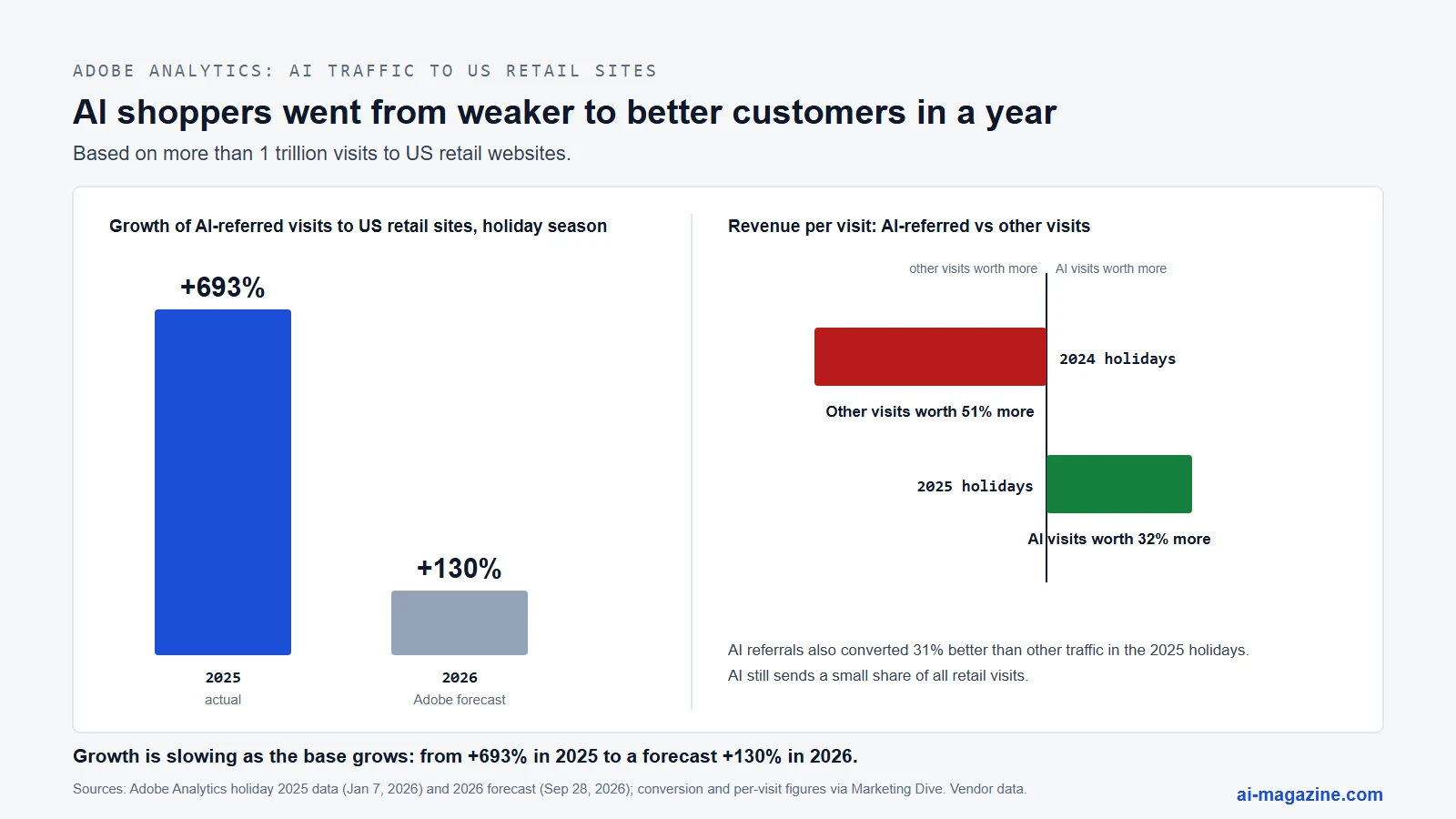
Adobe, which measures more than a trillion visits to US retail sites, found that traffic from generative AI tools rose 693% over the 2025 holiday season and that these visitors converted 31% better than other traffic and spent 32% more per visit. A year earlier the opposite was true: non-AI visits were worth 51% more. Adobe forecasts AI traffic growth slowing to 130% for the 2026 holidays, when it expects record US online spending of $275.1 billion. Shopify said in November 2026 that orders referred by AI were up 3.3 times in a year and that shoppers from AI channels converted 64% more often. All of these are vendor or company figures, and AI still sends a small share of total traffic.
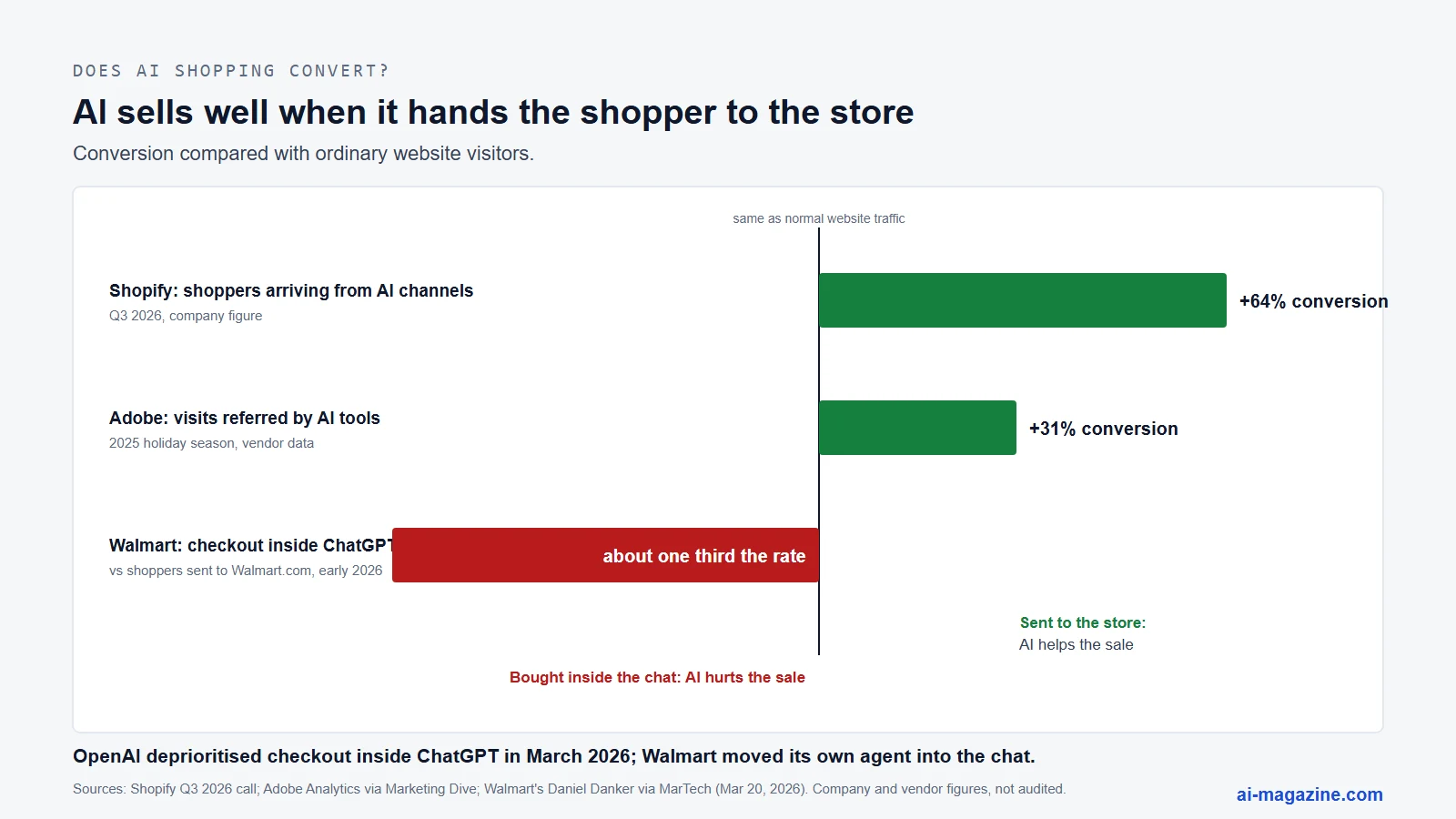
The pattern in our chart is the main lesson of 2026: when AI does the research and hands the shopper to the store, results are strong. When the AI tries to complete the purchase itself, as with ChatGPT checkout, conversion falls. Shoppers still want to see the retailer’s page, delivery options and returns policy before paying.
Salesforce estimates that AI and agents “influenced” $262 billion of global online holiday sales in 2025 and forecasts $75.8 billion in AI-influenced sales during Cyber Week 2026 alone. “Influenced” is broad and modelled, so treat it as a sign of direction rather than a measurement. Bain found that 24% of online shoppers planned to start their 2026 holiday shopping on an AI platform such as ChatGPT, Gemini or Claude, up from 17% in 2025.
Personalization and recommendations
Personalised recommendations are the oldest form of retail AI. McKinsey wrote in 2021 that personalization “most often drives 10 to 15 percent revenue lift”; other McKinsey pages give 5% to 15%, and none of these are retail-only AI measurements.
A widely repeated claim says 35% of Amazon’s sales come from recommendations. It traces back to a 2013 McKinsey article and has never been disclosed by Amazon; a University of Florida researcher called such estimates “inflated”. The best current Amazon figure is its own $12 billion estimate for the shopping assistant.
Generative AI also lets shoppers describe what they want in plain language (“a waterproof jacket for walking my dog in Scotland”) instead of filtering by category, which is why IBM found 41% of consumers use AI for product research. Deloitte’s 2026 outlook found 81% of retail executives think generative AI will weaken brand loyalty by 2027, because an agent picks the product, not the shopper’s habit.
Demand forecasting, inventory and supply chain
Forecasting is where AI quietly saves the most money, and where retailers publish the fewest numbers.
- Target found in physical audits that “half of the out-of-stocks were unknown to our systems”, and built a real-time inventory ledger and machine learning detection to fix it (Target tech blog). It reports fewer out-of-stocks but has not published a sales figure tied to AI.
- Walmart set targets in 2023 for about 65% of stores to be served by automation by early 2026, and in October 2026 expanded its deal with Symbotic to automate 25 regional distribution centers, an investment of about $6 billion. Walmart and Wing plan drone delivery from more than 270 stores by 2027.
- Inditex (Zara) reported 2% lower inventory at the end of its 2025 financial year, without attributing it to AI. Claims that Zara cut excess stock by half with AI have no primary source.
- Simbe says more than 3,000 of its shelf-scanning Tally robots are under contract; Kroger deployed its 500th in August 2026. In one retailer’s pilot reported by the vendor, pricing errors fell 92% and controllable out-of-stocks fell 58%.
Gartner forecasts worldwide AI spending of $2.7 trillion in 2026 across all industries; no current public estimate isolates retail.
AI pricing and “surveillance pricing”
Dynamic pricing (changing prices with demand) is old. What is new is AI setting different prices for different people based on personal data.
- FTC study. In January 2025, US Federal Trade Commission staff reported that intermediaries offer retailers tools that use location, demographics, browsing and even mouse movements to set individual prices. It was a study, not a finding of illegality, and two commissioners dissented (FTC).
- Instacart. A study by Consumer Reports, Groundwork Collaborative and More Perfect Union with 437 volunteer shoppers found identical grocery items priced differently, with some shoppers paying up to 23% more. In December 2025 Instacart ended the item price tests it ran for retailers, while denying it used personal data (Consumer Reports).
- New York now requires the label “THIS PRICE WAS SET BY AN ALGORITHM USING YOUR PERSONAL DATA”. A federal judge dismissed the retail industry’s challenge in October 2025.
Our guide to AI regulation covers wider rules, including the EU AI Act.
AI in physical stores
- Cashierless checkout. Amazon removed Just Walk Out from its US Fresh grocery stores in April 2024 in favour of smart Dash Carts, and in 2026 is rolling out a new Dash Cart at Whole Foods. Just Walk Out continues in Amazon Go shops and is sold to stadiums and airports.
- Theft. The National Retail Federation reported in July 2026 that shoplifting incidents fell 12.4% in 2025, the first fall in several years, and credited security technology and better analysis. The survey reflects retail executives’ reports, not police data, and NRF no longer publishes a total shrink figure.
- Facial recognition. The FTC banned Rite Aid from using facial recognition for surveillance for five years in December 2023, after its system produced “thousands of false positives” that disproportionately flagged shoppers in Black and Asian neighbourhoods; in one case an 11-year-old girl was searched.
- Drive-thrus. McDonald’s ended its IBM AI drive-thru ordering test at about 100 US restaurants in 2024.
Customer service, returns and fake reviews
Retail chatbots handle order tracking and returns well and struggle with anything unusual. Klarna, often cited as the model for replacing support staff with AI, said in May 2025 that focusing on cost had led to “lower quality” and began hiring people again. Our guide to AI in customer service covers what works.
Returns are a huge cost. The NRF and Happy Returns estimated that US shoppers would return $849.9 billion of goods in 2025, 15.8% of sales, with 9% of returns fraudulent; Appriss Retail, using different definitions, counted $706 billion returned with 14.2% fraud or abuse. Retailers report cases of AI-faked photos of “damaged” goods used to claim refunds, though no reliable total exists. On the other side, the FTC’s rule banning fake reviews, including AI-generated ones, has applied since October 2024, with penalties of up to $51,744 per violation.
AI try-on is moving into ordinary product pages: Google closed its standalone Doppl try-on app on April 30, 2026 and moved “try it on” into Search and Shopping. In an Adobe survey of 5,000 US consumers in July 2026, 69% of shoppers who used AI said they were less likely to return items. That is a stated intention, not measured returns.
The environmental side: waste, returns and overstock
Retail AI is usually sold on sales growth, but its biggest environmental lever is not making, moving and throwing away things nobody buys.
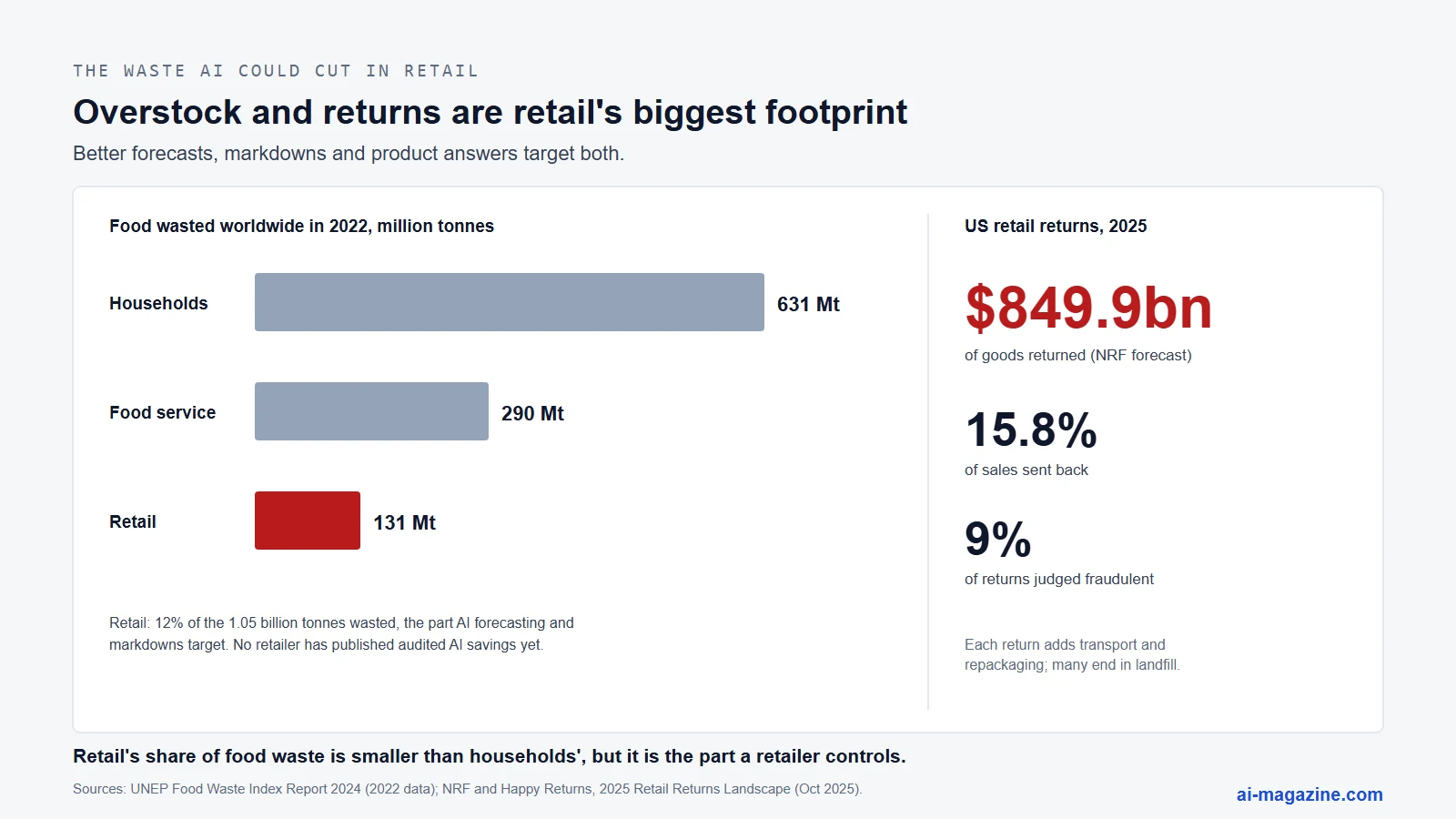
The UN Environment Programme’s Food Waste Index found that retail wasted 131 million tonnes of food in 2022, 12% of the 1.05 billion tonnes wasted worldwide. Better forecasting, dynamic markdowns on food nearing its date and shelf monitoring all target that waste, but we found no retailer that has published an audited figure for food waste cut by AI; most describe pilots. Returns add transport, repackaging and often landfill, so accurate sizing, try-on and better product answers have an environmental payoff if they work.
AI also has its own footprint. Every shopping conversation runs on the same data centers whose electricity and water use we measured in our guides to AI data centers and AI water usage. Amazon alone expects about $220 billion of capital spending in 2026, mainly on AI infrastructure.
AI and retail jobs
- Walmart, the largest private US employer with about 2.1 million staff, expects headcount to stay roughly flat for about three years as sales grow, while its CEO said AI “is going to change literally every job”.
- Amazon cut about 14,000 corporate jobs in October 2025 and about 16,000 more in January 2026. Its CEO said the first round was about “culture”, not “really AI-driven, not right now”, while an earlier memo said generative AI would shrink the corporate workforce over time.
- Target cut about 1,800 corporate roles in October 2025, framed as removing layers, not as AI.
- The US Bureau of Labor Statistics projects cashier jobs falling about 10% from 2024 to 2034, mainly because of self-checkout and online shopping.
Our article on generative AI and jobs covers the wider picture.
What has worked and what has been pulled
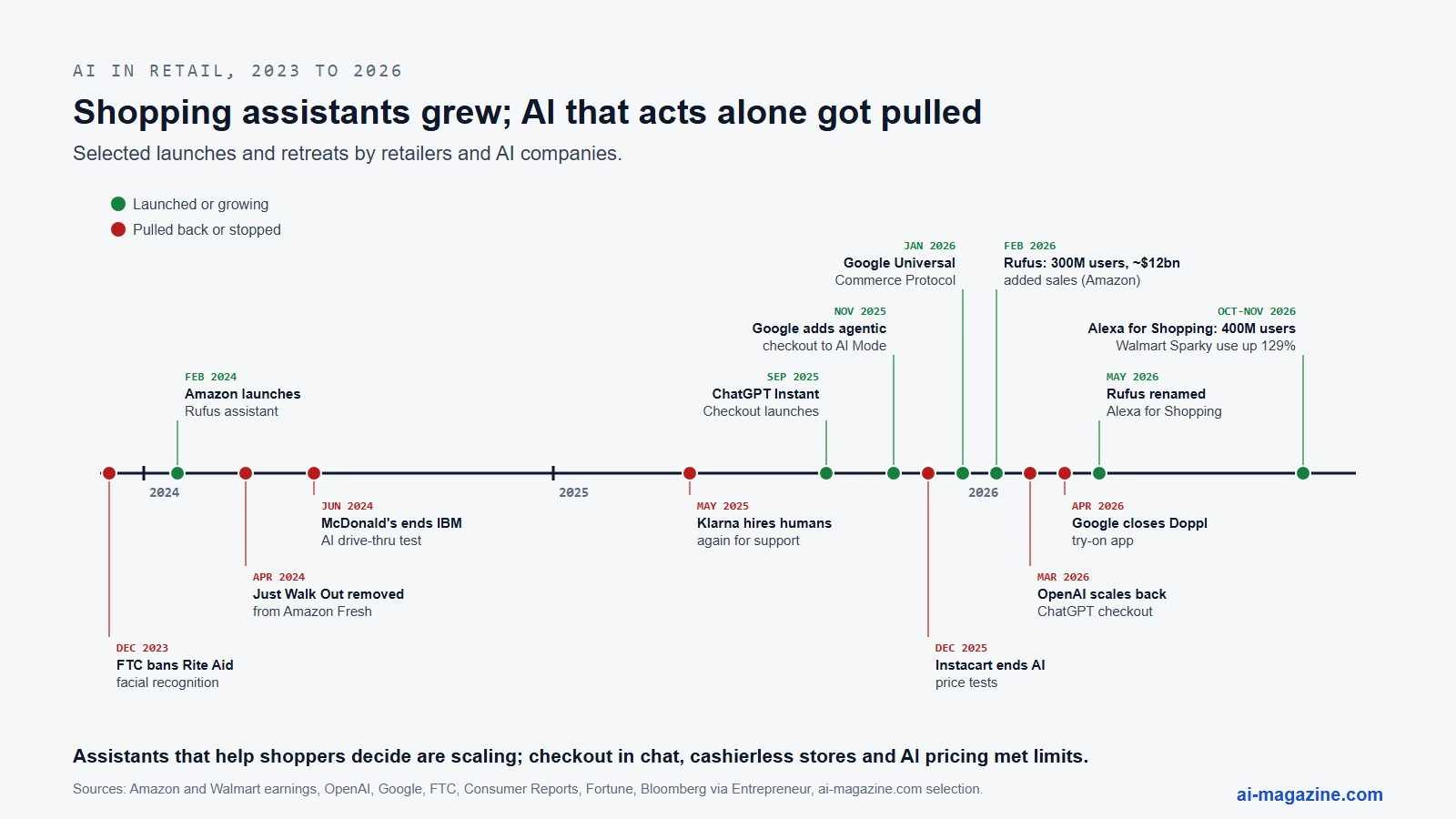
| Worked or growing | Reported result | Pulled back or failed | What happened |
|---|---|---|---|
| Amazon Alexa for Shopping | 400M+ users; about $12bn added sales in 2025 (Amazon estimate) | ChatGPT Instant Checkout | Deprioritised March 2026 |
| Walmart Sparky | Use up 129%, baskets about 40% larger | Walmart checkout inside ChatGPT | Converted at about a third of its website |
| AI-referred traffic | Converted 31% better in 2025 holidays (Adobe) | Just Walk Out in Amazon Fresh | Removed in 2024 |
| Shopify AI channels | AI orders up 3.3x, conversion 64% higher | Instacart AI price tests | Ended December 2025 |
| Shelf-scanning robots | Kroger at 500 robots | Rite Aid facial recognition | FTC five-year ban |
| Target inventory ledger | Fewer out-of-stocks (no figure) | Google Doppl try-on app | Closed April 2026 |
Analyst warnings apply here too. Gartner predicted in June 2025 that more than 40% of agentic AI projects will be cancelled by the end of 2027 because of cost, unclear value or weak risk controls.
How to start with AI in a retail business
- Fix your product data first. Agents and AI search read titles, attributes, prices, stock and return policies. Incomplete feeds make you invisible to them.
- Make your store readable by agents. Join Google Merchant Center’s agentic checkout if eligible, keep structured data current, and follow standards such as the Agentic Commerce Protocol and WebMCP.
- Start with forecasting and content, where the payoff is measurable and the risk to customers is low.
- Keep humans behind chatbots for complaints, refunds and anything unusual.
- Be careful with personalised pricing. Disclose it where required, as in New York, and expect regulators to ask.
- Measure against a control group, not against last year. Most published retail AI results are company attributions without one.
Frequently asked questions
How is AI used in retail? For shopping assistants and AI agents, product search and recommendations, demand forecasting and inventory, pricing, store checkout and theft detection, customer service, product content and warehouse automation.
What are examples of AI in retail? Amazon’s Alexa for Shopping (formerly Rufus), Walmart’s Sparky assistant, Target’s AI inventory ledger, Kroger’s shelf-scanning robots, Google’s virtual try-on in Search and ChatGPT’s shopping results.
What is agentic commerce? Shopping in which an AI agent searches, compares and buys products for a person. Google’s Universal Commerce Protocol and OpenAI and Stripe’s Agentic Commerce Protocol are the main standards; Visa and Mastercard support agent payments.
Does AI increase retail sales? Company figures say yes: Amazon credits its assistant with about $12 billion in added yearly sales, and Adobe found AI-referred shoppers converted 31% better. These are company and vendor figures without independent audits.
Is AI pricing legal? Dynamic pricing generally is. Personalised pricing based on personal data faces growing scrutiny: New York requires a disclosure label, and the FTC has studied the practice.
Will AI replace retail workers? It is changing jobs more than removing them so far. Walmart expects flat headcount while sales grow; cashier jobs are projected to fall about 10% by 2034, mostly because of self-checkout and online shopping.
How does AI reduce waste in retail? By forecasting demand more accurately, marking down food before it expires, spotting empty or overstocked shelves and cutting returns with better product information. Retail wastes about 131 million tonnes of food a year, but no retailer has published audited AI savings yet.
Related
- AI search and how it changes website traffic
- AI agents explained
- AI in customer service
- AI in marketing
- AI data centers
Figures checked November 25, 2026. Most adoption and sales figures come from companies or vendors (Amazon, Walmart, Shopify, Adobe, Salesforce, NVIDIA) and are marked as such. Some sources (Bloomberg, The Information, McKinsey’s agentic commerce chart, a Gartner retail software forecast) could not be accessed directly, so we relied on reports quoting them.