AI Chips in 2026: Nvidia, AMD, Google TPUs and the Power Problem

AI chips are processors designed to run the maths behind neural networks: huge numbers of multiplications done in parallel. They train models such as GPT, Claude and Gemini and then answer our questions with them. The best known are Nvidia’s graphics processors (GPUs), but in 2026 a quarter of new AI computing power comes from Google’s own chips, and Amazon, Microsoft, Meta and OpenAI are all building their own.
AI chips are also why data centres now need so much electricity and water. A single flagship chip draws up to 2,500 watts, more than an average American home, and a rack of 72 of them draws over 200 kilowatts. This guide explains the types of AI chips, who makes them, how they compare on our table of 15 flagship accelerators, what they cost and how much power they use. Figures were checked between November 24 and 25, 2026.
AI chips at a glance
| Company | Main AI chips | Who can buy them | Position, late 2026 |
|---|---|---|---|
| Nvidia | Blackwell (B200, GB300), Vera Rubin | Anyone, subject to export rules | About 63% of AI compute shipped; $107.6bn data-centre revenue last quarter |
| TPU v7 Ironwood, TPU 8t/8i announced | Google Cloud renters; Anthropic and Meta | About 25% of AI compute shipped | |
| AMD | Instinct MI355X, MI455X | Anyone | About 4% of AI compute; 6 GW deal with OpenAI |
| Amazon | Trainium2, Trainium3 | AWS renters; Anthropic | About 5% of AI compute |
| Microsoft | Maia 200 | Internal (Azure) | In service since January 2026 |
| Meta | MTIA 300 to 500 | Internal | Four generations planned to 2027 |
| Broadcom | Designs custom chips for Google, Meta, OpenAI | Large buyers only | $16.7bn AI revenue last quarter |
| Huawei | Ascend 910C, 950 | Mainly China | About 3% of AI compute |
| Cerebras, Groq, Etched, others | Wafer-scale and inference chips | Cloud or systems | Niche; Cerebras listed in May 2026 |
Shares of compute are Epoch AI’s estimates for Q2 2026; see market share below.
What is an AI chip?
An AI chip, or AI accelerator, is a processor built to do the matrix multiplications that neural networks run on, as fast and as cheaply per operation as possible. Ordinary CPUs can do this maths, but slowly, because they are designed to run a few complicated tasks one after another. AI chips run thousands of simple operations at once and sit next to very fast memory, because moving data is often the real bottleneck.
The main types:
- GPUs (graphics processing units). Originally built for video games, GPUs turned out to suit neural networks, and Nvidia’s CUDA software made them the default. Nvidia and AMD sell data-centre GPUs that no longer have a display output.
- Custom chips (ASICs). Chips designed for one company’s AI workloads, such as Google’s TPU, Amazon’s Trainium, Microsoft’s Maia and Meta’s MTIA. Broadcom and Marvell help design most of them, and almost all are made by TSMC in Taiwan.
- NPUs (neural processing units). Small AI engines inside phones and laptops, such as Apple’s Neural Engine or AMD’s “Ryzen AI” processors. They run small models locally at a few watts; this guide covers data-centre chips.
- Other designs. Cerebras builds a whole silicon wafer as one chip; Groq’s LPU keeps the model in on-chip memory for fast answers; Etched builds a chip only for transformer models.
Two numbers matter most when comparing them: how many operations per second the chip can do, and how fast it can read its memory (high-bandwidth memory, or HBM). Vendors quote operations at different precisions. Lower precision, such as 8-bit (FP8) or 4-bit (FP4) numbers, lets a chip do many more operations per second but with less accuracy; training usually uses 16-bit numbers (BF16), and answering queries increasingly uses 8 or 4 bits.
Nvidia AI chips
Nvidia designs the GPUs that most of the AI industry was built on, and it sells them as complete systems: chips, memory, networking and software. Its data-centre lines, newest last:
- Hopper (H100, H200), 2022 to 2024. The chips that trained the first wave of ChatGPT-era models. Still widely rented.
- Blackwell (B200, GB200), 2024 to 2025, and Blackwell Ultra (B300, GB300), 2025. The GB300 pairs Nvidia’s own Grace CPU with two GPUs, and is sold mainly as the GB300 NVL72, a rack of 72 GPUs that works as one machine.
- Vera Rubin, 2026. Nvidia began shipping Vera Rubin NVL72 racks in the quarter to October 2026 and calls it “the fastest product ramp in the company’s history”. Each Rubin GPU has 288 GB of HBM4 memory.
- Rubin Ultra, planned for the second half of 2027, in a 576-GPU “Kyber” rack drawing 600 kW. Trade press has reported a possible slip to 2028, which Nvidia denies.
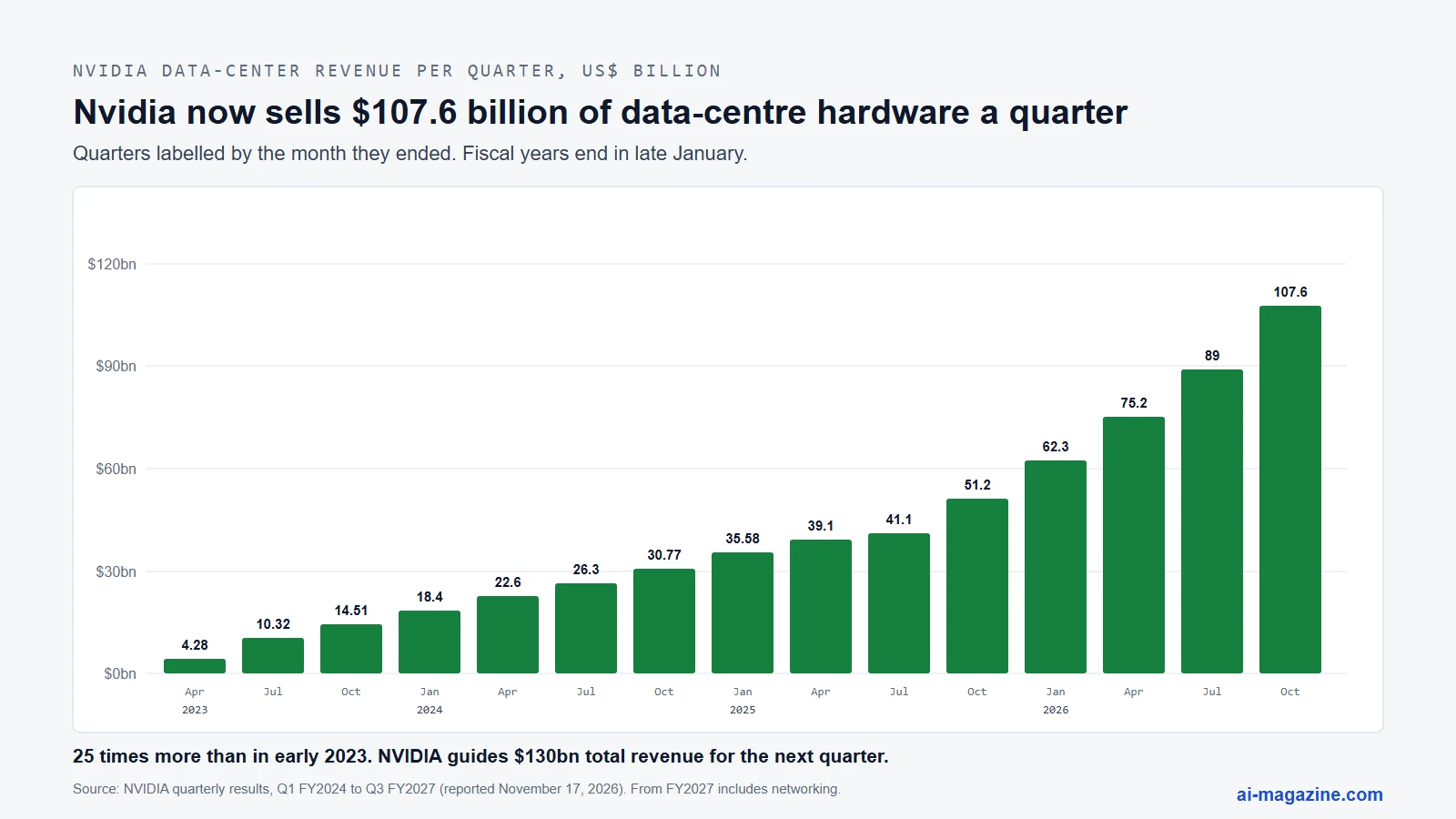
Nvidia’s data-centre revenue reached $107.6 billion in the quarter ended October 25, 2026, up 110% on a year earlier and 25 times its level in early 2023. It expects total revenue of $130 billion next quarter while assuming no data-centre sales to China. The company is going through a leadership change: on November 11, 2026, it disclosed that co-founder Jensen Huang had resigned as CEO, and finance chief Colette Kress became interim CEO. The filing gives no reason. Nvidia also paid $2.94 billion so far this fiscal year to Groq, the inference-chip start-up whose technology it licensed and whose founder it hired in December 2025; it has since launched a Groq 3 LPU rack of its own.
AMD AI chips
AMD is the only other company selling data-centre GPUs on the open market at scale. Its Instinct line:
- MI300X (2023) with 192 GB of memory, more than Nvidia’s H100 at the time.
- MI355X (2025), 288 GB and 1,400 W, broadly comparable to Nvidia’s B200 on paper.
- MI450 series (2026), including the MI455X at up to 2,500 W, sold in a 72-chip “Helios” rack. AMD says Helios is used by Anthropic, Meta, Microsoft, OpenAI and Oracle.
OpenAI agreed in October 2025 to deploy 6 gigawatts of AMD chips, starting with 1 GW of MI450 in the second half of 2026, and received warrants for up to about 10% of AMD. AMD’s data-centre segment, which also includes server CPUs, earned $8.5 billion in the third quarter of 2026, up 97%; it does not report AI chip sales separately.
Google, Amazon, Microsoft, Meta and OpenAI: custom chips
The biggest buyers of AI chips have all started designing their own, mainly to cut costs and reduce dependence on Nvidia.
- Google TPU. Google has made Tensor Processing Units since 2015. The seventh generation, Ironwood, became generally available in November 2025 and runs in pods of 9,216 chips drawing nearly 10 MW. Google announced two eighth-generation chips, TPU 8t for training and 8i for inference, in April 2026. TPUs are now sold well beyond Google: Anthropic agreed to use up to 1 million TPUs in October 2025 and “multiple gigawatts” more from 2027, and Meta rents TPU capacity on Google Cloud.
- Amazon Trainium. Trainium3 became available on AWS in December 2025. Amazon’s Project Rainier cluster uses nearly 500,000 Trainium2 chips for Anthropic, which agreed in April 2026 to up to 5 GW of Trainium capacity.
- Microsoft Maia 200, launched in January 2026: a 750 W inference chip on TSMC’s 3 nm process with 216 GB of memory, which Microsoft says gives 30% better performance per dollar than its current fleet.
- Meta MTIA. Meta announced four generations in March 2026; MTIA 300 runs its recommendation systems, and later chips are due in 2027. It signed a deal with Broadcom for more than 1 GW of custom chips.
- OpenAI is building its own accelerator with Broadcom, targeting 10 GW deployed between the second half of 2026 and 2029.
Broadcom, which co-designs most of these chips, reported $16.7 billion of AI revenue in its quarter to August 2026, up 221%.
Intel, Qualcomm and the start-ups
- Intel sells Gaudi 3 and is sampling Crescent Island, a 350 W air-cooled inference GPU, to customers in late 2026. It has not won a large share of the AI market.
- Qualcomm announced the AI200 and AI250 inference racks in October 2025, with Saudi Arabia’s Humain as the first customer.
- Cerebras makes the largest chip in the world, a wafer-scale engine. It listed on Nasdaq in May 2026, raising $5.55 billion at a valuation of about $56 billion.
- Groq continues to run GroqCloud after licensing its technology to Nvidia. SambaNova, Tenstorrent and Etched are other well-funded challengers; none ships at large scale yet.
Chinese AI chips
US export controls stop Nvidia’s best chips from being sold to China, and China in turn has told its companies to buy domestic chips. Huawei’s Ascend line (910C, then 950 in 2026) leads, with Cambricon, Hygon, Moore Threads, MetaX, Biren and the in-house chips of Alibaba and Baidu behind it. According to IDC, Nvidia’s share of China’s data-centre AI accelerator market fell to 34% in the first half of 2026, with Huawei at 28%. Epoch AI estimates Huawei will produce less than 4% of Nvidia’s AI computing power in 2026, held back mainly by a shortage of high-bandwidth memory.
Washington’s policy has changed several times. Sales of Nvidia’s China-specific H20 resumed in 2025 with 15% of revenue going to the US government; H200 exports were approved in December 2025 with a 25% share, but China has approved only small volumes. A rule released on November 16 and in force since November 19, 2026, also requires licences when data centres abroad rent large amounts of computing power to Chinese companies. Our guide to AI regulation covers the wider rules.
Who makes AI chips: market share
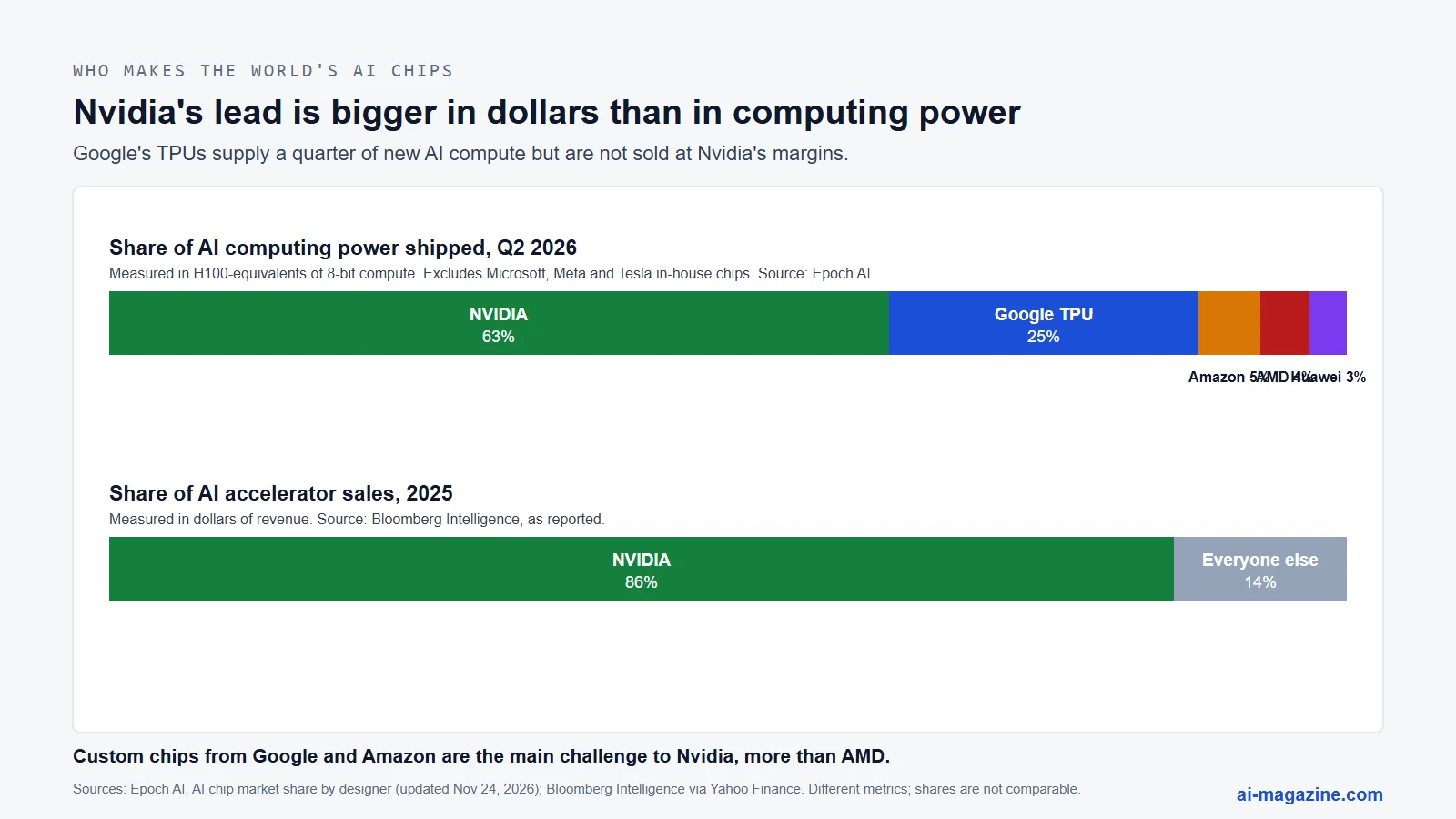
How dominant Nvidia is depends on what you count. Measured by revenue, Nvidia had about 86% of AI accelerator sales in 2025, according to Bloomberg Intelligence. Measured by computing power shipped, Epoch AI puts it at 63% in the second quarter of 2026, with Google’s TPUs at 25%. The gap exists because Google builds TPUs for itself and its cloud customers at cost, not at Nvidia’s margins. Epoch’s figures leave out Microsoft’s and Meta’s in-house chips, so the listed shares are slightly overstated.
A warning on market-size figures: several market-research firms put the 2026 “AI chip market” at $23 billion to $175 billion, which is less than Nvidia alone sells in a few months. Gartner’s estimate is more useful: about $1.6 trillion of total chip revenue in 2026, of which AI data-centre chips are about 36.5%.
AI chips compared: 15 flagship accelerators
We compiled this table from vendor datasheets, cross-checked against Epoch AI’s ML Hardware database. Throughput is peak dense (without the “sparsity” trick that doubles quoted numbers), in trillions of operations per second (TFLOPS).
| Chip | Available | Memory | Bandwidth | 16-bit (BF16) | Lowest precision | Max power |
|---|---|---|---|---|---|---|
| Nvidia V100 | 2017 | 16 GB | 0.9 TB/s | 125 | n/a | 300 W |
| Nvidia A100 | 2020 | 80 GB | 2.0 TB/s | 312 | n/a | 400 W |
| Nvidia H100 SXM | 2022 | 80 GB | 3.35 TB/s | 989 | 1,979 (FP8) | 700 W |
| Nvidia H200 | 2024 | 141 GB | 4.8 TB/s | 989 | 1,979 (FP8) | 700 W |
| Nvidia B200 | 2024 | 180 GB | 8.0 TB/s | 2,250 | 9,000 (FP4) | 1,000 W |
| Nvidia GB300 | 2025 | 279 to 288 GB | 8.0 TB/s | 2,500 | 15,000 (FP4) | 1,400 W |
| Nvidia Rubin | 2026 | 288 GB | 19.2 to 22 TB/s | 4,000 | 35,000 (FP4) | Not published |
| AMD MI300X | 2023 | 192 GB | 5.3 TB/s | 1,307 | 2,615 (FP8) | 750 W |
| AMD MI355X | 2025 | 288 GB | 8.0 TB/s | 2,517 | 10,066 (FP4) | 1,400 W |
| AMD MI455X | 2026 | 432 GB | 19.6 to 23.3 TB/s | 5,000 | 40,300 (FP4) | 2,500 W |
| Google TPU v7 Ironwood* | 2025 | 192 GB | 7.37 TB/s | 2,307 | 4,614 (FP8) | Not published |
| Amazon Trainium3 | 2025 | 144 GB | 4.9 TB/s | 671 | 2,517 (FP8) | Not published |
| Microsoft Maia 200* | 2026 | 216 GB | 7.0 TB/s | n/a | 10,000 (FP4) | 750 W |
| Intel Gaudi 3 | 2024 | 128 GB | 3.7 TB/s | 1,835 | 1,835 (FP8) | 900 W |
| Huawei Ascend 910C* | 2025 | 128 GB | 3.2 TB/s | 780 | n/a | Not published |
*The vendor does not say whether its figures are dense or sparse. Where two numbers are shown, the vendor’s own documents disagree. Peak figures are rarely reached in real work; a chip’s software, memory and networking often matter more.
How much power AI chips use
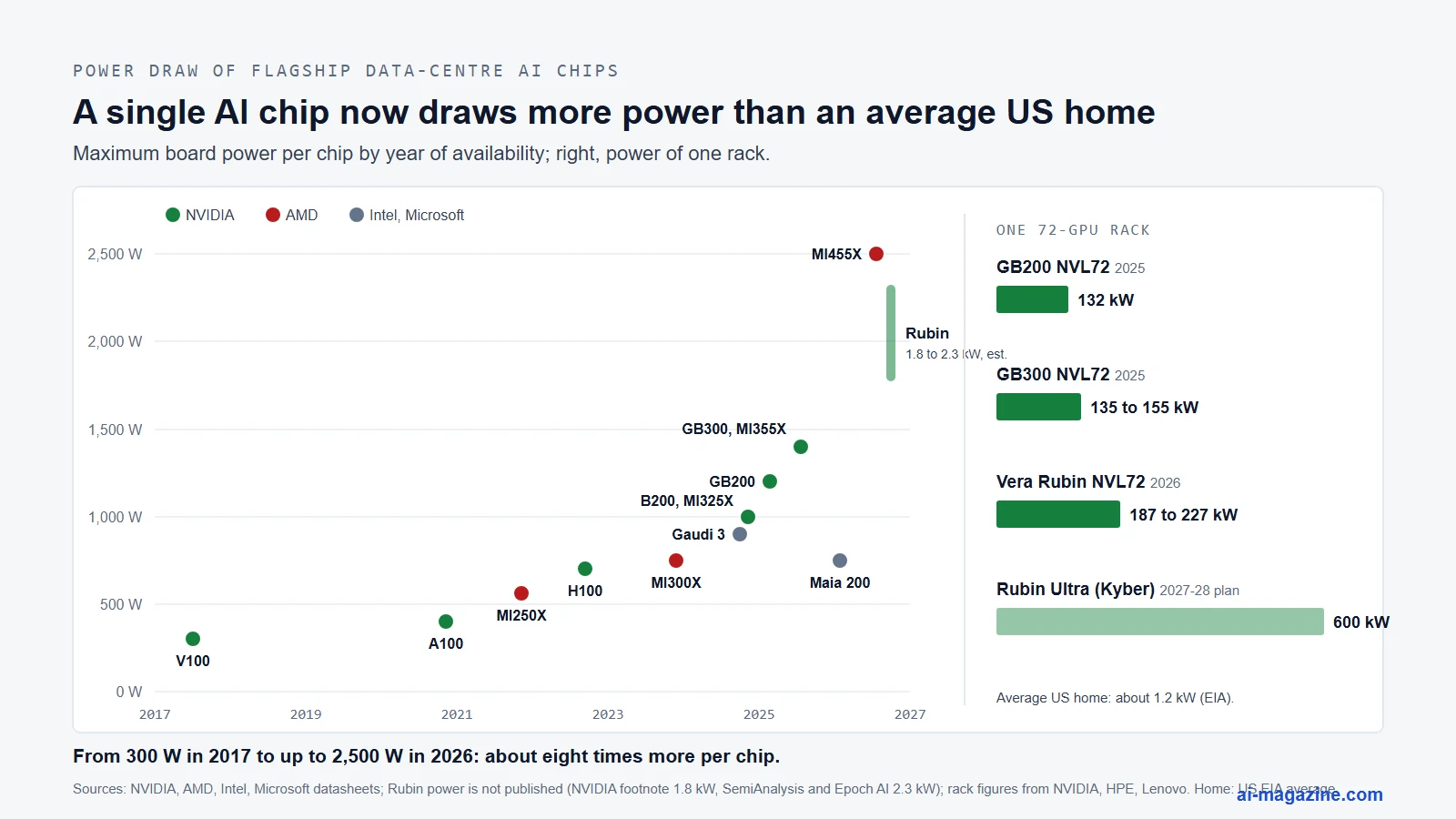
Each generation of AI chip draws more power. Nvidia’s V100 in 2017 drew 300 watts; the GB300 and AMD’s MI355X in 2025 draw 1,400 W; AMD’s MI455X can draw 2,500 W. Nvidia has not published Rubin’s figure: its own benchmark footnote assumes 1,800 W per GPU, while Epoch AI and SemiAnalysis use 2,300 W. For comparison, the average US home uses about 1.2 kW averaged over the year.
The rack is where this becomes a building problem. A GB200 NVL72 rack draws about 132 kW. Nvidia’s Vera Rubin NVL72 datasheet gives 187 to 227 kW depending on the power mode, and the planned Kyber rack 600 kW. A typical server rack a decade ago drew under 10 kW. That is why new AI data centres are measured in gigawatts, and why liquid cooling is now standard: TrendForce estimates it is used on about 53% of high-end AI chips in 2026, up from 33% in 2025.
Chips do get more efficient, but less than the marketing suggests.
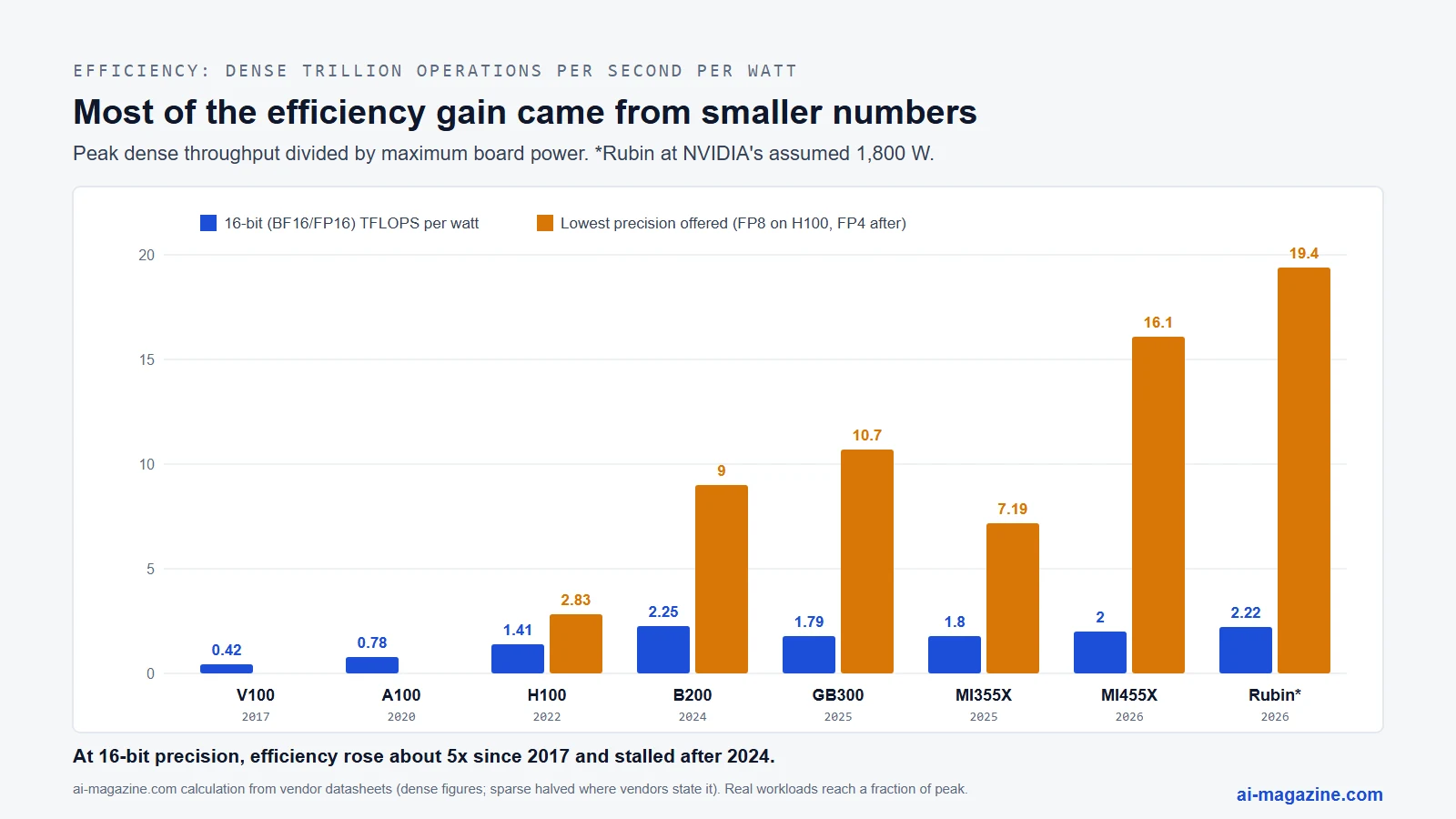
We divided each chip’s peak dense throughput by its maximum power. At 16-bit precision, operations per watt rose about five times between 2017 and 2026, and have barely moved since Nvidia’s B200 in 2024. Almost all the recent gains come from switching to 8-bit and 4-bit numbers, which do more work per watt by doing less precise work. Vendors’ own claims are larger and measure whole systems running specific models: Nvidia says Vera Rubin produces “up to 10x more tokens per megawatt” than GB200, and Google says Ironwood has about twice the performance per watt of its previous TPU. Those are vendor claims based on chosen workloads.
The total adds up. The International Energy Agency estimates data centres used 415 TWh of electricity in 2024, about 1.5% of the world’s total, heading to about 945 TWh by 2030, with servers full of AI accelerators growing about 30% a year and accounting for about half of the increase. In the US, Lawrence Berkeley National Laboratory projects data centres will use 6.7% to 12% of the country’s electricity by 2028, up from 4.4% in 2023.
The environmental cost of making AI chips
Running chips is only part of their footprint. Making them takes large amounts of electricity, water and chemicals:
- Carbon. Nvidia’s own product carbon footprint puts manufacturing emissions at 1,312 kg of CO2-equivalent for an eight-GPU H100 board, about 164 kg per GPU. Academic estimates for data-centre GPUs range from 150 to 300 kg. Memory chips are the largest contributor.
- Electricity. TSMC, which makes almost all advanced AI chips, used about 9% of Taiwan’s electricity in 2024, according to press reports; renewable energy covered about 11% of its Taiwan fabs’ use in 2025.
- Water. A chip factory can use 2 million to 10 million gallons of water a day, much of it purified to an extreme degree. A Xylem and Global Water Intelligence study estimates that chip manufacturing accounts for about 42% of AI’s additional water demand by 2050, against about 4% for cooling data centres; the rest comes from generating the power. Our report on AI water usage covers the cooling side.
- Lifespan. Big cloud companies write off servers over five to six years. Critics, including investor Michael Burry, argue that AI chips become obsolete in two to three years, which would mean faster replacement and more electronic waste; Nvidia and cloud providers say older chips keep earning, and rental prices for H100s actually rose in parts of 2026.
How AI chips are made: TSMC, packaging and memory
Nearly every advanced AI chip, from Nvidia’s to Google’s, is manufactured by TSMC, which had about 72.5% of the global foundry market in the second quarter of 2026, according to TrendForce. The chips are joined to their memory with TSMC’s CoWoS packaging, which has been a bottleneck since 2023; TSMC’s capacity is about 120,000 to 140,000 wafers a month in 2026.
The memory itself, HBM, comes from three companies: SK hynix (about 50% in Q2 2026), Samsung (33%) and Micron (18%), according to Counterpoint. Demand from AI has caused a memory shortage: TrendForce forecast conventional DRAM contract prices up 90% to 95% in a single quarter in early 2026, which has also raised prices of PCs and phones. Huawei and Cambricon are made by SMIC in China.
How much AI chips cost
No chipmaker publishes a price list; all figures are estimates or reports.
| Chip | Estimated price per chip | Source |
|---|---|---|
| Nvidia H100 | $25,000 to $40,000 new; about $14,250 used (Oct 2026) | Hashrate Index; American Compute |
| Nvidia B200 | $30,000 to $40,000 | Jensen Huang, March 2024 |
| Nvidia GB300 (per GPU) | About $43,000 | Epoch AI estimate |
| GB200 NVL72 rack | About $3 million | HSBC estimate, 2024 |
| AMD MI355X | About $30,000 | Reported, via Epoch AI |
| Google TPU v7 | About $12,000 (cost to Google) | Epoch AI estimate |
Most users rent instead. In mid-November 2026, the cheapest on-demand listings tracked by AIMultiple were $1.80 an hour for an H100, $2.09 for an H200 and $4.11 for a B200; typical prices are roughly double that. If you only need to run a small model, a laptop or desktop is often enough: see how to run an LLM locally.
AI chip stocks
AI chips have made Nvidia one of the world’s most valuable companies, but valuations swing sharply. At the close on November 24, 2026, Nvidia was worth about $3.75 trillion, TSMC about $1.7 to $1.8 trillion, Broadcom about $1.44 trillion and AMD about $684 billion, after a sell-off that cut Nvidia’s share price by about a third from its October peak. Our pieces on the AI bubble and the Anthropic IPO and November sell-off cover the market side. This is not investment advice.
Frequently asked questions
What are AI chips? Processors designed to run the calculations of neural networks quickly and efficiently, used to train AI models and to run them. The main kinds are GPUs from Nvidia and AMD, custom chips such as Google’s TPU and Amazon’s Trainium, and small NPUs inside phones and laptops.
Who makes the best AI chips? Nvidia leads in performance, software and sales; its Blackwell and Vera Rubin systems are the most widely used. AMD’s MI355X and MI455X match or beat Nvidia on some paper specs, and Google’s TPUs supply about a quarter of new AI computing power, mostly for Google and Anthropic.
What is the difference between a GPU and a TPU? A GPU is a general parallel processor that can run graphics and many kinds of AI. A TPU is Google’s custom chip built only for the matrix maths of neural networks, available through Google Cloud. TPUs can be cheaper per operation for large workloads; GPUs are more flexible and supported by more software.
Which companies make AI chips? Nvidia, AMD, Intel, Google, Amazon, Microsoft, Meta, Broadcom, Marvell, Qualcomm, Huawei and Cambricon, plus start-ups such as Cerebras, Groq, SambaNova, Tenstorrent and Etched. Almost all are manufactured by TSMC.
How much power does an AI chip use? Flagship data-centre chips draw 700 W (Nvidia H100) to 1,400 W (GB300, MI355X) and up to 2,500 W (AMD MI455X). A rack of 72 of them draws about 130 to 230 kW.
How much does an Nvidia AI chip cost? Nvidia does not publish prices. An H100 sold for about $25,000 to $40,000 new; Blackwell chips are estimated at $30,000 to $43,000 each, and a full GB200 NVL72 rack at about $3 million. Renting an H100 costs from about $1.80 an hour.
Can China buy Nvidia AI chips? Only restricted versions, under US licences, and China itself discourages purchases. Nvidia’s current forecasts assume no data-centre sales to China.
Related
- AI data centers: where they are built and what they cost
- AI water usage: the real numbers
- AI regulation by country
- LLM API pricing
- Glossary: GPU and TPU
Specifications and prices checked November 24 to 25, 2026. Throughput figures are peak values from vendor documents; vendors measure power differently (board power for Nvidia and AMD, chip power for Microsoft, none published for Google). Some sources (Gartner, TSMC’s climate report, SemiAnalysis) could not be accessed directly, so figures from them come from reports quoting them.