AI Regulation in 2026: Laws by Country, US States and the Deadlines Ahead
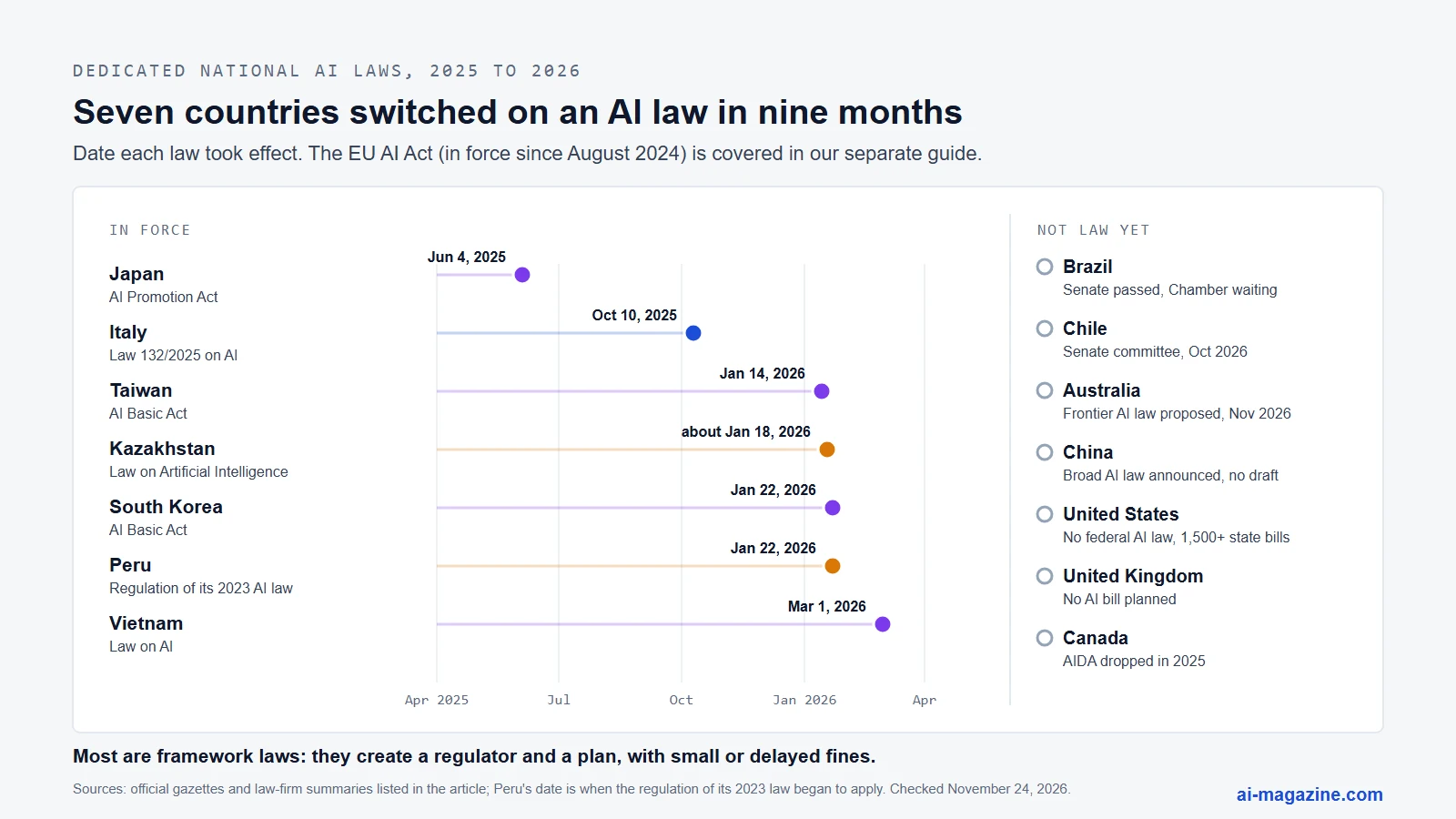
AI regulation means the laws, rules and official guidance that control how artificial intelligence is built, sold and used. In late 2026 there is still no single global rulebook. The European Union has a binding, risk-based law. China regulates AI service by service and makes providers register. The United States has no broad federal AI law: Washington is trying to stop the states from writing their own, while the states keep passing hundreds of AI measures a year. Between those poles, seven more countries put a dedicated AI law into effect in the nine months to March 2026.
This guide maps where things stand on November 24, 2026: what is actually law, what is only proposed, which court cases are holding rules back, and the dates businesses need in their calendar. We built our own tracker of the laws below from government texts, court filings and law-firm summaries; every figure links to its source or names it. Where official sources and trackers disagree, we say so.
AI regulation at a glance
| Jurisdiction | Approach | Main rules | Where it stands, Nov 2026 |
|---|---|---|---|
| European Union | One binding, risk-based law | AI Act, amended by the 2026 Omnibus | Bans and general-purpose AI rules apply; high-risk rules from December 2027 |
| United States (federal) | Light touch, push to override states | Executive orders 14179, 14365, 14409; TAKE IT DOWN Act | No broad AI statute; preemption not enacted |
| US states | Patchwork | Colorado, California SB 53, Texas TRAIGA, New York RAISE Act, Connecticut SB 5 | 280 AI measures enacted in 2026 so far (NCSL) |
| China | Targeted rules plus registration | Generative AI measures, labelling rules, Cybersecurity Law | 1,245 generative AI services filed; a broad AI law announced, no draft |
| United Kingdom | Existing regulators, no AI act | Data (Use and Access) Act 2025; AI Security Institute | No AI bill planned |
| Japan | Promotion law | AI Promotion Act | In effect since June 2025, no fines |
| South Korea | Framework law with fines | AI Basic Act | In force since January 22, 2026; fines after a grace period |
| Vietnam | Risk-based law | Law on AI No. 134/2025 | In force since March 1, 2026 |
| India | Platform rules | IT Rules amendment on synthetic content | Deepfake labels required since February 20, 2026 |
| Brazil | Risk-based bill | PL 2338/2023 | Passed the Senate in 2024, stuck in the Chamber |
| Canada | No AI law | AIDA died in January 2025 | National AI strategy only |
Three models of AI regulation
Almost every country is borrowing from one of three approaches, and knowing which one a jurisdiction uses tells you most of what to expect.
- Risk-based rules. The EU’s model: ban a few uses, put heavy duties on “high-risk” ones such as hiring and credit scoring, ask for transparency elsewhere, leave the rest alone. Vietnam, South Korea and Kazakhstan’s laws, and Brazil’s bill, follow this shape, usually with lighter duties and lower fines.
- Targeted rules. Regulate specific harms or products as they appear: deepfakes, chatbots, recommendation algorithms, automated decisions about people. China works this way, and so, in practice, do most US states.
- Promotion first. A law that creates a national AI strategy, a coordinating body and voluntary guidance, with few or no penalties. Japan, Taiwan and the current US federal government sit here.
The term “AI governance” usually covers a wider field than law: the internal policies, risk reviews and standards that organisations adopt, partly to comply with regulation and partly because customers and insurers ask for them. We cover that at the end.
United States: federal policy
There is no federal law that regulates AI in general. Federal AI policy is set by executive orders, agency actions and one narrow statute.
Executive orders. On January 23, 2025, Executive Order 14179 revoked the previous administration’s AI directives and ordered an AI Action Plan. The plan, published on July 23, 2025, lists about 90 federal actions and came with three more orders: faster permits for data centres (14318), a rule that federal agencies buy only language models meeting two “Unbiased AI Principles” (14319), and an AI export programme (14320). On June 2, 2026, Executive Order 14409 set up a voluntary scheme for the government to test the most capable “frontier” models for cyber risks before release. The White House stresses that it creates no licensing or pre-approval. A September 29, 2026 order tells agencies to say “Super Intelligence” instead of “Artificial Intelligence” in official documents; it adds no obligations.
The fight over state laws. The administration wants one national standard and fewer state rules. Its attempts so far:
- In July 2025 the Senate voted 99 to 1 to strip a moratorium on state AI laws from the budget bill. A second try in the December 2025 defense bill was also dropped.
- Executive Order 14365 (December 11, 2025) told the Justice Department to set up a task force to challenge state AI laws in court, told the Commerce Department to list “onerous” state laws and tie some broadband funding to them, and asked the FTC for a policy statement. Commerce’s list and the funding notice had not been published by late November 2026, according to public trackers.
- On March 20, 2026, the White House sent Congress legislative recommendations asking it to override state AI laws that impose “undue burdens”, while leaving states their powers over child safety, fraud and consumer protection. Congress has not acted on them.
- The FTC proposed a policy statement on July 1, 2026 arguing that state laws forcing AI systems to alter “truthful outputs” may be preempted. It is still a proposal.
- The Justice Department’s only court action so far is joining xAI’s lawsuit against Colorado (see below). In October 2026 its AI task force was merged into a new “Super Intelligence Task Force”.
The bottom line: as of November 2026, no federal statute preempts state AI laws, and state laws remain enforceable unless a court blocks them.
The one AI-specific statute. The TAKE IT DOWN Act, signed on May 19, 2025, makes it a crime to publish non-consensual intimate images, including AI deepfakes, and requires platforms to remove reported images within 48 hours. The FTC began enforcing the platform duty on May 19, 2026; penalties reach $53,088 per violation. The House passed the KIDS Act, with disclosure and crisis-resource duties for AI chatbots, on June 29, 2026; it is waiting in the Senate. For the scale of the problem the Act targets, see our report on AI deepfake porn.
Agencies. Several agencies have pulled back AI guidance since 2025: the SEC withdrew its 2023 proposal on predictive data analytics, the CFPB withdrew 67 guidance documents including one on algorithmic credit denials, and the EEOC removed its AI hiring guidance from its website. The NIST AI Risk Management Framework is still version 1.0 from January 2023; the Action Plan asked NIST to revise it, and no revision has appeared. Existing laws on discrimination, consumer protection and product safety still apply to AI, with or without the guidance.
Chips. Export controls are the strictest federal AI rules. On November 15, 2026 the Commerce Department’s BIS replaced the 2025 “AI Diffusion Rule” with a rule requiring a licence before data centres anywhere give Chinese-headquartered companies remote access to large amounts of advanced chip computing power (over 12 million TPP). It also adds licence requirements for Indonesia, Malaysia, Singapore, Thailand and Brazil.
United States: the states
The states are where most American AI law is being written. According to the National Conference of State Legislatures, lawmakers introduced 1,262 AI bills in 2025 and enacted or adopted 227 measures; in 2026, through early October, the figures were 1,539 and 280. Every state considered AI legislation in 2025, and by the end of that year only Missouri and Rhode Island had never passed a law mentioning artificial intelligence, according to the Stanford AI Index 2026.
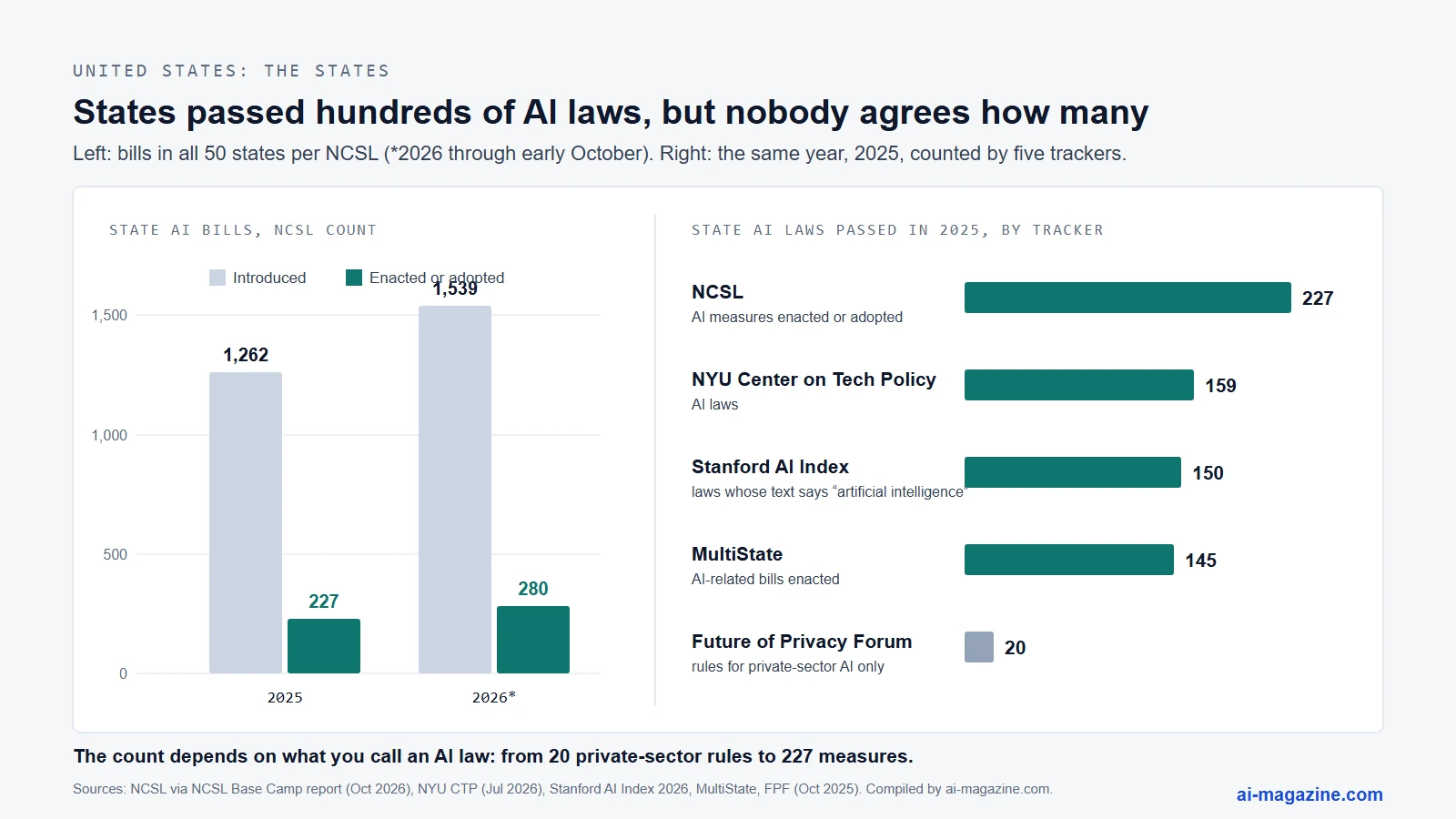
Those numbers come with a warning. We compared five trackers that count 2025, and their answers range from 20 to 227, because each defines an “AI law” differently. The Future of Privacy Forum counts only rules on private-sector AI; NCSL includes resolutions and budget items; the AI Index counts any law whose text says “artificial intelligence”. When you see a single number for state AI laws, check whose count it is.
Only a handful of states have broad laws. The rest regulate specific uses.
Colorado. Colorado passed the first broad US AI law in 2024 (SB 24-205), delayed it once, then repealed and replaced it with SB 26-189, signed on May 14, 2026. The new law is narrower. It covers automated systems that materially influence decisions about education, jobs, housing, lending, insurance, health care and government services. From January 1, 2027, companies must tell people when such a system is used, explain an adverse decision in plain language within 30 days, and let people correct their data and ask for human review. The attorney general enforces it; there is no private lawsuit right. Enforcement is on hold: in xAI’s lawsuit against the state, a court order of April 27, 2026, agreed by both sides, bars enforcement until 14 days after the court rules on an injunction request that xAI had not filed as of mid-November.
California. California has the most AI laws of any state, 62 between 2016 and 2025 by the AI Index count. The most important for AI companies:
- SB 53, in force since January 1, 2026, requires developers of frontier models with over $500 million in revenue to publish a safety framework, file transparency reports and report critical safety incidents. Fines reach $1 million per violation.
- AB 2013 requires generative AI developers to publish a summary of their training data from January 1, 2026. A court refused xAI’s request to block it on March 4, 2026; an appeal is pending.
- The state privacy agency’s rules on automated decision-making apply to significant decisions from January 1, 2027.
- SB 243, in force since January 1, 2026, requires companion chatbots to disclose that they are AI and to follow suicide-prevention protocols, and lets users sue.
Texas. The Texas Responsible AI Governance Act took effect on January 1, 2026. It is narrower than its first draft: it bans AI built with intent to encourage self-harm or crime, to discriminate unlawfully or to produce child sexual abuse material, and limits social scoring and biometric identification by government. Only the attorney general enforces it, after a 60-day chance to fix the problem; Latham & Watkins puts the top fine at $200,000 per violation that cannot be cured.
New York. The RAISE Act, as amended in March 2026, takes effect on January 1, 2027. Like California’s SB 53 it targets large frontier developers, with incident reports due within 72 hours and fines of up to $1 million for a first violation and $3 million after that. New York already requires AI companion apps to detect suicidal language (since November 2025) and makes retailers say when a price was set by an algorithm using personal data.
Connecticut. SB 5, signed in late May 2026, phases in from October 2026 to 2028: AI content provenance and anti-discrimination rules first, AI companions in January 2027, notices before employers use AI hiring tools in October 2027. NCSL counts it and Colorado’s law as the only two broad AI governance laws enacted in 2026.
Utah has required businesses to disclose generative AI since 2024, narrowed in 2025 to cases where a consumer asks or the interaction is high-risk; the law expires on July 1, 2027 unless renewed.
Targeted state laws are where most of the action is:
- Chatbots and AI companions. At least 12 states had companion-chatbot laws by June 2026, per MultiState, all requiring crisis protocols for users at risk of self-harm. Illinois and Nevada go further and ban AI from acting as a therapist.
- Sexual deepfakes. Between 45 and 48 states, depending on the tracker, criminalise or allow lawsuits over sexual deepfakes.
- Election deepfakes. Public Citizen counts 33 states with laws, but courts have struck down California’s and Hawaii’s on free-speech grounds, and a federal judge found Montana’s likely unconstitutional in September 2026.
- Hiring. New York City has required bias audits of automated hiring tools since July 2023; Illinois made discriminatory AI use in employment a civil-rights violation from January 1, 2026.
- Health care and insurance. At least 10 states passed health AI laws in 2025, many of them saying an algorithm cannot be the only basis for denying coverage.
- Likeness and voice. Tennessee’s ELVIS Act and two California laws protect performers against unauthorised digital replicas.
European Union
The EU AI Act is the world’s most complete AI law and applies to any company whose AI is used in the EU. Bans on practices such as social scoring and AI literacy duties have applied since February 2, 2025; rules for general-purpose AI models since August 2, 2025. The July 2026 Omnibus moved the high-risk rules back to December 2, 2027 for uses such as hiring and credit, and to August 2, 2028 for AI built into regulated products. Fines reach €35 million or 7% of worldwide turnover. Italy added its own national law on top, in force since October 10, 2025, which makes spreading harmful deepfakes a crime punishable by one to five years in prison. Our separate guide covers the Act in detail.
China
China does not have one AI law. It has a stack of targeted rules, enforced mainly by the Cyberspace Administration of China (CAC):
- Generative AI services must be filed with the CAC before launch. By October 31, 2026, 1,245 services had been filed and 955 apps or features registered, according to CAC figures reported in November.
- Labelling. Since September 1, 2025, AI-generated text, images, audio and video must carry visible labels and hidden metadata, and platforms must detect and flag unlabelled content.
- Human-like AI companions. Rules in force since July 15, 2026 require these services to tell users they are talking to an AI and to show a reminder after two hours of continuous use.
- The Cybersecurity Law gained its first article on AI, with higher penalties, from January 1, 2026.
On November 3, 2026, the national planning agency said China will speed up work on a broad AI law. No draft has been published. Meanwhile the state’s “AI Plus” plan aims for more than 70% adoption of intelligent devices and AI agents by 2027.
United Kingdom
The UK has chosen not to pass an AI act. The King’s Speech of May 13, 2026 contained no AI bill, and ministers say the UK will not copy the EU. AI is instead regulated by existing bodies, such as the data protection regulator and the competition authority, under existing law. The Data (Use and Access) Act 2025 relaxed the rules on automated decisions about people from February 5, 2026: they are now allowed with safeguards rather than broadly prohibited. The government’s AI Security Institute tests frontier models but has no power to block them.
Other countries
Japan. The AI Promotion Act, in effect since June 4, 2025, sets up a national AI strategy headquarters and a basic plan. It has no fines; the strongest tool is publishing the names of companies that ignore government guidance.
South Korea. The AI Basic Act took effect on January 22, 2026, one of the first broad AI laws outside the EU. Providers must tell users when they are dealing with AI or AI-generated content, and foreign providers above a size threshold must appoint a local representative. Fines are capped at KRW 30 million, and the science ministry says it will not impose them for at least a year except in cases of serious harm.
Vietnam. The Law on AI, in force since March 1, 2026, sorts AI systems into three risk tiers. Systems already in use get 12 months to comply, 18 in health, education and finance.
Taiwan and Kazakhstan both brought AI framework laws into force in January 2026. Peru began applying the regulation of its 2023 AI law the same month.
India has no AI law, but amended IT Rules in force since February 20, 2026 require platforms to label AI-generated content and take it down faster.
Australia dropped plans for mandatory high-risk AI rules in December 2025, then on November 10, 2026 proposed a law imposing safety duties on frontier AI companies, enforced by a new regulator. There is no bill yet.
Singapore relies on voluntary frameworks, including the first government framework for agentic AI, published in January 2026. The UAE created a federal AI and Data Authority in June 2026 but has no AI statute.
Brazil’s bill, PL 2338/2023, passed the Senate in December 2024 and has waited in the Chamber of Deputies ever since; a vote planned for May 2026 did not happen. Canada’s AI and Data Act died in January 2025 and has not been replaced. Chile’s AI bill cleared a Senate committee in October 2026.
International agreements
No international AI agreement binds companies directly. The main ones:
- Council of Europe Framework Convention on AI, the first binding AI treaty, opened for signature in September 2024. It had 21 signatories by October 2026, including the US, UK, Japan, Canada and the EU, but only the EU had ratified it, according to public trackers, so it is not yet in force.
- OECD AI Principles, first adopted in 2019 and updated in May 2024, have 47 adherents and underpin many national laws.
- G7 Hiroshima Process: more than 50 companies have pledged to publish reports on how they manage AI risks.
- United Nations: a 40-member Independent International Scientific Panel on AI, appointed in February 2026, published its first report on July 1; the first Global Dialogue on AI Governance met in Geneva on July 6 and 7.
- Summits: 20 AI companies have signed the Seoul Frontier AI Safety Commitments. The US and UK declined to sign the Paris summit statement in February 2025, but reportedly joined the 92 signatories of the non-binding New Delhi Declaration in February 2026.
AI governance inside companies
For most organisations the practical question is not which country’s law is strictest but how to run AI responsibly across all of them. Two frameworks dominate:
- NIST AI Risk Management Framework. Free, voluntary and widely referenced, including by Texas, whose AI law gives companies a defence if they follow it. It organises the work into four functions: govern, map, measure and manage.
- ISO/IEC 42001:2023, the certifiable standard for an AI management system. There is no official count of certificates; one tracker counted about 223 publicly announced certifications in 29 countries by October 2026.
Formal AI governance is still uneven. In McKinsey’s 2025 State of AI survey, 28% of respondents said their CEO was responsible for AI governance and 17% said the board oversaw it. An IAPP survey found 60% of organisations had, or planned within a year, a dedicated AI governance function. For the ethical principles behind these frameworks, see our glossary entries on AI ethics, bias, explainable AI and AI guardrails.
The deadlines coming next
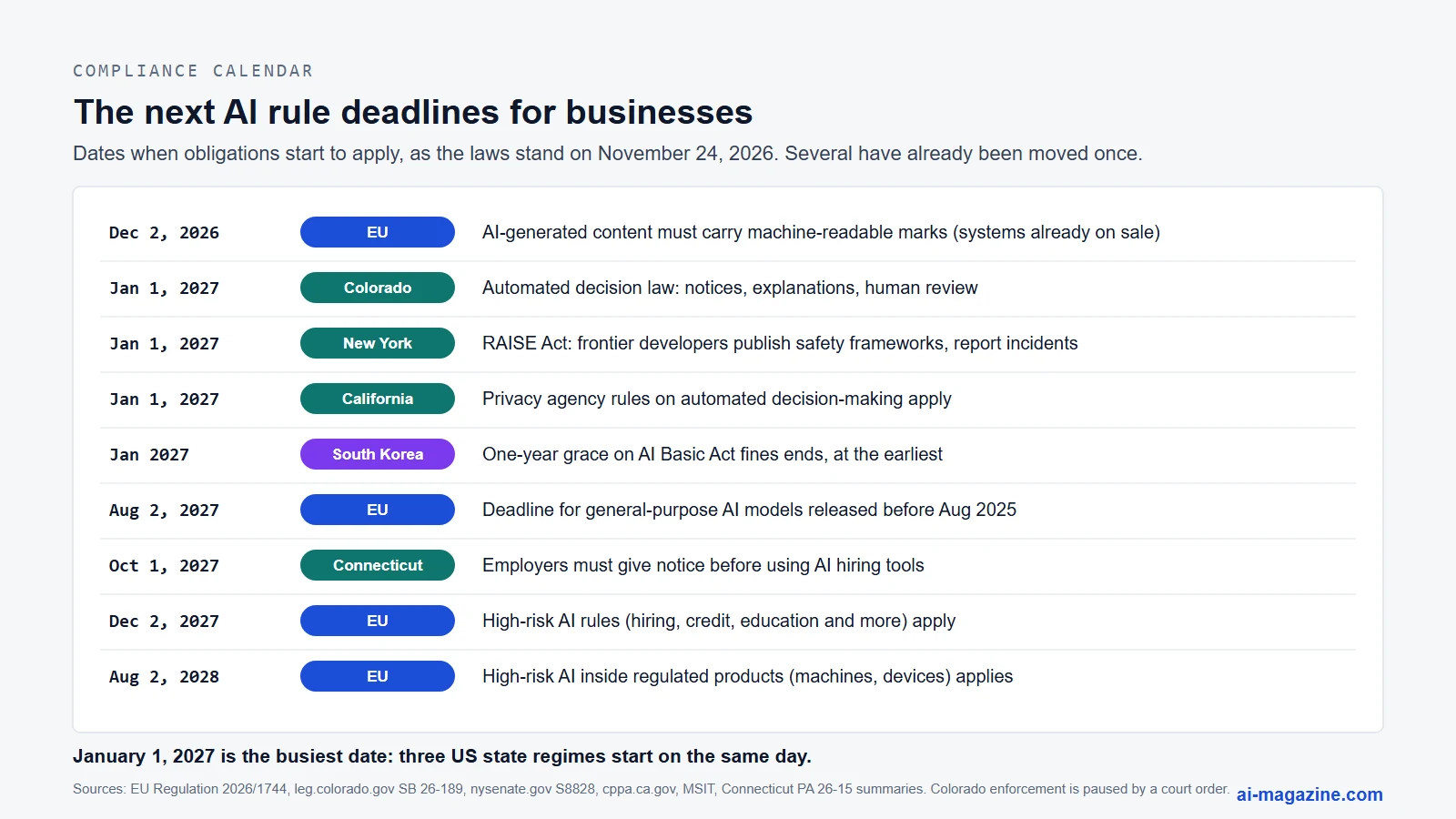
January 1, 2027 is the busiest date on the calendar, with three US state regimes starting together. Treat every date as provisional: Colorado’s law has been delayed once and then replaced, the EU moved its high-risk deadlines by 16 months, and federal preemption could still change the US picture.
What to do now: a checklist
- Make an inventory. List every AI system you build or use, what it decides and where its users are. Most laws apply based on where the affected people are, not where you are.
- Flag decisions about people. AI used in hiring, lending, insurance, housing, education or health care is regulated almost everywhere: the EU, Colorado, California, Connecticut, New York City and Illinois.
- Label AI content and chatbots. Disclosure is the most common duty worldwide: the EU from December 2026 for existing systems, China since 2025, India since February 2026, Korea and several US states.
- Check for companion or mental-health features. Chatbots that form ongoing relationships with users, or that minors use, face specific crisis-protocol rules in at least 12 states and in China.
- Pick a framework. Mapping your controls to the NIST AI RMF or ISO 42001 gives you one programme that answers most regulators, and Texas law rewards it.
- Watch the courts. Several state laws are on hold or under challenge; enforceability can change in weeks.
None of this is legal advice. For rules specific to legal work, see our guide to AI in law; for financial firms, AI in financial services.
Frequently asked questions
What is AI regulation? AI regulation is the set of laws and official rules that govern how AI systems are developed, sold and used. It ranges from broad risk-based laws such as the EU AI Act to targeted rules on deepfakes, chatbots or automated decisions about people.
Is there a federal AI law in the United States? No broad one. The US has executive orders, agency guidance, export controls and one AI-specific statute, the TAKE IT DOWN Act on intimate deepfakes. Most binding AI rules in the US come from the states.
Can US states still regulate AI after the 2025 executive order? Yes. An executive order cannot cancel state laws by itself. Congress has twice rejected a moratorium on state AI laws, and no federal statute preempts them. Individual state laws can still be blocked by courts, as happened with election deepfake laws in California and Hawaii.
Which countries have AI laws? Broad AI laws are in force in the EU (plus Italy’s national law), South Korea, Vietnam, Japan, Taiwan, Kazakhstan and Peru. China regulates AI through several targeted regulations. The US, UK, India, Canada and Australia have no broad AI law.
Does the EU AI Act apply to American companies? Yes, if their AI systems are placed on the EU market or their output is used in the EU, regardless of where the company is based.
What is the difference between AI regulation and AI governance? Regulation is what governments require. Governance is how an organisation manages AI internally: policies, risk reviews, documentation and oversight. Good governance is usually how companies meet regulation, and frameworks such as the NIST AI RMF and ISO 42001 describe it.
Is ChatGPT regulated? Yes, in several ways. In the EU it falls under the AI Act’s rules for general-purpose AI models; in California and New York its developer is covered by the frontier AI laws; in China, any generative AI service offered to the public must be filed with the regulator first. Data protection and consumer law apply everywhere.
Related
- The EU AI Act explained
- AI in law: tools, cases and rules
- AI deepfake porn: the scale of the problem
- AI in cybersecurity
- Glossary: AI ethics
Status as of November 24, 2026. Laws and court orders change often; check the linked primary sources before relying on any date. Some official pages (the Council of Europe treaty office, NCSL) could not be reached during our research, so figures from them come from reports quoting them.