AI Water and Energy Use: How Much Does a ChatGPT Prompt Really Use?
A typical text prompt to ChatGPT or Gemini uses about 0.3 watt-hours of electricity and, by the companies’ own figures, about a third of a millilitre of cooling water: roughly five drops. That is far less than the “bottle of water per email” that went viral in 2024. But both numbers are true in their own way, and the gap between them explains most of the confusion about AI’s environmental impact.
The small numbers are per prompt. The big numbers are in the totals. Google’s data centers consumed 41 billion litres of water in 2025, more than double 2021. Data centers worldwide used about 485 terawatt-hours of electricity in 2025, and the International Energy Agency expects that to roughly double by 2030. And the type of AI work matters far more than the brand: a reasoning model, an image or a video can use tens to thousands of times the energy of a simple text answer.
This guide sets out what is known, from company disclosures, government laboratories and independent measurements, and adds two things of our own: a chart of the big tech companies’ water use from their latest reports, and a test of how much extra work “reasoning” mode adds to the same everyday questions.
AI water and energy use at a glance
| Question | Short answer |
|---|---|
| How much energy does one AI prompt use? | About 0.24 to 0.34 Wh for a typical text prompt, by Google’s and OpenAI’s figures. About what a microwave oven uses in one second (our arithmetic) |
| How much water does a ChatGPT prompt use? | About 0.3 mL of cooling water by OpenAI’s and Google’s figures. Counting water used at power plants, about 1 to 2 mL (our estimate); older academic estimates for GPT-3 put it at about 17 mL |
| Is “a bottle of water per email” true? | It is an upper-range estimate for GPT-4 that counts power-plant water, from 2024. Newer company figures are hundreds of times lower, but they count only cooling water |
| What uses the most energy? | Video generation, then reasoning models and long inputs. A 5-second video clip can use 25 to 415 Wh, against about 0.3 Wh for a text answer |
| How much water do AI companies use in total? | Google consumed 41 billion litres in 2025, Microsoft 8.2 billion litres (fiscal 2025) and Meta 3 billion litres |
| How much electricity do data centers use? | About 485 TWh worldwide in 2025 (1.5% of global electricity) and 192 TWh in the US in 2024 (4.7%) |
| Is it getting worse? | Per prompt, it is falling fast. In total, it is rising fast, because use is growing faster than efficiency improves |
How much energy does an AI prompt use?
Three AI companies have published a per-prompt figure. All three are for text, and all three land close to 0.3 watt-hours (Wh):
- Google, Gemini: 0.24 Wh for the median text prompt in the Gemini apps, measured in May 2025 and published in August 2025 with a technical paper. Google counted the AI chips, the servers’ processors and memory, idle machines kept ready for traffic and the data center’s overhead for cooling and power conversion. It did not count training, the manufacture of the hardware or image and video prompts. Google says the figures have not been checked by an independent third party, and its June 2026 environmental report repeats the same numbers.
- OpenAI, ChatGPT: “the average query uses about 0.34 watt-hours”, according to Sam Altman’s June 2025 blog post. OpenAI has published no method, no model name and no definition of a query.
- Microsoft Research: a modelled median of 0.34 Wh per query for frontier-scale models, in a September 2025 paper. These are estimates for models running on Nvidia H100 servers, not metered Copilot data.
Independent estimates agree on the order of magnitude. Epoch AI, a research group, estimated about 0.3 Wh for a typical GPT-4o query in February 2025 and called its own figure “relatively pessimistic”.
To put 0.3 Wh in context:
- An average US home uses about 28,000 Wh of electricity a day (US Energy Information Administration, 2024), the same as roughly 100,000 text prompts.
- Boiling one litre of water in a kettle takes about 100 Wh, or around 300 to 400 prompts (our arithmetic).
- Streaming an hour of video used about 80 Wh in 2019 by the IEA’s estimate, more on a large TV.
Why “ChatGPT uses 10 times more than Google search” is out of date
The often-quoted 3 Wh per ChatGPT query comes from a 2023 estimate by the researcher Alex de Vries, based on assumptions about GPT-3-era hardware running at peak power. It was then compared with Google’s own figure of 0.3 Wh per search, which dates from 2009. Both numbers are old. The newer company and independent figures put a typical text prompt at about the same 0.3 Wh, and search itself has become more efficient since 2009. Google also says the median energy of a Gemini prompt fell 33 times between May 2024 and May 2025.
The comparison that matters now is not chatbot against search, but one kind of AI task against another.
Reasoning, images and video use far more
The 0.3 Wh figures are for a typical text prompt. AI does many other things, and they cost much more.
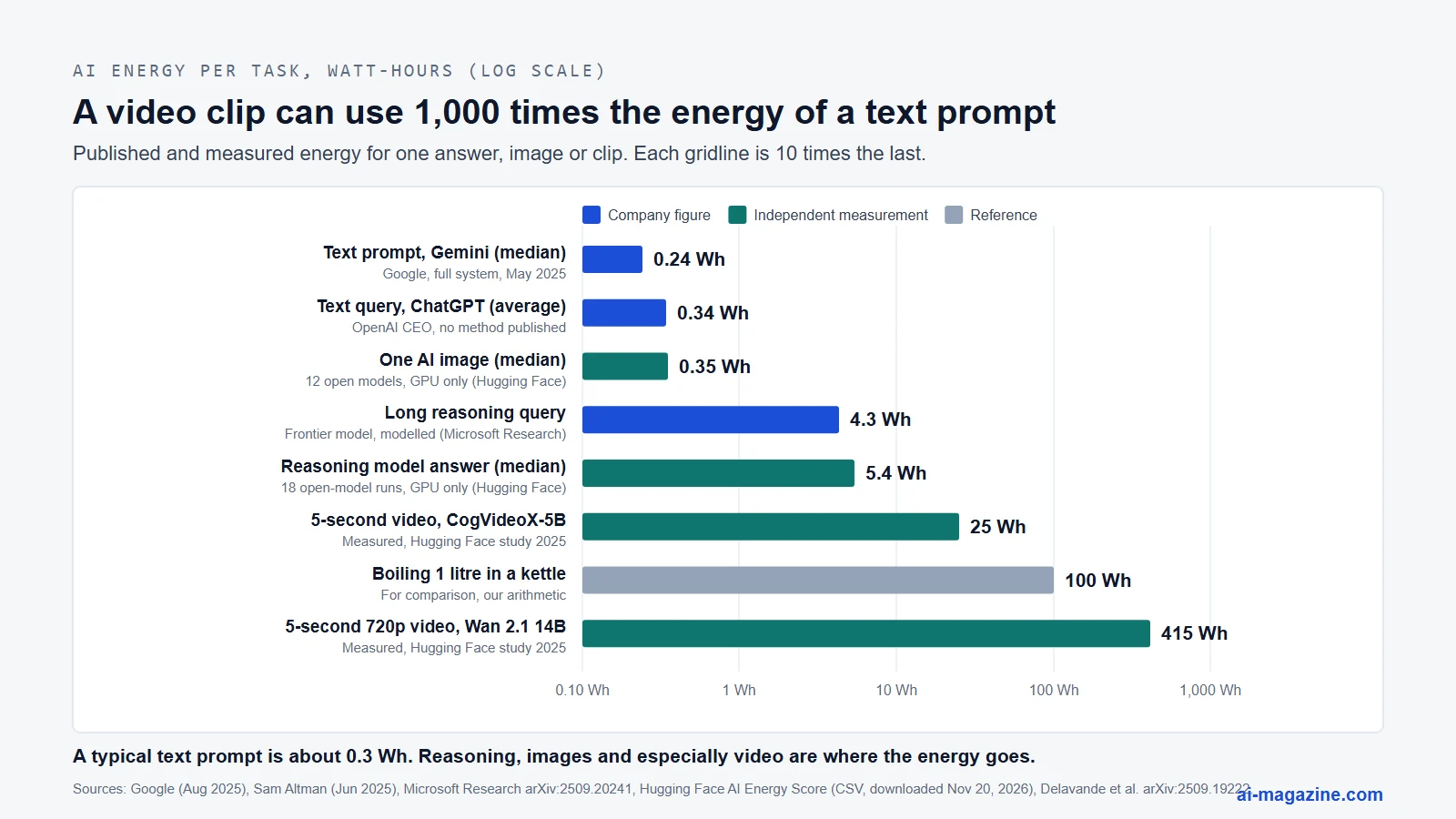
The measurements in the chart come from three sources:
- Hugging Face’s AI Energy Score measures open models on the same Nvidia H100 hardware with 1,000 test queries per task. We downloaded its data on November 20, 2026. The median text-generation model used 0.019 Wh per query and the largest about 3.4 Wh. The median reasoning model used 5.4 Wh, and the range ran up to 19 Wh. The median image generator used 0.35 Wh per image. These figures count the GPU only, so whole-server figures would be somewhat higher.
- Microsoft Research modelled long reasoning queries, which produce about 15 times more tokens, at a median of 4.32 Wh: 13 times a short query.
- A Hugging Face study of video generation (Delavande, Pierrard and Luccioni, 2025) measured one 5-second clip at about 25 Wh with CogVideoX-5B and about 415 Wh with the larger Wan 2.1 14B at 720p. Energy grows roughly with the square of resolution and clip length, so doubling the length about quadruples the energy.
The pattern is simple. Energy follows the amount of computation, and computation follows the number of tokens a model reads and writes, the size of the model and, for images and video, the number of pixels and frames. Long inputs matter too: Epoch AI estimates that a prompt with 100,000 tokens of input, such as a long document, uses almost 40 Wh.
Our test: what reasoning mode does to the same questions
Reasoning models “think” before answering by writing out hidden steps, which are billed and computed as output tokens. Hugging Face found that switching reasoning on in the same model raised energy use 154 to 697 times on its test set. But its reasoning tasks are hard problems. We wanted to know what happens with everyday questions.
We asked 50 ordinary questions twice each: short facts, explanations, writing tasks, simple maths and logic, and small coding tasks. We used Qwen3.6-35B-A3B, an open model with a switchable thinking mode, on our own vLLM server, once with reasoning off and once with it on, at the same settings. Then we counted the tokens generated.
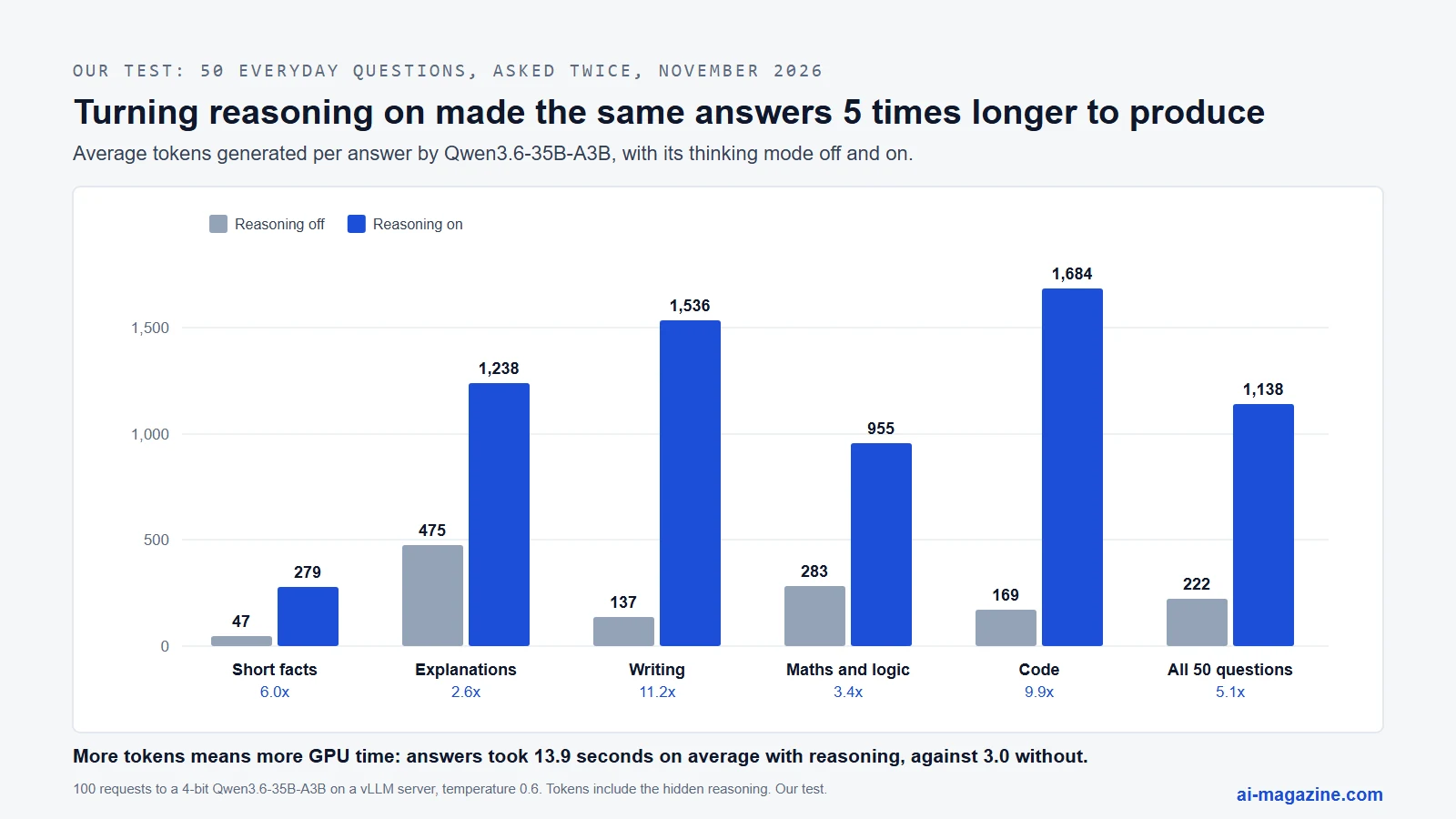
What we found:
- Reasoning made answers about 5 times more expensive to produce on average (222 tokens without reasoning, 1,138 with), and 6.3 times for the median question.
- The multiplier depends on the task. Writing tasks rose 11 times and code 10 times, because the model drafts and checks before answering. Explanations rose least, 2.6 times, because the answers were already long.
- The worst case was 77 times for a single question: a bash one-liner to count lines in text files, which took 27 tokens to answer directly and 2,070 with reasoning. A four-line poem went from 38 tokens to 2,358.
- Time followed tokens. Answers took 13.9 seconds on average with reasoning against 3.0 without, on the same server.
For a model of this design, GPU time and energy rise roughly in line with the number of tokens generated, so the same everyday question with reasoning on uses several times the energy. On easy questions this buys little. If you choose the model or the reasoning level yourself, as you can in most AI apps and every API, a lighter setting for simple tasks is the single biggest saving in your control. We cover the money side in how to reduce LLM API costs, and how reasoning models work in the glossary.
How much water does AI use?
Data centers use water in two ways, and most of the argument about AI’s water footprint is really an argument about which one to count.
- Directly, for cooling. Many data centers use evaporative cooling towers, which cool the building by evaporating water. That water is “consumed”: it does not return to the river or aquifer. Closed-loop and air cooling use little water but more electricity.
- Indirectly, through electricity. Thermal power stations (gas, coal and nuclear) evaporate large amounts of water in their own cooling towers, and hydroelectric reservoirs lose water to evaporation. Every kilowatt-hour a data center draws carries this hidden water.
The indirect part is usually much bigger. Lawrence Berkeley National Laboratory (LBNL) estimated that US data centers consumed about 66 billion litres of water directly in 2023, and about 800 billion litres indirectly through the electricity they used: about 12 times more. Its national average is 4.52 litres of water per kWh of electricity (LBNL 2024 report). These are still LBNL’s latest water figures; its June 2026 update covered electricity only.
Meta’s 2026 report shows the same gap at company level: in 2025 it consumed 790 million gallons of water directly, against 26,101 million gallons embedded in the electricity it bought, 33 times more.
Why estimates range from five drops to a bottle
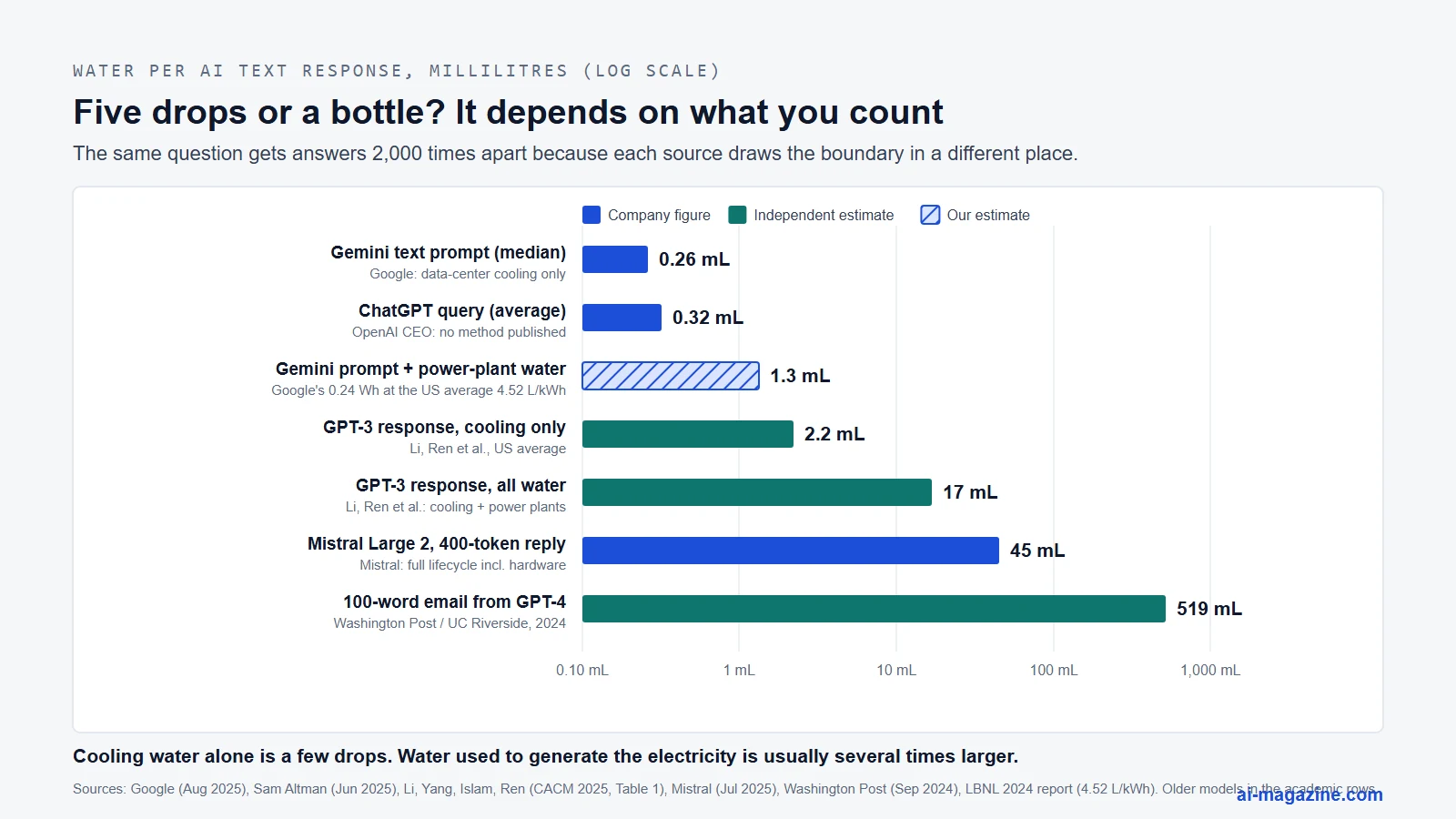
The numbers in this chart are not really in conflict. Each one measures something different:
- Google: 0.26 mL per median Gemini text prompt, about five drops. Cooling water in Google’s own data centers only.
- OpenAI: about 0.32 mL, “roughly one fifteenth of a teaspoon”, per average ChatGPT query. No method published.
- Our estimate: about 1.3 mL. Google’s 0.24 Wh at LBNL’s US average of 4.52 litres per kWh adds about 1.1 mL of power-plant water to Google’s 0.26 mL of cooling water. The real figure depends on where the electricity comes from: wind and solar use almost no water, thermal plants a lot.
- The academic estimate: 16.9 mL per GPT-3 response in the US on average, of which 2.2 mL is cooling and 14.7 mL is power-plant water. It comes from the Making AI Less “Thirsty” paper by Pengfei Li, Jianyi Yang, Mohammad Islam and Shaolei Ren, published in Communications of the ACM in 2025. Its famous line is that GPT-3 needs to “drink” a 500 mL bottle “for roughly 10-50 medium-length responses, depending on when and where it is deployed”. That is a bottle per 10 to 50 responses, not per conversation.
- Mistral: 45 mL per 400-token reply from Mistral Large 2. This is a full lifecycle figure that also counts the water used to make the hardware, from a study done with the consultancy Carbone 4 and the French environment agency ADEME and reviewed by two other firms (Mistral, July 2025).
- Washington Post and UC Riverside: 519 mL for a 100-word email written by GPT-4, a US average that includes power-plant water, ranging from 235 mL in Texas to 1,408 mL in Washington state (September 2024). This is the source of “a bottle of water per email”.
So the honest answer to “how much water does ChatGPT use per prompt” is: a fraction of a millilitre for cooling, plus somewhere around a millilitre or two at the power plant for a short text answer on current hardware, and much more for long, reasoning or image and video tasks. Hugging Face researchers concluded in 2025 that the company figures “cannot be used to meaningfully compare systems”, because they draw the boundaries differently.
How much water the big AI companies use
The per-prompt figures look small. The totals do not, because the prompts number in the billions every day and data centers also train models and run everything else on the internet.
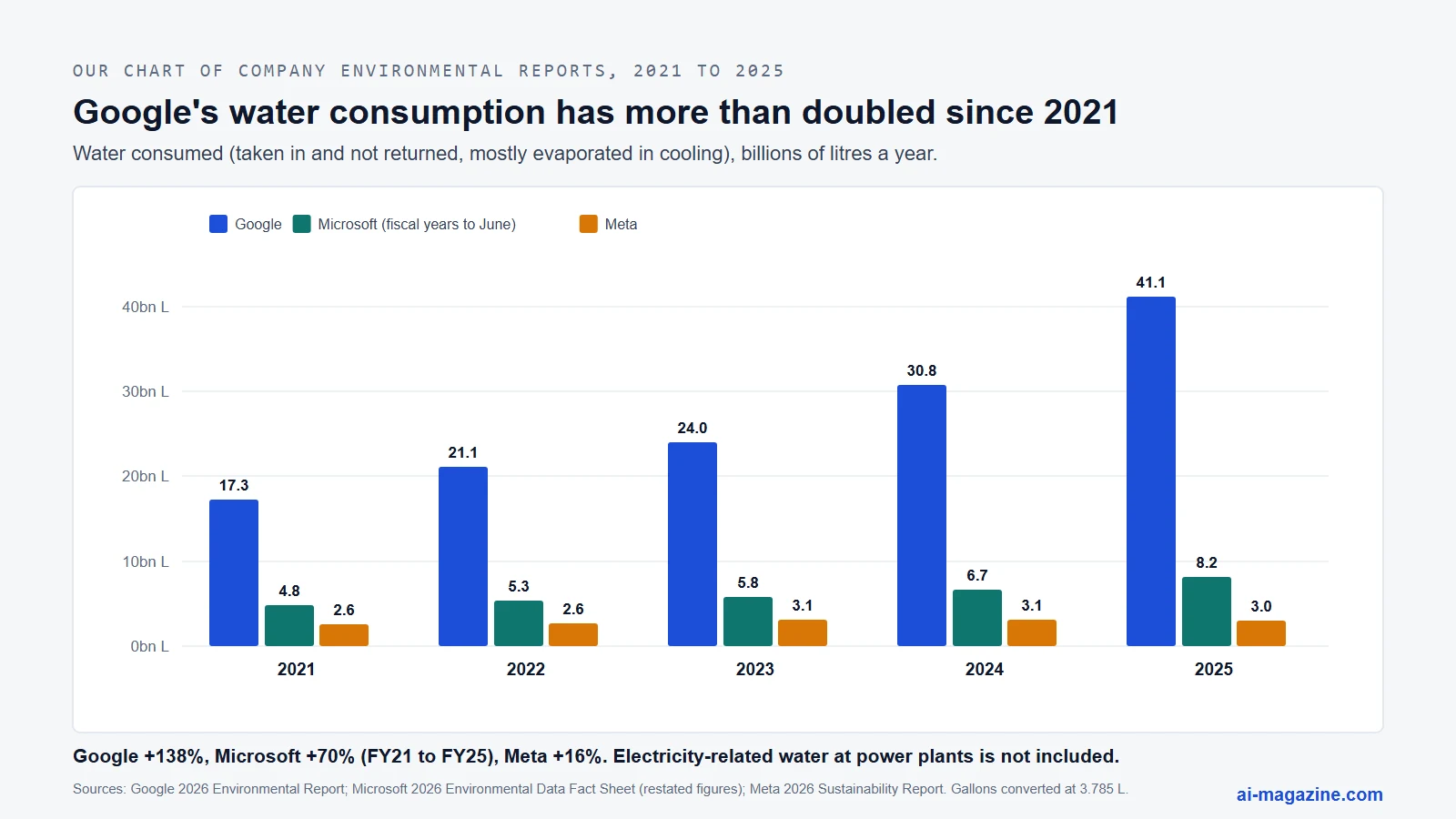
From the companies’ own 2026 reports:
- Google consumed 10.9 billion gallons (41 billion litres) of water in 2025, up 34% in a year and 138% since 2021. Its data centers accounted for 10.5 billion gallons of that. Google compares the total to irrigating 73 golf courses in the US Southwest for a year. It replenished 78% of what it consumed in 2025 through watershed projects, against a goal of 120% by 2030.
- Microsoft consumed 8.2 billion litres in fiscal 2025 (to June 2025), roughly double fiscal 2020. Microsoft restated all its earlier figures in this edition, so older articles quoting its water use use superseded numbers. 48% of its consumption was in water-stressed areas. Microsoft says that in fiscal 2025 it replenished more water than it withdrew for the first time.
- Meta consumed 790 million gallons (3 billion litres) in 2025, slightly less than in 2024. Its water use per kWh fell 26% in a year.
- Amazon Web Services reports withdrawals rather than consumption: 9.4 billion litres in 2025, with water use per kWh down from 0.25 litres in 2021 to 0.12 litres. It says it is “75% of the way” to its goal of returning more water than it uses by 2030.
These totals are for direct use only. They leave out the larger amount of water used at the power stations that supply the companies, and the companies use different definitions, so they are not strictly comparable with each other. Cooling choices matter too: evaporative cooling uses more water but less electricity than air cooling, so a company can lower one number by raising the other.
How big is this nationally? LBNL’s 66 billion litres of direct US data center water use in 2023 is about 17 billion gallons. Americans use about 80 to 100 gallons of water a day each at home (USGS), so that is roughly the yearly home use of half a million to 600,000 people (our arithmetic). Google points out that US data centers use less than 1% of the water Americans put on their lawns. Both are true. The national total is modest; the problem is that data centers concentrate it in a few places, often dry ones.
Where water becomes a local fight
The disputes are local because water is local. Examples from public records and reporting:
- Chile: an environmental court partly reversed the permit for Google’s planned Santiago data center in February 2024 over its plan to use about 7.6 million litres of drinking water a day. Google said in September 2024 it would redesign it with air cooling.
- Uruguay: Google’s data center plan became public in 2023 during the country’s worst drought in about 74 years. The project was redesigned for air cooling and approved.
- Tucson, Arizona: the city council voted 7-0 in August 2025 to end its involvement in “Project Blue”, a data center linked to Amazon, over water and energy concerns. The developer switched to closed-loop air cooling and pursued county approval instead.
- Newton County, Georgia: residents near a Meta data center reported dry and silty wells in 2025. Meta’s commissioned study denies a link, and four families sued Meta in September 2026.
- Memphis, Tennessee: the local utility says xAI’s Colossus supercomputer can take up to 1 million gallons of city water a day for cooling. xAI is building a wastewater recycling plant to replace it.
- California: the Imperial Irrigation District rejected a 330 MW data center’s water application in May 2026, and the developer sued.
The industry’s answer is to stop evaporating water. Microsoft says its data center design from August 2024 “consumes zero water for cooling” by circulating liquid in a closed loop through the chips, at the cost of slightly more electricity; it expects each such site to save more than 125 million litres a year. AWS says it uses no water for cooling in some regions and is moving more sites to recycled wastewater.
How much electricity does AI use?
The latest independent totals:
- Worldwide: data centers used about 485 TWh of electricity in 2025, up 17% in a year and about 1.5% of global electricity. Use by AI-focused data centers grew 50%. The IEA projects about 950 TWh by 2030, close to 3% of the world’s electricity, with AI-focused use tripling (IEA, April 2026).
- United States: data centers used 192 TWh in 2024, 4.7% of US electricity. LBNL’s reference case is 649 TWh by 2030, about 11.8%, within a range of 9.5% to 15.3% (LBNL, June 2026).
Not all of this is AI. Data centers also run cloud storage, streaming, email and websites. But AI is the fastest-growing part, and the company figures show it:
- Google’s electricity use rose from 18.1 TWh in 2021 to 43.6 TWh in 2025, up 37% in the last year alone, its biggest annual rise.
- Microsoft’s rose about 3.4 times between fiscal 2020 and fiscal 2025, to 37 TWh.
- Meta’s rose from 9.4 TWh in 2021 to 24.9 TWh in 2025.
For scale, 43.6 TWh is about what 4 million average US homes use in a year (our arithmetic). A single 1 GW AI campus running all year uses as much as about 850,000 homes, as we calculated in our guide to AI data centers.
The IEA also puts the per-prompt and total pictures side by side: if every conventional web search became a simple AI text query, it would use under 4 TWh a year, less than 1% of data center use. Most of the growth is coming from heavier work: training, reasoning, agents, images, video and AI built into business software.
Training versus everyday use
Training a frontier model is a one-off cost, but a large one. Epoch AI estimates that training xAI’s Grok 4 used about 310 GWh of electricity and about 750 million litres of water, much of the power coming from gas turbines (Epoch AI). The figure of about 50 GWh often quoted for GPT-4 is not from Epoch; it is a blog estimate based on leaked details, and a 2025 paper puts it nearer 33 GWh. GPT-3 in 2020 needed about 1.3 GWh.
Once a model is popular, everyday use soon outweighs training. Mistral’s lifecycle study, for example, found that training plus 18 months of use accounted for 85.5% of its model’s greenhouse gas emissions and 91% of its water consumption, with use growing every month.
The grid and your electricity bill
The strain shows first on the grid. In the PJM market, which serves 13 US states and Washington, DC, from Illinois to New Jersey, the December 2025 auction for 2027/28 capacity cleared at the price cap of $333.44 per megawatt-day, cost about $16.4 billion and still fell 6,517 MW short of the reliability target (PJM). The independent market monitor attributed about $6.5 billion, or 40%, of that cost to data center demand. The July 2026 auction fell short again.
Whether data centers raise household bills everywhere is less clear. Studies covering 2015 to 2024 found that states with faster demand growth had slightly lower average prices, because fixed grid costs were spread over more sales. The PJM region is the main exception so far.
To get power fast, AI companies are signing deals for nuclear power. Microsoft is paying to restart the Three Mile Island Unit 1 reactor as the Crane Clean Energy Center, now planned for the second half of 2027. Google has agreed to buy up to 500 MW from Kairos Power’s small reactors, and Amazon up to 1,920 MW from the Susquehanna plant in Pennsylvania. Meta has signed deals for up to 6.6 GW by 2035. In the meantime, much new capacity is gas: the IEA expects 15 to 27 GW of gas generation built on site at data centers by 2030, mostly in the US.
AI’s carbon emissions
More electricity means more emissions, even for companies that buy large amounts of renewable power. From the companies’ own reports:
- Google: about 14.5 million tonnes of CO2-equivalent in 2025, up 18% in a year and 81% since 2019, on the new method in its 2026 report. Older reports used a different method, so “+48%” or “+51%” figures from previous years are not comparable. Its goal is net zero by 2030.
- Microsoft: 21.1 million tonnes in fiscal 2025, up 25% in a year and about 62% since its fiscal 2020 baseline. Its goal is to be carbon negative by 2030.
- Meta: 11.8 million tonnes in 2025, up 45% in a year. Most of it is in its supply chain, and 73% comes from building data centers and making equipment.
- Amazon: about 81 million tonnes in 2025, up 16%, its largest one-year rise since it started reporting.
A large part of the increase is “embodied” carbon: the steel, concrete and chips that go into new data centers. That is why emissions keep rising even where the electricity is clean.
Per prompt, the numbers are small: Google puts a Gemini text prompt at 0.03 grams of CO2-equivalent and Mistral puts a 400-token reply at 1.14 grams, the difference again coming from what each counts.
How to reduce your own AI footprint
For an individual, the footprint of chatting with an AI is small next to driving, flying, heating or diet. A hundred text prompts a day for a year come to about 11 kWh: roughly what an average US home uses in nine hours (our arithmetic). The choices that matter most are the heavy ones:
- Use reasoning modes when they help. In our test they multiplied the work 5 times on average for everyday questions, often for no better answer.
- Do not paste whole documents when a section will do. Input length drives energy; a 100,000-token input can cost 100 times a short prompt.
- Be sparing with video. One 5-second clip can use as much energy as hundreds or thousands of text prompts. See what it costs in money in our guide to AI video generation costs.
- Use smaller models for simple tasks. On Hugging Face’s measurements, Llama 3 8B used about a hundredth of the energy of Llama 3 70B for the same text task. Small language models can even run on your own laptop.
For companies running AI at scale, the same levers apply, plus where and when the work runs: a data center on a clean grid in a cool, wet region has a very different footprint from one on a gas-heavy grid in a desert.
What we do not know
- Totals per company and model. No AI company publishes how many prompts it serves or the total energy and water of its AI services. Anthropic, Meta, xAI and DeepSeek have published no per-prompt figure at all.
- Images, video and agents. The company figures cover text prompts only. Independent measurements exist only for open models.
- Verification. Google’s, OpenAI’s and Microsoft’s figures are their own and have not been independently verified. Mistral’s study was reviewed by outside firms.
- Fresh water figures for the US. LBNL’s latest national water estimates are for 2023.
FAQ
How much water does ChatGPT use per prompt?
OpenAI says about 0.32 mL, roughly one fifteenth of a teaspoon, for an average query. That covers cooling water only. Counting water used to generate the electricity, a short text answer is more like 1 to 2 mL on current hardware (our estimate from Google’s figures and US averages). Long, reasoning, image and video tasks use more.
Does ChatGPT use a bottle of water per conversation?
Not on current company figures. The “bottle” comes from a 2023 paper on GPT-3, which said a 500 mL bottle covers roughly 10 to 50 responses, and from a 2024 Washington Post estimate of 519 mL for a 100-word GPT-4 email. Both count power-plant water and older hardware. Company figures for 2025 are hundreds of times lower, though they count only cooling water.
How much energy does an AI prompt use?
About 0.24 Wh for a median Gemini text prompt (Google) and 0.34 Wh for an average ChatGPT query (OpenAI). Independent estimates are similar. Reasoning answers can use 4 to 20 Wh and a short AI video clip 25 to more than 400 Wh.
Is AI bad for the environment?
Per prompt, the impact is small and falling. In total, AI is driving a fast rise in data center electricity, water and emissions: Google’s water consumption and Microsoft’s and Meta’s emissions have all risen sharply since 2020-21. The local effects on water supplies and power grids are where the impact is most visible.
Why do AI data centers use water?
To cool the chips. Many data centers use evaporative cooling towers, which evaporate water to remove heat. Power stations that supply the electricity also evaporate water. Newer closed-loop liquid cooling uses very little water but slightly more electricity.
How much electricity do data centers use?
About 485 TWh worldwide in 2025, around 1.5% of global electricity (IEA), and 192 TWh in the US in 2024, 4.7% of US electricity (LBNL). Both are expected to roughly double or more by 2030.
Which uses more energy, Google search or ChatGPT?
On current figures, a simple ChatGPT text answer and a Google search are in the same range, around 0.3 Wh, though Google’s search figure dates from 2009. The old claim that ChatGPT uses 10 times more relies on a 2023 estimate that newer data has replaced.
Related: AI data centers, is AI a bubble?, how AI works and how to reduce LLM API costs.