AI in Law: How Lawyers and Courts Use It, What Works and the Risks (2026)
More than 2,000 court decisions around the world now deal with filings that cited cases or quotations an AI tool made up. Attorneys have been sanctioned, cases dismissed, and opinions withdrawn after relying on AI to generate legal authority. This is the defining tension of legal AI in 2026: generative AI delivers measurable speed and cost savings, yet it introduces a specific, high-stakes risk of fabrication that the courts are actively policing.
This guide covers how law firms and legal departments are actually using AI, the market landscape of the major platforms, and what the evidence says about performance. We look at the Stanford RegLab study on hallucination rates, the Vals Legal AI Reports and the growing number of judicial sanctions, and we ran our own test of how often an AI model gets case citations wrong. Note that this is general information, not legal advice.
How lawyers use AI today
Adoption of AI in the legal sector has moved from experimental to structural, though the depth of integration varies significantly by firm size and practice area. The American Bar Association’s 2024 Legal Technology Survey, published in 2025, found that 30.2% of attorneys reported their offices currently use AI-based tools. Usage scales with firm size: 47.8% of firms with 500 or more lawyers use AI, compared to 29.5% of mid-sized firms (10–49 lawyers), 24.1% of small firms (2–9 lawyers), and just 17.7% of solo practitioners. The trend has been sharp; the same ABA series recorded only 11% usage in 2023.
Clio’s Legal Trends reports show higher adoption but reveal a nuance in how lawyers define “use.” In 2024 and 2025, 79% of legal professionals reported using AI “in some capacity.” However, only 25% use it widely or universally. More tellingly, Clio’s 2025 data shows that while overall AI use remained flat at 79%, the number of professionals using legal-specific AI tools dropped from 58% to 40%. Firms with broad AI adoption were about three times as likely to report higher revenue, although that is a correlation, not proof that AI caused it.
Thomson Reuters’ data underscores the strategic gap. Their 2025 “Future of Professionals” survey of 2,275 professionals found that while AI users expect to save five hours a week within the next year, only 22% of organizations have a visible AI strategy. Organizations with a clear strategy are twice as likely to see AI-driven revenue growth. Its 2026 report, which covers several professions, found that 40% of professionals say their organization uses generative AI, up from 22% the previous year, while 19% have no plans to adopt it.
Wolters Kluwer’s “Future Ready Lawyer” 2024 report highlights a divide between corporate and firm practice. Weekly Generative AI use stood at 76% in corporate legal departments versus 68% in law firms. Daily use was reported by 35% of corporate lawyers and 33% of firm lawyers. In the UK and Ireland, LexisNexis reported that the share of law firms using GenAI rose from 11% in July 2023 to 41% by September 2024.
The main use cases have stabilized around four pillars: legal research, drafting, document review, and contract analysis. Lawyers also use it to summarize depositions, support e-discovery and handle client intake. Thomson Reuters puts the potential value of the time saved at $20 billion a year for the US legal sector alone, based on respondents’ own forecasts.

Legal AI tools and the market
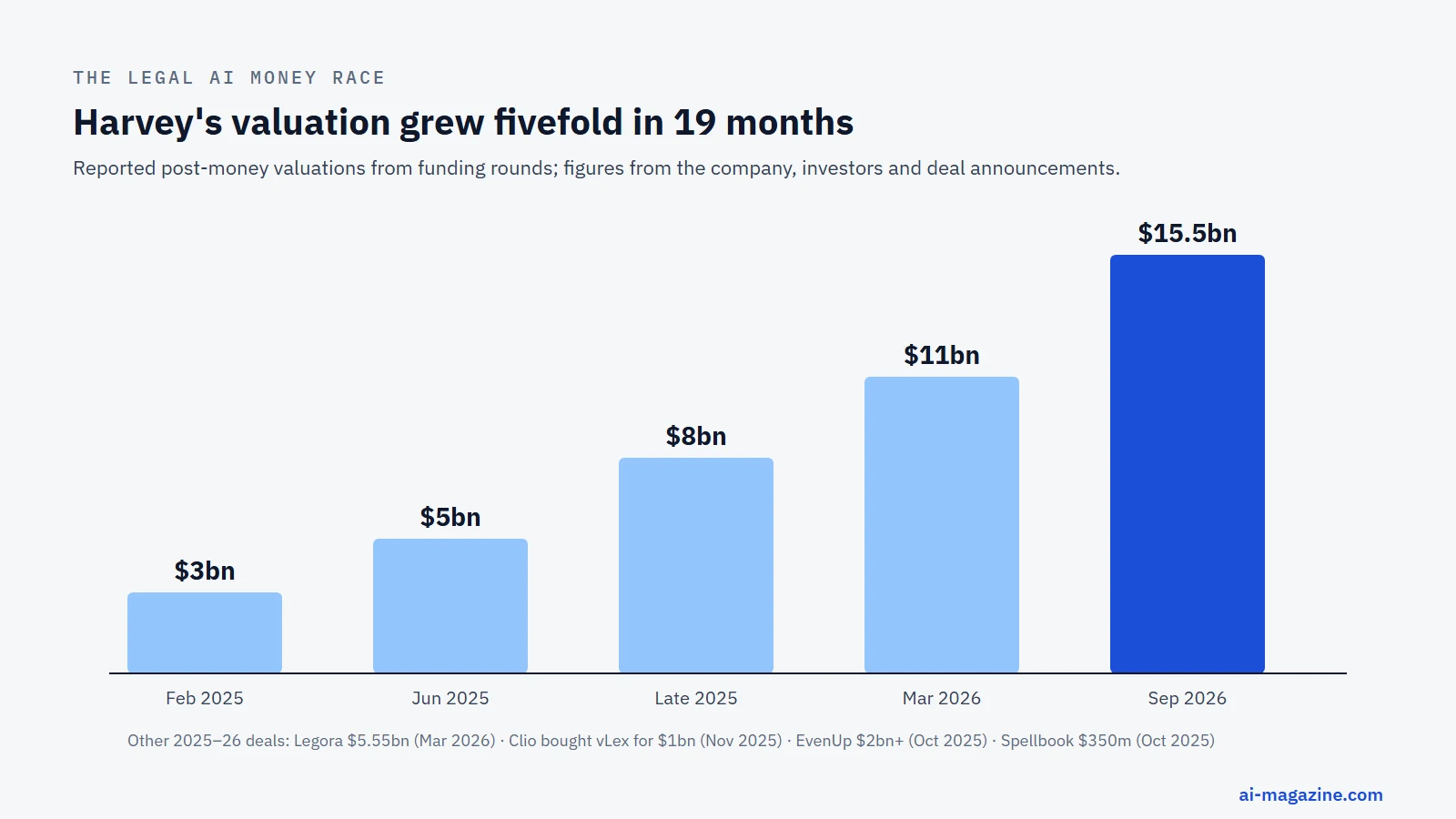
The market for legal AI is dominated by a few major players and a cluster of specialized startups. Harvey is the best-funded of them. It has raised more than $1 billion, and a $550 million round in September 2026 valued it at $15.5 billion, according to the deal announcement by its lawyers, Latham & Watkins. Around its March 2026 round Harvey said it had more than 100,000 lawyers across 1,300 organizations, including the majority of the AmLaw 100, and that customers had built more than 25,000 custom agents. A&O was its launch partner in 2023, rolling it out to more than 3,500 lawyers; Harneys, Slaughter and May and CMS announced firmwide rollouts in 2026.
Thomson Reuters integrated AI deeply through its $650 million acquisition of Casetext in 2023. In August 2025 it launched CoCounsel Legal, with agentic “Deep Research” on Westlaw and Practical Law, alongside Westlaw Advantage, which it billed as the final version of Westlaw. LexisNexis answered with its Protégé assistant, launched in August 2024. The “next-generation” Protégé of December 2025 combines LexisNexis content, the customer’s own documents and the open web, with a choice of models including Claude and GPT-5.
Other notable players include Legora, which raised $550 million in March 2026 at a $5.55 billion valuation, and Clio, which acquired vLex in November 2025 for $1 billion. Clio’s acquisition brings Vincent AI and over 1 billion documents across 110 jurisdictions. Spellbook focuses on contract drafting and review and raised $50 million at a $350 million valuation in October 2025. EvenUp, which builds AI tools for personal injury law firms, raised $150 million at a valuation above $2 billion the same month. At the consumer end, DoNotPay, which marketed a “robot lawyer”, agreed to an FTC order in February 2025 over claims it could not support and paid $193,000.
Valuations and customer counts below are company or investor figures.
| Tool | Company | What it does | Latest reported funding or deal |
|---|---|---|---|
| Harvey | Harvey | Legal research, drafting and custom agents | $550m at $15.5bn (Sept 2026) |
| CoCounsel | Thomson Reuters | Research and drafting on Westlaw and Practical Law | $650m Casetext acquisition (2023) |
| Protégé | LexisNexis | Legal research and drafting assistant | Next-generation release (Dec 2025) |
| Vincent AI | Clio (vLex) | Legal research across 110 jurisdictions | $1bn vLex acquisition (Nov 2025) |
| Legora | Legora | Legal AI platform for law firms | $550m at $5.55bn (Mar 2026) |
| Spellbook | Spellbook | Contract drafting and review | $50m at $350m (Oct 2025) |
| EvenUp | EvenUp | AI for personal injury firms | $150m at $2bn+ (Oct 2025) |
Does legal AI actually work?
The question of accuracy is the central concern for legal professionals. A preregistered study by Stanford’s RegLab and Human-Centered AI Institute, published in the Journal of Empirical Legal Studies in April 2025, found that Lexis+ AI, Westlaw AI-Assisted Research and Ask Practical Law AI each hallucinate between 17% and 33% of the time. That is less than GPT-4 on its own, but far from the “hallucination-free” research some vendors had advertised.
Another Stanford study, “Large Legal Fictions,” published in the Journal of Legal Analysis in June 2024, asked LLMs to answer verifiable questions about random federal cases. The models hallucinated at least 58% of the time. Those were general chatbots answering from memory, which is exactly how many of the fake citations in court filings were produced.
However, AI is not useless. The Vals Legal AI Reports (VLAIR), published in February 2025, tested Harvey, CoCounsel, Vincent AI, and Oliver against a lawyer baseline on seven tasks. AI beat lawyers in Data Extraction, Document Q&A, Document Summarization, and Transcript Analysis. For example, Harvey scored 94.8% in Document Q&A versus the lawyer baseline of 70.1%. CoCounsel scored 77.2% in summarization versus 50.3%. Lawyers won in Redlining and EDGAR Research.
In October 2025 a Vals legal research benchmark found the best legal AI tool at 81% accuracy and ChatGPT at 80%, against a lawyer baseline of 71%. On authoritativeness (citing good sources), legal AI tools averaged 76% and ChatGPT 70%. Thomson Reuters, LexisNexis and vLex did not take part.
Productivity evidence is clearer. A randomized trial by Choi, Monahan, and Schwarcz, published in the Minnesota Law Review in 2024, gave law students GPT-4 to use on legal tasks. They found “large and consistent increases in speed,” with quality improving only “slightly and inconsistently.” The lowest-skilled participants gained the most. This suggests AI acts as a force multiplier for routine work, leveling the playing field for junior lawyers but not replacing senior judgment.
The bar exam results are mixed. A 2024 study in Philosophical Transactions of the Royal Society A found GPT-4 passed the UBE with scores above every jurisdiction’s pass mark. However, Eric Martínez showed in Artificial Intelligence and Law (2024) that OpenAI’s claim of a 90th-percentile score leaned on a February exam cohort heavy with repeat takers. Against first-time takers, the paper’s estimates put GPT-4 around the 63rd percentile overall and about the 42nd on essays. The pattern across these studies is consistent: AI is fast and often good at extraction and summaries, and much less reliable when it must produce authority from memory.

Our test: do AI case citations exist?
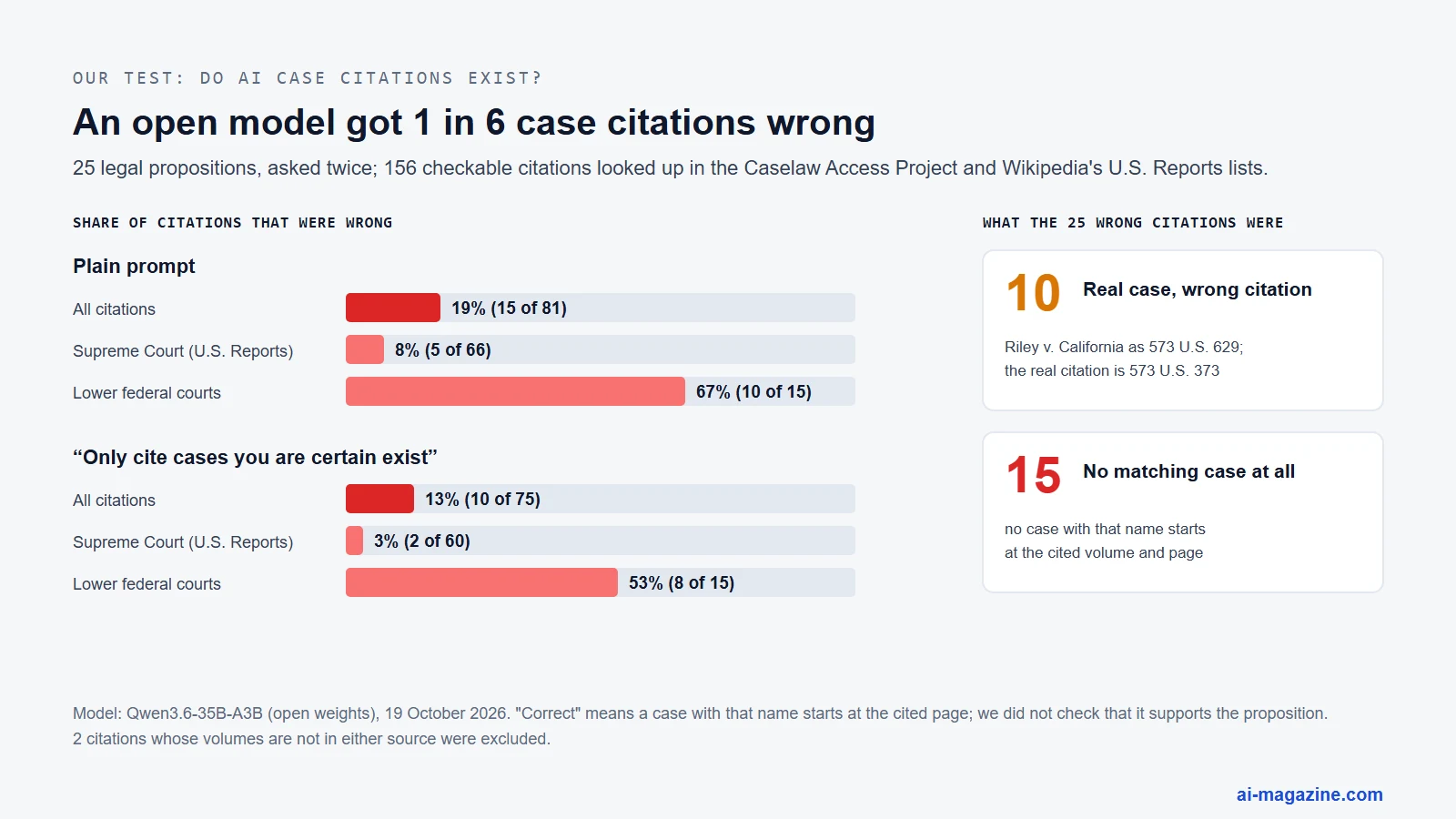
Court sanctions show what happens after a fake citation reaches a judge. We wanted to see how often a general-purpose model produces one in the first place. On 19 October 2026 we gave an open-weight model, Qwen3.6-35B-A3B, 25 well-known legal propositions, from “a police officer must warn a suspect in custody of the right to remain silent” to “courts should not defer to an agency’s interpretation of an ambiguous statute”, and asked it to cite three U.S. court decisions supporting each one with full reporter citations. We ran every question twice: once with a plain request, and once with an added instruction: “Only cite cases you are certain exist and say so if you are not sure. Never invent a case or a citation.”
We then looked up each of the 158 citations it produced. For Supreme Court cases up to volume 572 of the U.S. Reports and for the Federal Reporter and Federal Supplement we used the Harvard Law School Caselaw Access Project, which lists every case with the page it starts on; for newer Supreme Court volumes we used Wikipedia’s per-volume lists of U.S. Reports. We counted a citation as correct only if a case with the name the model gave starts on the cited page of the cited volume. Two citations, to volumes neither source covers, were left out, which leaves 156.
| Plain prompt | “Only cite cases you are certain exist” | |
|---|---|---|
| Citations checked | 81 | 75 |
| Wrong citations | 15 (19%) | 10 (13%) |
| Supreme Court citations wrong | 5 of 66 (8%) | 2 of 60 (3%) |
| Lower federal court citations wrong | 10 of 15 (67%) | 8 of 15 (53%) |
| Answers with at least one wrong citation | 8 of 25 | 5 of 25 |
Four things stood out.
Famous cases are mostly safe; everything below them is not. The model got Miranda, Brown v. Board of Education, Gideon, New York Times v. Sullivan and dozens of other landmark Supreme Court citations right. Its errors piled up as soon as it reached for appellate and district court decisions: more than half of those citations were wrong even with the cautious prompt. That is the pattern the court cases above show too: the fake authority is usually an obscure-sounding circuit decision, not a famous Supreme Court case a judge would recognize.
Many errors are near misses, which makes them harder to catch. Ten of the 25 wrong citations named a real case that does exist, with a wrong page or volume. Riley v. California came back as 573 U.S. 629 (it starts at 573 U.S. 373); AT&T Mobility v. Concepcion as 563 U.S. 331 instead of 333, in both runs; Bill Graham Archives v. Dorling Kindersley as 448 F.3d 115 instead of 605. A lawyer skimming the brief would recognize the case name and move on. The other 15 matched nothing at the cited volume and page; one answer cited the 2024 Loper Bright decision at “60 U.S. 598”, a volume from the 1850s.
Telling the model to be careful helped, but only a little. The cautious prompt cut the error rate from 19% to 13%, with fewer mistakes on both Supreme Court and lower-court citations. But in none of the 25 cautious answers did the model say it was unsure about a case. One answer opened its list with “I am certain these cases exist and their citations are accurate” and then gave the wrong page for Concepcion.
A correct citation is not the same as a correct answer. We only checked that each case exists at the cited place. We did not check whether each case actually supports the proposition it was cited for, which is the second way an AI-drafted brief can mislead a court.
Limits: one open-weight model of moderate size, 50 answers, U.S. federal law only, and an exact-page standard (a citation one page off counts as wrong, as it would in a brief). Commercial legal research tools retrieve from their own databases and should do much better than a general model answering from memory; the Stanford study above still found them wrong 17% to 33% of the time on its questions. Whatever the tool, the lesson is the one courts keep repeating: look up every citation before you file.
AI hallucinations in court
The era of trusting AI-generated citations is over. What began as isolated incidents has become a systemic risk that courts are now addressing with financial penalties and professional sanctions. The turning point arrived in Mata v. Avianca, where the Southern District of New York in June 2023 imposed a $5,000 Rule 11 sanction on two attorneys and their firm for a brief citing cases that ChatGPT had invented. Judge P. Kevin Castel found “conscious avoidance” and false statements, ordering the lawyers to notify the judges they had falsely named as authors of the fabricated decisions.
Since then the number has grown fast. As of 16 October 2026, Damien Charlotin’s AI Hallucination Cases database lists 2,199 court decisions worldwide. It held about 116 in May 2025, 979 in March 2026 and about 1,600 by early June 2026. The University of North Carolina Law Library counted 1,058 U.S. cases in early June 2026, noting that roughly 60% came from pro se litigants and 40% from attorneys. It is not only a problem for people representing themselves; large firms have been caught too.
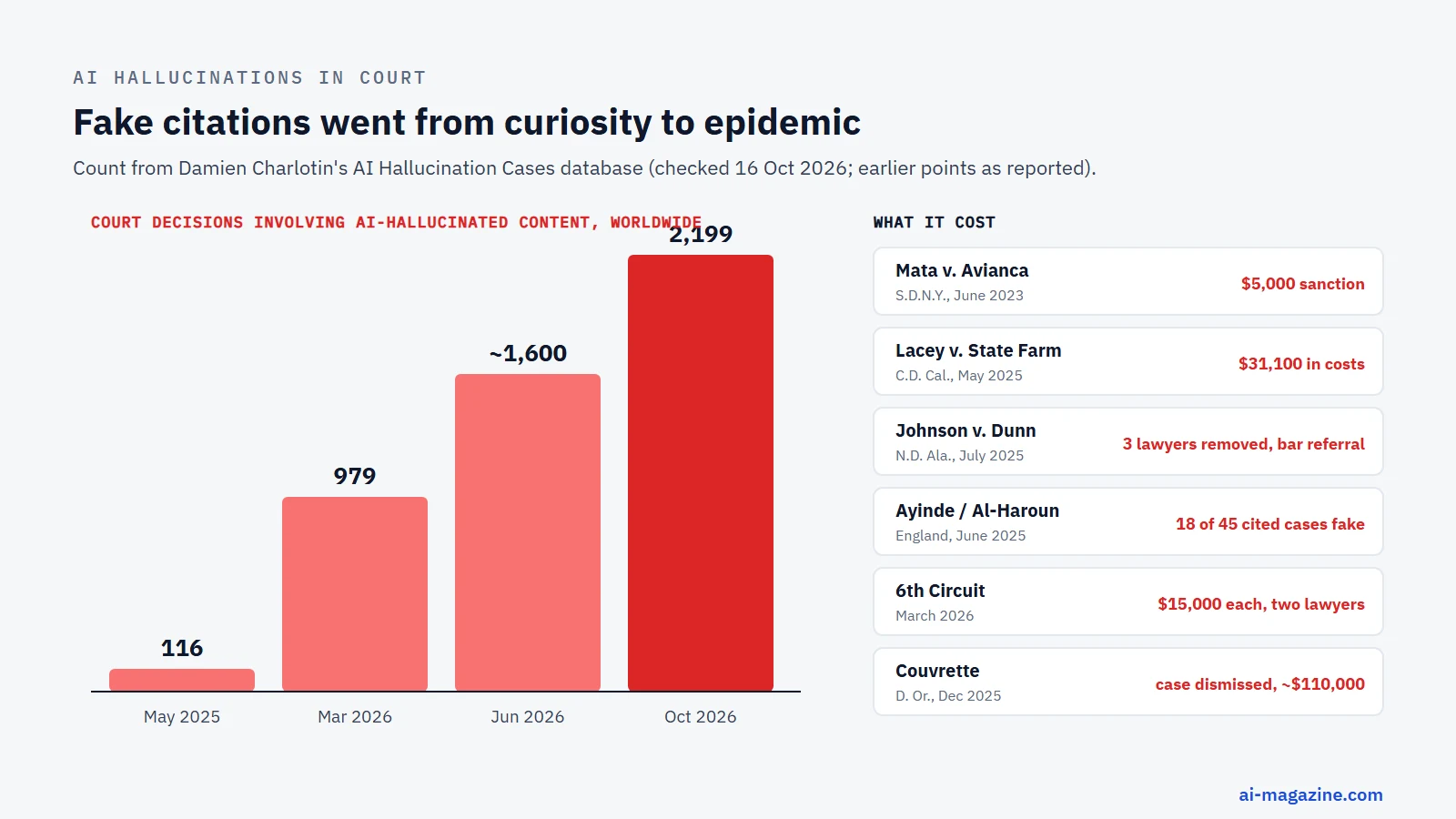
In Wadsworth v. Walmart (February 2025), the District of Wyoming sanctioned lawyers who cited eight nonexistent cases generated with Morgan & Morgan’s in-house tool, MX2.law. The attorney who drafted the motion was fined $3,000 and lost permission to appear in the case; two other lawyers, including local counsel, were fined $1,000 each. In Lacey v. State Farm (May 2025), a special master in the Central District of California, a retired magistrate judge, struck briefs in which about nine of 27 citations were wrong and at least two cases did not exist. The plaintiff’s law firms were ordered to pay the defense $31,100, and the discovery relief they sought was denied.
The risks extend to the United Kingdom as well. In Ayinde v Haringey and Al-Haroun v Qatar National Bank, the Divisional Court found that a barrister had cited five fake cases and another lawyer had cited 18 nonexistent cases out of 45. The court warned in June 2025 that deliberately placing false material before the court could lead to contempt proceedings or a police investigation. In the United States, Johnson v. Dunn saw three Butler Snow lawyers sanctioned for hallucinated citations despite having AI policies in place, resulting in their removal from the case and referral to the Alabama State Bar; the judge said fines alone had proved insufficient. In Couvrette v. Wisnovsky (December 2025), the District of Oregon dismissed the action with prejudice after 15 fake case citations and eight fabricated quotations; sanctions and fee awards reportedly came to about $110,000.
The Sixth Circuit has also acted decisively. In Whiting v. City of Athens (March 2026), it fined each of two attorneys $15,000 for more than two dozen fabricated or misrepresented citations; the opinion does not say whether AI produced them. Interestingly, judges are not immune to these errors. In October 2025, Senator Chuck Grassley wrote to judges Julien Neals and Henry Wingate after their opinions contained AI-generated errors. Judge Wingate said a law clerk had used Perplexity on a July 2025 order; the judge now requires a second independent review and printed copies of every cited case. Judge Neals said a law school intern had used ChatGPT without authorization; the opinion was withdrawn and those chambers now ban AI for drafting. The common thread is not one tool or one kind of lawyer: a large language model produces text that looks like a citation, and nobody checked it. We explain the mechanics in our guide to LLM hallucinations.
The rules: ethics and regulation
Regulatory frameworks are evolving to address these risks, though they vary significantly by jurisdiction. In the United States, the American Bar Association issued its first formal opinion on the topic on 29 July 2024. ABA Formal Opinion 512 establishes that lawyers must maintain competence by understanding the capabilities and limits of AI tools, though they do not need to be technical experts. On confidentiality, it says lawyers may need a client’s informed consent before entering client information into AI tools. The opinion also reinforces the duty of candor to the tribunal, mandating that lawyers verify AI output, supervise staff and tools, and bill only the time actually spent on the work.
State bars have followed suit with their own guidance. The California Board of Trustees adopted “Practical Guidance for the Use of Generative AI in the Practice of Law” on 16 November 2023, framing the guidance as principles rather than strict rules. Florida issued Ethics Opinion 24-1 on 19 January 2024, covering confidentiality, oversight, fees, and advertising. New York’s NYSBA AI Task Force report, approved on 6 April 2024, provides guidelines on disclosure to clients and continuing education.
Courts are also setting rules through standing orders. Judge Brantley Starr of the Northern District of Texas implemented a mandatory certification requiring lawyers to certify whether they used generative AI and whether a human checked the output. Filings without this certificate are struck. At the federal level, proposed Federal Rule of Evidence 707, which would govern machine-generated evidence, was published for public comment in 2025. After receiving 59 comments, the Advisory Committee did not recommend action at its May 2026 meeting, preferring to refine a “Version 2” draft.
Internationally, the UK Judicial AI guidance, updated on 31 October 2025, warns judges against putting private data into public tools and keeps them personally responsible for anything issued in their name. The EU AI Act classifies AI used by judicial authorities to assist in researching facts and interpreting law as high-risk under Annex III point 8. Those obligations were due to apply from 2 August 2026; a provisional Digital Omnibus deal in spring 2026 would move them to 2 December 2027. In China, the Supreme People’s Court issued “Opinions on Regulating and Strengthening the Applications of AI in the Judicial Field” on 9 December 2022, stating that AI serves only as a supplementary reference and may not replace judges.
AI in courts and access to justice
Courts are increasingly adopting AI to improve access to justice and streamline operations. The Arizona Supreme Court introduced AI avatars named “Daniel” and “Victoria” in March 2025. These avatars read scripts written by the justices to summarize rulings, making judicial decisions more publicly accessible. A video takes about 30 minutes to produce instead of hours, allowing the court to communicate more effectively with the public without generating or interpreting new legal content.
Regulatory sandboxes are also shaping the landscape. A Stanford study published on 2 June 2025 analyzed data from Utah and Arizona. Utah’s sandbox entities fell from 39 in 2022 to 11 by April 2025, failing to attract the hoped-for legal technologies. In contrast, Arizona’s alternative business structures (ABS) rose from 19 to 136, with a concentration in personal injury and mass tort cases. Consumers, rather than corporate clients, are the main beneficiaries of these reforms.
The boundary between legal advice and technology remains a point of contention. The DoNotPay FTC order, finalized on 11 February 2025, highlighted the risks of unregulated AI claiming to be a lawyer. The FTC required DoNotPay to pay $193,000 in monetary relief and banned it from claiming its service performs like a human lawyer without evidence. On the other end of the spectrum, Garfield.Law Ltd became the first purely AI-based firm authorized by the SRA in May 2025, handling small-claims debt recovery for SMEs. While the tool does not propose case law, named solicitors remain accountable for its output. These developments show that AI is reshaping how legal services are delivered, but human oversight remains essential to maintain professional standards.
The copyright cases shaping legal AI
Copyright litigation is determining the ownership of legal data and the fair use of training materials. In Thomson Reuters v. Ross Intelligence, the Third Circuit Court of Appeals affirmed on 29 September 2026 that Westlaw’s 2,243 headnotes are copyrightable. Writing for the panel, Judge Arianna Montgomery-Reeves said Ross’s use of these headnotes to train its non-generative search tool was not fair use, describing it as “minimally transformative, at best.” The case returns to the district court on remaining claims, and Ross says it will seek rehearing by the full court and then go to the Supreme Court.
In Bartz v. Anthropic, the Northern District of California approved a $1.5 billion class settlement in July 2026. Judge Araceli Martínez-Olguín granted final approval, awarding about $3,000 per work. Earlier, in June 2025, Judge William Alsup had found that training on books was fair use, but that keeping more than 7 million pirated books was not protected. Meanwhile, The New York Times v. OpenAI continues in the Southern District of New York. Cross-motions for summary judgment were filed on 4 September 2026, and the DOJ filed a brief supporting OpenAI. No trial date is set, but the core claims survived earlier motions to dismiss, keeping the pressure on AI developers to resolve licensing disputes. These cases will define how much legal data can be used freely and how much must be licensed.
What AI means for lawyers’ jobs and the billable hour
AI is changing the economics of legal work. Goldman Sachs estimated in March 2023 that about 1/4 of U.S. work tasks could be automated by AI, with exposure highest in administrative (46%) and legal (44%) work. Globally, about 300 million full-time jobs are exposed, potentially adding 7% to global GDP. In Thomson Reuters’ 2025 survey, AI users expected to save five hours a week within a year, which the company values at about $19,000 per professional, with a total potential value of $20 billion for the U.S. legal sector.
However, speed does not always equal quality. A randomized trial by Choi, Monahan, and Schwarcz published in the Minnesota Law Review in 2024 found that while GPT-4 increased speed significantly, it improved quality only “slightly and inconsistently,” primarily benefiting the lowest-skilled participants. This efficiency is putting pressure on the billable hour. CMS, for example, has said its firmwide AI rollout lets it reduce write-offs and offer more competitive prices to clients. With 79% of legal professionals using AI in some capacity according to Clio’s 2025 report, the traditional model of billing for time spent is evolving. Junior lawyers are getting more work done faster, but firms must ensure that the volume increase doesn’t come at the cost of thoroughness. The billable hour may remain, but the value proposition is shifting toward strategic oversight rather than mere hours logged.
How to use AI safely in legal work
To mitigate the risks of hallucinations and ethical breaches, lawyers should follow this checklist:
- Verify every citation in a primary database. Never rely on AI to confirm case law. Pull up every cited case in Westlaw, Lexis or a free source such as CourtListener, and read the passage you rely on, before filing. Our test above shows why: many wrong citations name real cases.
- Protect client confidentiality. Ensure client data is not used to train public models unless the tool’s privacy policy guarantees otherwise. Use anonymized data when possible.
- Understand the tool. Know the limitations of the AI you are using. Is it generative or search-based? Does it hallucinate frequently? Read the terms of service.
- Supervise. Maintain professional responsibility for AI output. Review AI-drafted documents thoroughly. The lawyer is ultimately accountable.
- Disclose where required. Follow court standing orders and ABA Formal Opinion 512 regarding disclosure to clients and tribunals. Certify AI use when mandated.
- Record usage. Document when and how AI was used in a matter. This helps in billing, discovery, and proving due diligence.
- Bill fairly. Charge only for time actually spent. Tool costs are generally overhead. Do not bill for time the AI spent “thinking.”
Frequently asked questions
How is AI used in law? AI is used for document review, legal research, contract analysis, and drafting. Tools like CoCounsel and Harvey allow lawyers to search vast databases and generate summaries quickly. It is also used for predictive analytics and automating routine tasks, though human oversight remains critical for accuracy.
Can AI replace lawyers? No. AI can perform specific tasks faster than humans, but it lacks judgment, creativity, and the ability to navigate complex ethical dilemmas. GPT-4 scored above the bar exam pass mark in one study, but rankings against real test-takers were lower, and models still invent authority. Lawyers provide strategic advice and advocacy that AI cannot replicate.
What is the best AI for lawyers? There is no single best tool. Research tools built on a legal database, such as CoCounsel on Westlaw, Lexis+ AI and Protégé, or Vincent AI on vLex, ground answers in real case law, while platforms such as Harvey and Legora focus on drafting, review and custom workflows. Independent tests such as the Vals reports are a better guide than marketing, and none of the tools tested was error-free.
Is it legal for lawyers to use ChatGPT? Yes. The ABA and state bars have confirmed that lawyers can use generative AI tools like ChatGPT. However, lawyers must ensure confidentiality, verify output, and supervise the work. Using AI does not absolve them of their professional responsibilities.
What happens if a lawyer submits fake AI citations? Lawyers can face sanctions, including fines, dismissal of cases, and referral to the bar association. In Mata v. Avianca, lawyers were fined $5,000 and had to notify the judges they had misled. In Couvrette, the case was dismissed with prejudice and the sanctions and fees reportedly came to about $110,000.
Is Harvey AI worth it? Harvey is used by large firms such as A&O Shearman, Ashurst and Slaughter and May, and says more than 100,000 lawyers use it. It does not publish prices, and independent evidence on return on investment is thin: Thomson Reuters found only 18% of organizations measure it. Whether it pays off depends on volume and how well the firm adapts its workflows.
Can I use AI as my lawyer? No. AI cannot appear in court or represent you. DoNotPay marketed a “robot lawyer” and was ordered by the FTC to stop claiming it performs like a human lawyer without evidence. Chatbots can help you understand a legal topic, but for anything that matters you still need a licensed lawyer.