AI Music Generators (2026): Best Tools, Free Plans, Who Owns the Song and the Lawsuits

An AI music generator is a tool that writes and produces a piece of music from a text description, and often writes and sings the lyrics too. You type something like “upbeat 80s synth-pop about a night drive, female vocals” and get a finished track with vocals, instruments and mixing in under a minute. The best-known AI song generators are Suno and Udio; Google, ElevenLabs, Stability AI and several smaller companies offer their own, and some good models are open source.
Making the song is now the easy part. What separates the tools in 2026 is what you are allowed to do with the result: whether you can download it, use it commercially, upload it to Spotify, and whether anyone owns it at all. Udio switched off downloads after settling with Universal Music, Suno capped downloads per month, and in the US a song made from a prompt alone is unlikely to be protected by copyright. This guide compares the main tools on price and rights, explains the lawsuits and covers how streaming services treat AI music. Prices and terms were checked on November 27, 2026; company figures are marked as such.
Best AI music generators compared
| Tool | Free plan | Cheapest paid plan | Commercial use | Vocals | Notes |
|---|---|---|---|---|---|
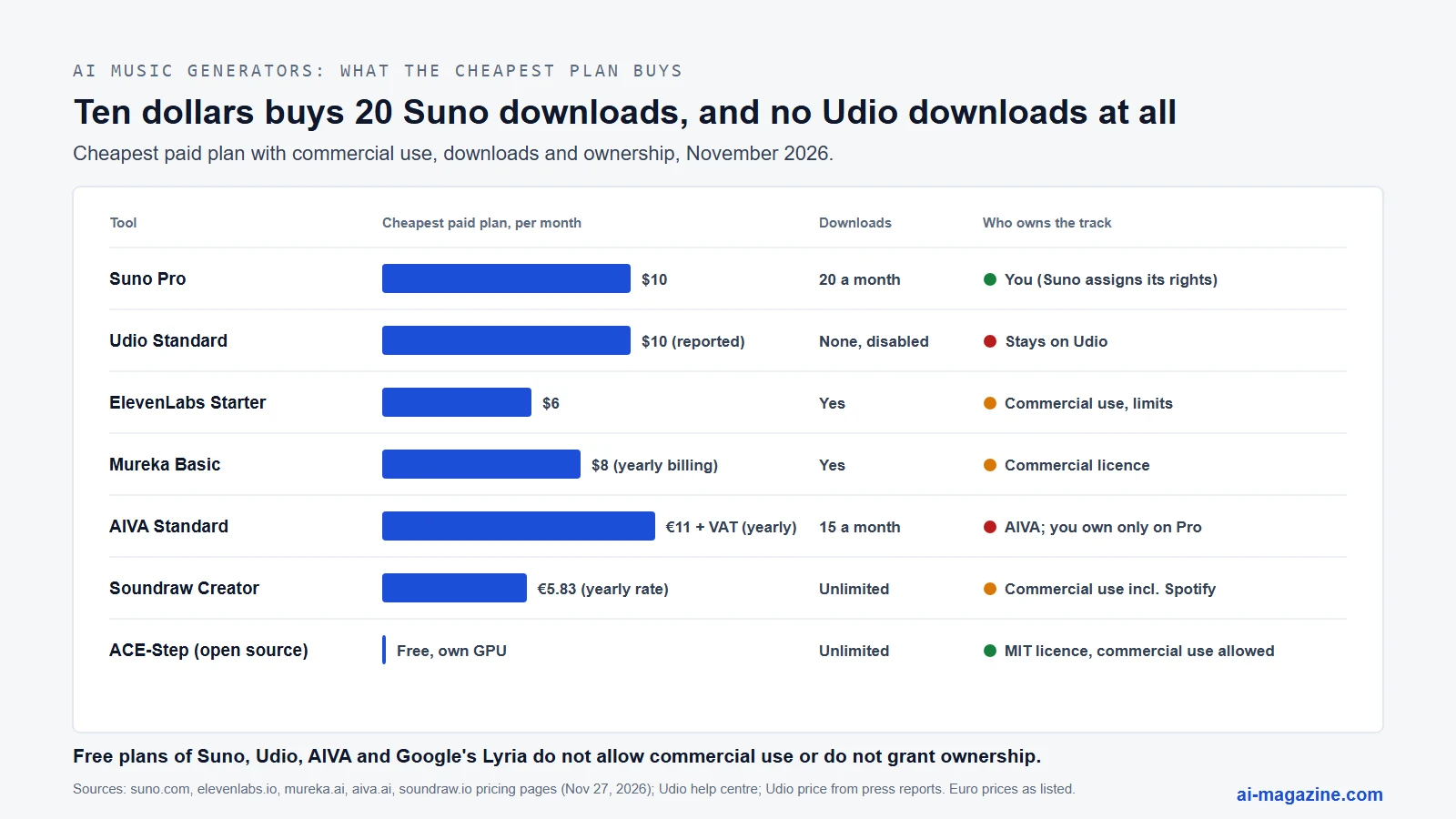
| Suno | 50 credits a day, no downloads | Pro, $10 a month (20 downloads) | Paid plans, downloaded songs only | Yes | Market leader; licensed v6 models since September 2026 |
| Udio | Yes | Standard, about $10 a month (reported) | No downloads since October 2025 | Yes | Tracks stay inside Udio while it moves to a licensed platform |
| ElevenLabs Eleven Music | 10,000 credits | Starter, $6 a month | From Starter; film, TV, radio and games need Enterprise | Yes | Launched with licences from Merlin and Kobalt |
| Google Lyria (Gemini app, Flow Music) | Lyria 3, 30-second tracks | Gemini subscription for 3-minute Lyria 3 Pro | No clear statement found | Yes | Every track carries a SynthID watermark |
| Mureka | Basic features | Basic, $8 a month billed yearly | Basic: commercial licence; Pro: full rights | Yes | Pro is $24 a month billed yearly |
| AIVA | 3 downloads a month, credit required | Standard, €11 a month + VAT billed yearly | Social platforms only on Standard; you own the copyright only on Pro (€33) | No | Instrumental and orchestral music |
| Soundraw | None listed | Creator, €5.83 a month | Yes, including Spotify and Apple Music | Not stated | Plans for companies under 10 employees |
| Beatoria | Free, no card | None | No; personal listening only | Yes, 20 languages | Built on the open-source ACE-Step model (disclosure below) |
| ACE-Step 1.5 (open source) | Free, runs on your own GPU | None | Yes, MIT licence | Yes | Songs from 10 seconds to 10 minutes |
Which one to pick:
- For full songs with vocals you want to release: Suno Pro or Premier. It has the most users, and paid plans assign Suno’s rights in the output to you, within the monthly download limit.
- For background music for videos and podcasts: Soundraw, ElevenLabs or AIVA, which are built around licensing for creators.
- To try AI music for free: Suno’s free plan, Google’s Gemini app (30-second tracks with Lyria 3) or Beatoria, all without paying. None of them allow commercial use of free tracks.
- For full control and no per-song fees: an open-source model such as ACE-Step on your own computer.
Free AI music generators: what you actually get
Almost every AI song generator has a free plan, but free plans are for trying the tool, not for publishing.
- Suno Free gives 50 credits a day on the lighter v6-mini model, with no song downloads and no commercial use.
- Udio lets free and paid users create, but downloads of audio, video and stems have been disabled for everyone since October 29, 2025.
- Google’s Gemini app makes 30-second tracks with Lyria 3; full 3-minute songs with Lyria 3 Pro started with paid subscribers. Google says Lyria 3.5, released September 4, 2026, is available to all users.
- ElevenLabs Free includes 10,000 credits. At about 900 credits per minute of music, that is roughly 11 minutes a month (our calculation), and commercial use is not listed for free users.
- AIVA Free allows 3 downloads a month of tracks up to 3 minutes, but AIVA keeps the copyright and you must credit it.
- Beatoria is free with no card; generating needs a free account, and listening to its catalog needs nothing.
- Open-source models are free without limits if you have a suitable graphics card. ACE-Step 1.5 says it runs locally with less than 4 GB of video memory.
The main tools
Suno
Suno is the largest AI music company. It raised over $400 million at a $5.4 billion valuation in June 2026 (company statement) and has more than 2 million paying subscribers, according to a September 2026 report. Its v6 models, launched on September 9, 2026, were developed with partners including Warner Music Group, BMG and Believe, and the older models were retired.
Plans: Free (50 credits a day), Pro at $10 a month with 20 downloads, Premier at $30 with 60 downloads, and Platinum at $120 with 120 downloads; yearly billing is cheaper. Since September 3, 2026, only songs downloaded within that monthly allowance can be used commercially, but they stay usable after you cancel. On paid plans Suno assigns its rights in the output to you, while its terms state that Suno makes “no representation” that any copyright will exist in it.
Udio
Udio was Suno’s main rival on sound quality. After settling with Universal Music in October 2025, it disabled downloads and kept songs inside its own service while it builds a licensed platform; it has since signed deals with Warner, the indie licensing body Merlin and the publisher Kobalt (press reports). As of the latest reports, the new platform had not launched. Udio is fine for making and sharing music inside the app, but not for anything you want to release.
ElevenLabs Eleven Music
ElevenLabs, known for AI voices, launched Eleven Music in August 2025 with licences from Merlin and Kobalt already in place. Commercial use starts with the $6 Starter plan, but self-serve plans exclude film, TV, radio and games, which need an Enterprise contract (per its terms, via reports). It is a safer choice for creators who need clear licensing more than the best-sounding vocals.
Google Lyria and Flow Music
Google’s Lyria models power music in the Gemini app, Google AI Studio, Vertex AI and YouTube tools. Lyria 3 (February 2026) makes 30-second tracks from text or images; Lyria 3 Pro (March 2026) makes songs up to 3 minutes; Lyria 3.5 (September 2026) is Google’s best-sounding version so far. Google bought ProducerAI, formerly Riffusion, in February 2026 and turned it into Flow Music (press reports). All Lyria 3 output is marked with Google’s invisible SynthID watermark.
Mureka, AIVA and Soundraw
Mureka is a song generator with vocals; its Basic plan ($8 a month billed yearly) includes a commercial licence, and Pro ($24) gives “full commercial rights” and up to 1,600 songs a month. AIVA makes instrumental, often orchestral, music; on its Free and Standard plans AIVA owns the copyright, and only Pro (€33 a month billed yearly) transfers it to you. Soundraw generates royalty-free background music and lets paying users distribute tracks to Spotify and Apple Music.
Stable Audio 2.5
Stability AI’s model generates tracks up to 3 minutes in under two seconds on a GPU, according to the company, which says it was “trained on a fully licensed dataset”. It is aimed at businesses making sound for ads, games and apps rather than at songs with vocals. ai-magazine.com covered the first Stable Audio release in 2023.
Beatoria
Beatoria is a free AI song generator and catalog. You describe a track in a sentence, choose the vocal language and length, and it writes the lyrics, sings them and produces the song. Vocals are available in 20 languages, including English, Spanish, Ukrainian, Arabic, Hindi, Chinese, Japanese and Korean. The catalog holds about ten thousand songs, browsable by genre, mood prompt and country: originals, and “covers” that reimagine well-known songs as new tracks with newly written lyrics. Tracks are generated with the open-source ACE-Step model.
Beatoria’s terms cover listening and personal use and do not include a commercial licence, so for YouTube videos, ads or releases use a paid plan from a tool that grants commercial rights.
Disclosure: Beatoria is a project of the team behind ai-magazine.com.
Open-source music models
Open models run on your own hardware, with no credits or download limits, but their licences differ:
- ACE-Step 1.5: MIT licence, commercial use allowed; songs from 10 seconds to 10 minutes, lyrics in over 50 languages.
- YuE: full songs with vocals; individuals may make money from the output, companies need a licence.
- MiniMax Music 3.0: weights released in August 2026, songs up to 5 minutes with vocals; reports disagree on whether the licence allows commercial use.
- Meta MusicGen (AudioCraft): instrumental; the weights are for non-commercial use only.
For running AI models locally in general, see how to run an LLM locally with Ollama and the GPU glossary entry. Most music models are diffusion or transformer models trained on large amounts of recorded music.
How to make a song with AI
- Describe the sound, not an artist. Genre, mood, tempo, era, instruments and vocal type work best: “slow acoustic folk, warm male vocals, fingerpicked guitar and cello, melancholy”. Many services block artist names, and they rarely help.
- Write or edit the lyrics yourself. Generated lyrics are often generic, and lyrics you wrote are the part of the song most likely to be protected by copyright. Lyrics length also controls song length in many tools.
- Generate several versions. The same prompt gives different songs each time; pick the best and extend or remix it.
- Edit outside the generator. Stems (separate vocal and instrument tracks), where offered, let you mix, cut and add your own parts in a music editor.
- Check the licence before publishing. Make sure the plan you used allows commercial use and that you downloaded the track within your allowance.
AI cover songs and voice cloning
“AI cover” usually means one of two things. A voice-conversion tool makes an existing recording sound as if another singer performed it; using a real singer’s voice this way without permission breaks most platforms’ rules, and Spotify allows vocal impersonation only with the artist’s authorisation. The other kind, such as Beatoria’s covers, takes a familiar song as inspiration and makes a new track with new lyrics. Even then, the melody and arrangement of the original song can still be protected, so covers are for personal listening unless you have a licence. Fake songs in a real artist’s voice are a form of deepfake.
Can you own and sell an AI-generated song?
- Copyright (US): the US Copyright Office concluded in January 2025 that prompts alone do not give enough human control to make the user the author. Human-written lyrics, melodies, and creative selection or editing can be protected. The courts agree that a human author is required: the Supreme Court declined in March 2026 to hear Thaler v. Perlmutter, leaving that rule in place.
- The service’s terms: these decide what you may do with the file. Suno assigns its rights to paying users but does not promise that copyright exists; AIVA keeps copyright unless you pay for Pro; Udio does not let you download at all.
- Releasing on Spotify and other services: most distributors accept AI music, but Spotify asks for AI disclosures in credits, Deezer tags fully AI tracks and keeps them out of recommendations, and Tidal will remove music made primarily with AI from December 9, 2026.
- Charts: AI songs can still enter US Billboard charts, with labels. Australia’s ARIA has required chart entries to be “substantially human made” since August 31, 2026, and major labels proposed in July 2026 that fully AI tracks be barred from charts.
Lawsuits and licensing deals
In June 2024 Universal, Sony and Warner sued Suno and Udio, accusing them of training on copyrighted recordings without permission. Two years later the picture is split: Warner and Universal settled and signed licences, while Sony and Universal are still in court with Suno, and Sony with Udio.
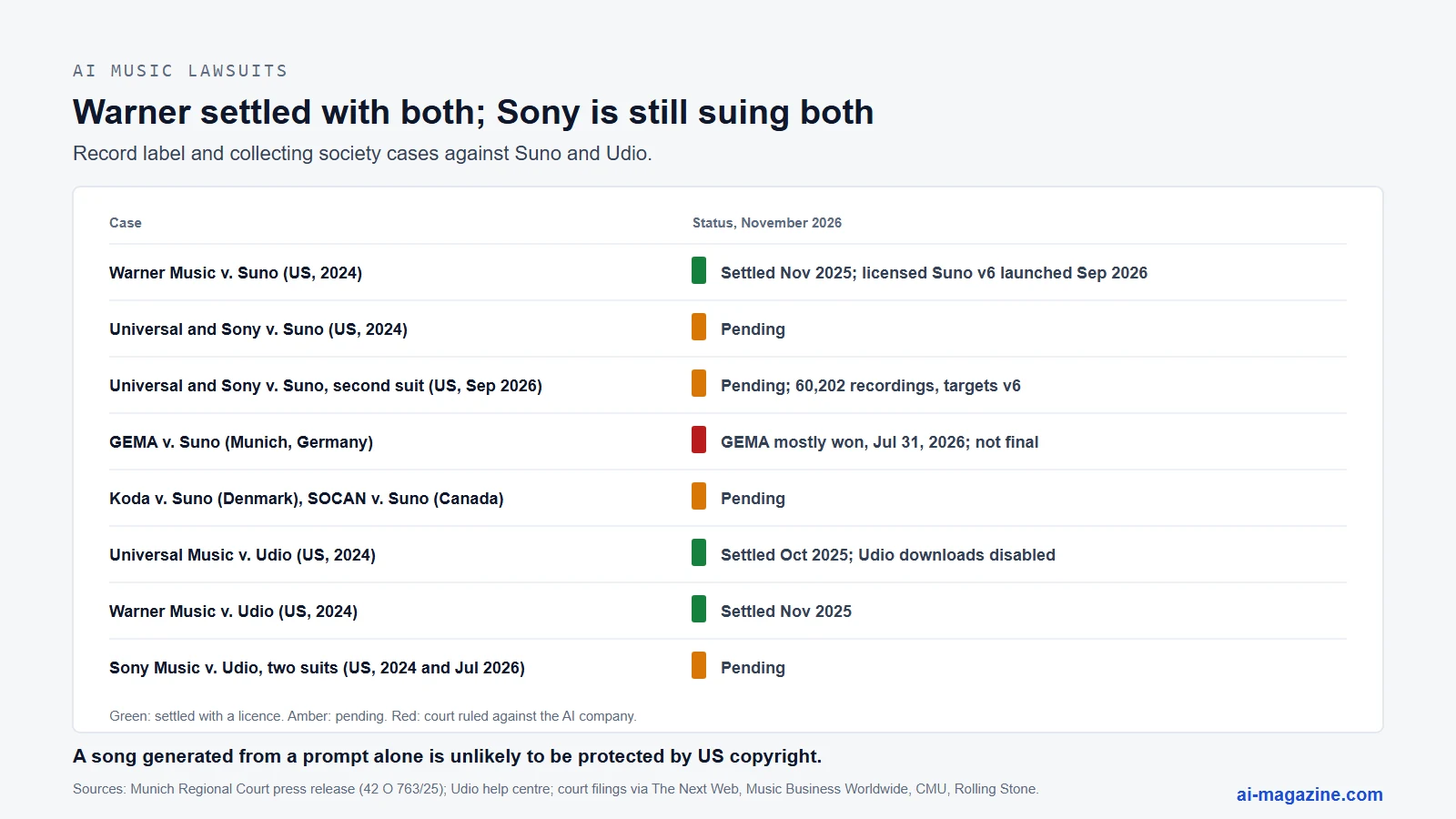
- Universal and Udio settled in October 2025; Udio got recording and publishing licences and must move to a platform trained on licensed music.
- Warner settled with Udio and then with Suno in November 2025. Suno agreed to launch licensed models in 2026 and limit downloads, which led to v6 and the download caps.
- Universal and Sony v. Suno continues. In September 2026, after a judge refused to add about 61,000 more recordings to the original case, the labels filed a second suit over 60,202 recordings, describing v6 as “the fruit of the same poisoned tree”. Suno says v6 was not trained on their recordings (press reports).
- Sony v. Udio continues, with a second suit filed in July 2026 over about 30,000 recordings (press reports).
- GEMA v. Suno: on July 31, 2026, the Munich Regional Court mostly upheld the German collecting society’s claims over six songs, including “Daddy Cool” and “Forever Young”. It found the songs were memorised in Suno’s models and that Suno, not its users, was liable. The ruling is not final. The same court ruled against OpenAI over song lyrics in November 2025.
- Koda (Denmark) and SOCAN (Canada) have also sued Suno; no rulings yet.
For the wider rules on AI and copyright, see AI regulation by country and the EU AI Act.
AI music on streaming services
More than half of all new tracks uploaded to Deezer were fully AI-generated at the June 2026 peak, about 90,000 a day, but they drew only 1 to 3% of streams, and Deezer found up to 85% of streams on fully AI tracks in 2025 to be fraudulent (company data from its own detector). In a Deezer and Ipsos survey of 9,000 people, 97% could not tell fully AI music from human-made music in a blind test.
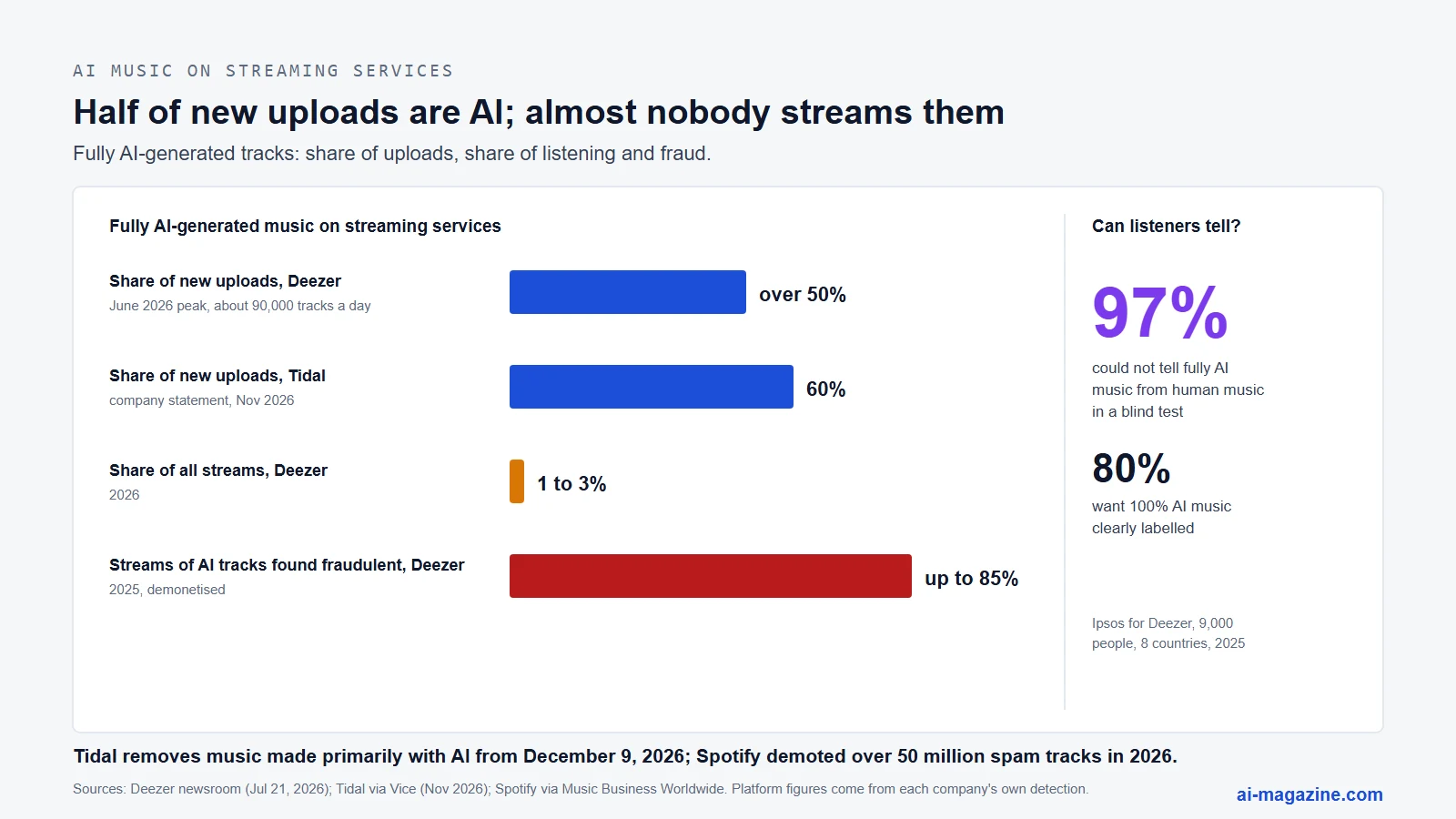
Platforms are responding by labelling and demoting rather than banning, with Tidal the exception: from December 9, 2026 it removes music made primarily with AI, saying 60% of its new uploads are AI-generated. Spotify said in October 2026 that it had kept over 50 million “slop and spam” tracks out of recommendations that year. The Velvet Sundown, a band revealed as AI-generated in 2025, passed a million monthly Spotify listeners, and the AI artist Xania Monet, created with Suno, signed a record deal reportedly worth up to $3 million. The month-by-month Deezer figures are in our article on AI slop.
Effect on musicians: a study commissioned by CISAC, the global body of authors’ societies, estimated in December 2024 that 24% of music creators’ revenues are at risk by 2028, about €4 billion a year.
Energy use: no AI music company publishes how much energy a song takes to generate. Academic tests of short text-to-audio clips show energy rising with the number of generation steps, and Stability says its model makes a 3-minute track in under two seconds on a GPU, which suggests a small cost per song compared with AI video (see what AI video costs).
FAQ
What is the best AI music generator? For complete songs with vocals, Suno is the most widely used and, on paid plans, lets you download and use songs commercially. ElevenLabs, Soundraw and AIVA are better for licensed background music, and ACE-Step is the strongest free open-source option.
Is there a free AI music generator? Yes. Suno, Udio, Google’s Gemini app, ElevenLabs, AIVA and Beatoria all have free options, and open-source models are free to run. Free plans do not allow commercial use, and Suno’s and Udio’s free plans do not allow downloads.
Can I use AI music on YouTube? Only if your plan grants commercial use: for example Suno Pro or Premier, ElevenLabs Starter and above, Soundraw, Mureka paid plans or AIVA Standard and Pro. Free-plan tracks are for personal use only.
Who owns a song made with AI? It depends on the service’s terms and on your own input. In the US, a song made from a prompt alone is unlikely to be protected by copyright; lyrics or music you wrote yourself can be. Suno assigns its rights to paying users but does not promise copyright exists.
Why can’t I download songs from Udio? Udio disabled downloads of audio, video and stems on October 29, 2025, as part of its settlement with Universal Music, while it moves to a licensed platform.
Can I upload AI songs to Spotify? Yes, through a distributor, if your plan allows commercial use. Spotify asks for AI disclosures, bans unauthorised voice impersonation and filters spam. Tidal will remove music made primarily with AI from December 9, 2026.
Is AI-generated music legal? Making and listening to it is legal. The legal disputes are about how the models were trained and about songs that copy existing works or imitate real singers.
Related
- AI slop: how much of the internet is AI-generated
- How much AI video generation costs
- AI regulation by country
- Glossary: generative AI and deepfake
Prices and terms checked November 27, 2026, on the companies’ own pages. Udio’s and Boomy’s pricing pages did not load, so Udio’s price comes from press reports and Boomy is not included. Several Music Business Worldwide, EDM.com and Washington Times pages were blocked and are cited through other reports. Company, platform and survey figures are marked as such.