AI Slop by the Numbers: How Much of the Internet Is Now Machine-Made

AI slop is low-quality content produced in bulk with generative AI and published mainly because it is cheap to make, not because anyone asked for it: filler articles, uncanny images, auto-generated music, narrated videos stitched from stock clips. In 2025 the word became official. Australia’s Macquarie Dictionary chose “AI slop” as its Word of the Year, Merriam-Webster chose “slop”, and in January 2026 the American Dialect Society chose “slop” as well.
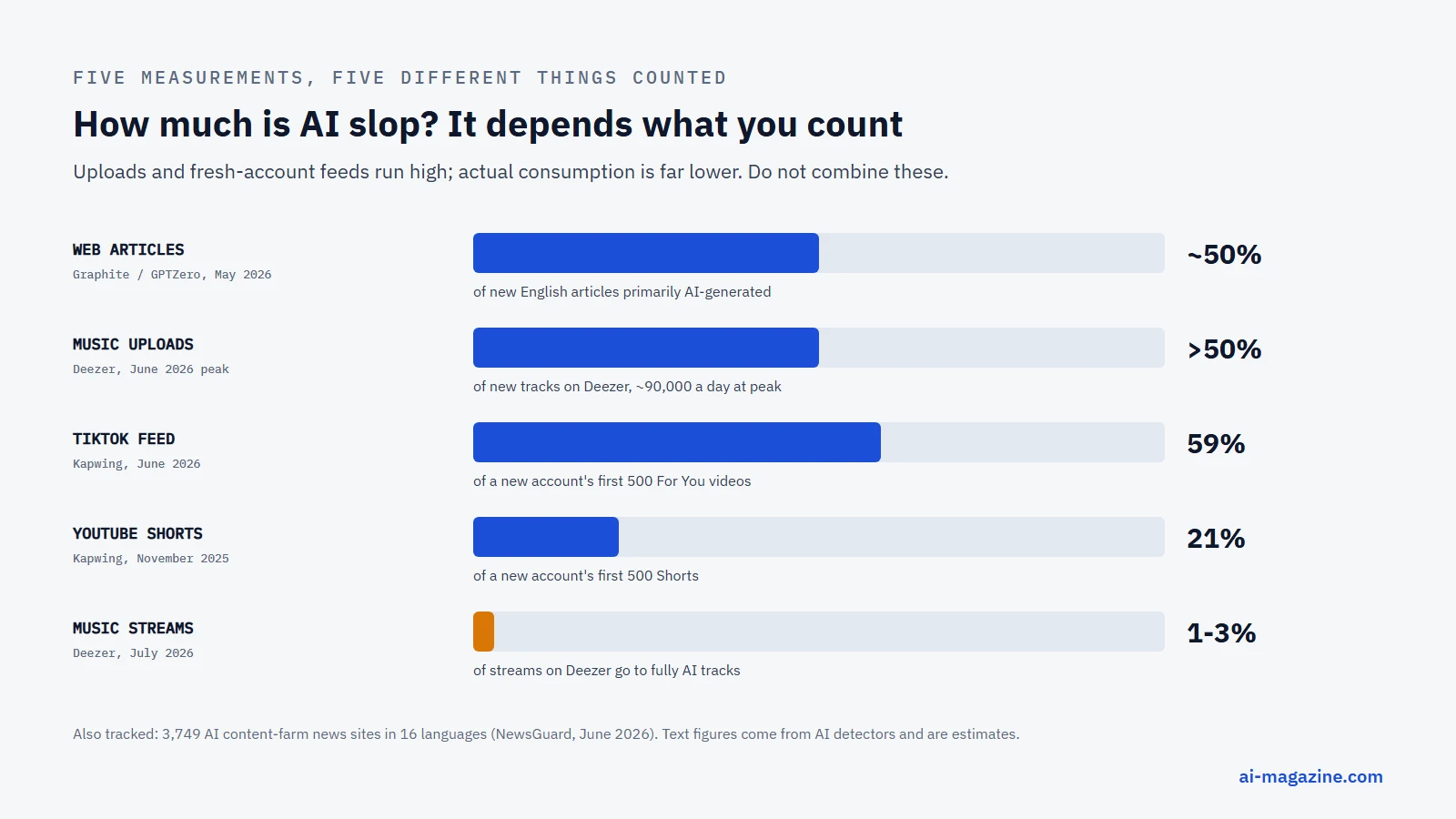
The word spread because people could see the change in their feeds. This guide collects the measurements that exist, platform by platform, and is precise about what each number counts, because “half the internet is AI” is not something any study has shown. The real picture is more specific, and in places more striking.
Where the word came from
The usage took off in May 2024, when developer Simon Willison wrote that “slop” was becoming the term for unwanted AI-generated content, crediting the idea to an X user called @deepfates. The comparison he drew was with spam: the way “spam” became the term for unwanted email, “slop” was becoming the term for unwanted AI output. He added that not all AI-generated content is slop, just as not all promotional content is spam.
The 2025 dictionary definitions settle the meaning:
- Macquarie Dictionary (24 November 2025): “low-quality content created by generative AI, often containing errors, and not requested by the user.” Both the committee and the public vote picked it.
- Merriam-Webster (15 December 2025): “digital content of low quality that is produced usually in quantity by means of artificial intelligence.”
- American Dialect Society (9 January 2026): “low-quality, high-quantity content, most typically produced by generative AI.”
Two ideas recur in all three: low quality and high volume. AI-assisted work that someone wanted and checked is not slop. The defining trait is mass production with no one accountable for the result.
The numbers, platform by platform
Music: Deezer’s upload counter
The longest consistent series comes from Deezer, which has run its own AI-music detector since January 2025 and publishes the share of new uploads it flags as fully AI-generated:
| Deezer report | AI tracks per day | Share of daily uploads |
|---|---|---|
| January 2025 | about 10,000 | about 10% |
| April 2025 | over 20,000 | 18% |
| September 2025 | over 30,000 | over 28% |
| November 2025 | about 50,000 | 34% |
| January 2026 | about 60,000 | 39% |
| April 2026 | about 75,000 | 44% |
| June 2026 (peak) | about 90,000 | over 50% |
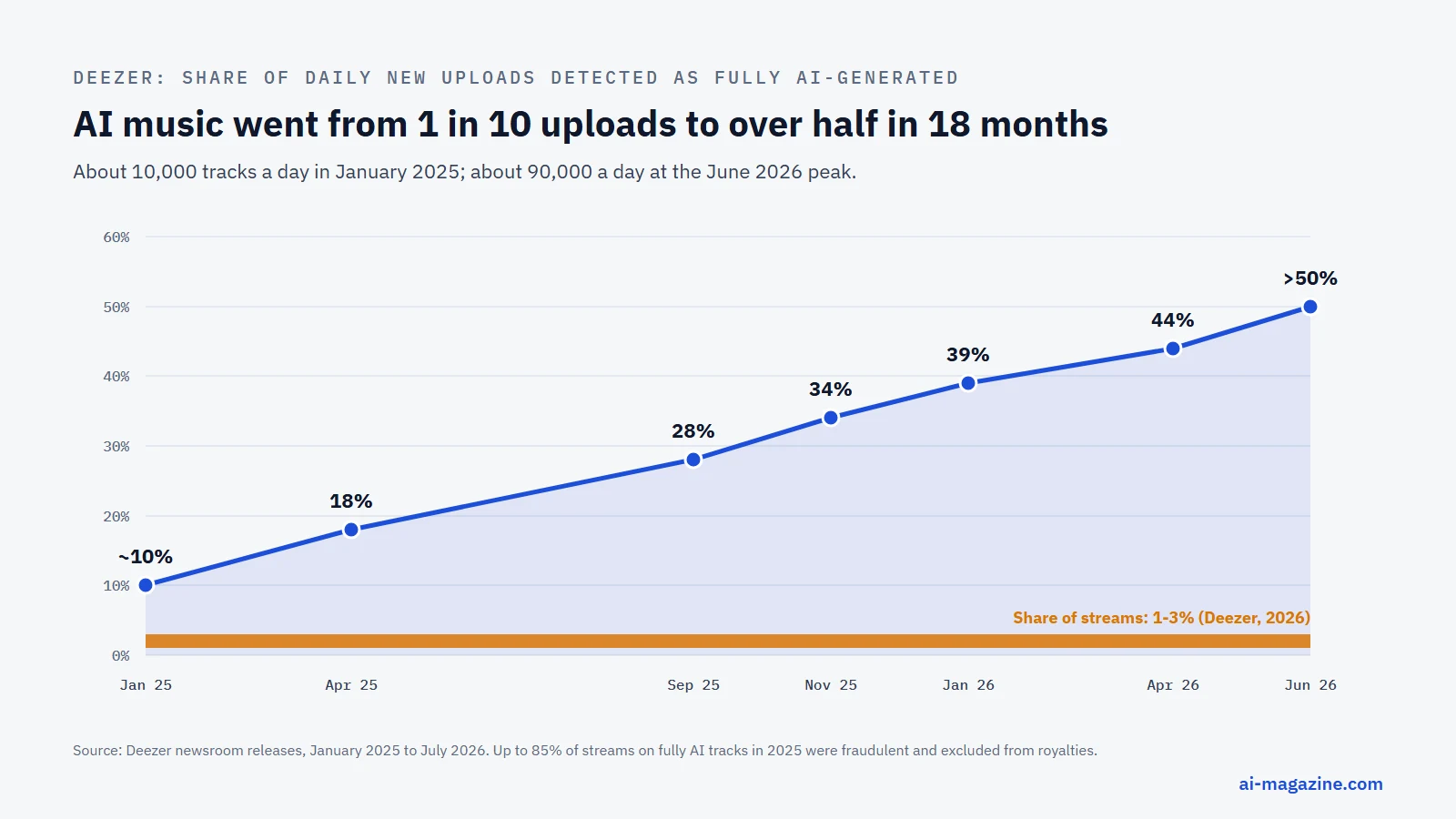
Deezer says it detected and tagged more than 13.4 million AI tracks in 2025. But uploads are not listening. In its July 2026 report, Deezer puts fully AI-generated music at “between 1-3%” of streams, and says that in 2025 “up to 85% of the streams generated by fully AI-generated tracks were in fact fraudulent”, meaning bots rather than listeners. Most of this music is not uploaded to be heard. It is uploaded to collect royalties from fake plays.
Spotify reported removing “over 75 million spammy tracks” in the twelve months to September 2025, and in August 2026 announced an “AI Persona” badge for AI-generated artist identities, which are excluded from editorial and algorithmic recommendations by default.
Video: what a new account sees
Video-editing company Kapwing measured what platforms serve to a brand-new account with no history:
- YouTube Shorts (report of 28 November 2025): 104 of the first 500 Shorts, or 21%, were AI slop, and 33% were what the report called “brainrot”. The most-viewed slop channel it identified, India’s Bandar Apna Dost, had 2.07 billion views and an estimated income of about $4.25 million a year, based on Social Blade data.
- TikTok (report of 9 June 2026): 294 of the first 500 “For You” videos, or 59%, were AI slop. By category the share was highest in kids’ content (57.4%), then science and education (35.0%), health (33.8%) and history (33.5%), and lowest in fashion (1.3%).
These are feed samples for a fresh account, not a share of all videos on either platform. They show what the recommendation system puts in front of a new user before it knows anything about them, which is when slop has the easiest path.
TikTok itself said in November 2025 that it had labeled “over 1.3 billion videos” as AI-generated. In his January 2026 annual letter, YouTube CEO Neal Mohan addressed “concerns about low-quality content, aka ‘AI slop’” directly and said the company was building on its existing systems to reduce it.
Text: the web, LinkedIn and books
- Web articles. SEO firm Graphite sampled English-language articles from Common Crawl and found that AI-generated articles overtook human-written ones in November 2024. A May 2026 follow-up, using three detectors (Pangram, GPTZero and Copyleaks), put the split at about 50/50, flat since early 2025. The same research found these AI articles “largely do not appear in Google and ChatGPT”, so the web is filling with text that search engines mostly ignore.
- LinkedIn. Originality.ai classified 81.2% of 5,000 long-form LinkedIn posts from July 2026 as “Likely AI”. LinkedIn launched a report option labeled “Seems like AI slop” the same month.
- News sites. NewsGuard’s tracker counted 3,749 “AI Content Farm” news and information sites in 16 languages as of June 2026, up from 3,006 in March 2026.
- Books. A July 2026 study by Chakrabarty and co-authors of 14,419 self-published genre-fiction books on Amazon found the number of books with sales grew 19.2 times between 2023 and 2026, while revenue grew only 8.9 times. Their conclusion: AI is reshaping the market “through scale rather than quality”. Amazon had already capped self-published uploads at three new titles per author per day in September 2023.
A caution on all text figures: they come from AI detectors, which estimate rather than prove. Graphite says its detectors kept false positive rates below 2% in testing. Detector numbers are best read as trends, not exact counts.
Images: the Facebook “Shrimp Jesus” era
The first serious study of image slop came before the word was common. In August 2024, Renée DiResta and Josh Goldstein published an analysis of 125 Facebook Pages that each posted at least 50 AI-generated images. One of those posts, in Q3 2023, drew 40 million views and more than 1.9 million interactions. The context they identified explains why: posts from accounts users do not follow grew from 8% of the Facebook feed in Q2 2021 to 24% in Q3 2023. Recommendation systems were actively pushing content from strangers, and AI images were a cheap way to win that slot.
Why slop pays
Slop is a business model, not an accident. It exists because three conditions now hold at once:
- Production cost is near zero. A track, an image, an article or a narrated Short costs seconds of compute.
- Platforms pay per view or stream. Ad revenue sharing, creator bonuses and royalties reward volume. 404 Media traced much of 2024’s Facebook image slop to creators in India, Vietnam and the Philippines paid through Facebook’s bonus program, with YouTube tutorials teaching the method.
- Recommendation systems deliver unconnected content. Feeds no longer depend only on whom you follow, so an unknown page can reach millions.
At the fraud end, the clearest case is Michael Smith of North Carolina. US prosecutors said he used hundreds of thousands of AI-generated songs and bot accounts to collect about $10 million in streaming royalties. He pleaded guilty to wire fraud conspiracy in March 2026, agreeing to forfeit more than $8 million, and was scheduled for sentencing on 6 October 2026.
How platforms are responding
| Platform | Measure | Date |
|---|---|---|
| Google Search | “Scaled content abuse” spam policy, covering many pages generated to manipulate rankings, including with generative AI. Google said the update cut low-quality, unoriginal results by 45%. | March–April 2024 |
| YouTube | Partner Program rules now exclude content that is “mass-produced, generic, repetitive, or manipulative” from monetization | July 2025 |
| Meta | Monetization cuts for accounts reposting unoriginal content; about 10 million impersonator profiles removed in the first half of 2025, as reported by Tubefilter | July 2025 |
| Spotify | Spam filter, AI disclosures in credits, ban on unauthorized voice clones; “AI Persona” badges with no default recommendations | September 2025; August 2026 |
| Deezer | AI tags on tracks, exclusion from recommendations, removal of fraud-linked AI tracks and of AI tracks unplayed for six months | June 2025; July 2026 |
| TikTok, Pinterest | Controls for users to see less AI-generated content | October–November 2025 |
| “Seems like AI slop” report option | July 2026 |
The pattern is consistent: platforms mostly do not ban AI content. They label it, cut its pay, and remove it from recommendations. That targets the economics, which is the reason slop exists in the first place.
The feedback loop: model collapse
Slop also has a technical cost for AI itself. In July 2024, Ilia Shumailov and co-authors showed in Nature that “indiscriminate use of model-generated content in training causes irreversible defects in the resulting models, in which tails of the original content distribution disappear”. They called the effect model collapse. Models trained repeatedly on the output of earlier models gradually lose rare information and drift into repetition. In one of the paper’s examples, text about church architecture had degenerated into lists of jackrabbits by the ninth generation.
The authors’ conclusion is the economic flip side of slop: as more of the web is generated, data about genuine human interaction becomes “increasingly valuable”. The same web that is half AI-written is the main source of training data for the next generation of models. For a related reliability problem, see our guide to LLM hallucinations.
What the numbers do not show
- No platform publishes its total share of AI content. Deezer’s upload figures are the closest, and they come from its own detector.
- Uploads, feeds and consumption are different things. Over half of new uploads on Deezer are AI, but they draw 1–3% of streams. A fresh TikTok feed is 59% slop, but that is not the share of all TikTok viewing.
- Detectors are estimates. Text measurements depend on classifiers with their own error rates, and the methods differ between studies.
- Not all AI content is slop. The definitions turn on low quality, volume and nobody asking for it, not on whether AI was used.
Frequently asked questions
What does AI slop mean?
Low-quality content made in bulk with generative AI, such as text, images, music or video, and published because it is cheap to produce, not because anyone wanted it. Macquarie Dictionary and Merriam-Webster both made it their 2025 Word of the Year (Merriam-Webster as “slop”).
Who coined the term AI slop?
No single person. Simon Willison’s May 2024 post popularized “slop” for unwanted AI content and credited the idea to the X user @deepfates. The word was already circulating online before that.
How much of the internet is AI-generated?
There is no single figure. Measured slices include about 50% of new English web articles (Graphite and GPTZero, May 2026), over 50% of new music uploads on Deezer at the June 2026 peak, and 59% of the first 500 videos shown to a new TikTok account (Kapwing, June 2026). Shares of what people actually consume are usually much lower.
Why is there so much AI slop on Facebook and YouTube?
It is cheap to produce, platforms pay creators by views or engagement, and recommendation feeds show content from accounts users do not follow. Research on 2024 Facebook image slop traced much of it to creators paid through Facebook’s bonus program.
What is model collapse?
The degradation that happens when AI models are trained on content produced by earlier AI models. A 2024 Nature study showed the effect causes models to lose rare information and become more repetitive over generations.
Are platforms banning AI-generated content?
Mostly not. Google, YouTube, Meta, Spotify, Deezer, TikTok and LinkedIn are labeling it, demonetizing mass-produced material and excluding it from recommendations, rather than banning AI use outright.
Related
- AI Porn in 2026: How Much Is Out There, Who Makes It, and What the Law Does, another measurement of what generative AI is filling the web with
- LLM Hallucinations: Why They Happen and How to Reduce Them
- AI in Design, on how professional designers use image generators and the copyright cases around them
- Best AI Model for Writing: Why Four Leaderboards Disagree, on measuring quality rather than volume
- Generative AI, deepfake and synthetic data in the glossary