AI in Real Estate (2026): Valuations, Virtual Staging, Agents, Rent Algorithms and the Rules

AI in real estate is the use of artificial intelligence to value homes, write and illustrate listings, match buyers with properties, screen tenants, set rents, approve mortgages, run buildings and catch fraud. Most of it is already routine: every home on Zillow or Redfin has an automated price estimate, almost half of US real estate agents use AI tools at least weekly, and about one main listing photo in ten on the big US portals has been digitally altered.
The rules are catching up unevenly. California has required disclosure of digitally altered listing photos since January 2026, the US Department of Justice made the rent-pricing company RealPage change how its software works, and several states have restricted rent-setting algorithms. At the same time, federal agencies withdrew their 2024 guidance on AI in tenant screening and lending. This guide covers each use, the measured results and failures, the rules as of November 2026 and the effect on energy use in buildings. Figures were checked on November 26, 2026; vendor and company figures are marked as such.
How AI is used in real estate
- Home valuation: automated valuation models (AVMs) such as the Zestimate estimate a home’s price from sales records and property data.
- Listings and marketing: AI writes listing descriptions and social posts, edits photos, adds virtual furniture and creates 3D tours.
- Search and matching: portals use AI search and chat, including Zillow’s app inside ChatGPT.
- Agents’ admin: emails, follow-ups, market summaries and document review.
- Tenant screening and rent pricing: scoring applicants and recommending rents for apartment buildings.
- Mortgages: automated underwriting, appraisal waivers based on AVMs, and fraud detection.
- Commercial property and buildings: lease analysis, portfolio analytics and AI control of heating, cooling and lighting.
- Fraud and security: detecting fake sellers and wire fraud, while criminals use deepfakes to commit it.
How many agents and firms use AI?
The National Association of Realtors’ 2026 technology survey, published in September 2026, found that 23% of Realtors use AI every day and 48% at least weekly. Among those who use it, 75% write listing descriptions with it, 56% social media posts and 52% emails and follow-ups. Asked about the effect on their business, 55% said it was positive and 11% negative, up from 4% negative a year earlier. ChatGPT is the main tool, followed by Gemini, Copilot and Claude. The survey had 1,165 responses, a 1.5% response rate.
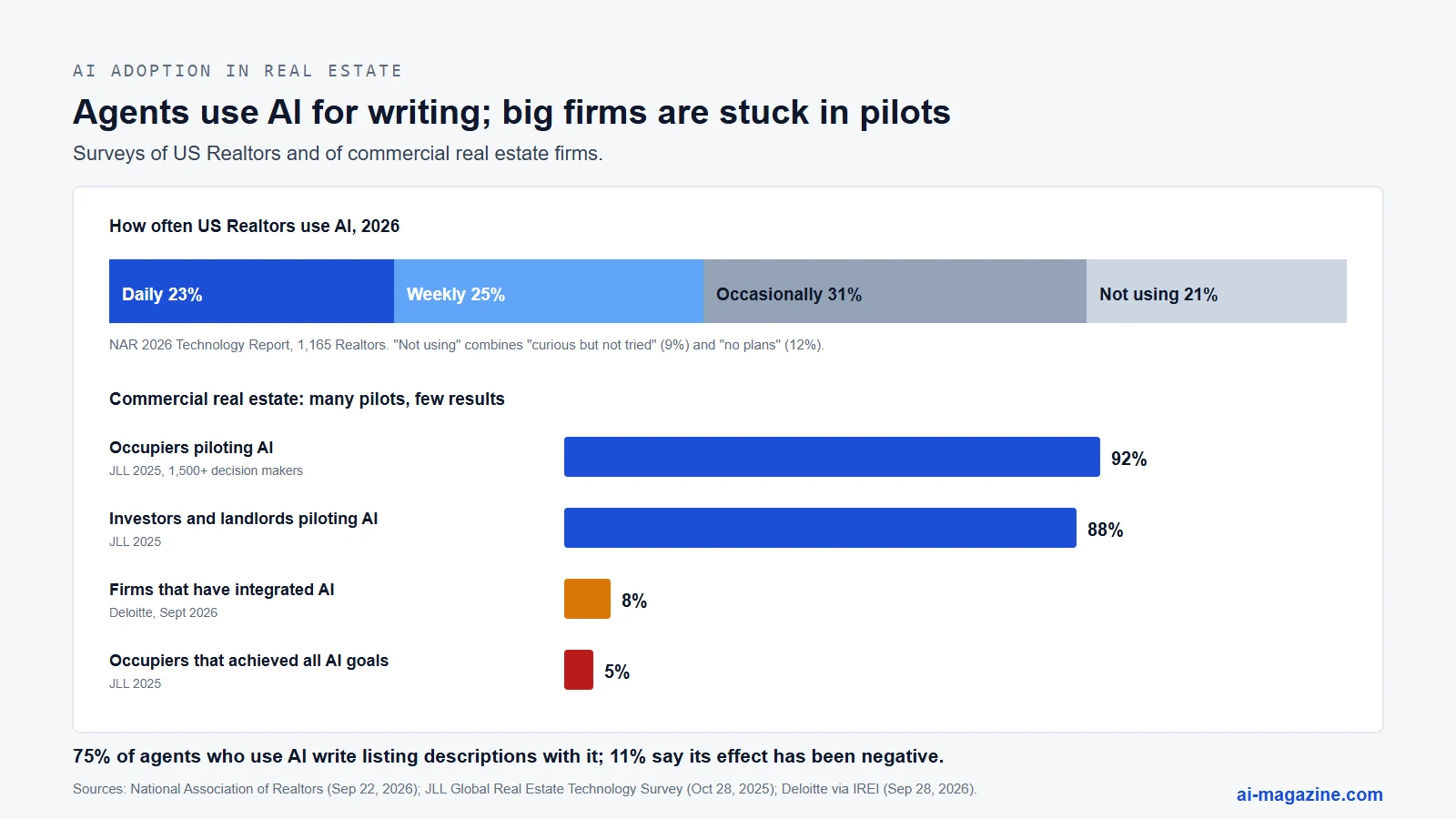
Commercial real estate is piloting far more than it is delivering. JLL’s 2025 survey of more than 1,500 senior decision makers found 88% of investors and landlords and 92% of occupiers had started AI pilots, up from under 5% in mid-2023, but only 5% of occupiers had achieved all their program goals. Deloitte’s survey for its 2027 outlook, reported in September 2026, found 92% of commercial real estate executives were still researching or piloting AI and only 8% had integrated it.
Automated home valuations: how accurate is the Zestimate?
Automated valuation models estimate a home’s value from past sales, tax records, property features and listing data. They are fast and free to consumers, and they are now used in mortgages: Fannie Mae and Freddie Mac accept a computer valuation instead of a full appraisal for some loans, and an interagency rule in force since October 1, 2025 requires lenders to have quality controls for the AVMs they use, including checks for discrimination.
The accuracy depends heavily on whether the home is for sale.
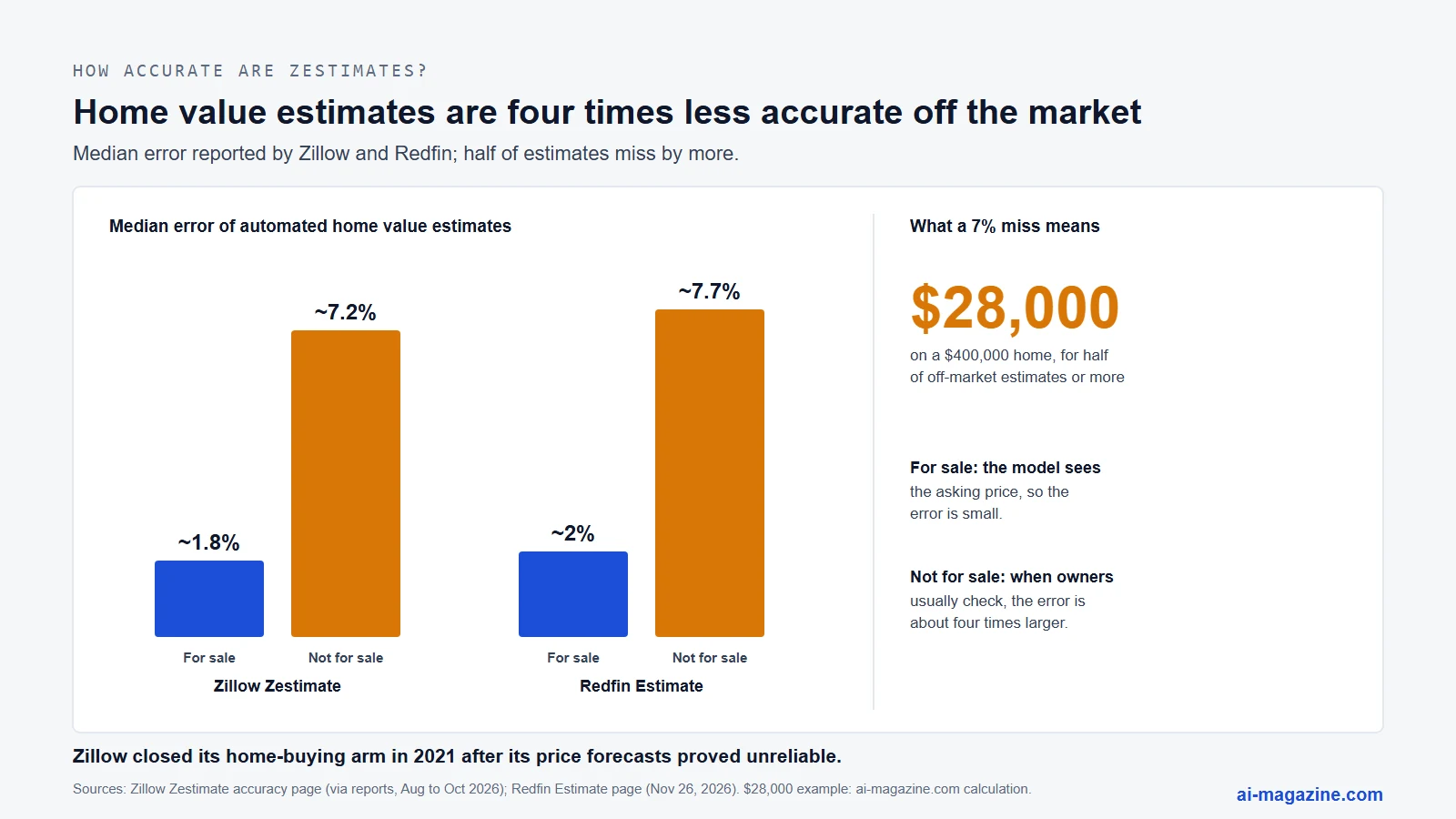
Zillow reports a median error of under 2% for homes listed for sale and about 7% for homes that are not; Redfin reports about 2% and 7.7%. Median means half of estimates are further off than that. Our reading: the low on-market error is mostly the model seeing the asking price. For a home that is not for sale, which is when owners usually check the estimate, a typical miss of 7% on a $400,000 house is about $28,000, and errors are larger in areas with few sales.
The clearest warning came from Zillow itself. In November 2021 it shut down Zillow Offers, which bought homes based on its own price forecasts, wrote down $304 million of inventory in one quarter, expected another $240 million to $265 million of losses and cut about a quarter of its staff. Its chief executive said “the unpredictability in forecasting home prices far exceeds what we anticipated.”
Human appraisals have their own problems. A 2021 Freddie Mac study of more than 12 million appraisals found that homes in majority-Black neighbourhoods were valued below the contract price 12.5% of the time, and in majority-Latino neighbourhoods 15.4%, against 7.4% in majority-white areas. AVMs can repeat such gaps if they learn from biased past sales, which is why the 2025 rule names nondiscrimination.
Virtual staging and AI-edited listing photos
Virtual staging means adding furniture and decor to photos of empty rooms with software, now usually AI. It is far cheaper than physical staging, which the NAR’s 2025 staging report put at a median of $1,500, and buyers respond to staged homes: 83% of buyers’ agents said staging helps buyers picture a property as their future home. Agents are less sure about virtual staging: 34% of sellers’ agents said it was less important than physical staging and 24% equally important.
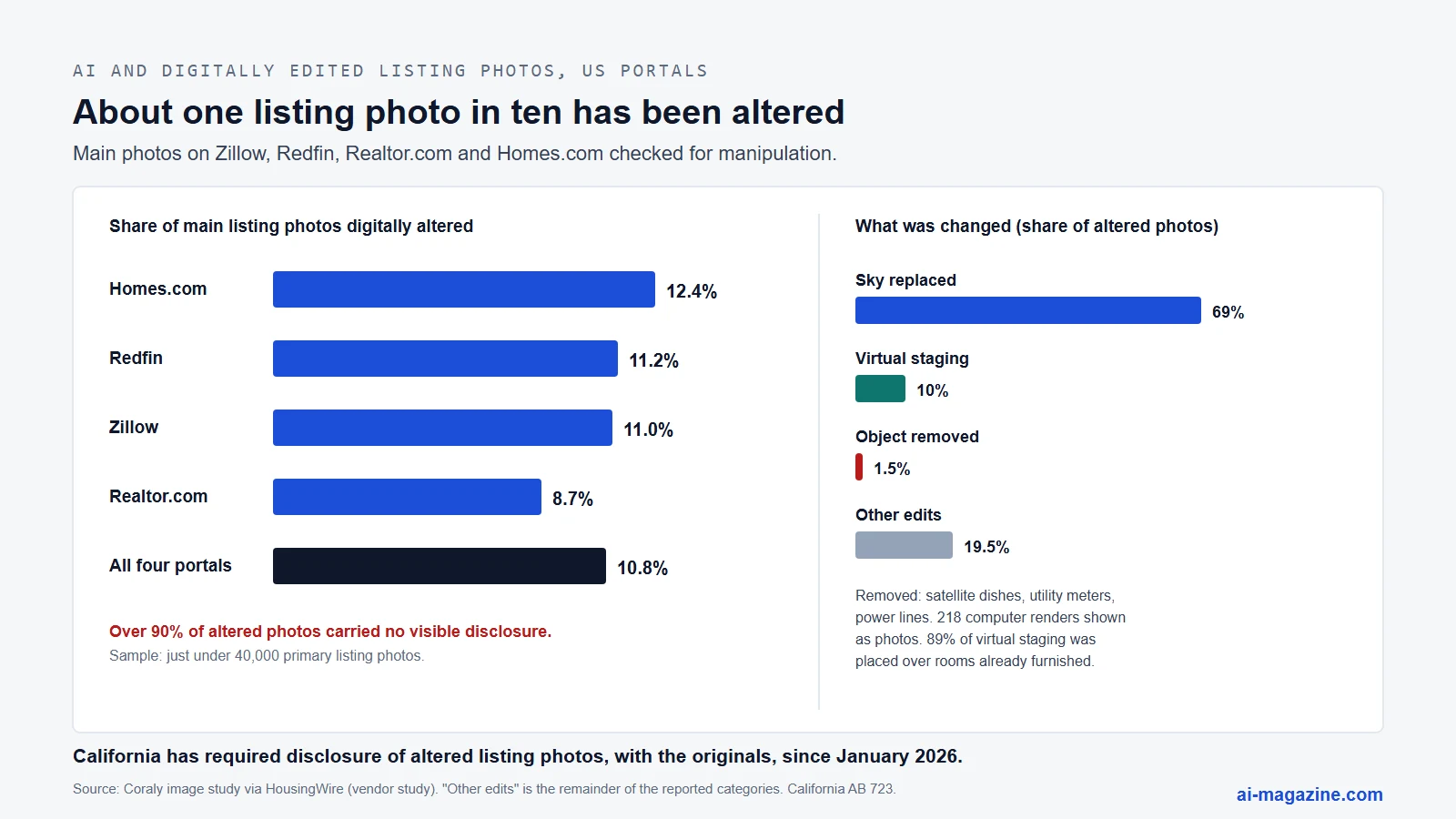
The problem is what else AI can change. A study of almost 40,000 main listing photos on Zillow, Redfin, Realtor.com and Homes.com by the image company Coraly, reported by HousingWire, found that 10.8% had been digitally altered and that more than 90% of the altered photos had no visible disclosure. Replacing a grey sky with a blue one made up 69% of alterations and virtual staging 10%; some edits removed satellite dishes, utility meters or power lines, and 218 images were computer renders presented as photos. This is a vendor study, but it is the largest count we found.
The rules:
- California AB 723, in force since January 1, 2026, requires agents to disclose digitally altered listing images, including virtual staging and changes to views or surroundings, and to give access to the unaltered originals. California’s largest listing service requires the original to sit next to the altered photo.
- The NAR Code of Ethics requires a “true picture” in advertising and bans concealing pertinent facts; it has no AI-specific rule. Listing services’ best-practice guides allow virtual furniture but not altering or hiding permanent features.
- New York City’s mayor announced a plan in July 2026 to require disclosure of AI-generated or altered rental listing photos.
Practical rule for sellers and agents: stage furniture, label it, show the original, and never remove or add anything a buyer would see on a visit, such as power lines, cracks, views or neighbouring buildings.
AI for real estate agents
Listing descriptions are the most common use, followed by social posts, emails and market summaries. In October 2025 Zillow became the first real estate app inside ChatGPT, letting US users search listings in conversation and hand off to Zillow for tours. The industry is consolidating around large platforms: Rocket bought Redfin in July 2025, and Compass completed its takeover of Anywhere in January 2026.
Several start-ups sell themselves as an “AI real estate agent”: licensed brokerages that automate most of the work and rebate part of the buyer’s commission. They have raised small seed rounds of $1.5 million to $6.4 million. They are helped by the August 2024 rule changes from the NAR’s $418 million commission settlement, which require written agreements with buyers before tours; an appeals court upheld the settlement in August 2026.
Fair housing risk. AI-written ads and chat answers can break the Fair Housing Act by mentioning protected characteristics or steering buyers. An MIT audit published in 2024 found GPT-4 steered minority home seekers toward lower-opportunity neighbourhoods. Zillow says it runs a fair housing classifier on its ChatGPT app. Agents remain responsible for what they publish, so every AI draft needs a human check; our guide to LLM hallucinations explains why chatbots also invent facts such as square footage or school districts.
Tenant screening and rent-pricing algorithms
Tenant screening. In Louis v. SafeRent Solutions, a federal court approved a settlement of about $2.3 million in November 2024 over claims that an AI screening score disadvantaged Black and Hispanic applicants using housing vouchers; SafeRent agreed not to give such scores for voucher holders for five years. The Department of Housing and Urban Development (HUD) issued guidance on AI in tenant screening and housing ads in May 2024, then withdrew it on September 17, 2025. The Fair Housing Act itself still applies.
Rent algorithms. RealPage’s software recommends rents to landlords using data from many buildings. The Department of Justice sued in August 2024, arguing that this let competing landlords align prices. Under a settlement filed in November 2025 and approved in May 2026, RealPage may train its models only on competitors’ non-public data that is at least 12 months old, may not model rents below state level, must remove features that limited price cuts, and is supervised by a monitor; it paid no money and admitted no wrongdoing. Landlords in a separate class action have agreed settlements totalling about $359 million.
States and cities have gone further:
| Jurisdiction | Rule | Status, November 2026 |
|---|---|---|
| New York State | Ban on algorithmic rent setting | In force since December 15, 2025; partly blocked by a federal judge in September 2026 on free speech grounds |
| California (AB 325) | Bans using a “common pricing algorithm” to coordinate prices | In force since January 1, 2026 |
| San Francisco, Seattle, Philadelphia, Jersey City and others | Local bans on rent-setting software | About a dozen cities |
Our guide to AI regulation covers the wider picture, and our AI in retail guide covers the similar fight over personalised prices in shops.
Mortgages and lending
Lenders use AI for underwriting, document checks and fraud detection. Fannie Mae and Freddie Mac accept automated valuations instead of appraisals for some loans: the waiver share fell from nearly half of loans at the 2021 peak to 16% in June 2025, and Fannie Mae says the program has saved borrowers $3 billion since 2018. In May 2025 Fannie Mae announced an AI fraud unit with Palantir. The Consumer Financial Protection Bureau withdrew its 2023 guidance on explaining AI-based credit denials in May 2025, but lenders must still give specific reasons when they turn applicants down. Our guide to AI in finance covers credit models in detail.
Deepfakes and real estate fraud
Real estate is a favourite target because a single wire transfer can be worth hundreds of thousands of dollars. The FBI’s Internet Crime Complaint Center recorded 12,368 real estate fraud complaints and more than $275 million in losses in 2025, up from 9,359 complaints and $173 million in 2024. In 2025 the FBI also counted AI-related complaints separately for the first time: 22,364, with about $893 million in losses across all sectors.
A 2026 survey of 245 title firms by the American Land Title Association found that 59% had seen at least one attempt by a fraudster posing as a property seller in 2025, up from 28% a year earlier, and 58% said image or voice deepfakes were at least somewhat common in these attempts. Vacant land is the main target because no owner lives there to notice. In one Florida case, a “seller” appeared on a video call as a looping AI video.
Warning signs: a seller who will only communicate remotely, wants a quick cash sale below market value, is selling vacant land or a rental they do not live in, or changes wiring instructions by email. Always confirm wiring details by phone with a number you found yourself.
Commercial real estate, data centers and buildings
The hottest commercial property in 2026 is the building that houses AI itself. CBRE reported in August 2026 that vacancy in North America’s main data center markets had fallen to a record 1.4%, with 7,481 megawatts under construction and 80% of it leased before completion; Atlanta overtook Northern Virginia for construction. Our guide to AI data centers covers their power and water demands. In offices and shops, firms such as JLL sell AI tools for lease analysis, portfolio data and building operations.
The environmental side: AI and building energy
Buildings are where AI could cut the most emissions in real estate. The UN Environment Programme’s 2025 global status report says buildings account for about 32% of the world’s energy use and 34% of its carbon dioxide emissions, and that the sector is not on track: operational emissions rose 5.4% against the previous baseline.
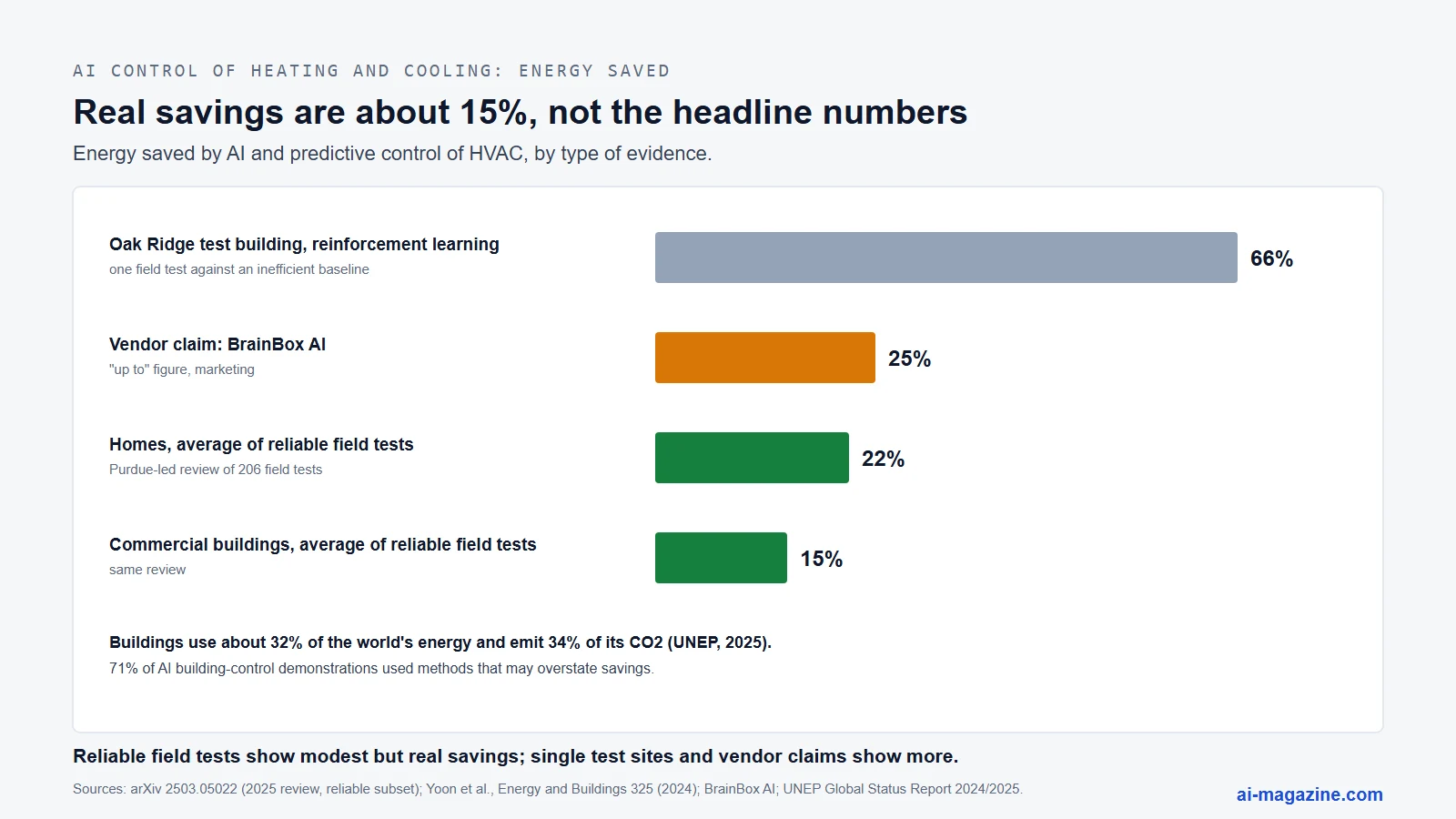
The evidence on AI control of heating, ventilation and air conditioning (HVAC) is promising but less dramatic than marketing suggests. A 2025 review led by Purdue University of 206 field tests of model predictive and reinforcement learning control found average energy savings of about 15% in commercial buildings and 22% in homes among the tests with reliable methods, and noted that 71% of demonstrations used methods that may overstate savings. A field test at Oak Ridge National Laboratory cut HVAC energy by 66% with reinforcement learning, but against an inefficient starting point. The vendor BrainBox AI, bought by Trane in 2024, advertises energy cuts of “up to 25%”.
Even 15% matters at this scale. The catch is that AI itself runs in data centers whose electricity use we measured in our AI water and energy guide; a building’s control model is tiny, but the generative AI tools agents use every day are not.
What has worked and what has not
| Working | Evidence | Failed or reversed | What happened |
|---|---|---|---|
| AVMs for listed homes | Median error about 2% | Zillow Offers home buying | Shut down 2021; $304m inventory write-down in one quarter |
| AI listing descriptions | 75% of AI-using agents use them | Undisclosed AI photos | 10.8% of listing photos altered, over 90% undisclosed; now illegal in California |
| AI HVAC control | About 15% average savings in commercial field tests | SafeRent AI screening score | $2.3m settlement; dropped for voucher holders |
| Appraisal waivers | $3bn saved for borrowers (Fannie Mae) | RealPage rent algorithm | DOJ settlement restricting data and features |
| AI fraud detection | Title firms catching more attempts | Deepfake seller fraud | 59% of title firms targeted in 2025 |
How to use AI in real estate safely
- Treat online estimates as a starting point. Check recent sales nearby and get an appraisal or agent opinion for any real decision.
- Disclose every AI-edited photo and keep the original next to it, whatever your state requires.
- Check AI-written listings for wrong facts and for language about who “suits” a home.
- Do not let software set rents or reject tenants on its own. Keep a person responsible and know what data the tool uses.
- Verify every seller and every wire instruction by phone or in person, especially for vacant land.
- For buildings, measure against a baseline before trusting an AI energy saving claim.
Frequently asked questions
How is AI used in real estate? For home value estimates, listing descriptions and photo editing, virtual staging, property search, agents’ emails and admin, tenant screening, rent pricing, mortgage underwriting, fraud detection and building energy control.
How accurate is the Zestimate? Zillow reports a median error of under 2% for homes listed for sale and about 7% for homes off the market. Half of estimates miss by more than that, and errors are larger where few homes sell.
Is virtual staging legal? Yes, but it must not mislead. California has required disclosure of digitally altered listing photos, with access to the originals, since January 2026. Elsewhere, the NAR Code of Ethics and listing service rules require photos to give a true picture of the property.
Will AI replace real estate agents? Not so far. AI handles writing and admin, and some start-ups use it to cut commissions, but buyers and sellers still rely on agents for pricing, negotiation and local knowledge. Only 23% of Realtors use AI daily.
Is AI rent pricing legal? Software that recommends rents is legal in most places, but coordinating prices with competitors is not. RealPage settled with the Justice Department in 2025, and New York, California and about a dozen cities restrict rent-setting algorithms.
Can AI be used to screen tenants? Yes, but screening must comply with the Fair Housing Act. A tenant-screening firm paid about $2.3 million in 2024 to settle claims its AI score discriminated against voucher holders.
How does AI help buildings save energy? By adjusting heating, cooling and ventilation to forecasts of occupancy and weather. Reliable field tests show average savings of about 15% in commercial buildings.
Related
- AI data centers
- AI in finance and banking
- AI regulation by country
- AI in retail
- Glossary: deepfake and NeRF, the technique behind some 3D tours
Figures checked November 26, 2026. Zillow’s accuracy page, an Inman report on the NAR survey, the UNEP report summary and several court reports (Law360, MLex) could not be accessed directly, so their figures come from reports quoting them. Company, vendor and survey figures are marked as such.