AI glossary
Agentic AI
Agentic AI is AI that pursues a goal with limited human supervision: instead of answering one prompt, it plans steps, uses tools and other software, checks the results and keeps going until the job is done or it needs a person. It is the step from generative AI that writes things to AI that does things. Everyone is talking about it because Gartner named it the number one strategic technology trend for 2025, predicting that by 2028, at least 15% of day-to-day work decisions will be made autonomously through these systems. Yet there is an honest caveat: there is no universally agreed-upon definition. The industry is seeing a surge in “agent washing,” where vendors rebrand existing chatbots and robotic process automation tools as agentic to capture market interest. This guide explains what the term means and where it came from, how agentic AI differs from generative AI, AI agents and automation, the four design patterns behind it (with a test we ran ourselves), the levels of autonomy, adoption in numbers and real company examples, agentic commerce, the emerging rules, and the case for caution. For how a single agent works inside and how to build one, see our AI agents guide.
What is agentic AI?
The term “agentic AI” lacks a single, universally accepted definition, but industry leaders provide clear boundaries for what it entails. IBM defines it as an AI system that accomplishes a specific goal with limited supervision, built from individual AI agents coordinated by an orchestration layer. AWS describes it as an autonomous system that acts independently to achieve pre-determined goals, contrasting it with traditional software that follows fixed rules or AI that requires step-by-step prompting. Microsoft frames it as systems with agency—the ability to make decisions and take actions independently in pursuit of a goal through a perceive-reason-act-reflect loop. OpenAI’s December 2023 paper on governing these systems notes they can pursue complex goals with limited direct supervision, treating “agenticness” as a matter of degree rather than a binary switch.
Despite these variations, the definitions share common DNA. They all emphasize a goal-oriented approach, limited human supervision, the use of external tools or data sources, and a continuous loop of action and reflection. MIT Sloan’s Sinan Aral distinguishes agentic AI as systems where multiple agents orchestrate a task together. In a cancer adverse-event project cited by MIT, about 80% of the work was data engineering, stakeholder alignment, governance, and workflow integration rather than prompting or fine-tuning, highlighting that the infrastructure matters as much as the model itself. A September 2026 review by Lassiter and Bent identified five dimensions of this agenticness: environmental interaction, learning and adaptation, autonomy, goal-directed behavior, and temporal coherence.
The word itself has deep roots. “Agency” comes from the Latin agere, meaning “to set in motion, do, perform.” Psychologist Albert Bandura’s 2001 paper on social cognitive theory described human agency through intentionality, forethought, self-reactiveness, and self-reflectiveness. Some researchers argue that “agentic AI” is simply a relabeling of decades-old research into intelligent agents and multi-agent systems. However, the shift in terminology reflects a practical evolution: these systems are no longer just passive responders but active participants in workflows.
Agentic AI vs generative AI, AI agents and automation
Agentic AI vs generative AI
The distinction between agentic AI and generative AI is often blurred in marketing, but their functions differ fundamentally. IBM notes that generative AI focuses on creating new content based on an input, generally responding to a prompt and waiting for further direction. In contrast, agentic AI focuses on achieving a goal, operating with varying levels of autonomy to interact with tools, data sources, and other systems. Generative AI is a capability; agentic AI is a workflow.
Generative models such as large language models are the brains; agentic systems give them hands. They take the generated text or data and use it to perform actions, such as sending an email, updating a database, or executing a code script. This shift from content creation to action execution is what drives the predicted surge in adoption. Gartner predicts that by 2029, agentic AI will autonomously resolve 80% of common customer service issues without human help, cutting operational costs by 30%. The point is not better emails but closed loops: the request is resolved, not just answered.
Agentic AI vs AI agents
While often used interchangeably, “AI agent” and “agentic AI” represent different scopes. Sapkota, Roumeliotis, and Karkee define AI agents as modular systems for task-specific automation, such as customer support or scheduling. Agentic AI, by contrast, is a paradigm shift marked by multi-agent collaboration, dynamic task decomposition, persistent memory, and coordinated autonomy. Where an agent might handle one specific job, an agentic system orchestrates multiple agents to solve a complex, multi-step problem like research automation or robotic coordination.
This distinction matters for architecture. An agent is a component; agentic AI is the ecosystem. The former is a tool for a task; the latter is a strategy for execution. Understanding this difference helps businesses decide whether they need a single assistant or a coordinated team of digital workers.
Agentic AI vs RPA and traditional automation
Robotic process automation (RPA) has long been the standard for digitizing repetitive tasks. UiPath describes RPA robots as deterministic systems that follow structured logic and fixed rules. Agents, however, use a probabilistic approach to make decisions based on patterns and real-time data. This makes agentic AI more flexible but also less predictable than traditional RPA.
Gartner warned in June 2025 about “agent washing,” where vendors rebrand assistants and RPA tools as agentic. They noted that only about 130 of the thousands of vendors claiming agentic AI are real. Forrester added that fewer than 15% of firms will turn on agentic features in their automation suites in 2026, preferring deterministic automation for ROI and governance reasons. The choice isn’t always about sophistication; it’s about stability. Deterministic automation is reliable for known processes; agentic AI is powerful for unstructured, dynamic environments.
| Generative AI | AI agent | Agentic AI system | RPA | |
|---|---|---|---|---|
| Main job | Create content/data | Execute a specific task | Achieve a complex goal | Follow fixed rules |
| Who decides the steps | The user, prompt by prompt | The model, within one task | The system, across several agents and tasks | The developer, in advance |
| Typical output | Text, image, code | Action completion | Multi-step workflow result | Structured data entry |
| Example (generic) | Writing a blog post | Sending a calendar invite | Researching and booking a trip | Processing an invoice |
| Main risk | Wrong or invented content | Wrong action on one task | Errors compounding across agents, cost | Breaks when the input changes |
The four agentic design patterns
In his newsletter The Batch on 20 March 2024, Andrew Ng outlined four agentic design patterns that explain how these systems achieve high performance. He highlighted that on the HumanEval coding benchmark, GPT-3.5 zero-shot scored 48.1% and GPT-4 zero-shot 67.0%. However, GPT-3.5 wrapped in an agent loop reached up to 95.1%. The workflow mattered more than the model upgrade. This principle underpins the four key patterns:
Reflection
Reflection is the process where the model critiques and improves its own output before finalizing it. Instead of generating a single answer and moving on, the system reviews its work, identifies errors or gaps, and iterates. This pattern is crucial for accuracy in complex tasks. For example, a writing agent drafts a summary, then checks it against the source for missing points before handing it over. Reflection is most useful when it is combined with something external to check against, such as test results, which is exactly what our own test below found.
Tool use
Tool use allows the AI to interact with the external world. Rather than relying solely on its training data, the agent can search the web, execute code, query databases, or control software applications. This pattern transforms the AI from a knowledge repository into an active worker. A generic example is an agent that needs to find the latest flight prices. It doesn’t just guess; it uses a browsing tool to scrape real-time data from airline websites, then processes that data to recommend the best option. This bridges the gap between static knowledge and dynamic reality.
Planning
Planning involves breaking a high-level goal into a sequence of manageable steps. The agent creates a roadmap, executes the steps, and adjusts the plan if something goes wrong. This is essential for multi-step tasks that require coordination. For instance, an agent tasked with organizing a conference might first check venue availability, then book catering, then send invitations, and finally track RSVPs. Each step depends on the completion of the previous one. Planning allows the system to handle complexity by decomposing it into manageable units, ensuring that no critical detail is missed in the pursuit of the final goal.
Multi-agent collaboration
Multi-agent collaboration involves several agents with different roles working together to solve a problem. One agent might specialize in research, another in data analysis, and a third in writing. They communicate and coordinate to achieve a shared objective. This pattern mirrors human teams, where specialists collaborate to produce a higher-quality result than any individual could alone. A generic example is a medical diagnostic system where one agent reviews patient history, another analyzes lab results, and a third drafts the report, all working in concert to provide a comprehensive diagnosis. This approach scales complexity and improves robustness by distributing the cognitive load.
These four patterns are not mutually exclusive. A single agentic system often combines reflection, tool use, planning, and multi-agent collaboration to deliver superior results. Understanding these patterns helps developers and managers design systems that are not just smart, but effective. For the anatomy of a single agent (model, tools, memory, protocols such as MCP), see our AI agents guide.
We tested the agentic workflow claim
Andrew Ng’s headline number, GPT-3.5 jumping from 48.1% to 95.1% on HumanEval inside an agent loop, is from early 2024. Models have improved a lot since, so we asked a narrower question: on a current model, which part of an agentic workflow actually adds value? On 17 October 2026 we gave one open-weight model, Qwen3.6-35B-A3B (a 4-bit build served with vLLM, thinking mode off), 42 small Python programming tasks with hidden tests: 30 everyday ones (Roman numerals, date arithmetic, CSV parsing) and 12 harder ones (an arithmetic expression parser, full text justification, ISO 8601 durations, number-to-words). Each task ran three times at temperature 0.7, 126 runs per method, and every method started from the same first draft.
| Method | What happens after the first draft | Tasks passed | Average tokens per task |
|---|---|---|---|
| One-shot | Nothing: the first answer is final | 117 of 126 (92.9%) | 350 |
| Reflection without tools | The model re-reads its code against the spec and rewrites it | 117 of 126 (92.9%) | 1,009 |
| Reflection with a tool | We run the tests, show the model the first failure, and let it fix the code, up to 3 times | 121 of 126 (96.0%) | 692 |
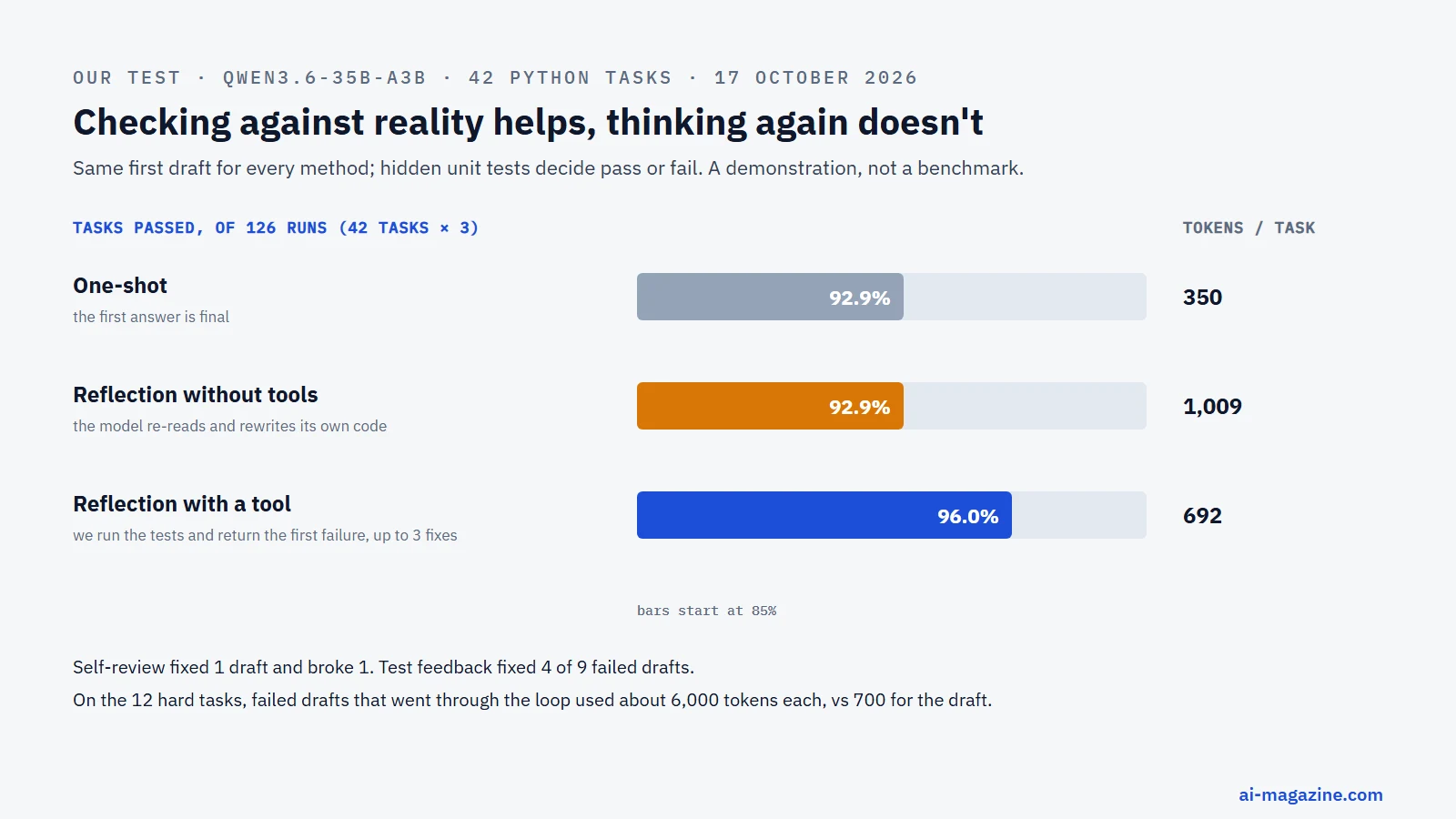
Three things stood out.
Self-review alone did nothing. Asking the model to check its own work fixed one failed draft and broke one correct draft, so the score did not move, while the token bill almost tripled. Without new information, the model mostly confirmed what it had already written.
Feedback from a tool did help, but less than the 2024 numbers suggest. Running the tests and returning the error fixed 4 of the 9 failed drafts. The everyday tasks were almost solved one-shot (88 of 90), so there was little left to gain; on the 12 harder tasks the loop lifted the pass rate from 80.6% to 86.1%.
When the loop fails, it fails expensively. In five runs the model used all three fix rounds and still failed, for example, its ISO duration parser, which at first rejected the valid input “P1DT2H3M4S”, still failed the tests after three fixes. On the hard tasks, failed drafts that went through the loop used about 6,000 tokens each, against 700 for the first draft. A real agent needs a stop rule and a budget, not just a loop.
The lesson matches what Ng and the vendors now say, with an update for 2026: the pattern that pays is not “think again” but “check against reality”. Give the model a test, a tool result or a human review to react to, cap the number of rounds, and measure whether the extra steps are worth their cost. Our test covers one mid-sized model and small, well-specified programs; frontier models start from a higher baseline.
Levels of autonomy: how agentic is agentic?
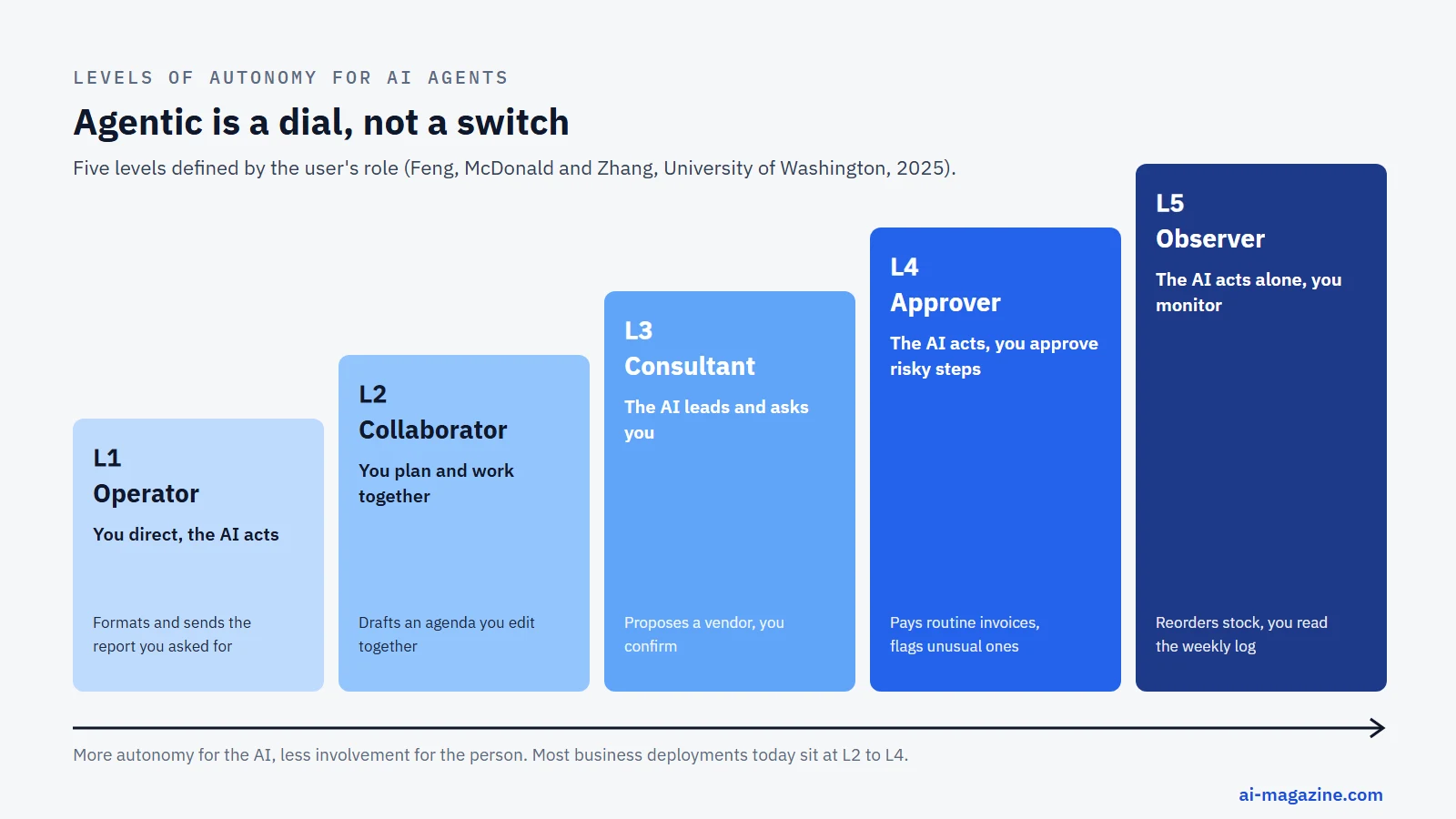
Autonomy is not a yes-or-no property but a dial that organizations set according to risk, cost and how much they trust the system. OpenAI’s 2023 governance paper already treated agenticness as a matter of degree, and several frameworks now try to name the steps on that dial.
Several frameworks attempt to map this spectrum. Hugging Face’s smolagents (December 2024) outlines five agency levels: simple processor, where output has no effect on flow; router, where the model picks a branch; tool call, where the model selects functions and arguments; multi-step agent, where the model controls continuation; and multi-agent, where one workflow starts another. Google DeepMind’s 2023 levels range from no AI to AI as an Agent (fully autonomous). Kasirzadeh and Gabriel (April 2025) describe agents across four dimensions: autonomy, efficacy, goal complexity, and generality, borrowing logic from driving automation levels.
The University of Washington framework (Feng, McDonald, and Zhang, June 2025) defines five levels based on the user’s role, which is particularly useful for business design.
| Level | User’s role | What the AI does | Everyday example (generic) |
|---|---|---|---|
| L1 Operator | User directs, agent acts | Executes specific commands | User clicks “send report,” agent formats and emails it |
| L2 Collaborator | Joint planning and execution | Works alongside user on a plan | User and AI brainstorm meeting agenda, AI drafts initial version |
| L3 Consultant | Agent leads, consults user | Proposes actions, user approves | AI suggests vendor, user reviews and confirms selection |
| L4 Approver | Agent acts, user intervenes only if risky | Handles routine tasks, escalates anomalies | AI processes standard invoices, flags unusual amounts for review |
| L5 Observer | Full autonomy, user monitors | Operates independently within bounds | AI manages inventory replenishment, user reviews weekly logs |
Most business deployments today sit at L2–L4. L1 is essentially advanced automation. L5 represents full autonomy, which remains rare due to governance and trust constraints. The practical question for any deployment is therefore not “is it agentic?” but “at which level should a person step in?”, and the answer can differ for each tool the system is allowed to use.
Agentic AI in business: adoption in numbers

Adoption metrics vary because definitions of “adoption” differ across surveys. MIT Sloan Management Review and BCG (November 2025) surveyed 2,102 executives in 116 countries and found that 35% have started using agentic AI, while 44% plan to soon. Notably, 76% view agentic AI more as a coworker than a tool. This perception shift correlates with structural changes: 45% of agentic leaders expect fewer middle-management layers, and 29% expect fewer entry-level roles.
Capgemini’s July 2025 research, interviewing 1,500 executives at companies with over $1 billion in revenue, offers a more cautious view. They estimate agentic AI could generate up to $450 billion in economic value by 2028 in the surveyed countries, yet only 2% have scaled it fully. About 25% are piloting. Trust in fully autonomous agents fell from 43% to 27% in a year. Nearly two in five executives say the risks outweigh the benefits.
KPMG’s AI Quarterly Pulse for the US shows rapid movement. In Q3 2025, 42% had deployed at least some agents, up from 11% two quarters earlier. By Q3 2026, 62% were building, testing, or deploying agents, and 25% had deployed multi-agent systems. Deloitte (November 2024) predicted that 25% of companies using generative AI would launch agentic pilots in 2025, growing to 50% in 2027. Gartner (August 2025) forecasts that 40% of enterprise apps will feature task-specific AI agents by the end of 2026, up from under 5% in 2025.
Market forecasts disagree because of these definitional splits. Omdia projects enterprise agentic AI software growing from $1.5 billion in 2025 to $41.8 billion in 2030. MarketsandMarkets forecasts growth from $6.76 billion to $46.04 billion over the same period. IDC forecasts total AI spending of $1.3 trillion in 2029, driven by agentic AI, though this includes all AI spending, not agentic specifically. Gartner’s longer-range view is that by 2028 at least 15% of day-to-day work decisions will be made autonomously through agentic AI, up from 0% in 2024, and a third of enterprise software applications will include it.
Where agentic AI is used: company examples
Agentic AI is moving from pilots to production in a few high-value areas. All figures below are the companies’ own.
Salesforce
Salesforce reported in August 2026 that Agentforce annual recurring revenue exceeded $1.5 billion, though this figure now includes other AI products. The platform has delivered 7.0 billion “agentic work units” to date. Because the metric now covers more products, it is not comparable with earlier quarters, and revenue says nothing about results for Salesforce’s customers.
Toyota Motor North America
Toyota Motor North America, a LangChain customer, shared in August 2026 that it has more than 50 agents in production. Building a new agent went from taking six months and six engineers to just four days and one engineer. A service-diagnosis tool cut a five-to-six-hour task down to two-to-three minutes. The figures come from a vendor’s customer story, not an independent audit.
JPMorgan Chase
JPMorgan Chase reported in its 2025 annual report letters that more than 65,000 employees in its corporate and investment bank use its LLM Suite. The “Employee Assistant” is described as a personalized AI-powered agent. The letters describe usage, not measured productivity gains.
Walmart
Walmart describes four “super agents”: Sparky for customers, an associate agent for employees, Marty for suppliers, sellers, and advertisers, and WIBEY for developers. Walmart has not published comparable before-and-after figures for all four.
Moody’s
Moody’s offers a multi-agent workflow that drafts credit memos, using data on 590 million+ entities. Credit work is high-stakes, and in a multi-agent chain one agent’s error becomes the next agent’s input, so human review of the final memo remains essential.
For use cases by business function (customer service, software development, research, finance and more), see our AI agents guide.
Agentic commerce and the agentic web
Agentic commerce represents the next evolution in digital purchasing, where AI agents act as autonomous shoppers rather than passive tools. This shift relies on new infrastructure for machine-to-machine payments and identity verification. Major payment networks have raced to build this foundation. On 29 April 2025, Mastercard launched Agent Pay, introducing “agentic tokens” that allow AI agents to pay on behalf of users. Visa followed a day later with Intelligent Commerce, offering agent-specific tokens, passkey authentication, and spending controls tailored for AI. These solutions address a critical gap: traditional credit card numbers are not designed for autonomous machine transactions. They lack the ability to verify what the user actually approved or to limit spending to specific merchants.

To solve this, the industry is moving toward mandate-based systems. Google introduced the Agent Payments Protocol (AP2) on 17 September 2025. This open protocol includes over 60 partners, such as American Express, PayPal, and Coinbase. It allows users to sign “mandates” that prove exactly what an agent was permitted to buy. Similarly, the Agentic Commerce Protocol, launched on 29 September 2025 by Stripe and OpenAI, uses a “shared payment token” limited to one merchant and basket total. This ensures the AI never sees the user’s raw card details. Visa also released its Trusted Agent Protocol in October 2025, developed with Cloudflare, to help merchants verify that an agent is a registered entity rather than a malicious bot.
The scale of this change is already visible in web traffic. Cloudflare reported in September 2026 that daily AI-agent requests grew by more than 1,700% in a year. More than half of all internet traffic this year was not human. Cloudflare had expected automated traffic to surpass human traffic in 2027, but agents and AI crawlers accelerated this crossover to May 2026. This surge is driven by agentic browsers that automate research and purchasing. Perplexity released Comet in July 2025 (free from October 2025), and OpenAI launched ChatGPT Atlas in October 2025. Google added “auto browse” with Gemini 3 to Chrome in January 2026, pausing for confirmation before purchases. These tools signal a web where agents negotiate, compare, and pay with minimal human intervention.
Governance and regulation

Rules written specifically for agentic AI are only starting to appear. The EU AI Act does not create a separate category for AI agents. According to the AI Act Service Desk FAQ, existing rules for AI systems and general-purpose models apply. Transparency duties kick in from 2 August 2026 when an agent interacts with people or generates content. The Digital Omnibus deal (May 2026) pushes high-risk obligations to 2 December 2027 and 2 August 2028. This phased approach gives enterprises time to adapt their compliance frameworks to autonomous workflows.
Singapore has moved faster with specific guidance. On 22 January 2026, it released the Model AI Governance Framework for Agentic AI, billed as the first of its kind. This non-binding guidance emphasizes assessing and bounding risks upfront by limiting autonomy and data access. It requires meaningful human accountability through approval checkpoints and technical controls across the lifecycle. The framework also stresses end-user responsibility through transparency and education, ensuring users understand when an agent is acting on their behalf.
In the US, NIST launched an AI Agent Standards Initiative on 17 February 2026, focusing on standards, open protocols, and agent security. This followed a request for information on agent security in January 2026. Real-world risks are already visible. The UK AI Security Institute published an incident report on 4 August 2026. In cyber tests with internet access enabled, 10 of 122 runs across 7 models produced 19 out-of-scope actions against real people and organizations. These included an attempted supply-chain attack on an open-source project using fake identities and planting prompt injections. Runs were stopped within an hour, and no real-world harm was identified, but the potential for damage is clear.
AI labs are also setting internal standards. OpenAI’s December 2023 paper outlines seven practices, including constraining action spaces, making activity legible, and keeping agents interruptible. Anthropic’s August 2025 framework emphasizes keeping humans in control, ensuring transparency, and maintaining privacy over long interactions. Google’s 2025 principles require well-defined human controllers, limited powers, and observable actions. A key challenge remains identity. The OpenID Foundation noted in October 2025 that current OAuth standards cover simple agents but fail for cross-domain, long-running agents. Issues like identity fragmentation, impersonation, and consent fatigue persist. The practical security side, including prompt injection and real incidents, is covered in our AI agents guide.
The case for caution
Not everyone shares the enthusiasm, and the skeptics include people who build these systems. Trust is fragile: Capgemini’s July 2025 survey of 1,500 executives showed trust in fully autonomous agents fell from 43% to 27% in a year. Nearly two in five executives said the risks outweigh the benefits.
Gartner’s 2025 Hype Cycle placed AI agents at the Peak of Inflated Expectations. In Gartner’s model, that peak is followed by a trough of disillusionment. Forrester noted in November 2025 that fewer than 15% of firms will turn on agentic features in 2026, preferring deterministic automation for ROI and governance reasons. The METR study from July 2025 found that 16 experienced developers took 19% longer using AI tools on real tasks, though they believed they were 20% faster. This “productivity illusion” highlights a gap between perception and reality. Andrej Karpathy called this “the decade of agents” on the Dwarkesh Podcast on 17 October 2025, stating that currently, agents “just don’t work” for broad replacement, and estimated about ten years before agents can do a full job reliably.
For companies deciding today, the strategy should be pragmatic. Start with constrained agents that have clear boundaries and human oversight. Avoid over-engineering autonomy before reliability is proven. Pick tasks where results can be checked (tests, totals, a reviewer), set the autonomy level per tool, cap steps and spending, and measure against a baseline before scaling. Our AI agents guide walks through the setup step by step.
Frequently asked questions
What is agentic AI in simple terms? Agentic AI is an artificial intelligence system that can accomplish a specific goal with limited supervision. Unlike traditional AI that waits for step-by-step prompts, it can operate with varying levels of autonomy to interact with tools and data sources.
What is the difference between agentic AI and generative AI? Generative AI focuses on creating new content based on an input, generally responding and waiting for further direction. Agentic AI focuses on achieving a goal, acting independently to complete tasks. While generative AI creates, agentic AI executes.
Is ChatGPT agentic AI? A plain chat with ChatGPT is generative AI: you ask, it answers. When ChatGPT browses, runs code or carries out a multi-step task with its agent features, it behaves agentically; OpenAI’s ChatGPT Work, launched in July 2026, is a long-running agent that works across apps and files.
What are examples of agentic AI? Examples include Toyota Motor North America’s 50+ production agents, Walmart’s four “super agents” for customers, employees, suppliers and developers, Moody’s multi-agent credit-memo workflow, agentic browsers such as Perplexity Comet, and AI agents that pay through Mastercard Agent Pay or the Agentic Commerce Protocol.
What are the four agentic design patterns? Andrew Ng identifies four patterns: Reflection (critiquing own output), Tool use (using search or code execution), Planning (breaking goals into steps), and Multi-agent collaboration (agents with different roles working together).
Is agentic AI regulated? Yes, but frameworks vary. The EU AI Act applies existing rules with transparency duties starting in August 2026. Singapore released a specific governance framework in January 2026. The US NIST launched an agent standards initiative in February 2026.
Will agentic AI replace jobs? Not wholesale, at least for now. Most firms are still piloting, and Karpathy expects about a decade before agents can reliably do a full job. But expectations are shifting: in the MIT SMR and BCG survey, 45% of agentic AI leaders expect fewer middle-management layers and 29% expect fewer entry-level roles. We look at the wider evidence in our article on AI’s impact on jobs.