Best Open-Source LLMs in 2026: The Top Open-Weight Models Compared
The best open source LLM in October 2026 is no longer a cheap stand-in for a closed model. Epoch AI estimates that the strongest open-weight models trail the closed frontier by about four months, and Stanford’s AI Index 2026 measured a 3.3% gap between the top closed and top open model in March 2026. The map has also changed: the top of the open leaderboards is now almost entirely Chinese (Xiaomi, DeepSeek, Z.ai, Moonshot, StepFun, Alibaba), Meta has moved from Llama to a new family called Muse, Google relicensed Gemma 4 under Apache-2.0, and OpenAI’s gpt-oss is still its only open model. This guide compares the open models that matter, explains what “open” actually allows under each license, shows which models people really download (from our own Hugging Face data) and what hardware you need to run them.
Quick picks for October 2026:
- Best overall: Xiaomi MiMo-V2.6-Pro, the top open model on the Artificial Analysis Intelligence Index; Kimi K3 is the top open model on the Arena text leaderboard.
- Best for coding: DeepSeek V4.1 Flash, Kimi K3, and GLM-5.3 (Arena WebDev top ranks).
- Best to run on one GPU or a Mac: Qwen3.8-27B and Google Gemma 4, both Apache-2.0.
- Best US-made models: Meta Muse Spark Open (performance) and OpenAI gpt-oss (permissive license).
- Best fully open: Ai2’s Olmo 3.1, with training data, code and checkpoints published.
The best open-source LLMs at a glance
| Model | Developer | Released | Parameters (total / active) | Context | License | Best at |
|---|---|---|---|---|---|---|
| MiMo-V2.6-Pro | Xiaomi | Sep 2026 | 1.02T / 42B | 1M | MIT | Top open score on Artificial Analysis |
| DeepSeek V4.1 Flash | DeepSeek | Sep 2026 (refresh Oct) | 552B backbone, MoE | 1M | MIT | Coding (top open model on Arena WebDev) |
| GLM-5.3 | Z.ai | Aug 2026 | 753B, MoE | up to 1M | GLM-5.3 License (custom) | Agentic coding |
| GLM-5.3-Flash | Z.ai | Aug 2026 | 320B / 18B | up to 1M | MIT | Strong model with a clean license |
| Kimi K3 | Moonshot AI | Jul 2026 | 2.8T / 104B | 1M | Kimi K3 License (custom) | Top open model on Arena text |
| Qwen3.8-27B | Alibaba | Aug 2026 | 27B dense | 262K (to 1M) | Apache-2.0 | One-GPU workhorse |
| Muse Spark Open | Meta | Oct 2026 | 816B / 42B | 1M | Muse Model License (custom) | Strongest US-made open model |
| Gemma 4 (31B, 26B-A4B, 12B, E4B, E2B) | Apr 2026 | 31B dense to 2.3B effective | 128K–256K | Apache-2.0 | Local and on-device, multimodal | |
| gpt-oss-120b / 20b | OpenAI | Aug 2025 | 117B / 5.1B; 21B / 3.6B | 131K | Apache-2.0 | Runs on one 80 GB GPU / in 16 GB |
| Mistral Small 4 | Mistral AI | Mar 2026 | 119B / 6.5B | 256K | Apache-2.0 | European option, efficient MoE |
| Nemotron 3.5 Super VL | NVIDIA | Oct 2026 | 120B / 12B | up to 1M | OpenMDW-1.1 | Enterprise inference on NVIDIA GPUs |
| Olmo 3.1 32B | Ai2 | Dec 2025 | 32B dense | 65K | Apache-2.0 | Fully open: data, code, checkpoints |
Release dates are the public release or first weight commit on Hugging Face; parameter counts are from the model cards.
Open source vs open weight: what “open” means in 2026
Defining “open” in 2026 requires navigating a legal and technical distinction that often gets blurred in marketing materials. The Open Source Initiative (OSI) released the Open Source AI Definition 1.0 in October 2024, built on four freedoms: to use the system for any purpose, study it, modify it and share it. To qualify, a model must come with the “preferred form” for making changes: the weights, the full training and inference code, and information about the training data detailed enough for a skilled person to build a substantially equivalent system (the data itself is not required). In OSI’s validation OLMo, Pythia, CrystalCoder and T5 passed, while Llama 2, Phi-2, Mixtral and Grok fell short.
However, the vast majority of what the industry calls “open-source LLMs” are technically “open weight” models. These models release their trained parameters, allowing developers to run, fine-tune, and deploy them, but they do not always release the training data or the full training code. Models like Qwen3.8-27B or Gemma 4 ship their weights under an OSI-approved license (Apache-2.0), but without the training-data information they are open-weight rather than open source in OSI’s sense. Our open weights glossary entry explains the distinction. Kimi K3, for instance, released weights but withheld training data, fitting the open-weight definition but not the strict OSI standard.
The license tier is equally critical for commercial buyers. We see three distinct categories emerging. First, permissive licenses like Apache-2.0 and MIT (used by DeepSeek, Gemma 4, and gpt-oss) allow almost unrestricted commercial use. Second, a new class of “permissive-with-thresholds” licenses has appeared. Models like Mistral Medium 3.5 or the Qwen Community License allow commercial use but impose revenue caps (e.g., companies with over $20 million in monthly revenue must negotiate a separate license) or attribution requirements. Meta’s Muse Model License, Moonshot’s Kimi K3 License and Alibaba’s licenses for its biggest Qwen models also belong here: free for most users, but model-as-a-service (MaaS) businesses above a revenue threshold need a separate agreement. Third, some licenses are non-commercial by default, such as the MiniMax Community License for MiniMax M3 and Mistral’s license for Codestral.
Regulatory pressure is also shaping these definitions. The EU AI Act’s Article 53(2) exempts models under a free and open-source license from certain transparency obligations, provided the weights, architecture, and usage info are public. The exemption does not apply to general-purpose models with systemic risk, presumed above 10^25 FLOPs of training compute, and the copyright and training-summary duties apply to everyone. Licenses that charge for or restrict use are unlikely to count as free and open source under the Act, so revenue-gated licenses probably do not qualify (our reading, not a ruling). For developers, this means “open” no longer guarantees “free of legal friction.”
The top open models, one by one
Xiaomi MiMo-V2.6-Pro
Xiaomi’s MiMo-V2.6-Pro is the highest-scoring open-weight model on the Artificial Analysis Intelligence Index (v4.3.2, 46 points, ahead of DeepSeek V4.1 Flash and GLM-5.3 at 45). Released on 21 September 2026, it is a massive MoE architecture with 1.02 trillion total parameters and only 42 billion active parameters. It supports a 1-million-token context window and is multimodal, handling text, image, video, and audio inputs. It is MIT-licensed, which makes it the strongest open model with no strings attached. On the Arena text leaderboard (22 October 2026) it ranks #28, just behind Kimi K3 and GLM-5.3. A smaller sibling, MiMo-V2.6-Flash (309B total, 15B active), was released the same day. Running the Pro version yourself needs a multi-GPU server.
DeepSeek V4.1 Flash and V4 Pro
DeepSeek’s V4 generation arrived as a preview in April 2026: V4-Pro (1.6T total, 49B active) and V4-Flash (284B, 13B active), with official releases in July and August. V4.1 Flash, released on 10 September 2026 and refreshed on 17 October, is a multimodal MoE model with a 552-billion-parameter backbone but activates only 8 to 16 billion parameters per token. It features a 1-million-token context and uses 45 trillion training tokens to achieve its performance. DeepSeek says its memory cache for long contexts is about four times smaller than V4-Flash’s. It is licensed under the permissive MIT license. On the Arena WebDev coding leaderboard (22 October 2026) it is the top open model at #13, and on Artificial Analysis it scores 45. We covered its pricing in our V4.1 Flash news story.
GLM-5.3 and GLM-5.3-Flash (Z.ai)
Z.ai’s GLM-5.3 family represents a significant leap in Chinese open-weight capabilities. The flagship GLM-5.3 (late August 2026) is a 753-billion-parameter mixture-of-experts model with 256 routed experts, 8 used per token. It supports a 1-million-token context window. Z.ai claims it is the “most capable open-weights model for coding,” and independently it ranks #24 on Arena WebDev and #26 on Arena text, and scores 45 on Artificial Analysis. It is licensed under the custom “GLM-5.3 License,” which is permissive but requires security reviews for large MaaS businesses with more than $10 billion in revenue over 12 months. The lighter GLM-5.3-Flash (320B total, 18B active, natively multimodal) is MIT-licensed and had 6.4 million downloads on Hugging Face in the 30 days to 23 October, the most of any large open model.
Kimi K3 (Moonshot)
Kimi K3 from Moonshot AI is a behemoth, boasting 2.8 trillion total parameters with 104 billion active parameters across 896 experts. It supports a 1-million-token context window and uses a novel KDA and Gated MLA attention mechanism. Moonshot claims it is the “world’s first open 3T-class model.” It is the best open model on the Arena text leaderboard (#18 overall, 1487 points, 22 October 2026) and the second-best open model on Arena WebDev; Artificial Analysis gives it 44. However, its license is restrictive: it requires a separate agreement for MaaS businesses with over $20 million in revenue over 12 months and mandates attribution if MAU exceeds 100 million. Internal use is exempt, so for most companies it is effectively free; large API resellers need to talk to Moonshot.
Qwen3.8 (Alibaba)
Alibaba’s Qwen3.8 family offers a spectrum of options for different hardware constraints. The Qwen3.8-27B is a dense, 27-billion-parameter model licensed under Apache-2.0. It accepts images as well as text, supports a native 262K context that extends to 1M, and was the most downloaded Qwen3.8 model, with 7.8 million downloads in 30 days. It scores 34 on Artificial Analysis, well below the giants, but it runs on one 24 GB GPU when quantized. For those needing more power, the Qwen3.8-Max open version releases a 2.4T-parameter model with 95B active parameters. It uses a custom Qwen3.8-Max License: MaaS and AI-assistant businesses with more than $50 million in revenue over 12 months need a separate license. The Qwen3.8-Flash-Next is a highly efficient MoE model (125B total, 6B active) under the Qwen Community License, which requires a separate license for any MaaS business. Earlier 2026 releases, including Qwen3.5 and Qwen3.6, are Apache-2.0. Qwen’s derivative ecosystem is massive, with over 113,000 derivative models, according to Hugging Face, more than Google’s and Meta’s combined.
Meta Muse Spark Open (and what happened to Llama)
Meta has shifted its open-weight focus from the Llama lineage to the Muse family. Muse Spark Open, released on 15 October 2026, is an 816-billion-parameter MoE model with 42 billion active parameters. It supports a 1-million-token context and is fully multimodal (text, image, video, audio). It is released under the Muse Model License: access is gated, products must display “Built with Muse Spark Open”, and MaaS businesses with more than $20 million in gross revenue over 12 months must sign a separate agreement. Meta calls it the most capable US open-weight model to date, and it scores 39 on Artificial Analysis, the best US-made open model there. It is big: Meta’s card lists at least 700 GB of GPU memory in NVFP4, or two Mac Studios with M5 Ultra through MLX. A smaller Muse Glimmer 30B is Apache-2.0. Llama itself has had no new model since Llama 4 Scout and Maverick in April 2025.
Google Gemma 4
Google’s Gemma 4 series is a robust, Apache-2.0 licensed family of models that released in April 2026, includes a 31B dense model, a 26B mixture-of-experts model with 3.8B active parameters, a 12B model and two small “E” models (2.3B and 4.5B effective parameters). The 31B dense model and the 26B-A4B MoE variant are particularly popular for local deployment. Gemma 4 supports text, image, and video inputs, with some smaller variants handling audio. Apache-2.0 is a real change from Gemma 3, which used Google’s own Gemma terms. Google also provides quantized GGUF builds (QAT q4_0) to facilitate local running. The 26B-A4B and 31B models were downloaded 9.4 million and 8.6 million times in 30 days, and the 31B is the best Western open model on Arena text (#76).
OpenAI gpt-oss
OpenAI released gpt-oss in August 2025 under Apache-2.0, its first open-weight language models since GPT-2, and has released no newer open LLM since. The gpt-oss-120b is a 117-billion-parameter MoE model with 128 experts (4 active), designed to fit on a single 80 GB GPU like the H100. The smaller gpt-oss-20b fits within 16 GB of memory. Both models use MXFP4 post-training for efficiency. Both are text-only with a 131K context and adjustable reasoning effort. By October 2026 they trail the newest models (gpt-oss-120b ranks #194 on Arena’s text board without style control), but they remain among the easiest capable models to run on one machine, and the 20b version was downloaded 5.8 million times in 30 days.
Mistral (Small 4, Large 3, Medium 3.5, Devstral 2)
Mistral AI continues to offer a diverse portfolio. Mistral Large 3 (December 2025, 675B total, 41B active, multimodal, 256K context) is Apache-2.0. Mistral Small 4 (119B total, 6.5B active) is also Apache-2.0. However, the larger Mistral Medium 3.5 and Devstral 2 use a Modified MIT license that bans commercial use for companies with global consolidated monthly revenue exceeding $20 million. This revenue cap makes them less suitable for large-scale commercial products compared to their Apache-licensed smaller siblings. The family also includes specialized models like Devstral Small 2 (24B, Apache-2.0) for local coding tasks and Magistral Small 2509, a 24B reasoning model with vision.
NVIDIA Nemotron 3 and 3.5
NVIDIA’s Nemotron models are built to run efficiently on its GPUs. Nemotron 3.5 Super VL (October 2026) is a 120-billion-parameter model with 12B active, a hybrid (Mamba-2 + MoE + attention) licensed under OpenMDW-1.1, a permissive license that allows unrestricted use. Nemotron 3.5 Lightning (August 2026, 30B total, 3B active) runs with a 256K context on a single H100. NVIDIA’s licensing is notably flexible, with OpenMDW-1.1 allowing redistribution and usage without restriction, provided license notices are kept. This makes Nemotron a strong choice for enterprise deployments where legal clarity and high throughput are priorities. The largest is Nemotron 3 Ultra (June 2026, 550B total, 55B active).
Olmo 3.1 (Ai2), the fully open option
Allen AI’s Olmo 3.1 stands out as one of the few truly “fully open” models. Unlike most competitors that release only weights, Olmo 3.1 provides the training data (Dolma 3, about 9.3 trillion tokens), the training code, and the model weights. This transparency allows for complete auditability and reproducibility. Olmo 3 came in November 2025 in 7B and 32B sizes, and Olmo 3.1 32B followed in December; all are Apache-2.0. While it may not match the raw benchmark scores of the trillion-parameter models, its openness makes it ideal for researchers and organizations that need to verify training data biases or reproduce results exactly. OLMo had the top score (89) when Artificial Analysis launched its Openness Index in December 2025.
Other open models worth knowing
The open landscape is broad, with several notable models rounding out the top tier. MiniMax M3 (June 2026, about 428B total, 23B active, 1M context) uses a community license that grants non-commercial use; commercial use needs a “Built with MiniMax M3” notice, or written permission above $20 million in yearly revenue, and military use is banned. StepFun’s Step 5 Preview (September 2026, 600B total, 27B active) scores 44 on Artificial Analysis under a custom license. Tencent’s Hy3 (295B, 21B active) and Hy4 preview (770B, 49B active) are Apache-2.0. IBM’s Granite 4.2 (August 2026; 3B, 8B and 30B) is Apache-2.0 with official GGUF and MLX builds. Cohere’s Command A+ (May 2026, 218B total, 25B active) moved to Apache-2.0 after earlier non-commercial releases. Ant Group’s Ling-3.1-flash (October 2026, 560B total, 25B active, 1M context) is MIT, and Microsoft’s latest small model is the MIT-licensed Phi-4-reasoning-vision-15B (March 2026).
How close are open models to the best closed models?
The gap between open-weight and proprietary LLMs has narrowed significantly, but it has not closed. On the Arena leaderboard (text, style control) published October 22, 2026, the best open model, Kimi K3, ranks #18 with a score of 1487, compared to #1 Gemini 4 Argon (High) at 1517—a 30-point difference. The best Western open model, Gemma 4 31B, sits at #76. Artificial Analysis reported in April 2026 that the performance gap between the best open and closed models is now just 3–6 points, down from roughly 13 points a year earlier, while open models also offer significantly lower pricing. Epoch AI’s data indicates that, on average, best-in-class open-weight models lag behind closed frontier models by about four months. Stanford’s AI Index 2026 notes that as of March 2026, the top closed model leads the top open model by 3.3%, a gap that reopened in 2025 after briefly closing the previous year. Epoch also warns that public benchmarks may flatter open models compared with how they perform in real use, so treat small gaps with caution.
Best open-source LLM by use case
Coding and agents
For coding and agentic workflows, DeepSeek-V4.1-Flash and Kimi K3 lead on Arena WebDev (Code Arena), ranking #13 and #16 respectively. GLM-5.3 is widely considered a top choice for coding tasks, with Z.ai claiming it is the most capable open-weights model for coding based on benchmarks like Terminal Bench 3.0 and CyberGym. For running your own coding agent, Qwen3-Coder-Next (80B total, 3B active, Apache-2.0) works with agent tools such as Claude Code, Qwen Code and Cline, and Devstral Small 2 (24B, Apache-2.0) fits on one GPU; the larger Devstral 2 has a revenue cap.
Reasoning and general use
If you need a general-purpose model that rivals frontier capabilities, Xiaomi’s MiMo-V2.6-Pro currently tops the Artificial Analysis open-source index. DeepSeek-V4.1-Flash and GLM-5.3 are also exceptional for complex reasoning, while Kimi K3 offers massive context handling with strong general intelligence. For a transparent, fully open research model, Allen AI’s Olmo 3 provides complete visibility into training data, code, and weights.
Running on one GPU or a laptop
OpenAI’s gpt-oss-20b runs smoothly on machines with 16 GB of memory, while gpt-oss-120b fits on a single 80 GB GPU (like an H100 or MI300X). Gemma 4 26B-A4B and 31B, and Qwen3.8-27B, fit a 24 GB GPU or a 32 GB Mac when quantized, and Gemma 4 E2B/E4B, Qwen3.5 (0.8B to 9B), Phi-4-mini and Granite 4.2 3B/8B run on ordinary laptops.
Multilingual work
Qwen3.5 supports 201 languages and dialects, making it a strong candidate for global applications. Gemma 4 handles 35+ languages out of the box and was pretrained on 140+. Muse Spark Open supports over 100 training languages, and Cohere’s Command A+ is optimized for multilingual enterprise use.
Long documents (1M-token context)
Several models natively support 1-million-token contexts. Kimi K3, DeepSeek-V4.1-Flash, MiniMax-M3, GLM-5.3, and Muse Spark Open all handle this length natively. Meta’s Llama 4 Scout (April 2025) still has the longest advertised context of any open model, 10 million tokens. Remember that long context costs memory: serving a million tokens takes far more hardware than the weights alone.
Research and auditability
For maximum transparency, Allen AI’s Olmo 3 is the gold standard. It releases the full model flow: training data (Dolma 3), code, weights, and intermediate checkpoints. This allows for deep auditing of biases and capabilities in a way that closed or partially open models cannot match.
Commercial products with a clean license
If you need a safe, permissive license for commercial products, Gemma 4, gpt-oss, Qwen3.8-27B, Mistral Small 4, and IBM’s Granite 4.2 are all Apache-2.0 or MIT licensed with no revenue thresholds. DeepSeek models are also MIT licensed. Avoid models with revenue caps like Mistral Medium 3.5 or Llama 4 if you are scaling quickly, as they may require separate agreements once you hit specific MAU or revenue milestones.
Open model licenses: what you can and cannot do
Not all open-weight models are created equal. Apache-2.0 and MIT models (like Gemma 4, DeepSeek, and gpt-oss) are the safest for commercial use. However, many top-tier models use custom licenses with thresholds. For example, Kimi K3 requires a separate agreement if you run a Model-as-a-Service (MaaS) business with over $20 million in revenue over 12 months. Qwen3.8-Max has a $50 million revenue threshold for MaaS, while Qwen Community License requires a separate license for any MaaS business regardless of revenue. Muse Spark Open requires notification and a separate agreement for MaaS businesses with over $20 million in gross revenue. Llama 4 requires a license request if you exceed 700 million MAU and excludes EU entities from multimodal rights. Mistral Medium 3.5 and Devstral 2 restrict rights if your company’s monthly consolidated revenue exceeds $20 million. GLM-5.3 uses a custom license requiring a security review for MaaS businesses with over $10 billion in revenue. Some are non-commercial by default: MiniMax M3 allows commercial use only with an attribution notice (or written permission above $20 million in yearly revenue), older Cohere Command releases were CC-BY-NC, and Codestral has a non-production license. Grok 2’s license bans using the model or its outputs to train other general-purpose language models. NVIDIA’s OpenMDW is highly permissive, allowing unrestricted dealing in the model materials. Always read the license file itself, not just the Hugging Face tag or a leaderboard label: Arena, for example, lists GLM-5.3 as MIT, while the license file in its repository is a custom GLM-5.3 License.
Running open models locally: what hardware you need
To run open models locally, you can use tools like Ollama, llama.cpp, LM Studio, MLX, or vLLM. Quantization is key for fitting larger models onto consumer hardware. Using llama.cpp’s GGUF format, an 8B model can be quantized to about 4.9 GB, while a 70B model takes up around 43 GB. Ollama adjusts context length based on your VRAM: less than 24 GB defaults to 4k context, 24–48 GB to 32k, and over 48 GB to 256k. For specific hardware targets, gpt-oss-20b runs on 16 GB of memory, and gpt-oss-120b fits on a single 80 GB GPU. The largest models, like Muse Spark Open, may require over 700 GB of VRAM in NVFP4 format. Context length also impacts memory usage, so be mindful of your hardware limits when loading long-context models. Step-by-step setup is in our guide to running an LLM locally with Ollama.
| Model | Weights at 4-bit (approx.) | What it needs in practice |
|---|---|---|
| Gemma 4 E4B (8B with embeddings) | about 5 GB | Laptop or phone-class hardware |
| gpt-oss-20b | under 16 GB (official) | 16 GB GPU or Mac |
| Gemma 4 26B-A4B | about 15 GB | 24 GB GPU or 32 GB Mac |
| Qwen3.8-27B | about 17 GB | 24 GB GPU or 32 GB Mac |
| Gemma 4 31B | about 19 GB | 24 GB GPU (short context) or 32 GB+ Mac |
| gpt-oss-120b | fits 80 GB (official) | One 80 GB GPU (H100, MI300X) |
| Mistral Small 4 (119B) | about 72 GB | 96–128 GB Mac or two to four GPUs |
| Kimi K3 (2.8T) | well over 1 TB | Multi-GPU server cluster |
Estimates use llama.cpp’s Q4_K_M rate of about 0.6 GB per billion parameters (an 8B model shrinks to 4.9 GB); add memory for the context window. gpt-oss figures are OpenAI’s.
Our data: which open models people actually download
Leaderboards show which open models are strongest. To see which ones people actually pull, we took the 1,000 most-downloaded text-generation models on the Hugging Face Hub on 23 October 2026, about 397 million downloads in the previous 30 days. We traced every fine-tune, quantized copy and re-upload back to the model it was built from, through the base_model tags its uploader declared, and grouped them by original developer.
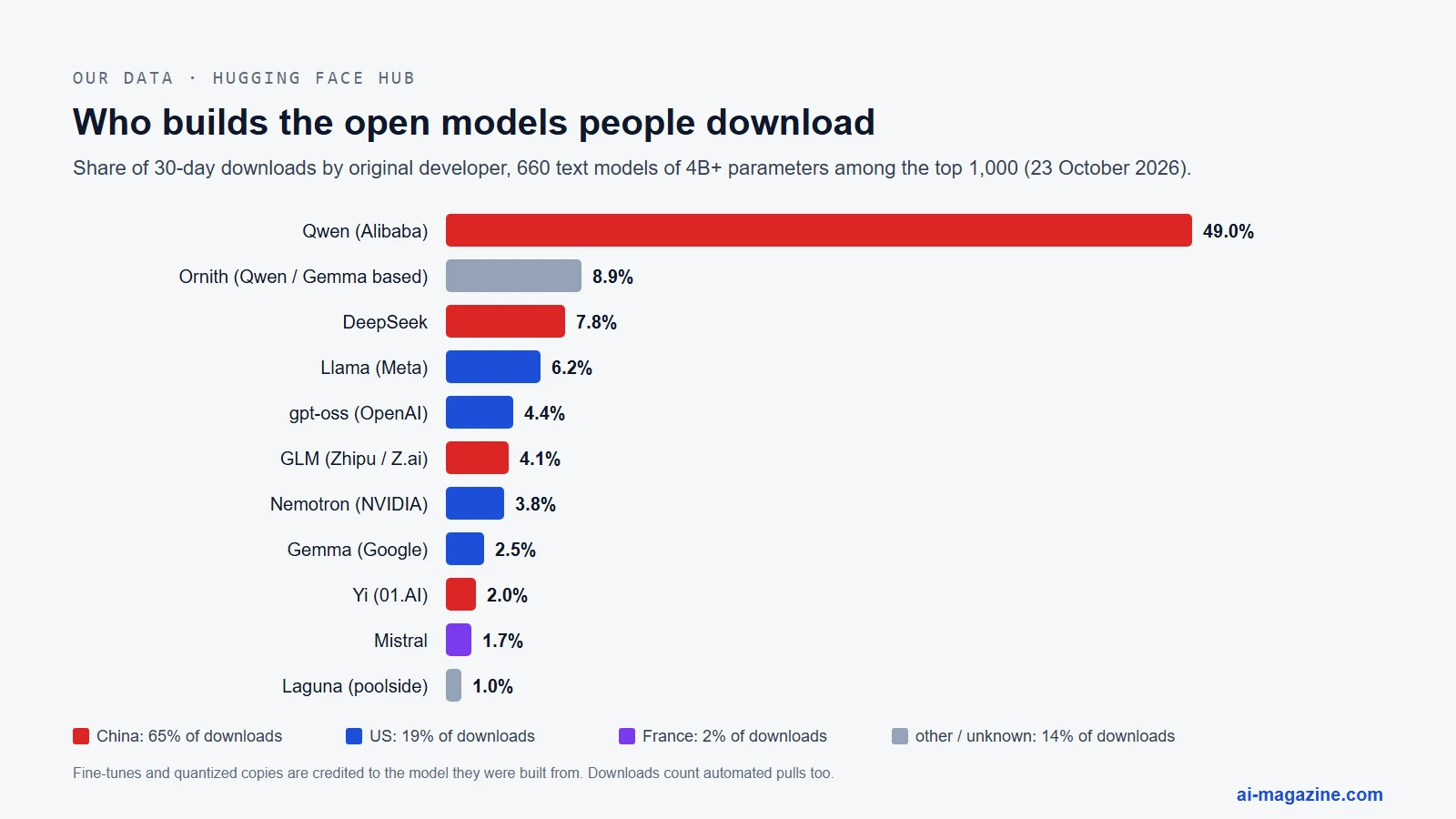
Four findings:
Qwen is the default base model of the open ecosystem. Among models with 4 billion parameters or more, Alibaba’s Qwen and the models built on it took 49% of downloads, more than the next nine families combined. Counting every size, the share is 47%. This matches Hugging Face’s own spring 2026 report, which counted more than 113,000 Qwen derivatives, more than Google’s and Meta’s combined.
Chinese developers lead downloads, as they lead the leaderboards. Models originally from Chinese labs took 59% of all downloads in our sample and 65% among models of 4B parameters or more; US developers took 28% and 19%. Hugging Face’s spring report put China at 41% of downloads over the previous year, so the shift has continued.
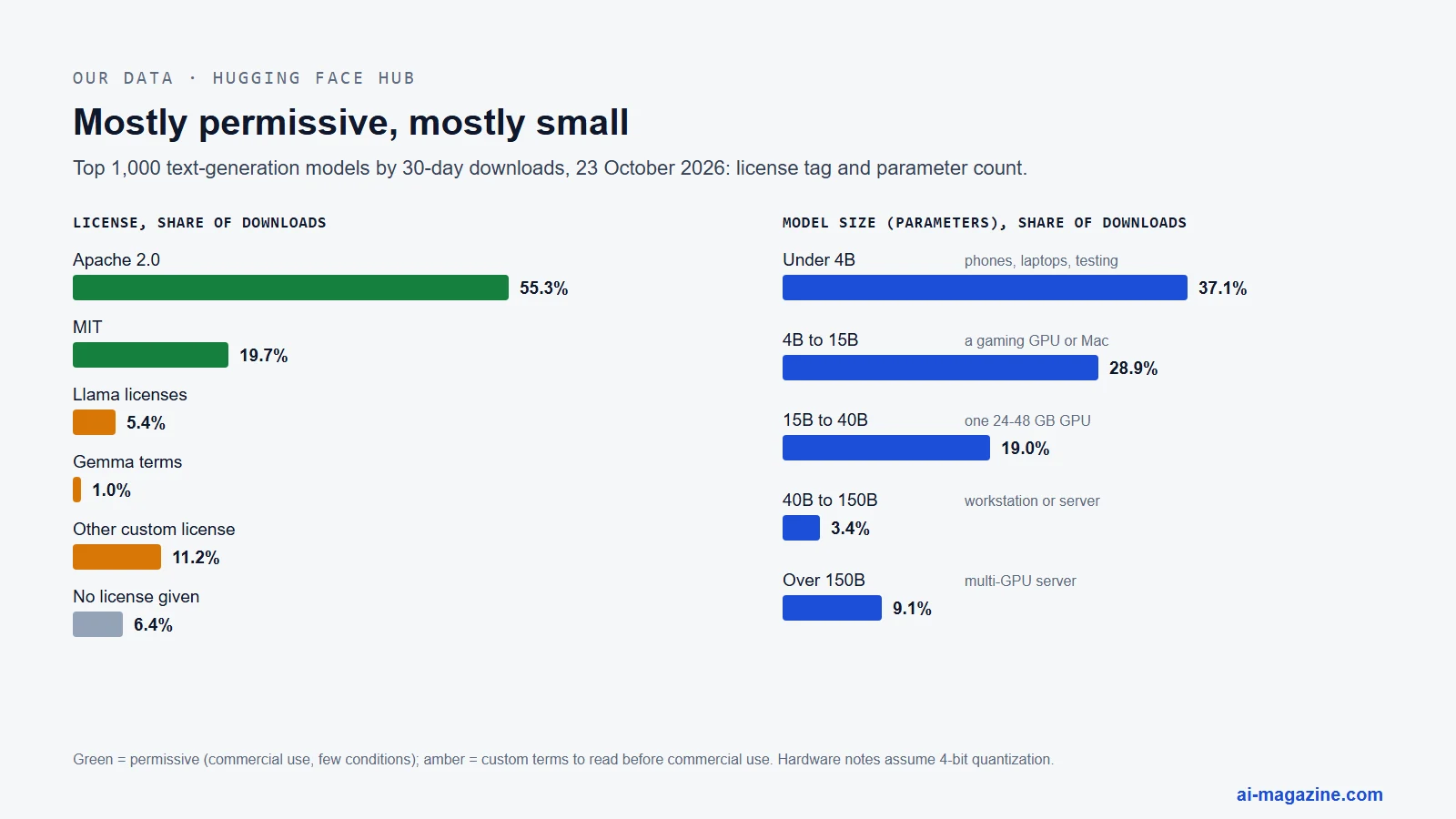
Most downloads are small models. 37% of downloads went to models under 4 billion parameters, the kind that run on a laptop or phone or serve as test fixtures in software pipelines. The single most-downloaded model was Qwen3-0.6B (26.7 million downloads), and second was GPT-2, a 124-million-parameter model from 2019 that is still pulled 18.8 million times a month, most likely by automated tests. Models above 150 billion parameters took 9%.
Three-quarters of downloads carry a fully permissive license. Apache-2.0 models took 55% of downloads and MIT models another 20%. Llama’s licenses covered 5%, Gemma’s older terms 1%, and other custom licenses 11%.
About 31% of downloads went to copies uploaded by someone other than the original developer: quantized versions in GGUF, AWQ or NVFP4 formats, fine-tunes and merges. That is the practical face of “open”: once the weights are out, the community repackages them for every kind of hardware.
How to read this: download counts include automated pulls by build systems and servers, one popular model can count several times through its copies, and the largest models are often downloaded once and served to many users, so downloads measure reach among builders, not quality or end-user traffic. Models whose uploaders declared no base model were counted under their own developer. Ornith, a family its developer says was built on Qwen 3.5 and Gemma 4, is shown separately because it cannot be split between the two.
Who uses open models
Open models are gaining significant market share. On OpenRouter, an API marketplace that routes requests to many models, open-weight models peaked at 79% of tokens in early July 2026 and stayed above 62% through September; in the week to 20 September, Chinese labs’ models processed 69% of all tokens there. A 2025 a16z/OpenRouter report estimated that open-weight models made up about one-third of usage by late 2025. Hugging Face’s spring 2026 report found Chinese models took 41% of downloads over the previous year, more than US models, and the ATOM project (Nathan Lambert and colleagues) dates the moment Chinese open models overtook US ones to summer 2025. The top 200 models on the platform drive nearly half of all downloads, indicating a concentration of usage around a few high-performing open models.
How to choose an open-source LLM
- Check the license first. Ensure it allows your intended commercial use without hitting revenue or MAU thresholds.
- Define your hardware budget. Decide if you need a model that runs on a laptop, a single GPU, or a multi-GPU server.
- Identify your primary task. Coding, reasoning, or multilingual support will point you to different model families.
- Consider context length. If you need to process long documents, prioritize models with 1M+ token contexts.
- Evaluate language support. Ensure the model is trained on the languages you need.
- Check independent leaderboards. Look at Arena and Artificial Analysis for real-world performance, not just vendor claims.
- Test on your own data. Benchmarks can be misleading; always run a small-scale test with your specific use case.
Frequently asked questions
What is the best open-source LLM in 2026? It depends on the yardstick: Xiaomi MiMo-V2.6-Pro leads the Artificial Analysis index among open models and Kimi K3 leads Arena’s text leaderboard. Among US models, Meta Muse Spark Open is the strongest, and Gemma 4 and gpt-oss are the best with a fully permissive license.
What is the best local LLM? For local use, gpt-oss-20b is excellent for low-resource machines, while Qwen3.8-27B offers a strong balance of performance and size. Gemma 4 26B-A4B is a good middle ground on a 24 GB GPU or a 32 GB Mac.
What is the best open-source LLM for coding? DeepSeek-V4.1-Flash and Kimi K3 are currently ranked highest on coding-specific leaderboards like Arena WebDev. GLM-5.3 is also highly regarded for its coding capabilities and agentic performance.
Are open-source LLMs free for commercial use? Not necessarily. While Apache-2.0 and MIT models are generally free for commercial use, many models like Kimi K3 and Llama 4 have revenue or user thresholds that require additional licensing or fees for large-scale commercial use.
What is the difference between open source and open weight? “Open weight” means the model’s parameters (weights) are available for download. “Open source” typically implies that the weights, code, and training data are all available. Most modern LLMs are open weight but not fully open source, as they often keep their training data proprietary.
Is Llama still open source? Llama 4 is open weight but uses a custom license with thresholds (like 700 million MAU) and excludes certain regions (like the EU) from multimodal rights. Earlier Llama versions also used Meta’s own community licenses, not an OSI license, and Meta’s newest open models are now the Muse family.
Has OpenAI released open-source models? Yes. In August 2025 OpenAI released gpt-oss-120b and gpt-oss-20b, open-weight mixture-of-experts models under Apache-2.0 that run on one 80 GB GPU and in 16 GB of memory respectively. As of October 2026 it has released no newer open language model.
Can I run an open-source LLM on my laptop? Yes, smaller models like gpt-oss-20b, Phi-4-mini, and Qwen3.5 (up to 9B) can run on modern laptops with 16 GB of RAM. With 32 GB or more of unified memory, a Mac can also run 26B–31B models such as Gemma 4 or Qwen3.8-27B at 4-bit.