Best AI Model for Coding: What the Benchmarks Actually Say

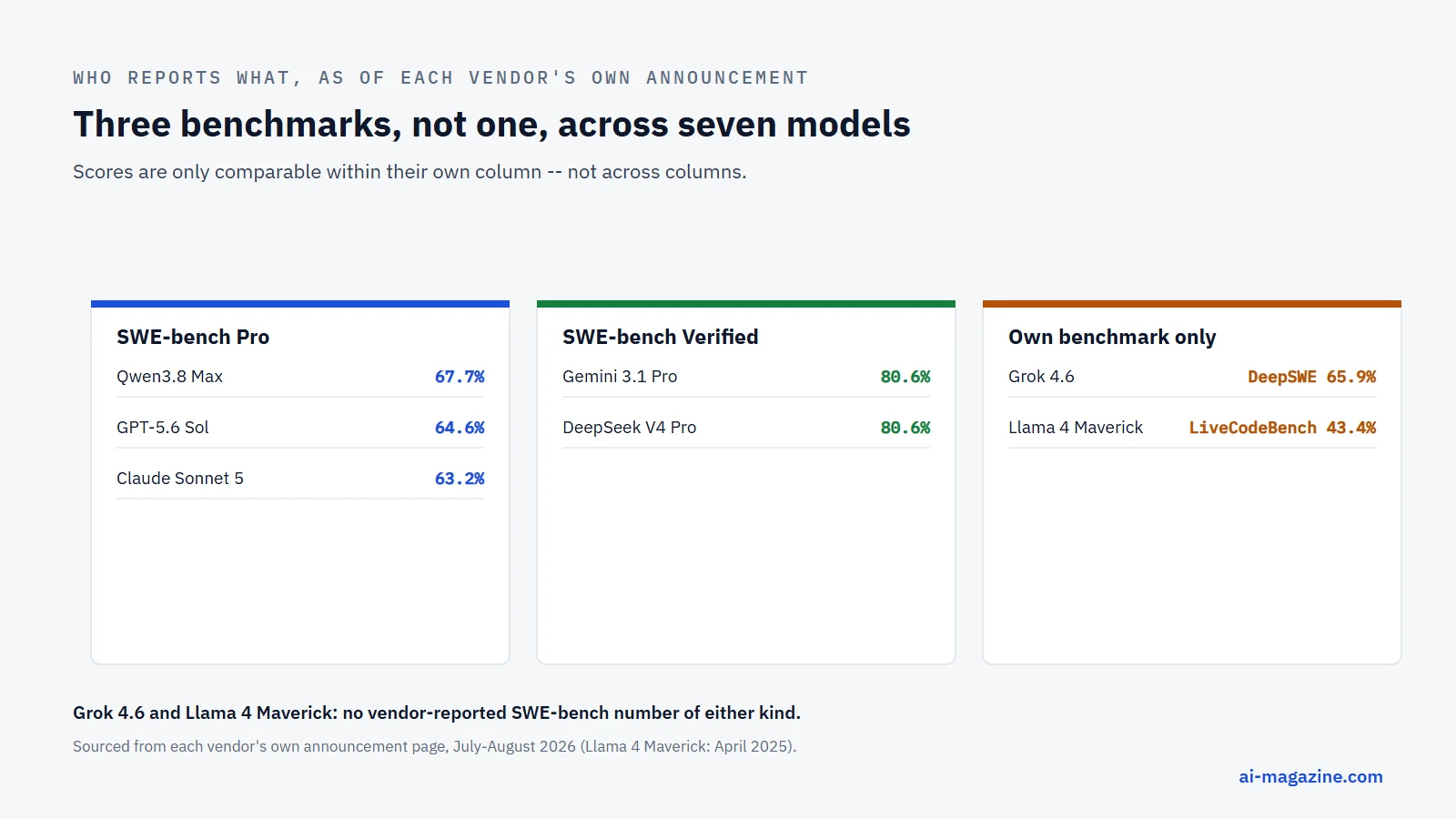
“Best AI model for coding” sounds like a question with a clean answer. It isn’t — not because the data doesn’t exist, but because the seven models this site tracks don’t even agree on which benchmark to report. (Newer models, such as GPT-6 and later Claude, Gemini and Grok releases, exist and are not covered here.) Three publish SWE-bench Pro scores. Two publish SWE-bench Verified — a different, older, easier benchmark that most of the field now considers saturated. Two publish neither. This guide uses only numbers each vendor put on its own page, grouped honestly by what’s actually comparable, plus the pricing and context-window data this site already tracks for each model.
What SWE-bench actually measures
SWE-bench takes real, closed GitHub issues from real open-source Python repositories and asks a model to generate a code patch that actually resolves the issue — not a multiple-choice quiz, a working fix checked against the project’s real test suite. SWE-bench Verified is a human-filtered subset released by OpenAI in 2024 to remove ambiguous or unsolvable issues. By 2026, most frontier vendors consider Verified saturated — scores clustered too close to the ceiling to distinguish models meaningfully — and have shifted to SWE-bench Pro, a harder, newer successor. These are not interchangeable numbers, and this guide doesn’t pretend they are.
The models that report SWE-bench Pro
These three scores are directly comparable to each other — same benchmark, same methodology:
| Model | SWE-bench Pro | Price (input/output per 1M tokens) | Context window |
|---|---|---|---|
| Qwen3.8 Max | 67.7% | $2 / $6 | 1,000,000 (native 262,144) |
| GPT-5.6 Sol | 64.6% | $4 / $20 | 1,050,000 |
| Claude Sonnet 5 | 63.2% | $2 / $10 | 1,000,000 |
Sources: OpenAI’s GPT-5.6 announcement (9 July 2026), Anthropic’s Claude Sonnet 5 announcement (30 June 2026), and Qwen’s official model card for Qwen3.8 Max (12 August 2026). Worth noting directly: on this specific benchmark, the cheapest of the three — Qwen3.8 Max, an open-weight model — scores highest. Price and SWE-bench Pro rank don’t move together here.
The models that report SWE-bench Verified instead
A different, easier, older benchmark — don’t compare these numbers to the table above:
| Model | SWE-bench Verified | Price (input/output per 1M tokens) | Context window |
|---|---|---|---|
| Gemini 3.1 Pro | 80.6% | $2 / $12 | 1,048,576 |
| DeepSeek V4 Pro | 80.6% | $0.66 / $1.98 | 1,048,576 |
Sources: Google DeepMind’s Gemini 3.1 Pro model card and DeepSeek V4 Pro’s own technical paper and Hugging Face model card. Both land at the identical 80.6% — independently reported, not the same measurement. DeepSeek V4 Pro’s price is roughly a third of Gemini 3.1 Pro’s at this score level, which is the more useful comparison than the raw percentage alone.
The two models with no published SWE-bench number
Neither xAI nor Meta put a SWE-bench score of either kind on their own announcement pages for these models — and this guide won’t substitute a third-party number for a vendor that didn’t report one.
Grok 4.6 reports its own set of coding benchmarks instead: DeepSWE v1.1 at 65.9%, Terminal-Bench v3.0 at 26%, and APEX-SWE at 56.4% (xAI’s launch post, 12 August 2026). Priced at $2 / $6 per million tokens, with a smaller 500,000-token context window than the rest of this group.
Llama 4 Maverick reports LiveCodeBench at 43.4% pass@1 (Meta’s official blog, 5 April 2025) rather than any SWE-bench variant. The date matters: Maverick launched in April 2025, well over a year before the other six models here, with a 128,000-token context window — an order of magnitude smaller than the rest — and no controllable reasoning mode at all. It’s also the cheapest model in this comparison by a wide margin ($0.19 / $0.65). Comparing it head-to-head against 2026’s frontier cohort isn’t really fair to either side; it belongs in a different, budget-tier conversation.
A benchmark three of them share: Terminal-Bench 2.1
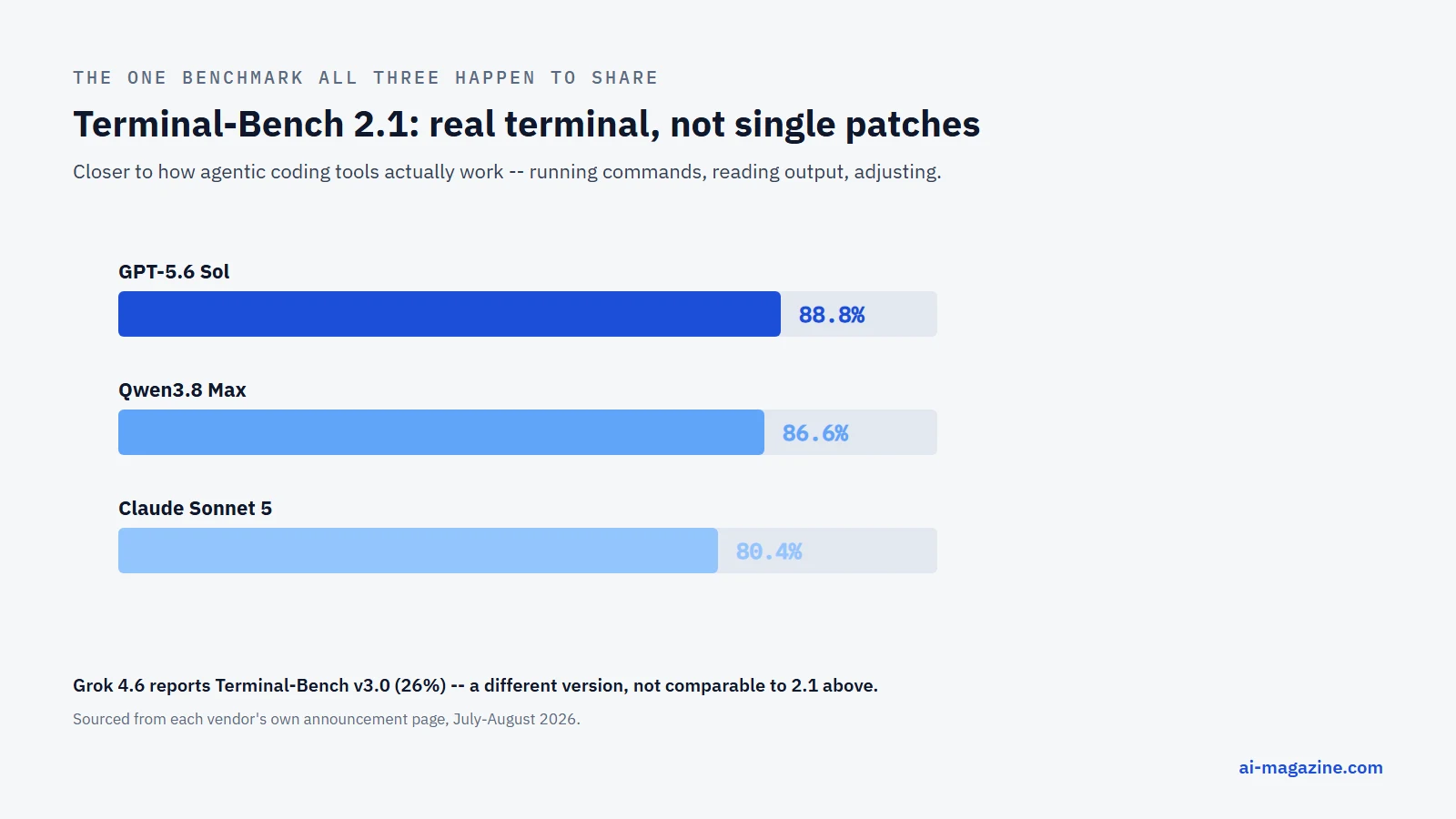
Terminal-Bench 2.1 measures something SWE-bench doesn’t directly: working inside a real terminal environment — running commands, reading their output, adjusting course — which is closer to how agentic coding tools (Claude Code, Codex-style CLI agents, terminal-based copilots) actually operate day to day. Three of the seven models happen to report it on their own pages: GPT-5.6 Sol at 88.8%, Qwen3.8 Max at 86.6%, and Claude Sonnet 5 at 80.4%. Grok 4.6 reports a different Terminal-Bench version (v3.0, 26%) that isn’t comparable to 2.1 — another instance of the same fragmentation problem showing up a second time.
Picking one, by scenario
- Best SWE-bench Pro score, lowest price of the three that report it: Qwen3.8 Max — open-weight, $2/$6, and the top score in its comparable group.
- Best terminal/agentic coding score: GPT-5.6 Sol, if Terminal-Bench-style agentic work (not single-patch generation) is the actual job.
- Best price-to-SWE-bench-Verified-score ratio: DeepSeek V4 Pro — matches Gemini 3.1 Pro’s 80.6% at roughly a third of the per-token cost.
- Highest raw context window relative to price: DeepSeek V4 Pro again — 1,048,576 tokens at $0.66/$1.98 is the cheapest large-context option in this group by a wide margin.
- Avoid for new 2026-era coding work: Llama 4 Maverick, purely on vintage and context-window grounds, not on its LiveCodeBench number alone — it’s a different generation being asked a different question than the rest of this list.
None of this replaces testing a model against your own actual codebase and failure cases — a benchmark score is a population-level average, and coding tasks vary enormously in what they actually demand.
Frequently asked questions
What is SWE-bench, exactly?
A benchmark built from real, closed GitHub issues on real Python repositories. A model is given the issue and the codebase, and must produce a patch that actually passes the project’s own test suite — not a synthetic or multiple-choice task.
Why do SWE-bench Verified and SWE-bench Pro scores look so different for similar models?
They’re different benchmarks of different difficulty. Verified is older and considered saturated by 2026 — most frontier models now score high enough on it that it stops distinguishing them well. Pro is newer and harder, which is why vendors reporting Pro show lower raw percentages than vendors still reporting Verified, even when the underlying coding ability is comparable or better.
Why don’t Grok 4.6 and Llama 4 Maverick have a SWE-bench score?
Because xAI and Meta didn’t publish one on their own official pages for these models. This guide reports what each vendor’s own announcement actually says rather than substituting a third-party or community-run number in its place.
Is the highest SWE-bench score always the right choice for coding?
No. Price per request, context window (how much of a real codebase fits in one call), and whether the task is single-patch generation versus multi-step agentic terminal work all matter — the three models sharing Terminal-Bench 2.1 scores rank in a different order than they would on SWE-bench Pro alone.
Is Llama 4 Maverick a fair comparison point here?
Only loosely. It launched in April 2025, over a year before the rest of this group, with a far smaller context window and no controllable reasoning mode — it’s useful as a cheap baseline, not as a frontier-tier coding comparison.
Related
- Best AI Model for Writing, the next guide in this series
- LLM API pricing for current per-token rates across vendors, and the LLM API cost calculator
- How to Build an AI Agent, for what agentic coding actually requires beyond raw benchmark scores
- How to Reduce LLM API Costs, relevant once you’re running coding tasks at volume
- Structured Outputs, for reliable tool-call arguments in coding agents